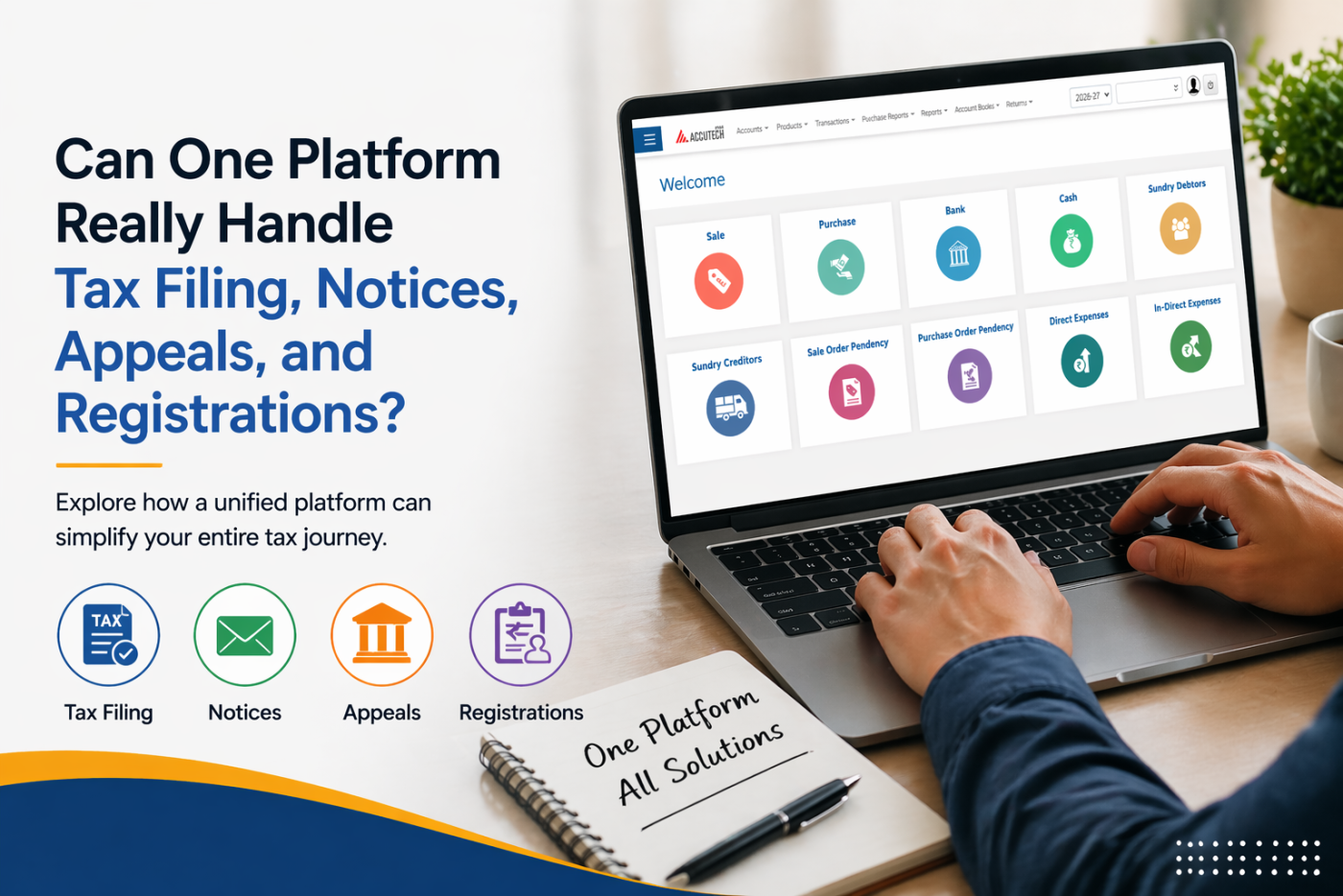
THE CHALLENGE OF MANAGING MULTIPLE TAX PROCESSES
Managing tax compliance is one of the most complex responsibilities facing individuals, freelancers, and business owners in India. Historically, this responsibility has required navigating multiple government portals, using separate software tools, and manually coordinating between different systems from filing income tax returns to managing tax notices, submitting appeals, and completing registration processes.
This fragmented approach creates significant challenges. Manual data entry across systems introduces errors, deadlines slip through the cracks, and inconsistencies between different filings can trigger unwanted notices from tax authorities. What if a single, integrated platform could eliminate these challenges altogether?
INDUSTRY INSIGHT: According to tax compliance research, 64% of businesses that switched to unified tax management platforms reported a 40% reduction in compliance-related errors within the first quarter of implementation.
The modern approach to tax compliance as of 2026 is transforming how individuals and organizations manage their tax obligations. Rather than juggling multiple systems, forward-thinking businesses are adopting integrated solutions that consolidate all tax-related activities into one unified workflow.
CAN ONE PLATFORM REALLY HANDLE TAX FILING, NOTICES, APPEALS, AND REGISTRATIONS?
The answer is definitively yes. A single, well-designed platform can reliably handle tax filing, notices, appeals, and registrations by integrating data management, automated compliance workflows, and expert support into one structured system. Tax processes are inherently interconnected, and when managed separately, they often lead to duplication, delays, and costly errors.
Modern Accutech ERP systems represent a significant evolution in tax compliance technology. By consolidating all tax-related activities within one platform, users can:
- Maintain consistent financial records across all compliance activities
- Automate routine compliance tasks to reduce manual work
- Access professional guidance exactly when needed
- Eliminate data silos and inconsistencies
- Receive real-time alerts for upcoming deadlines
- Track compliance status throughout the year
KEY PRINCIPLE: When all tax processes are unified under one roof, information flows seamlessly between filing, notice management, appeals, and registration reducing errors and accelerating compliance timelines.
TAX FILING CAPABILITIES: ENSURING ITR ACCURACY AND COMPLIANCE
Income Tax Return (ITR) filing is the foundation of tax compliance. Modern platforms simplify this process by automatically integrating data from authoritative sources:
- Form 16: Salary income and tax deducted at source (TDS) information
- Annual Information Statement (AIS): All income reported to the Income Tax Department by financial institutions
- Form 26AS: Complete TDS credit history maintained by the Income Tax Department
By pulling data directly from these sources, filing platforms ensure that income, eligible deductions, and tax credits are accurately reported. Automated validation checks identify inconsistencies such as unreported income or missing deductions before submission. This significantly reduces the risk of defective returns and subsequent notices.
HOW PLATFORMS ENSURE FILING ACCURACY
A Best ERP Software in India for tax compliance uses multiple layers of validation:
- Data Reconciliation: Cross-references reported income with AIS and Form 26AS
- Deduction Verification: Validates eligible deductions based on income level and category
- Tax Credit Matching: Ensures all TDS credits are properly claimed
- Return Format Validation: Checks compliance with ITR format requirements
- Final Review: Provides a summary for user review before submission
This structured approach not only simplifies the filing process for users but also ensures compliance with the Income Tax Act, 1961, without requiring exhaustive manual verification of every transaction.
HOW INTEGRATED PLATFORMS SIMPLIFY TAX NOTICE MANAGEMENT
Tax notices from the Income Tax Department can be complex, intimidating, and time-sensitive. Many taxpayers struggle to understand the exact issue being raised or how to prepare an appropriate response within the given timeframe. A unified platform addresses this challenge comprehensively.
KEY FEATURES OF NOTICE MANAGEMENT
An integrated tax compliance platform assists with notices by:
- Automatic Fetch: Retrieving notices directly from the income tax portal
- Issue Identification: Analyzing the notice to identify the specific compliance gap or discrepancy
- Response Guidance: Providing step-by-step instructions for preparing the required documents
- Document Management: Organizing supporting materials and ensuring correct upload
- Deadline Tracking: Sending alerts to prevent missed submission deadlines
- Communication Logging: Maintaining complete records of all correspondence with tax authorities
By automating this process, the platform significantly reduces the risk of penalties while ensuring proper communication with tax authorities. Users gain confidence knowing that their response is comprehensive and submitted on time.
APPEALS HANDLING AND CIT(A) PROCESSES THROUGH INTEGRATED SYSTEMS
When a taxpayer disagrees with an assessment, filing an appeal before the Commissioner of Income Tax (Appeals) commonly referred to as CIT(A) is a critical legal remedy. However, appeals require precise documentation, accurate representation of facts, and strict adherence to procedural timelines.
HOW PLATFORMS SUPPORT APPEAL FILING
Integrated platforms assist with appeals by:
- Organizing supporting documents in a structured, legally defensible format
- Helping draft comprehensive appeal representations with clear factual basis
- Tracking procedural deadlines and status updates with automatic reminders
- Maintaining complete records for audit and future reference
- Providing guidance on common appeal grounds and success factors
- Coordinating with tax professionals for complex cases
This support reduces the complexity of dealing with appellate authorities and ensures that all required documentation is available when needed. Users can pursue legitimate appeals with confidence, knowing that their case is properly documented and presented.
REGISTRATION SERVICES: PAN, TAN, AND COMPLIANCE SETUP
Tax compliance in India begins with proper registration. Whether obtaining a new Permanent Account Number (PAN), Tax Deduction and Collection Account Number (TAN), or other registration credentials, these processes must be completed accurately and linked correctly to subsequent tax filings.
REGISTRATION SUPPORT FEATURES
Comprehensive platforms guide users through:
- PAN registration and updates
- TAN registration for employers and deductors
- GST registration and compliance setup
- Corporate registration requirements
- Professional registration (CA, CS, etc.)
Critically, these registrations are correctly linked to tax filings and ongoing compliance activities, creating a seamless end-to-end workflow where all components work together as an integrated system.
THE ROLE OF AUTOMATION AND AI IN MODERN TAX COMPLIANCE
Automation and artificial intelligence are revolutionizing tax compliance. Modern platforms use intelligent systems to:
KEY AUTOMATION BENEFITS
- Data Analysis: Identifying missing deductions and tax-saving opportunities
- Error Detection: Flagging inconsistencies before they lead to notices
- Workflow Automation: Eliminating manual, repetitive tasks
- Compliance Recommendations: Suggesting actions based on individual circumstances
- Predictive Alerts: Warning of potential issues before they occur
- Document Processing: Automatically extracting and categorizing tax documents
By reducing manual effort and improving accuracy, automation allows individuals and businesses to focus on their core activities while maintaining consistent compliance. This transformation from reactive to proactive compliance is a hallmark of modern tax management.
ENSURING ACCURACY THROUGH DATA RECONCILIATION AND VALIDATION
Accurate reporting is essential to avoid notices and penalties. A well-designed platform reconciles reported income and tax credits with official records from AIS and Form 26AS. Any mismatch such as income reported differently across filings is flagged immediately, allowing corrections to be made before filing.
RECONCILIATION PROCESS
The reconciliation process typically involves:
- Extracting data from Form 16, AIS, and Form 26AS
- Comparing reported income with official records
- Identifying discrepancies and variances
- Providing explanations or corrections
- Final verification before return submission
This level of detail significantly reduces the chances of post-filing mismatches and the corresponding notices from tax authorities. Users can file with confidence, knowing that their returns accurately reflect their financial situation.
BANK ACCOUNT VALIDATION AND REFUND PROCESSING
Bank account details are critical for processing income tax refunds efficiently. Platforms verify:
- Account numbers (correct format and validity)
- IFSC codes (matching the specified bank)
- Account holder names (matching PAN records)
- Account status (active and operational)
This validation prevents refund failures, delays, and the frustration of waiting for refunds that never arrive. Tax refunds are credits earned by taxpayers ensuring they are processed correctly and credited without issues is a critical function of any compliance platform.
BENEFITS FOR DIFFERENT USER CATEGORIES
FOR INDIVIDUAL TAXPAYERS
A single platform simplifies managing multiple income sources (salary, interest, capital gains) and tracking eligible deductions across different categories. Individual taxpayers gain clarity on their tax position throughout the year.
FOR FREELANCERS AND CONTRACTORS
Platforms designed for variable income handle quarterly advance tax calculations, GST compliance, and business expense tracking automatically. Freelancers can focus on their work while compliance runs in the background.
FOR SMALL BUSINESS OWNERS
When evaluating best ERP systems for small businesses, those with integrated tax features offer significant advantages. These platforms link business transactions directly to tax filings, reducing manual reconciliation and ensuring consistency between business records and tax returns. Small business owners gain a comprehensive view of financial performance with tax implications clearly identified.
FOR GROWING ENTERPRISES
As businesses scale, managing multiple PAN numbers, TAN deductions, and complex deduction categories becomes increasingly complex. A comprehensive best ERP software in India consolidates all these elements, providing a single source of truth for compliance. Enterprise-level features support multi-entity structures and consolidated reporting.
INTEGRATED ACCOUNTING AND ADVANCE ACCOUNTING FEATURES
For businesses managing complex operations, Advance accounting capabilities are essential. Modern platforms combine accounting functions with tax compliance, allowing:
- Real-time reconciliation of accounting records with tax positions
- Automated generation of required tax schedules from accounting data
- Multi-entity consolidation for businesses with multiple divisions
- Provision tracking and tax liability calculations
- Deferred tax asset/liability management
- Inter-company transaction elimination
This integration eliminates the need to maintain separate accounting and tax systems, significantly reducing operational complexity. Accounting teams and finance departments work with unified data, reducing reconciliation efforts and ensuring financial accuracy.
YEAR-ROUND COMPLIANCE MONITORING AND PROACTIVE ISSUE DETECTION
True tax compliance doesn't end at filing it continues throughout the financial year. Effective platforms support this ongoing responsibility by tracking deadlines, monitoring financial activities, and identifying potential issues before they become problems.
CONTINUOUS MONITORING BENEFITS
- Visibility: A consolidated view of income, tax liabilities, deductions, and compliance status
- Data Synchronization: Regular syncing with bank statements, tax records, and compliance reports ensures accuracy
- Early Issue Detection: Discrepancies between reported income and available tax records are flagged well in advance
- Better Financial Planning: Real-time insights enable informed decisions about investments, deductions, and tax-saving strategies
- Deadline Reminders: Automatic alerts for advance tax, TDS returns, GST filings, and other statutory requirements
By transforming tax compliance from a reactive task into a planned, structured process, year-round monitoring significantly reduces stress and improves financial discipline.
WHY ACCUTECH ERP OFFERS END-TO-END TAX SOLUTIONS
Accutech ERP is built to handle the entire lifecycle of tax compliance rather than focusing on a single activity like return filing. The platform integrates:
- Data Collection: Automated gathering of income, deduction, and credit information
- Validation: Multi-stage checks ensuring data accuracy and completeness
- Filing Support: Guided ITR preparation with real-time error detection
- Post-Filing Monitoring: Continuous tracking of compliance status and upcoming obligations
- Expert Assistance: Professional guidance for complex situations
- Appeal Support: Complete assistance from notice to resolution
By centralizing financial data, Accutech ERP ensures that the same verified information flows across multiple compliance activities from ITR filing to GST returns to TDS reporting significantly reducing the chances of mismatches. This integrated approach represents the future of tax compliance technology.
READY TO SIMPLIFY YOUR TAX COMPLIANCE?
Download the Accutech ERP mobile app for a simplified, secure, and hassle-free experience in managing all your tax obligations throughout the year.
View Packages & Request Demo
HOW INTEGRATED PLATFORMS REDUCE ERRORS, DELAYS, AND NOTICES
By centralizing data and automating workflows, integrated platforms substantially reduce errors caused by manual entry or fragmented systems. They ensure consistency across filings, improve coordination between departments, and provide timely alerts for upcoming deadlines.
ERROR REDUCTION STRATEGIES
- Automated data validation at multiple checkpoints
- Elimination of manual data re-entry between systems
- Real-time consistency checks across filings
- Comprehensive audit trails for accountability
- Professional review capabilities for complex situations
The result? Fewer delays in filing, reduced risk of receiving notices, and improved relationships with tax authorities. Users and businesses gain peace of mind knowing their compliance is handled with precision and care.
FUTURE TRENDS IN TAX COMPLIANCE TECHNOLOGY (2026 AND BEYOND)
The tax compliance landscape is evolving rapidly. Here are the emerging trends shaping the future:
KEY 2026 TRENDS
- AI-Powered Insights: Predictive analytics identifying tax-saving opportunities before year-end
- Real-Time Compliance: Continuous monitoring replacing manual review cycles
- Blockchain Integration: Enhanced audit trails for immutable record-keeping
- API-First Architecture: Seamless integration with government portals and banking systems
- Mobile-First Design: Full compliance management through mobile applications
- Automated Appeals: AI-assisted appeal preparation and filing
2026 PREDICTION: By end of 2026, 70% of tax filers will use digital compliance platforms, up from 35% in 2024. This shift reflects growing recognition that integrated, automated solutions deliver superior accuracy and peace of mind.
CONCLUSION: FROM FRAGMENTED TO UNIFIED TAX MANAGEMENT
The evidence is clear: managing tax filing, notices, appeals, and registrations through separate systems creates inefficiencies, errors, and compliance risks. A unified platform simplifies these processes by integrating them into a single workflow, improving accuracy, reducing delays, and ensuring better overall compliance.
For anyone looking to manage tax obligations in a structured and efficient manner whether you're an individual, freelancer, or business owner a comprehensive approach is highly recommended. Accutech ERP combines the best practices in tax compliance technology with professional support, making it the ideal solution for modern tax management.
The question is no longer whether a single platform can handle all your tax needs modern technology has proven that it can. The question is: why would you continue managing your tax compliance through fragmented systems when a unified solution is available?
Install Accutech ERP today and experience the difference unified tax management can make.
FREQUENTLY ASKED QUESTIONS ABOUT UNIFIED TAX COMPLIANCE PLATFORMS
Q: Can a single platform really manage tax filing, notices, appeals, and registrations together?
Yes. Modern platforms are specifically designed to integrate all these functions into one system. By connecting financial data, compliance workflows, and validation tools, they allow users to manage filing, notices, appeals, and registrations without switching between multiple portals. This integration ensures consistency and eliminates the errors that come from manual coordination.
Q: How does a single platform ensure accurate income tax return filing?
Platforms pull data from Form 16, AIS, and Form 26AS, then perform comprehensive validation checks before submission. This ensures income, deductions, and tax credits are reported correctly. Automated reconciliation with government records identifies discrepancies before filing, reducing the risk of errors and subsequent notices.
Q: What role does the platform play in managing tax notices?
The platform fetches notices directly from government portals, identifies the specific issue, and guides users in preparing proper responses. It ensures documents are submitted within deadlines and that all required attachments are included correctly. This eliminates the confusion and stress that typically accompanies tax notices.
Q: Is it possible to file tax appeals through a single platform?
Yes. Platforms support appeal filing by helping prepare documentation, draft comprehensive responses, and track appeal status through different stages. This simplifies the process of filing appeals before authorities such as CIT(A), ensuring all procedural requirements are met.
Q: Can PAN, TAN, and other registrations be handled on the same platform?
Yes. Comprehensive platforms guide users through all registration processes and ensure these details are correctly linked to tax filings and ongoing compliance workflows. Registration is the starting point, and integration throughout the platform ensures consistency.
Q: How does automation improve reliability in tax compliance?
Automation reduces manual intervention, performs real-time validation, and identifies inconsistencies early. This ensures accurate data processing and minimizes compliance risks significantly. Where humans are prone to fatigue and errors, automated systems maintain consistent accuracy.
Q: How do platforms ensure accuracy using AIS and Form 26AS?
They reconcile reported income and tax credits with official AIS and Form 26AS data. Any mismatches are flagged before filing, allowing corrections to be made in advance.