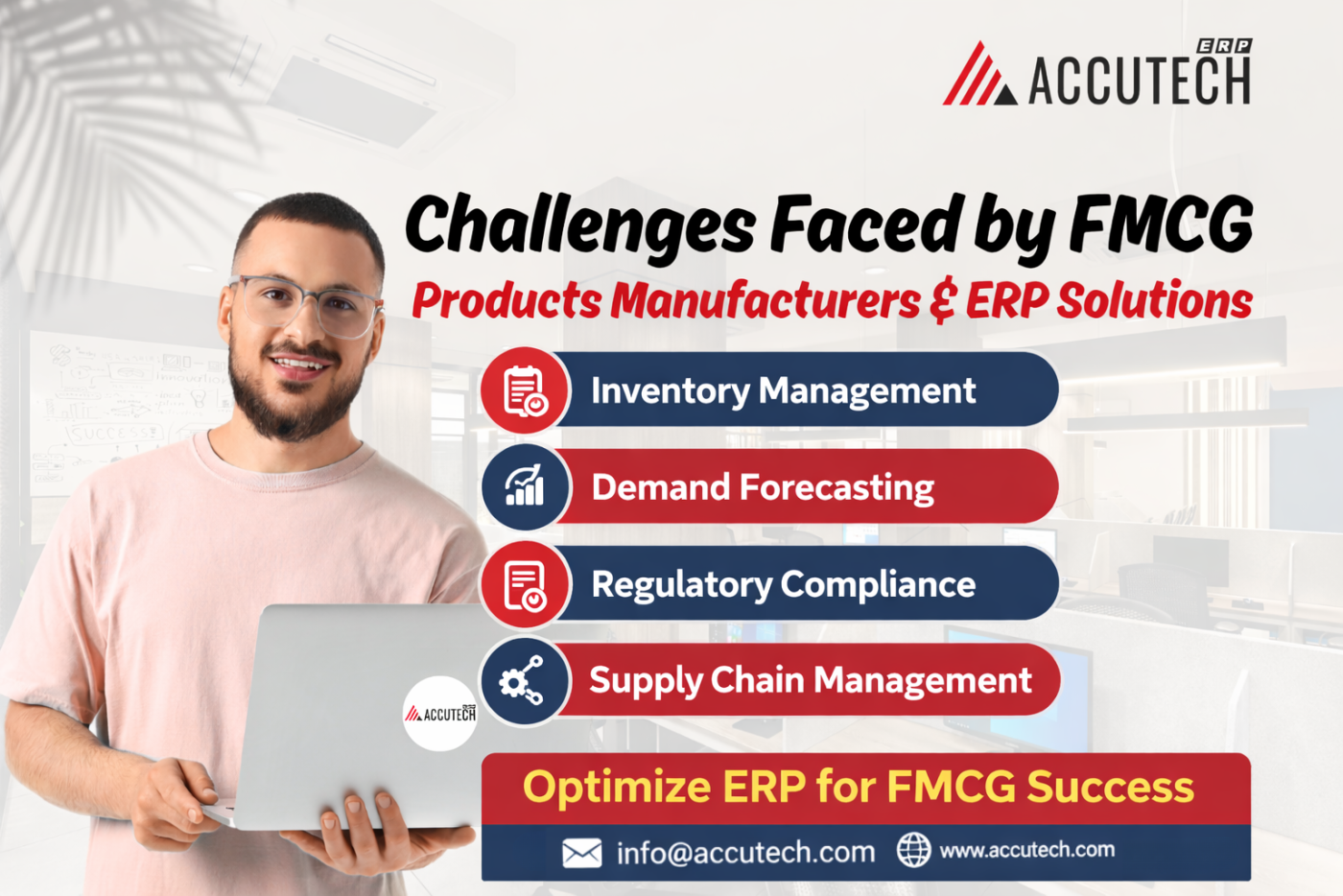
The FMCG industry is one of the most fast-paced and competitive industries in the global marketplace. It runs on precision, accuracy, and efficiency, where even a small delay can impact business performance.
Managing large-scale operations, complex logistics, and fluctuating demand manually becomes difficult. This is where ERP software plays a crucial role in simplifying and optimizing business processes.
You can also explore more industry insights from our ERP blogs section.
Understanding FMCG Manufacturing Complexity
FMCG manufacturing involves multiple interconnected processes such as procurement, production, inventory management, warehousing, and distribution. Since products are fast-moving and often perishable, businesses must maintain speed and precision at every stage.
Key Factors That Increase Complexity
High product turnover, short shelf life, large distribution networks, seasonal demand fluctuations, and price-sensitive markets make FMCG operations highly complex.
Major Challenges Faced by FMCG Manufacturers
1. Inventory Mismanagement
Inventory is critical but difficult to manage efficiently.
Issues include overstocking, understocking, expired products, and dead stock, leading to financial losses and reduced efficiency.
2. Inaccurate Demand Forecasting
Demand prediction becomes challenging due to seasonal trends and changing consumer behavior, leading to overproduction or shortages.
3. Complex Production Planning
Production requires proper coordination of raw materials, machines, and workforce. Poor planning results in delays and increased costs.
4. Distribution and Logistics Challenges
Managing multiple distributors, delivery delays, and high transportation costs create major operational hurdles.
5. Lack of Real-Time Data
Manual or disconnected systems lead to delayed reporting and poor decision-making.
6. Quality Control and Batch Tracking
Tracking batches and maintaining product quality becomes difficult, impacting brand reputation and compliance.
7. Compliance and Taxation Issues
GST compliance, invoicing accuracy, and audit readiness are critical challenges for FMCG manufacturers.
8. High Operational Costs
Manual processes increase manpower, errors, and overall operational costs.
How ERP Software Solves FMCG Manufacturing Challenges
1. Smart Inventory Management
ERP for small business provides real-time tracking, batch control, expiry monitoring, and automatic reorder alerts.
2. Accurate Demand Forecasting
ERP systems analyze historical data to predict demand and improve planning accuracy.
3. Automated Production Planning
ERP enables efficient scheduling, raw material planning, and resource allocation.
4. Efficient Distribution Management
ERP streamlines distribution with order management, delivery tracking, and route optimization.
5. Real-Time Data and Analytics
With centralized dashboards and reports, ERP enables faster and smarter decision-making.
6. Batch and Quality Tracking
ERP ensures complete traceability, quality checks, and easy recall management.
7. GST and Compliance Automation
ERP automates tax calculations, GST reporting, and compliance processes.
8. Cost Reduction and Efficiency Improvement
Automation reduces manual work, errors, and operational costs while improving productivity.
Key Benefits of ERP for FMCG Manufacturers
With FMCG ERP solutions, businesses achieve better inventory control, improved production efficiency, faster distribution, and enhanced customer satisfaction.
Why Cloud-Based ERP is Ideal for FMCG Businesses
Cloud ERP is becoming the preferred choice due to flexibility and scalability.
Advantages
Access from anywhere, no infrastructure cost, automatic updates, strong security, and easy scalability make cloud ERP highly effective.
Real-World Example (Simplified)
Consider an FMCG manufacturer handling high production daily.
Without ERP: Inventory issues, production delays, inefficient distribution.
With ERP: Real-time tracking, planned production, optimized delivery.
Result: Higher efficiency and profitability.
Future of FMCG Manufacturing with ERP
Modern ERP systems are evolving with AI, automation, and advanced analytics. Businesses adopting solutions like best ERP for manufacturing industry will stay ahead in the competition.
Conclusion
FMCG manufacturing comes with multiple challenges, but ERP software provides a powerful solution by streamlining operations, reducing errors, and improving efficiency.
In simple terms, ERP transforms operational challenges into growth opportunities.
F&Q
Q1. Why is ERP important for FMCG manufacturers?
ERP integrates all business processes and improves efficiency across operations.
Q2. Can small FMCG businesses use ERP software?
Yes, ERP solutions are scalable and suitable for small and medium-sized businesses.
Q3. How does ERP improve inventory management?
Through real-time tracking, alerts, and automation, ERP ensures better control over inventory.
Q4. Does ERP reduce operational costs?
Yes, automation and efficiency significantly reduce operational expenses.