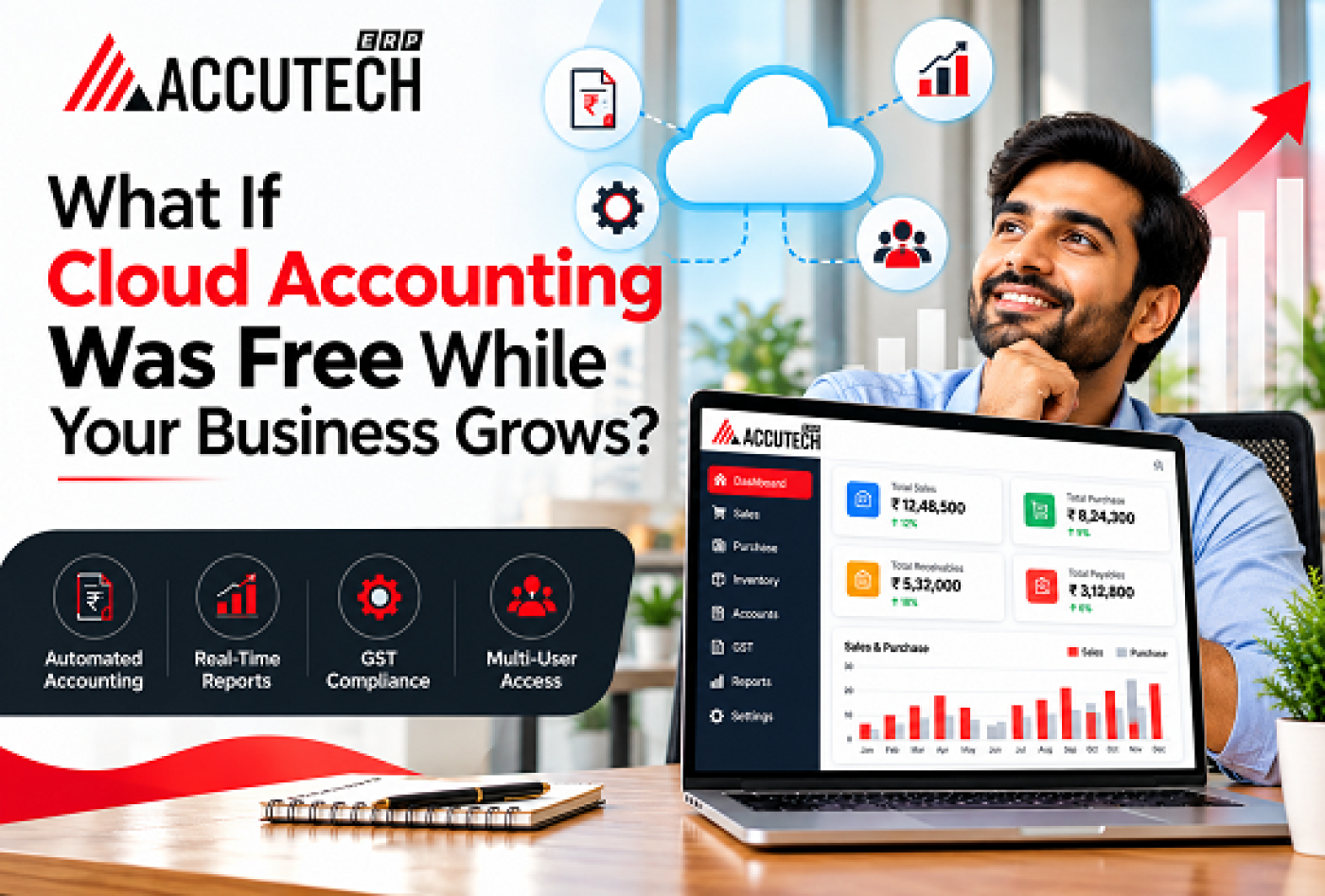
What If Cloud Accounting Was Free While Your Business Grows?
Imagine running your growing business without worrying about escalating accounting software costs. What if you could access the best advance accounting ERP software completely free for an entire year while your business scales? This isn't a dream, it's the reality that modern cloud accounting platforms are offering today.
For years, businesses have struggled with a fundamental problem: traditional accounting software demands expensive upfront investments, complex implementation processes, and ongoing maintenance costs that drain resources better spent on growth. Small and medium enterprises (SMEs) in India particularly face this challenge, where quality accounting infrastructure becomes a luxury rather than a necessity.
The landscape has shifted dramatically. Cloud accounting software for manufacturing, trading, and service businesses has evolved from a nice-to-have feature to an essential business tool. Companies are no longer asking "Can we afford accounting software?" but rather "How can we afford not to have one?"
This comprehensive guide explores how the advanced business accounting platform can transform your financial operations and what it means to have a full year free to prove it works for your business. Whether you're a manufacturing unit managing inventory complexities, a trading company handling multiple GST jurisdictions, or a growing service business scaling rapidly, we'll show you exactly what to look for and how to maximize your free accounting period.
Understanding the Accounting Dilemma for Growing Businesses
Growing businesses face a critical paradox: the more you expand, the more complex your accounting becomes. Yet traditional accounting systems weren't designed for this exponential growth in complexity.
Consider these challenges:
• Limited Resources: Startups and early-stage businesses can't afford dedicated accounting teams, yet they need professional-grade financial management
• Compliance Complexity: With operations across multiple states in India, GST compliance alone requires sophisticated tracking systems
• Manual Processes: Spreadsheet-based accounting becomes impossible to manage once you exceed 50-100 transactions daily
• Real-Time Visibility: Owners need instant access to financial position, not month-end reports prepared weeks after transactions occur
• Scalability Issues: Your accounting system must grow with your business without requiring complete overhaul every 2-3 years
This is precisely where advance accounting ERP software enters the picture. The comprehensive ERP accounting solution isn't just a tool for recording transactions, it's a strategic asset that enables intelligent business decisions.
The 1-year free trial model represents a fundamental shift in how accounting technology is accessed. Instead of betting thousands of rupees upfront on software you've never used, you can build your entire accounting infrastructure, train your team, validate processes, and prove ROI before spending a single rupee. This zero-risk approach to implementing the modern financial management system has changed everything.
What Makes the Integrated Accounting Platform?
Not all advance accounting software is created equal. The best advance accounting ERP software combines several critical characteristics that directly impact your business operations and growth trajectory.
Key Differentiators of Premium Advance Accounting Software
Feature | Basic Software | Best Advance Accounting ERP |
Transaction Limits | 5,000 transactions/year | Unlimited transactions |
User Access | Single user | Multiple users with role-based access |
Real-Time Reporting | Monthly manual reports | 24/7 live financial dashboards |
Multi-Entity Support | Single entity only | Unlimited entities & branches |
GST Compliance | Manual GST calculations | Automated GSTR filing & reconciliation |
Key Features You Need in Cloud Accounting Software
When evaluating business finance management software, certain features separate industry leaders from mediocre solutions:
1. Automated Transaction Processing
Cloud accounting software should eliminate manual invoice entry entirely. Look for solutions that automatically capture and categorize transactions from your bank, expense apps, and invoicing systems. This automation reduces errors by 99% and frees your team to focus on analysis rather than data entry.
2. Real-Time Financial Dashboards
The reliable accounting ERP solution provides instant visibility into your financial position. Key dashboards should include cash flow projections, account balances, outstanding receivables, and profit-and-loss summaries all updating as transactions occur.
3. GST Compliance Engine
For Indian businesses, GST compliance isn't optional, it's mandatory. Your advance accounting software must automatically calculate GST on every transaction, generate GSTR-1 and GSTR-2A ready exports, and flag potential compliance issues before they become penalties.
4. Multi-Branch & Multi-Entity Management
Growing businesses inevitably expand to multiple locations or create separate legal entities. Online financial reporting for Indian businesses demands solutions that handle multiple GSTINs, separate books per entity, and consolidated reporting across your entire organization.
5. Inventory Integration
For manufacturing and trading businesses, accounting and inventory are inseparable. The digital accounting system maintains real-time stock levels, tracks inventory valuation methods, and links physical stock movements to financial reports.
6. Bank Reconciliation Automation
Manual bank reconciliation is error-prone and time-consuming. Modern accounting software matches transactions automatically, highlights discrepancies, and reconciles accounts with a single click.
7. Audit Trail & Data Security
Complete visibility of who accessed what data and when. The feature-rich business accounting software maintains immutable audit trails and encrypts all data both in transit and at rest.
Why Cloud Financial Reporting in India Has Changed Everything
Cloud financial reporting in India represents the evolution from necessity to competitive advantage. Here's why the shift to cloud-based accounting is irreversible:
Remote Accessibility: Your business doesn't stop after 5 PM. Cloud accounting software means your team can work from anywhere office, home, client locations without losing access to critical financial data.
Regulatory Compliance: India's GST framework, TDS requirements, and frequent tax law changes demand systems that update automatically. Cloud financial reporting in India ensures you're always compliant without manual intervention.
Cost Efficiency: No server maintenance, no IT infrastructure investment, no expensive annual upgrades. Pay only for what you use, and scale instantly as your business grows.
Integration Ecosystem: Modern cloud accounting solutions integrate seamlessly with banking APIs, payment gateways, and other business software. This creates a unified data ecosystem where information flows automatically between systems.
Disaster Recovery: Your financial data lives in secure, redundant data centers with automatic backups. No risk of losing critical accounting records to hardware failures or disasters.
For manufacturing and distribution businesses managing complex supply chains, digital financial reporting solutions enable real-time visibility into cost of goods sold, inventory valuations, and profit margins by product or customer.
Manufacturing & Specialized Accounting Needs
Cloud accounting software for manufacturing addresses unique challenges that standard accounting software ignores:
Bill of Materials (BOM) Management: Track raw materials through production cycles with automatic inventory allocation. The best advance accounting ERP software links BOM structure to financial records, enabling accurate cost calculations and profit analysis by product.
Job Costing & Project Accounting: Manufacturing often involves custom work or project-based production. Your accounting system must allocate costs, labor, materials, overhead to specific jobs, providing real-time profitability insights before jobs complete.
Batch & Serial Number Tracking: For pharmaceutical and specialty manufacturing, tracking batches and serial numbers isn't just operational, it's compliance-critical. Cloud accounting software for manufacturing maintains complete traceability for audit and recall purposes.
Multi-Location Inventory Valuation: With manufacturing happening across multiple facilities, your advance accounting ERP software must aggregate inventory costs, manage inter-company transfers, and provide consolidated financial position across all locations.
Production Cost Analysis: The enterprise finance platform calculates standard costs, tracks actual costs, and highlights variances. This cost analysis drives production optimization and pricing decisions.
Compliance & Regulatory Reporting: Manufacturing businesses need additional reports for excise duty, weight variations, and product-specific taxes. Cloud financial reporting in India increasingly focuses on these industry-specific requirements.
Real-Time Reporting: The Game-Changer for Business Growth
The difference between streamlined accounting solutions and outdated alternatives is most visible in reporting capabilities.
Traditional monthly reporting creates decision-making delays. By the time you receive month-end reports, 30 days of business decisions have already been made often based on incomplete or outdated information. Worst case, you discover major issues only after significant damage.
Real-time financial reporting changes this completely:
Live Cash Flow Visibility: Know your exact cash position at any moment. See upcoming payment obligations and identify cash shortfalls before they become crises.
Account Ledger Deep-Dives: Drill from summary dashboards into transaction-level details instantly. Find any account imbalance in seconds instead of hours.
Customer Profitability Analysis: See which customers generate profits and which drain margins. This intelligence drives pricing and customer management decisions.
Inventory Valuation Updates: Real-time stock valuations (FIFO, weighted average, or standard cost) update every transaction, eliminating month-end surprises.
Tax Liability Tracking: Monitor GST liability as it accrues, not at month-end. This enables proactive payment planning and advance compliance preparation.
Period-Close Readiness: By leveraging continuous real-time reporting, month-end closing shifts from a painful week-long process to a simple review and approval cycle.
GST Compliance Made Simple with Advance Accounting
GST compliance remains the primary challenge for Indian businesses. The professional ERP accounting platform transforms GST from a painful compliance burden to a manageable, even automated process.
Here's how modern advance accounting software handles GST:
Automated GSTR Preparation: Every invoice automatically populates GSTR-1 data. Every purchase invoice aligns with GSTR-2B data. Your system is GSTR-ready the moment the filing date arrives.
Input Tax Credit Optimization: Automatically identify all eligible input credits, flag blocked credits, and optimize your ITC position. No more leaving money on the table due to missed eligible credits.
HSN Code Validation: The software validates HSN codes during invoice creation, prevents GST-rate mismatches, and maintains consistency across all transactions.
Reconciliation Intelligence: Compare your books against GSTR-2A/2B automatically. The best advance accounting ERP software flags discrepancies supplier-wise, rate-wise, and amount-wise making reconciliation a 30-minute task instead of a 30-hour nightmare.
Reverse Charge Handling: Complex reverse charge scenarios (job work, insurance, legal services) are handled automatically based on your configuration.
Monthly Return Timeline: GST returns that previously took your accounting team or CA a full week now complete in hours, with built-in validation preventing errors before filing.
Cost Savings: More Than Just Free Software
While the 1-year free access to business accounting technology is significant, the real savings extend far beyond zero licensing fees:
Labor Cost Reduction: Eliminate 60-70% of manual data entry, reconciliation, and report generation work. What previously required a full accounting staff can now be managed by one person using cloud accounting software.
Reduced Audit Issues: Real-time transaction tracking and automated compliance checking virtually eliminate audit surprises. Fewer audit findings mean lower compliance costs and faster audit closure.
Eliminated Spreadsheet Chaos: How many hours does your team waste copying data between spreadsheets, managing versions, and reconciling conflicting numbers? Cloud accounting software eliminates this entirely.
Better Cash Flow Management: Real-time visibility enables optimization of payment timing, early identification of collection issues, and prevention of unnecessary short-term borrowing.
Faster Month-End Closing: Reduce month-end closing from 5-10 days to 1-2 days. This frees your team for strategic financial analysis and business partnership.
Improved Decision-Making: Better information leads to better decisions. Decisions made on timely, accurate data generate substantially better business outcomes.
When you quantify these savings labor hours, eliminate errors, prevented cash crunches, and optimize working capital, the true value of the advanced business accounting platform often exceeds ₹10-15 lakhs annually for growing businesses. The 1-year free period lets you realize these savings without financial commitment.
Scalability: Growing Without Growing Pains
One of the defining characteristics of the comprehensive ERP accounting solution is scalability. Your system shouldn't require replacement as your business grows.
Cloud architecture enables true scalability:
User Expansion: Add accounting staff, team members in new locations, or external stakeholders (auditors, investors, lenders) instantly with role-based access control.
Transaction Volume: Whether you process 10 transactions daily or 10,000, the system handles equivalent performance. No slowdowns, no limitations.
Entity Growth: Expand to new locations, create subsidiary companies, or establish new business units without accounting system overhaul. Multi-entity management is built-in.
Feature Evolution: As your business matures, access advanced modules project accounting, revenue recognition, consolidation without switching systems.
Integration Expansion: Connect additional systems (HR, inventory, CRM) as your business infrastructure grows.
Geographic Expansion: Many cloud accounting solutions support multiple currencies and international operations, enabling seamless geographic scaling.
This scalability creates powerful ROI leverage. Your 1-year free investment in modern financial management system continues delivering value for years, supporting business growth from ₹1 crore annual revenue to ₹100+ crores without system replacement.
Security & Data Protection in Cloud Accounting
A common objection to cloud accounting software concerns data security. The reality is that reputable cloud providers offer superior security compared to on-premises systems.
Enterprise-Grade Security Measures:
Bank-Level Encryption: All data encrypted in transit (TLS/SSL) and at rest (AES-256). Your financial data receives identical security as bank customer information.
Multi-Factor Authentication: Prevent unauthorized access through required second authentication factors.
Role-Based Access Control: Define precisely which team members access which data. Finance staff can't access payroll; junior staff can't modify closed periods.
Immutable Audit Trails: Complete record of who accessed, modified, or deleted every transaction. No hiding unauthorized changes.
Regular Security Audits: Certified auditors regularly validate security controls. Most reputable solutions provide SOC 2 Type II certification.
Disaster Recovery & Backup: Automatic, geographically distributed backups ensure your data survives any disaster. Restoration takes minutes, not days.
Compliance Certifications: ISO 27001, ISO 9001, and other certifications demonstrate commitment to security and quality standards.
Data Residency: For India-regulated businesses, ensure your cloud provider maintains data centers in India to comply with data localization requirements.
Your financial data is far safer in cloud accounting software than on a single office server vulnerable to theft, hardware failure, or disasters.
Implementation & Transition Strategy
Successfully implementing the best advance accounting ERP software requires thoughtful planning. Your 1-year free period is perfect for deliberate, careful implementation:
Phase 1: Planning & Setup (Month 1)
Assess your current accounting structure. Document account heads, cost centers, and reporting needs. Configure the system structure to match your organization.
Phase 2: Historical Data Migration (Months 1-2)
Migrate opening balances as of the start date. Most implementations keep historical data in old systems and begin transactions fresh in cloud accounting software. This avoids data migration errors while maintaining historical records.
Phase 3: Process Documentation (Months 1-3)
Document your invoice-to-pay and order-to-cash processes. Identify where accounting integrations should occur. Determine approval hierarchies and authorization limits.
Phase 4: Team Training (Months 2-4)
Thorough training prevents implementation failure. Different teams need different training: how finance staff use the system differs from how operational staff generate transactions.
Phase 5: Parallel Running (Months 3-6)
Run both old and new systems simultaneously. Enter transactions in both systems and validate results match. This validation period builds confidence before going live.
Phase 6: Live Transition (Month 6+)
Cutover to exclusive use of cloud accounting software. Keep old systems running read-only for reference, but all new transactions go exclusively to the new system.
Phase 7: Optimization & Advanced Features (Months 7-12)
With basic processes stable, leverage advanced capabilities. Set up automated reconciliations, custom dashboards, and integration with other systems.
This 12-month free period provides the ideal window to implement thoroughly, validate completely, and build team proficiency ensuring success from day one of paid usage.
Frequently Asked Questions (FAQs)
Q1: What is advance accounting ERP software and how is it different from basic accounting software?
Advance accounting ERP software integrates accounting with inventory, multi-location management, GST compliance, and real-time reporting functioning as a complete financial management system. Basic accounting software handles invoicing and expense tracking only. The integrated accounting platform serves growing businesses managing complexity across multiple dimensions: locations, entities, product lines, and regulatory jurisdictions. Advanced features like job costing, project accounting, and advanced consolidation distinguish true ERP systems from basic accounting tools.
Q2: How does cloud accounting software for manufacturing differ from standard accounting software?
Cloud accounting software for manufacturing must manage inventory complexities inherent to manufacturing: Bill of Materials (BOM) structures, batch tracking, job costing, and production-based cost allocation. The business finance management software for manufacturing links production activities to financial records, enabling accurate cost of goods sold calculations and profitability analysis by product. Standard software lacks these manufacturing-specific capabilities, making it inadequate for manufacturing businesses of any size.
Q3: What real advantages does web-based financial reporting provide over desktop accounting software?
Cloud financial reporting in India eliminates server management, enables remote access from anywhere, ensures automatic regulatory updates for GST and other compliance requirements, and provides instant disaster recovery. Desktop software requires IT maintenance, limits access to office locations, requires manual updates for tax law changes, and exposes data to hardware failure risks. Additionally, cloud solutions integrate with banking APIs and modern payment systems more seamlessly than legacy desktop software, enabling greater automation and fewer manual processes.
Q4: How does the 1-year free period work? Are there hidden costs after the free period ends?
The 1-year free period provides complete access to all features with no hidden costs during the trial period. After one year, standard subscription pricing applies, typically ranging from ₹10,000-50,000 annually depending on features and user count. However, the true value proposition is that the free year enables you to implement thoroughly, train your team completely, and validate ROI before committing to paid subscriptions. By year two, you're fully operational and realize immediate return on investment through labor savings and better decision-making.
Q5: Can I use cloud accounting software if my business operates offline or has unreliable internet?
Most modern cloud accounting software offers offline capabilities. You can enter transactions offline, and the system synchronizes automatically when internet connectivity returns. However, cloud accounting thrives with stable internet. If your business operates in areas with consistent connectivity issues, discuss offline synchronization capabilities with your provider. For most Indian businesses, internet reliability has improved substantially, making cloud solutions practical even in semi-rural locations.
Q6: How does the reliable accounting ERP solution ensure GST compliance? Will it prevent GST filing mistakes?
The digital accounting system prevents GST errors through multiple mechanisms: validating HSN codes during invoice creation, automatically calculating GST based on configured rules, generating GSTR-1 and GSTR-2B data exports automatically, and reconciling your records against GSTR-2A/2B to identify discrepancies. However, software prevents errors but doesn't replace professional judgment. Your CA should review GST calculations before filing. The software reduces your compliance team's workload dramatically what takes weeks manually takes hours with automated software.
Q7: What happens to my data if the cloud accounting software company shuts down?
Established cloud accounting providers (typically backed by venture capital or profitable operations) are extremely unlikely to shut down. However, contractual terms should guarantee data ownership and export rights. Reputable providers offer guaranteed data export in standard formats (CSV, Excel) if the relationship ends. Your data remains legally yours; the software company merely provides access and services. Request data export rights explicitly in service agreements before implementation.
Q8: How many users can access the best advance accounting ERP software simultaneously? Will multiple users slow down the system?
Cloud architecture enables unlimited simultaneous users without performance degradation. Whether you have 1 user or 100 users accessing the system simultaneously, cloud infrastructure scales automatically. However, user access is typically metered by pricing (e.g., ₹5,000 per additional user annually). This differs from desktop software where additional users require additional licenses. You control costs by defining which team members need system access.
Q9: Can I integrate cloud accounting software with my existing business systems (payroll, CRM, inventory)?
Established cloud accounting solutions offer integration APIs and pre-built connectors to popular business systems. The feature-rich business accounting software integrates seamlessly with inventory systems, payroll software, CRM platforms, and banking systems. This integration eliminates manual data transfers between systems, reducing errors and saving significant team effort. Discuss specific integration requirements with the provider during evaluation not all solutions integrate with all systems.
Q10: How long does the transition from traditional accounting to cloud accounting software actually take?
Transition timelines vary: small businesses with simple accounting can go live in 4-6 weeks; mid-sized businesses with multiple locations typically require 2-3 months; large businesses with complex processes may need 4-6 months. The 1-year free period provides ample time for thorough implementation without time pressure. The investment in careful, methodical implementation during the free period ensures sustainable success, minimizes disruption, and maximizes long-term value realization.
Conclusion:
The question isn't whether your business needs the enterprise finance platform, it's whether you can afford not to have it. Every month your business operates without professional accounting infrastructure costs you in missed insights, compliance risk, and operational inefficiency.
The 1-year free offer from Accutech ERP represents a historic opportunity. For decades, accounting software was an investment that required financial commitment before validating its fit for your business. Today, the leading providers confident in their products' value remove that barrier entirely. They'll provide 12 months of free access to prove that their streamlined accounting solution dramatically improves your financial operations.
Key Takeaways:
Businesses using cloud financial reporting in India report 50-70% reduction in accounting team workload, while simultaneously improving reporting accuracy and compliance.
The professional ERP accounting platform pays for itself multiple times over through labor savings, prevented compliance penalties, and optimized working capital management.
Cloud accounting software for manufacturing enables product-level profitability analysis that guides pricing and production decisions insights impossible with traditional accounting systems.
The 1-year free period isn't a trial; it's a runway for complete implementation, thorough team training, and validated ROI before paying anything.
Your competitive advantage increasingly depends on financial visibility, compliance certainty, and operational efficiency. In 2026 and beyond, businesses using sophisticated advance accounting ERP software will out-compete those relying on outdated systems.
Don't let financial management limitations constrain your growth. Implement the best advance accounting ERP software with Accutech ERP today. Use the 1-year free period to transform how you manage finances, track compliance, and make decisions. By the time the free period concludes, you won't consider it an expense, you'll consider it essential infrastructure that generates returns exponentially exceeding its cost.
Your business deserves better than spreadsheets and manual processes. Implement cloud accounting software today and watch your financial management transform.