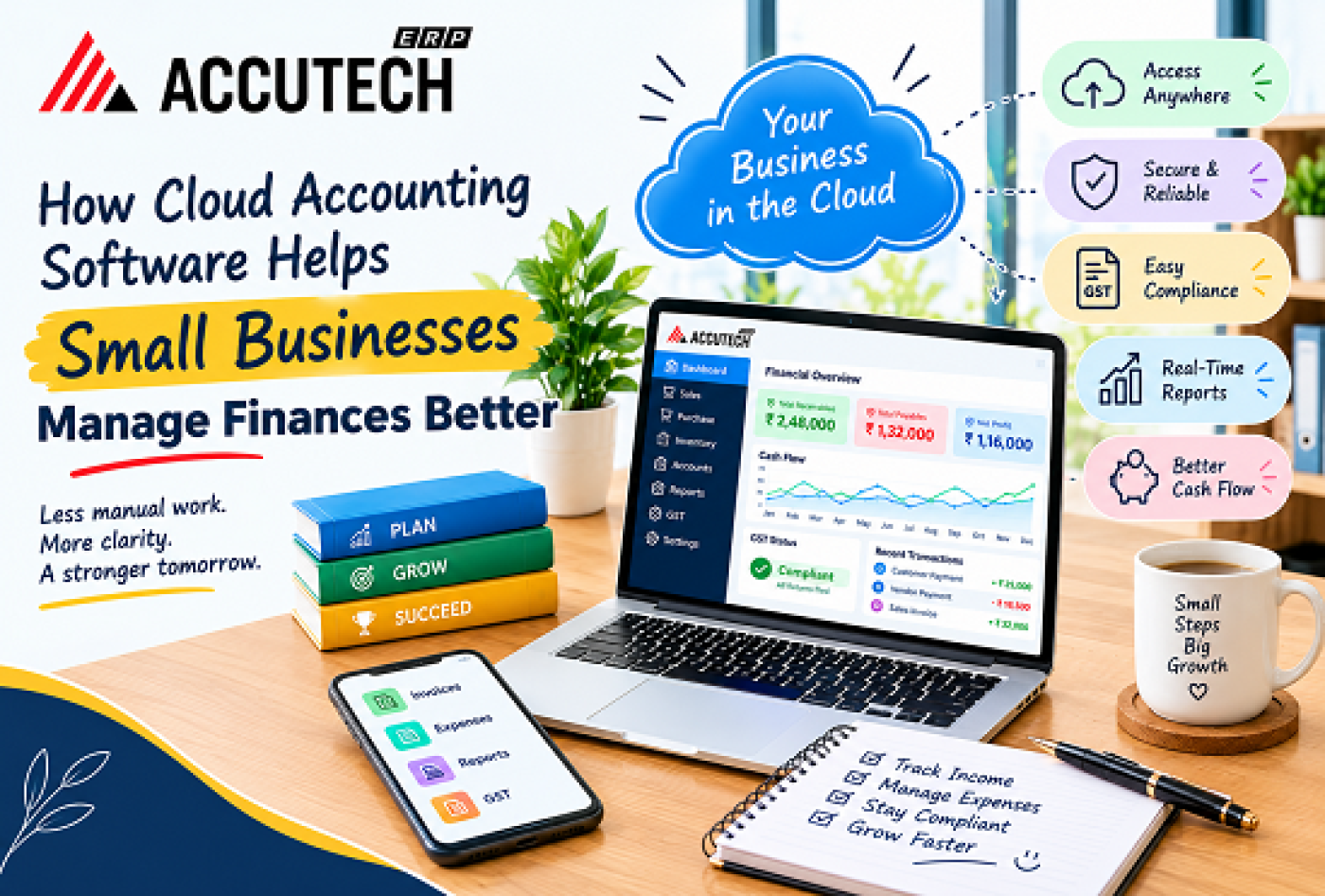
How Cloud Accounting Software Helps Small Businesses Manage Finances Better
In today's digital economy, small business owners face unprecedented pressure to manage finances accurately, stay compliant with tax regulations, and make data-driven decisions all while juggling limited resources. This is where modern accounting solutions become a game-changer.
According to recent market research, the global cloud accounting software market is projected to reach 5.39 billion in 2025, with a CAGR of 9.9%. For small businesses specifically, cloud-based solutions have become essential tools that transform financial management from a time-consuming burden into an automated, streamlined process.
In this comprehensive guide, we'll explore how cloud accounting software empowers small businesses to manage finances better, the specific features that matter most, and why the best advance accounting ERP software is crucial for sustainable growth.
What is Cloud Accounting Software?
Cloud accounting software is a web-based solution that stores and manages your financial data on secure remote servers instead of your local computer. Unlike traditional desktop-based accounting systems, this innovative approach allows you to access your complete financial records from anywhere, anytime, using any device with an internet connection.
This technology represents a fundamental shift in how businesses handle their accounting operations. Rather than maintaining separate spreadsheets or outdated software that requires manual data entry, cloud-based platforms provide automated workflows, real-time updates, and seamless collaboration across your entire team.
The best accounting software in India now comes with built-in features specifically designed for Indian tax regulations, GST compliance, and business practices. This localized approach ensures that small businesses don't have to compromise on regulatory requirements while enjoying modern technology benefits.
How Cloud Accounting Software Transforms Financial Management
The transition from manual accounting to digital solutions creates a transformation that goes beyond mere convenience. Here's how modern financial software fundamentally changes the way small businesses manage their finances:
1. Eliminates Manual Data Entry and Reduces Errors
Manual accounting processes are prone to human error. According to industry studies, approximately 80% of spreadsheet errors go undetected until they cause significant problems. Modern software automates data entry by integrating directly with your bank accounts, payment gateways, and invoicing systems. This eliminates the need for manual transaction logging and dramatically reduces costly mistakes.
2. Enables Real-Time Financial Visibility
With cloud accounting software for small business, you no longer need to wait days or weeks to understand your financial position. Real-time dashboards provide instant visibility into cash flow, outstanding invoices, expenses, and profit margins. This immediate access to financial data empowers you to make faster, more informed business decisions.
3. Streamlines Team Collaboration
Advanced ERP solutions enable multiple team members to work simultaneously on the same financial records. Your accountant, bookkeeper, and business manager can all access updated information from different locations, improving efficiency and reducing communication bottlenecks significantly.
Key Features That Matter for Growing Businesses
Not all cloud accounting software is created equal. Thebest advance accounting ERP software comes equipped with specific features that address the unique needs of small businesses:
Automated Invoicing and Payment Processing
Modern platforms generate professional invoices automatically, send payment reminders, and track payment status in real-time. This automation reduces the time spent on administrative tasks by up to 70%, allowing your team to focus on core business activities that drive revenue.
Expense Management and Reconciliation
Tracking expenses manually is tedious and error-prone. The best accounting software in India allows you to capture receipts via smartphone, categorize expenses automatically, and reconcile bank statements with a single click. This capability saves countless hours during monthly closing procedures.
Multi-Entity and Multi-Location Management
As your business grows, managing multiple locations or entities becomes complex. The best advance accounting ERP software supports unlimited entities and branches while maintaining separate accounting books and consolidated reporting, making it scalable for growing businesses.
Comprehensive Financial Reporting
Beyond basic balance sheets and profit & loss statements, advanced platforms provide detailed reports on customer analysis, vendor performance, cash flow projections, and tax liabilities. These insights help you understand your business performance comprehensively.
Real-Time Financial Visibility and Reporting
One of the most transformative benefits of cloud accounting software for small business is the ability to access real-time financial data. Traditional accounting methods often result in financial reports that are 30-60 days old by the time they're prepared, making them less useful for decision-making.
Digital solutions eliminate this lag completely. With instant access to your financial dashboard, you can:
- Monitor cash flow daily and identify potential shortfalls before they become critical problems
- Track customer receivables in real-time and follow up on overdue payments immediately
- Analyze profit margins by product, customer, or location to optimize business strategy
- Generate custom reports on-demand without waiting for your accounting team
- Make pricing decisions based on current cost and profitability data
GST Compliance and Tax Automation
For Indian small businesses, GST compliance is a critical challenge. The best advance accounting ERP software in India is specifically designed to handle GST requirements seamlessly, transforming what used to be a complex, time-consuming process into an automated workflow.
Automated Tax Calculations
The software automatically calculates applicable GST rates based on product classifications and customer locations, eliminating manual rate errors entirely. Every invoice is tax-compliant from the moment it's generated.
Return Filing Support
Premium platforms come with pre-configured GSTR-1, GSTR-2, GSTR-3B, and other return formats built-in. The system automatically maps your transactions to the correct return forms, reducing manual filing time from days to just a few hours.
Input Tax Credit (ITC) Reconciliation
Advanced systems automatically compare your purchase records with GSTR-2A from the GST portal, identifying discrepancies instantly. This prevents expensive mistakes in ITC claims and ensures you capture maximum tax benefits available.
Cost Efficiency and Scalability Benefits
Implementing the best advance accounting ERP software represents a smart financial investment for small businesses. Unlike traditional accounting systems that require substantial upfront investments in software licenses and IT infrastructure, cloud accounting software operates on a subscription model.
Key cost advantages include:
- Subscription-based pricing: Pay only for what you use, with costs that scale as your business grows
- No hardware costs: Eliminate expensive server installations and complex IT infrastructure
- Reduced staffing needs: Automation handles routine tasks that previously required dedicated accounting personnel
- Automatic updates: No costly software upgrades or time-consuming version migrations needed
- Outsourced maintenance: The provider handles all security updates and system maintenance responsibilities
Security and Data Protection Standards
Security concerns often deter small businesses from adopting cloud solutions. However, reputable providers typically offer superior security compared to on-premises systems. Premium platforms implement enterprise-grade security measures:
- End-to-end encryption for all data in transit and at rest
- Multi-factor authentication to prevent unauthorized access
- Role-based access controls to ensure users see only relevant data
- Automated daily backups with multiple redundancy layers
- Comprehensive audit trails tracking every change to financial records
- Compliance with international security standards (ISO 27001, SOC 2)
- 24/7 monitoring for suspicious activity and security threats
Multi-Entity and Multi-Location Support
As small businesses scale and expand, managing multiple locations or business entities becomes increasingly complex. Modern solutions are specifically designed to handle this growth scenario efficiently and seamlessly.
Unified Financial Management
Premium platforms maintain separate accounting books for each entity while providing consolidated reporting at the company level. This structure allows branch managers to focus on their location's performance while headquarters maintains complete visibility.
Intercompany Transaction Support
When transactions occur between your different entities, the software automatically handles intercompany eliminations in consolidated reports, ensuring accurate financial statements at all times.
Location-Wise Analysis
Modern platforms allow you to compare performance across locations effortlessly, identifying high-performing branches and problem areas requiring management attention.
Common Implementation Challenges and Solutions
While modern solutions are powerful, small businesses often encounter specific challenges during implementation. Here's how to overcome them:
Challenge 1: Data Migration from Legacy Systems
Moving data from old accounting systems requires careful planning. Leading vendors offer structured data migration support, mapping old account structures to new ones and ensuring no financial information is lost.
Challenge 2: User Adoption and Training
Your team needs proper training to maximize the benefits of new software. Choose cloud accounting software for small business that offers comprehensive onboarding programs, video tutorials, and responsive customer support.
Challenge 3: Integration with Existing Business Tools
Small businesses often use multiple software solutions (CRM, e-commerce, payroll). Leading platforms integrate seamlessly with popular business tools, creating a unified ecosystem.
Frequently Asked Questions
1. How does advanced accounting software ensure GST compliance for small businesses?
Modern ERP solutions ensure complete GST compliance through automated tax calculations on all transactions, automatic invoice mapping to GSTR forms (GSTR-1, GSTR-2, GSTR-3B), real-time tracking of input tax credits, and monthly tax liability statements. The system handles reverse charge mechanisms, inter-state transfers, and maintains complete audit trails. Regular system updates keep your business compliant with the latest GST regulations.
2. Can I manage multiple entities and branches in one cloud accounting system?
Yes, cloud accounting software for small business supports unlimited entities and branches with separate books for each while maintaining consolidated reporting. You can manage multiple GSTINs under a single account, track location-wise inventory, generate branch-wise financial statements, and handle intercompany transactions automatically.
3. What real-time reports can I generate?
Modern platforms provide access to comprehensive reports including account ledgers, stock summaries, party outstanding analysis, profit & loss statements, balance sheets, and detailed tax reports. You can drill-down from summary data to transaction-level details, export reports in multiple formats, and schedule automated report generation.
4. How much time is saved on GST filing?
Modern software automates the entire reconciliation process by comparing your transaction data with GSTR-2A/2B forms automatically. The system identifies mismatches supplier-wise and rate-wise, allowing you to fix discrepancies before filing. What traditionally takes 20+ hours of manual matching is now completed in 2-3 hours.
5. Is my financial data safe in cloud-based accounting software?
Yes, premium platforms provide bank-grade security with data encryption, multi-level user authentication, and role-based access controls. The system maintains complete audit trails for 8+ years, conducts regular automated backups, encrypts all communications, and complies with international security standards (ISO 27001, SOC 2).
6. How long does implementation typically take?
Implementation timelines vary based on business complexity, but most small businesses can go live within 2-4 weeks. The process includes data migration, system configuration, user training, and parallel runs to ensure accuracy.
7. Can I customize the solution for my specific industry?
Modern platforms offer high customization capabilities. You can configure chart of accounts, tax structures, reporting formats, and workflows to match your specific industry requirements, whether you're in manufacturing, distribution, services, or retail.
8. What happens if my internet connection goes down?
Most cloud-based accounting platforms offer offline mode for certain functions. You can continue entering data locally, which automatically syncs once your connection is restored. However, cloud solutions work best with generally stable internet connectivity.
9. How does accounting software integrate with my bank?
Modern platforms connect directly with your bank's API to automatically import transactions daily. This eliminates manual bank entry, automatically categorizes transactions, and enables one-click reconciliation.
10. What support and training options are available?
Leading providers offer comprehensive onboarding, video tutorials, knowledge bases, email support, and phone support. Most include regular training sessions, webinars on new features, and dedicated account managers for smooth implementation.
Conclusion
Cloud accounting software has evolved from a luxury for large enterprises to a necessity for small businesses competing in the digital economy. Modern ERP solutions don't just simplify bookkeeping, they transform financial management into a strategic advantage.
By implementing advanced accounting solutions like Accutech ERP, businesses can achieve:
- Significantly reduced accounting time and operational costs
- Real-time financial visibility for better decision-making
- Automated GST compliance and tax filing processes
- Scalability to support business growth and expansion
- Enhanced security and data protection standards
- Seamless collaboration with accountants and team members
Investing in Accutech ERP, one of the best accounting software solutions in India, helps businesses improve financial control, reduce compliance risks, and focus on core operations instead of spending excessive time on manual accounting tasks.
If you're ready to transform the way your small business manages finances, Accutech ERP provides the tools and technology needed for smarter accounting, efficient operations, and sustainable growth.