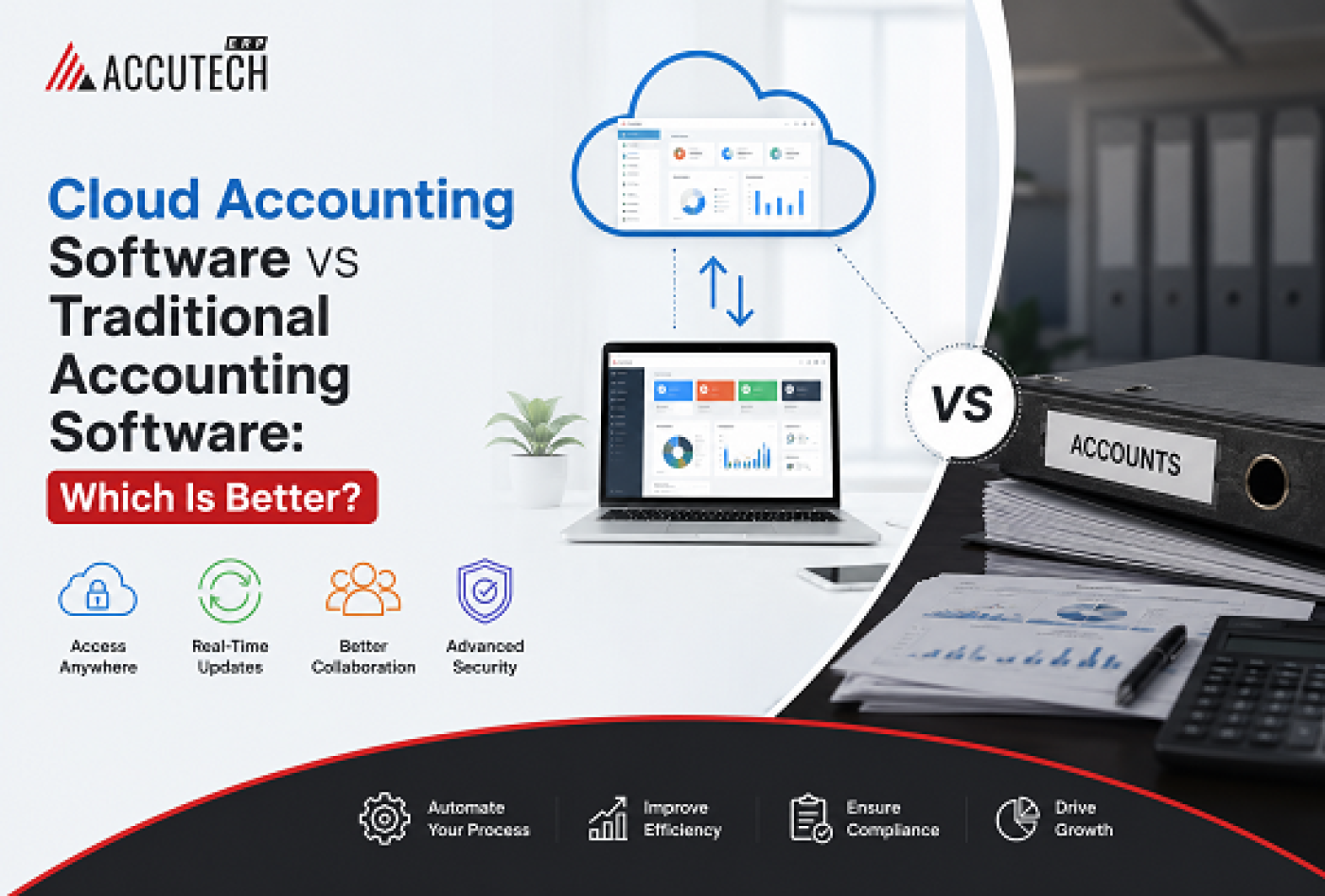
In today’s digital-first business environment, choosing the right accounting system is crucial for efficiency, compliance, and scalability. Businesses across India are transitioning from outdated methods to modern solutions, making the debate more relevant than ever:
Cloud Accounting Software vs Traditional Accounting Software – Which is better?
This guide provides a detailed comparison to help you choose the best advance accounting ERP software for your business needs.
What is Accounting Software?
Accounting software helps businesses manage financial operations such as:
- Bookkeeping
- GST billing and invoicing
- Expense tracking
- Payroll management
- Financial reporting
The best accounting software in India simplifies financial management while ensuring compliance with regulations.
Traditional Accounting Software
Traditional accounting software is installed locally on a computer or server.
Features:
- Offline functionality
- One-time purchase cost
- Manual updates and backups
Limitations:
- Limited accessibility
- Higher maintenance costs
- No real-time collaboration
Cloud Accounting Software
Cloud accounting software is hosted online and accessed through the internet.
Features:
- Access from anywhere
- Automatic updates
- Real-time collaboration
- Secure cloud storage
Key Differences
|
Feature |
Cloud Software |
Traditional Software |
|
Access |
Anywhere |
Office only |
|
Cost |
Subscription |
One-time + maintenance |
|
Updates |
Automatic |
Manual |
|
Security |
Advanced cloud security |
Local storage risks |
|
Scalability |
High |
Limited |
|
Backup |
Automatic |
Manual |
Advantages of Cloud Accounting Software
- Real-time access to financial data
- Lower upfront costs
- Automatic backups and updates
- Easy integration with other tools
- Better team collaboration
- GST and compliance-ready
Advantages of Traditional Accounting Software
- Full control over data
- No dependency on internet
- One-time investment
Which is Better for Indian Businesses?
For most businesses in India, cloud accounting software is the better choice due to:
- Scalability
- Cost efficiency
- Compliance automation
- Remote accessibility
Traditional systems may still be suitable for businesses with strict offline requirements.
ERP-Based Accounting Systems
Modern businesses are shifting toward ERP-based accounting solutions that integrate:
- Accounting
- Inventory
- Sales
Benefits:
- Centralized operations
- Real-time reporting
- Business process automation
How to Choose the Right Accounting Software
- Identify your business needs
- Check GST compliance features
- Evaluate scalability
- Compare pricing
- Ensure ERP integration
- Test usability and support
Common Mistakes to Avoid
- Choosing based only on price
- Ignoring scalability
- Overlooking compliance features
- Not checking integrations
- Skipping product demos
Expert Tips
- Choose cloud-first solutions
- Focus on automation features
- Ensure mobile accessibility
- Prefer ERP-based systems for long-term growth
FAQs
- Which is better: cloud or traditional accounting software?
Cloud accounting is better due to flexibility, automation, and scalability. - What is the best accounting software in India?
Cloud-based ERP solutions are considered the best. - Is cloud accounting secure?
Yes, it uses advanced encryption and security systems. - Can small businesses use ERP software?
Yes, modern ERP solutions are designed for SMEs. - Does cloud software require internet?
Yes, but it offers greater flexibility. - Can I migrate from traditional to cloud?
Yes, most providers support data migration. - What industries benefit the most?
Retail, manufacturing, and service industries. - Why choose ERP over basic software?
ERP integrates multiple business processes into one system.
Conclusion
Choosing between cloud and traditional accounting software is a strategic decision. While traditional systems offer control, cloud-based solutions provide flexibility, scalability, and automation.
For businesses aiming for growth and efficiency, adopting the best advance accounting ERP software is the right step forward.