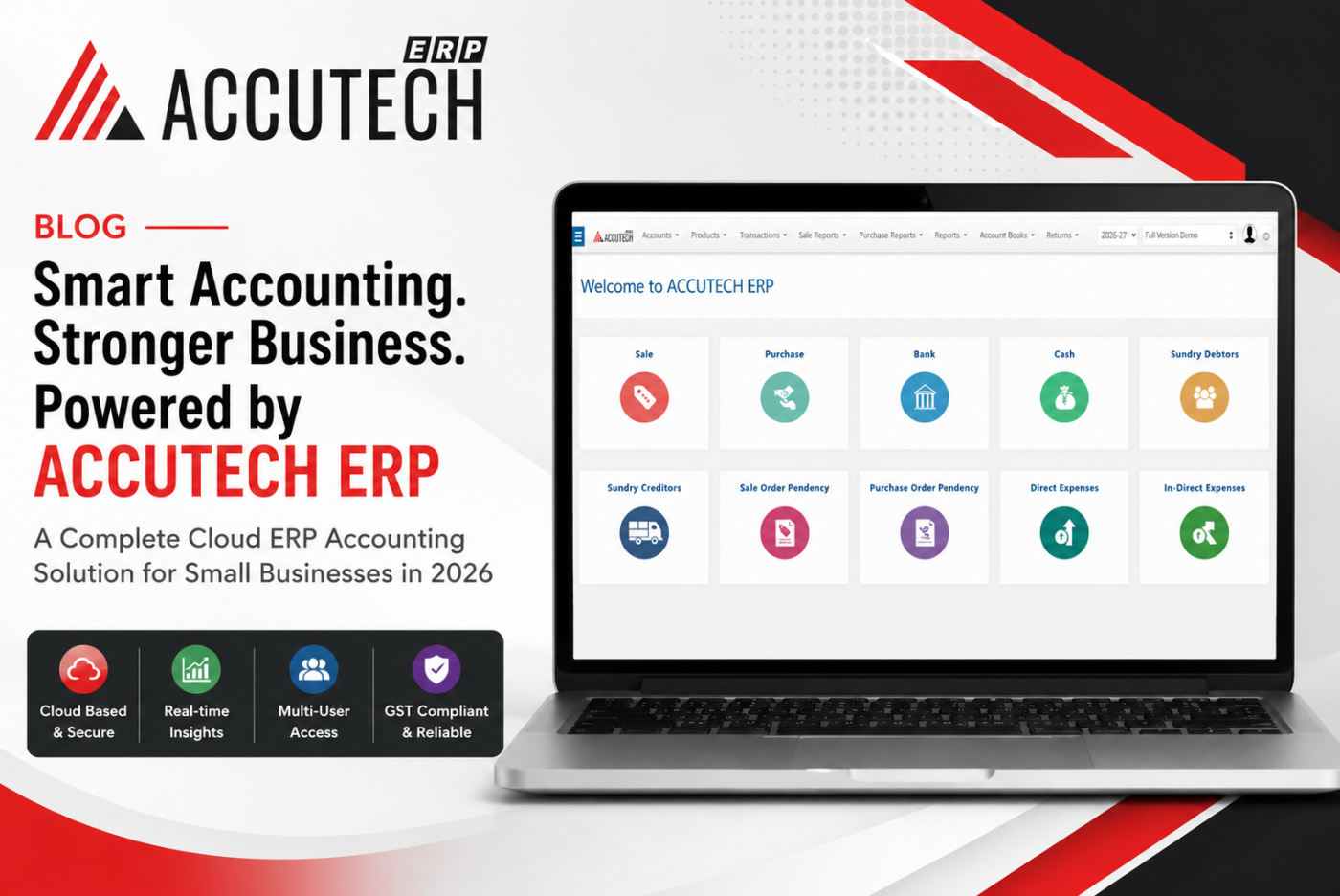
Why Your Small Business Needs Cloud ERP Accounting Software
If you're managing business finances with spreadsheets or outdated accounting systems, you're losing time and money. In 2026, cloud ERP accounting software is essential for small businesses that want to scale efficiently and reduce errors.
Running a small business means managing complex operations GST compliance, multi-branch inventory, invoicing, employee payments. A modern business accounting solution powered by cloud technology eliminates chaos and gives you real-time visibility for smarter decisions.
This guide explores everything you need to know about selecting the right ERP software for small business, and how solutions like Accutech ERP transform accounting, inventory, billing, and compliance management.
The Real Problems Small Businesses Face Without Modern Accounting Software
Before discussing solutions, let's address the real pain points small business owners experience with outdated systems.
1. Endless Hours on Manual Data Entry
Manually entering invoices, receipts, and payments is incredibly time-consuming. Your accounting team spends entire days entering data instead of analyzing it. Manual entry has error rates around 1 error per 300 entries for 10,000 monthly transactions, that's 30-50 errors.
2. GST Compliance and Taxation Challenges
GST compliance is complex and mandatory. Managing different tax rates, filing returns, and maintaining documentation manually is a nightmare. One mistake results in penalties and legal complications. GST accounting software eliminates these risks.
3. Inventory Management Chaos
Managing inventory across multiple locations manually is impossible. Stock levels go out of sync, you oversell out-of-stock items, and reordering becomes guesswork. Inventory and accounting software integration is critical.
4. Invoice Delays and Cash Flow Problems
Creating invoices manually, tracking payments, and sending reminders for overdue amounts damages cash flow. You have no visibility into who owes you or when they'll pay. Modern billing and accounting software automates this entire process.
5. No Real-Time Financial Visibility
When accounting is scattered across spreadsheets, generating accurate reports takes days or weeks. By then, the numbers are outdated. You can't make quick decisions because you lack real-time visibility into financial health.
Why Traditional Accounting Methods Are Failing in 2026
- Spreadsheets aren't scalable as your business grows
- Legacy software is expensive and doesn't integrate with modern tools
- Manual processes are vulnerable to errors and compliance violations
- Outdated systems can't handle multi-entity or multi-branch operations
- No remote access capability for distributed teams
- Data security is poor, risking sensitive financial information
Essential Features in Cloud Accounting Software
Not all cloud accounting software is equal. Ensure yours has these critical features:
1. Automated Invoicing and Billing
Your system should automate invoice generation, send payment reminders, and track payment status. This improves cash flow by reducing collection delays.
2. Integrated Inventory Management
Inventory and accounting software integration ensures real-time inventory tracking across locations with automatic balance sheet updates.
3. Built-in GST and Tax Compliance
Your accounting software for GST billing must automatically calculate GST, generate compliant documents, and create GST returns for filing.
4. Multi-User Access with Role-Based Permissions
Team members access the system from anywhere with appropriate permission levels for their roles.
5. Real-Time Financial Reporting
Instant access to profit and loss statements, balance sheets, and custom dashboards that update automatically.
6. Automated Bank Reconciliation
Automatic bank feeds eliminate manual reconciliation and catch discrepancies immediately.
7. Multi-Branch Support
Consolidate financial data from multiple locations with automatic currency conversions if needed.
8. Mobile Access
Full functionality on mobile devices with offline capability and automatic sync.
Benefits of Cloud-Based ERP Accounting Systems
Accessibility from Anywhere, Anytime
Cloud accounting is accessible from any device with internet. Your team works remotely, field staff check inventory on-site, and you review reports while traveling.
No Infrastructure Costs
You don't need expensive servers or IT staff. The vendor handles maintenance, updates, and security. Pay predictable monthly fees instead.
Automatic Updates and Compliance
Your software is always current with latest features and security. When GST rules change, your system updates automatically.
Scalability
Add branches, users, or features without system replacement. Cloud systems scale effortlessly.
Better Collaboration
Everyone works in the same cloud system. Sales, accounting, warehouse, and executives all access real-time data.
Improved Security
Cloud providers invest heavily in security. Your data is more secure in the cloud than on local servers. Regular backups ensure no data loss.
How Automation Saves Time and Reduces Errors
One biggest advantage of automated accounting software is eliminating repetitive manual tasks.
Automated Data Entry
Systems capture invoice data from emails or documents automatically. OCR technology reads details and creates entries in seconds which took 30 minutes per invoice.
Intelligent Expense Categorization
AI learns your patterns and automatically assigns expenses to correct accounts. Over time, the system becomes smarter.
Automatic GST Calculations
The system applies correct GST rates automatically, tracks input and output tax, and generates compliant returns ready for filing.
Real-Time Inventory Sync
Sales automatically decrease inventory and generate revenue entries. Purchases automatically increase inventory and create payables entries.
Automated Reminders and Reconciliation
The system sends payment reminders and reconciles incoming payments automatically. Your team focuses on analysis, not chasing money.
Elimination of Manual Errors
Removing manual entry eliminates typos and errors. Manual data entry has 1 error per 300 entries. Automation drops this to near zero.
How Accutech ERP Solves These Problems
Comprehensive Cloud-Based Platform
Accutech integrates accounting, inventory, billing, GST compliance, and financial reporting into one unified platform.
Built-In GST Compliance
Accutech's GST module automatically calculates GST, generates compliant invoices, and creates GSTR returns ready for filing.
Real-Time Inventory Synchronization
When you make a sale, inventory automatically decreases with proper GST calculations. Manage multiple warehouses with real-time visibility.
Automated Billing and Invoicing
Create professional invoices with a click. Accutech tracks payment status and sends automatic reminders for overdue accounts.
Smart Reporting and Analytics
Accutech provides real-time dashboards showing business metrics. Track profit margins, identify best-sellers, and monitor cash flow.
Cloud-Based with No Infrastructure Costs
Nothing to install. Accutech runs in the cloud accessible from anywhere using any device.
Advanced Security and Backups
Enterprise-grade security with automatic daily backups ensures your data is protected and never lost.
Scalable for Growing Businesses
Add branches, users, or inventory Accutech scales with you without expensive upgrades.
Manual vs ERP Automation Comparison
| Process | Manual Method | ERP Automation |
|---|---|---|
| Invoice Processing | 15-30 minutes per invoice | 30-60 seconds per invoice |
| GST Return Filing | 40-60 hours per month | 30 minutes per month |
| Inventory Tracking | 80-90% accuracy | 99.5%+ accuracy |
| Financial Reporting | 3-7 days after month-end | Minutes with real-time data |
| Error Rate | 1 error per 300 entries | Near-zero errors |
The Future of Accounting Software in 2026
AI-Powered Automation
AI now categorizes expenses, detects fraud, predicts cash flow, and identifies anomalies automatically.
Real-Time Financial Visibility
Monthly close is ending. Modern businesses have minute-by-minute financial visibility.
Predictive Analytics
Forecast cash, identify at-risk customers, predict inventory demand, and optimize pricing.
Mobile-First Design
Systems work flawlessly on smartphones. Managers approve invoices during commutes.
API Integration Ecosystem
Seamless connections with payment gateways, banks, CRM, e-commerce platforms create unified business systems.
Strong Conclusion and Call to Action
In 2026, the choice isn't whether to implement cloud ERP accounting software it's when. Small businesses clinging to manual processes face serious competitive disadvantages.
The real costs of outdated systems are enormous: lost time, accounting errors, missed insights, inventory chaos, and security risks. Meanwhile, businesses with modern cloud ERP experience 50-70% time reduction, near-zero errors, real-time profitability insights, seamless scaling, and enterprise-grade security.
Accutech ERP is specifically built for Indian small businesses and SMEs. It combines enterprise-grade ERP with simplicity and affordability small businesses can actually use. Whether wholesaler, distributor, retailer, pharma, or FMCG, Accutech scales with your operations.
Ready to Transform Your Business? Get Started With Accutech ERP Today.
Frequently Asked Questions About Cloud ERP Accounting Software
1. What is the difference between cloud accounting software and traditional ERP?
Cloud accounting is web-based and browser-accessed. Traditional ERP is installed on local servers. Cloud solutions eliminate IT costs, offer automatic updates, enable anywhere access, and scale effortlessly.
2. Is cloud accounting software secure?
Yes, cloud solutions are extremely secure. Professional providers invest heavily in encryption, firewalls, intrusion detection, and security audits.
3. How does cloud software handle GST compliance?
Modern GST accounting software automatically handles GST in every transaction. It applies correct rates based on product type and buyer classification.
4. Can I access the software on mobile devices?
Absolutely. Modern cloud accounting software is fully mobile-optimized for iOS and Android.
5. How does inventory and accounting software integration work?
In unified systems, inventory and accounting synchronize automatically. Sales automatically decrease inventory and record revenue.
6. What are implementation costs?
Cloud accounting typically uses subscription models monthly or annual fees based on users and features. No expensive hardware, no IT staff, no large upfront costs.
7. How does automation reduce errors?
Manual entry has error rates around 1 per 300 entries. Automation eliminates manual entry through OCR, automatic bank feeds, and system integrations.
8. Can I manage multiple branches with one system?
Yes, cloud ERP systems handle multi-branch operations. Each branch operates independently while the head office sees consolidated real-time data.
9. How does billing and accounting software improve cash flow?
Modern billing and accounting software generates invoices instantly, tracks payment status, sends automatic reminders, and improves collections.
10. What is smart reporting and business intelligence?
Smart reporting includes real-time dashboards, predictive analytics, and customizable reports for smarter business decisions.
11. How long does implementation take?
Cloud accounting typically implements in 4-12 weeks depending on complexity.
12. Is financial management software suitable for wholesalers and distributors?
Absolutely. Wholesalers need multi-warehouse management, purchase order automation, vendor management, and trade discount handling.
13. Can I use GST billing software across multiple product categories?
Yes. Modern GST billing software handles multiple categories with different GST rates simultaneously.
14. What happens if I switch accounting software later?
Your data belongs to you. Professional providers allow exporting data in standard formats anytime.
15. How does cloud ERP help with audit compliance and documentation?
Professional accounting software maintains complete audit trails and generates audit-ready statements instantly.