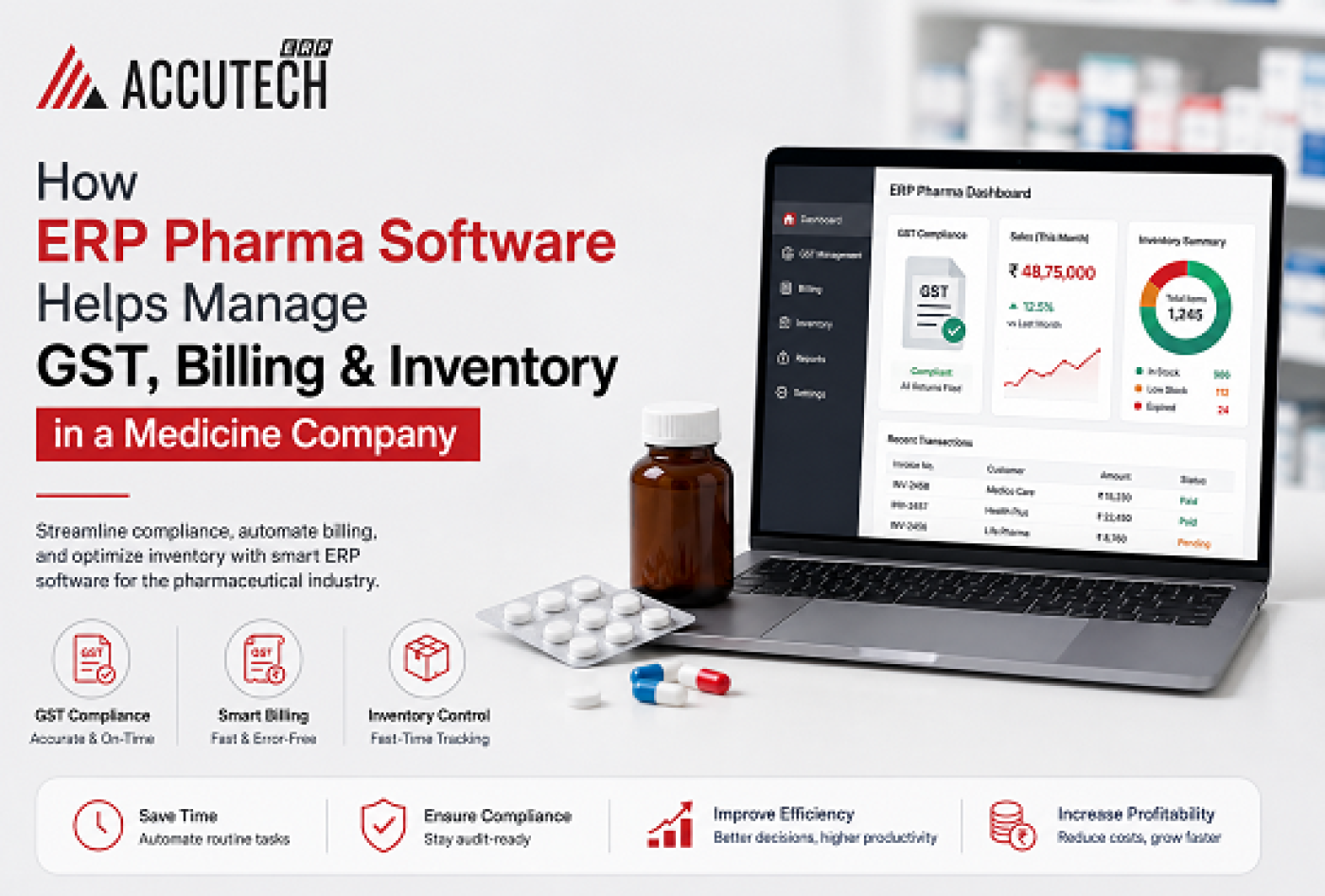
How ERP Pharma Software Helps Manage GST, Billing and Inventory in a Medicine Company
The pharmaceutical industry in India operates under complex regulatory frameworks, demanding precise management of GST compliance, billing accuracy, and inventory control. For medicine companies, managing these three critical areas manually is not just time-consuming; it's a recipe for costly errors that can jeopardize regulatory compliance and profitability.
A modern ERP pharma software solution has become indispensable for pharmaceutical companies, wholesalers, and distributors seeking to streamline their operations. Whether you're managing a small medicine shop, a mid-sized pharmaceutical distributor, or a large PCD franchise network, implementing the right accounting software can reduce operational costs by up to 40% while improving accuracy and compliance.
This comprehensive guide explores how to effectively manage GST compliance, billing processes, and inventory control in a medicine company using advanced pharma industry software solutions. We'll walk you through practical strategies, best practices, and actionable insights that have helped thousands of pharmaceutical businesses optimize their operations.
Understanding GST Compliance in Pharmaceutical Companies
GST Compliance: The Foundation of Modern Pharmaceutical Operations
The Goods and Services Tax (GST) has fundamentally transformed how pharmaceutical companies in India manage taxation and financial reporting. As of 2026, medicine companies must navigate multiple GST slabs, including the critical 5% rate on most essential medicines and higher slabs for specialized pharmaceuticals.
For medicine companies operating as distributors, retailers, or manufacturers, understanding GST compliance means:
- Correctly classifying medicines under HSN (Harmonized System of Nomenclature) codes to ensure accurate tax application
- Calculating Input Tax Credit (ITC) accurately to reduce overall tax burden and improve profitability
- Filing GSTR-1 (outward supplies), GSTR-2A (ITC reconciliation), and GSTR-3B (monthly tax liability) reports on time
- Maintaining batch-wise records for expiry tracking and regulatory compliance
Why Manual GST Management Fails in Pharmaceutical Businesses
Many medicine companies still rely on spreadsheets, manual calculations, and disconnected billing systems. This approach creates several critical problems:
- Tax calculation errors that result in penalties and compliance issues during GST audits
- Delayed invoice generation, leading to customer dissatisfaction and cash flow delays
- Inability to track ITC accurately, missing opportunities for tax savings
- Time-consuming month-end reconciliation and manual report generation
A practical example: A mid-sized pharmaceutical distributor in Bangalore was managing 2,000+ daily transactions manually. After implementing a cloud-based pharma accounting solution, they reduced billing time by 85%, eliminated calculation errors, and improved GST compliance visibility during audits.
The Role of ERP Pharma Software in Billing Management
Automating Billing Processes with ERP Pharma Software
Modern ERP pharma software transforms billing from a manual, error-prone process into a streamlined, automated workflow. In the pharmaceutical industry, billing accuracy is critical. Incorrect pricing, tax calculations, or discounts can damage customer relationships and create compliance issues.
Key billing features that pharma industry software must provide:
- Instant Invoice Generation: Create GST-compliant invoices in seconds, reducing customer wait times and improving operational efficiency
- Real-Time Price Updates: Automatic calculation based on product type, batch, expiry date, and negotiated discounts
- Batch-Wise Billing: Track medicines by batch number, enabling easy identification and management of specific product lots
- Multi-Payment Integration: Support for cash, credit, online transfers, and card payments with automatic reconciliation
Benefits of Implementing Pharmaceutical Accounting Software
Reducing Billing Errors: Studies show that an automated accounting system reduces billing mistakes by over 95%, directly improving customer satisfaction and reducing disputes.
Faster Payment Collections: Automated invoicing and payment tracking help medicine companies collect payments faster, improving cash flow and working capital management.
Enhanced Reporting: Real-time access to billing data enables better business decisions, pricing strategies, and profitability analysis across products and customer segments.
Real-World Case Study: A Delhi-based pharmaceutical PCD distributor adopted a cloud-based solution to streamline its operations, resulting in a 30% improvement in billing speed, a 20% reduction in payment disputes, and a 25% increase in on-time collections within the first quarter.
Advanced Inventory Management Strategies for Medicine Companies
Batch-Wise Inventory Tracking and Expiry Management
Inventory management in pharmaceutical companies is significantly more complex than in other industries due to expiry dates, batch-specific pricing, and regulatory tracking requirements. A single expired medicine on your shelf represents lost revenue and potential compliance violations.
Advanced pharma biotech ERP systems provide:
- Automated Expiry Alerts: Receive notifications when medicines are nearing expiry, enabling proactive management and minimizing waste
- FIFO (First-In-First-Out) Management: Ensure older stock is sold before newer batches, maintaining regulatory compliance and reducing losses
- Batch-Level Profitability Analysis: Track which batches generate the most profit and which are slow-moving
- Multi-Location Inventory Control: Manage stock across multiple branches, godowns, or franchise outlets from a single dashboard
Stock Optimization Techniques for Medicine Companies
Effective inventory management in medicine companies involves balancing three competing interests:
- Maintaining adequate stock to meet customer demand without stockouts
- Minimizing carrying costs and reducing tied-up capital in slow-moving inventory
- Preventing expiry losses through careful batch management and sales forecasting
The accounting system uses historical data analysis and predictive algorithms to optimize reorder points. This prevents both overstocking (which leads to expiry losses) and understocking (which results in lost sales and customer dissatisfaction).
Key Inventory Metrics Every Medicine Company Should Track:
Metric | Purpose | Target Range |
Inventory Turnover | How quickly medicine stock is sold and replaced | 8-12 times per year for most medicines |
Days Inventory Outstanding | Average days medicine sits before being sold | 30-45 days for optimal performance |
Expiry Loss Percentage | Percentage of inventory lost due to expiry | Below 2% indicates effective management |
Stock Accuracy Rate | Physical vs. system inventory match | 95%+ indicates reliable tracking |
Integrating GST, Billing, and Inventory with Pharmaceutical Accounting Software
The Unified Approach: Why Integration Matters
Many medicine companies use disconnected systems one for inventory, another for billing, and a third for accounting. This fragmented approach creates data inconsistencies, delays, and errors. An integrated accounting solution creates a single source of truth for all operational data.
When you sell a medicine through an integrated business management system:
- Inventory automatically reduces based on actual sales
- A GST-compliant invoice is generated with correct tax calculation
- Accounts are automatically updated with the revenue entry
- Customer ledger is updated for credit management
- HSN-wise sales data is compiled for GST return filing
This multi-step process occurs in seconds, eliminating manual intervention and reducing errors to near-zero levels.
Step-by-Step Integration Process
Step 1: Master Data Setup
Enter all product information including HSN codes, GST rates, batch details, and pricing structures. This foundation ensures accurate calculations throughout the system.
Step 2: Configure GST Rules
Set up GST slabs for different product categories. The system automatically applies the correct tax based on product classification.
Step 3: Establish Billing Rules
Define billing templates, discount structures, and payment terms. An integrated system ensures billing consistency across all transactions.
Step 4: Activate Real-Time Synchronization
Enable automatic data sync between inventory, billing, and accounts modules. This ensures immediate visibility of transactions across all departments.
Step 5: Monitor and Optimize
Use integrated reporting dashboards to monitor operations, identify inefficiencies, and optimize processes continuously.
Best Practices for Pharma Biotech ERP Implementation
Planning and Preparation
Successful implementation of pharma biotech ERP begins with thorough planning:
- Conduct a comprehensive audit of current processes to identify inefficiencies and pain points
- Document existing workflows and data structures
- Define clear implementation objectives and success metrics
- Allocate sufficient resources, including dedicated personnel and budget
Data Migration Strategy
Clean data migration is critical. The accounting system is only as reliable as the data it processes.
- Data Cleansing: Before migration, clean historical data by removing duplicates, standardizing formats, and validating accuracy. This prevents legacy issues from contaminating the new system.
- Phased Migration: Implement the system in phases starting with smaller modules like accounts, then expanding to inventory and billing. This reduces risk and allows staff to adapt gradually.
- Parallel Running: Run the old and new systems simultaneously during transition to verify accuracy and catch discrepancies.
Staff Training and Change Management
Even the best accounting solution fails without proper training. Invest in comprehensive staff training:
- Role-Based Training: Provide specialized training for different user groups accounts staff, warehouse managers, billing executives, and management.
- Hands-On Workshops: Conduct practical sessions using real business scenarios relevant to your medicine company.
- Continuous Support: Maintain dedicated support during and after implementation to address questions and troubleshoot issues.
Common Mistakes in GST Billing and Inventory Management
Mistake #1: Incorrect HSN Code Classification
Many medicine companies misclassify medicines under HSN codes, resulting in incorrect GST application.Modern business management solutions include HSN databases that ensure correct classification and reduce compliance risk.
Mistake #2: Ignoring ITC Reconciliation
Failing to reconcile Input Tax Credit (GSTR-2A vs. GSTR-3B) leaves money on the table. The system automatically reconciles ITC, ensuring you claim all available tax credits.
Mistake #3: Poor Expiry Date Management
Without proper tracking, medicine companies often discover expired stock only during physical inventory counts. Pharma biotech ERP systems provide automated expiry tracking and alerts, preventing losses.
Mistake #4: Manual Billing Calculations
Manual price calculations and discounts introduce errors that compound during the month. Integrated billing within a centralized system ensures consistency and accuracy.
Mistake #5: Lack of Real-Time Visibility
Companies relying on manual reports don't have real-time insights. Pharma industry software provides instant dashboards showing inventory levels, pending bills, and GST compliance status.
Future Trends in Pharma Industry Software
AI-Powered Demand Forecasting
Future business management solutions will use artificial intelligence to predict demand patterns, helping medicine companies optimize inventory levels and reduce expiry losses significantly.
Blockchain for Supply Chain Transparency
Blockchain integration in modern accounting software will enable complete supply chain visibility, ensuring medicine authenticity and regulatory compliance across distribution networks.
Enhanced Mobile Capabilities
Field sales representatives will use mobile apps integrated with pharma biotech ERP to create orders, access inventory information, and track commissions in real-time.
Automated Compliance Reporting
Future accounting systems will automatically generate GST returns, ensuring compliance without manual intervention, reducing audit risk significantly.
Frequently Asked Questions (FAQs)
Q1: What is the best software for small medicine shops?
For small medicine shops, look for cloud-based business management solutions that offer affordability, ease of use, and essential features like GST compliance, basic inventory tracking, and simple billing. Many affordable options provide starter packages tailored for retail chemists. The key is selecting a scalable solution that can grow with your business as it expands.
Q2: How much does pharma industry software typically cost?
Pricing varies significantly based on features, number of users, and deployment model. Cloud-based accounting software typically ranges from ₹5,000-50,000 per month for mid-sized businesses. Some vendors offer pay-per-transaction models, which work well for startups. Always evaluate total cost of ownership, including training and support, rather than just software licensing fees.
Q3: Can business management software integrate with existing accounting software?
Most modern accounting software solutions offer API integrations with popular accounting platforms like Tally, QuickBooks, and SAP. However, complete integration within a single integrated system is usually more efficient. Before implementation, verify integration capabilities with your existing software stack.
Q4: How long does it take to implement pharma biotech ERP?
Implementation timelines for pharma biotech ERP typically range from 2-6 months depending on business complexity, data volume, and customization requirements. Small medicine shops might go live in 1-2 months, while large pharmaceutical distributors might need 6-12 months. Phased implementation reduces disruption and allows staff adaptation.
Q5: What is GSTR-2A and why is it important for pharmaceutical companies?
GSTR-2A is an ITC (Input Tax Credit) reconciliation return showing taxes paid on purchases. For medicine companies, GSTR-2A is critical because it allows claiming tax credits on pharmaceutical raw materials, finished goods, and services purchased. The software automatically reconciles GSTR-2A with GSTR-3B, ensuring accurate ITC claims and reducing audit risk.
Q6: How does batch-wise inventory management work?
Batch-wise inventory management tracks medicines by batch number, allowing separate pricing, expiry tracking, and profitability analysis for each batch. When a medicine is sold, the system automatically removes it from the specific batch. Pharma industry software tracks batch details including manufacturer, expiry date, cost, and sale price, enabling detailed batch-level reporting.
Q7: Can accounting software handle multi-location management?
Yes, modern business management software supports multi-location management , allowing centralized control of multiple branches or franchise outlets. You can transfer inventory between locations, consolidate financial reports, and maintain separate accounting books for each location all from a single dashboard. This is particularly valuable for PCD distributors managing multiple franchise territories.
Q8: What are the top compliance requirements for pharma industry software?
Key compliance requirements include GST compliance (GSTR-1, GSTR-2A, GSTR-3B filing), Schedule H drug tracking, batch-level expiry management, HSN-based tax classification, ITC tracking, e-way bill generation, and audit trail maintenance. Comprehensive pharma biotech ERP solutions include built-in compliance modules addressing these requirements, reducing manual effort and audit risk.
Q9: How does real-time inventory visibility improve profitability?
Real-time inventory visibility enables data-driven decisions about stock levels, pricing, and product mix. You can quickly identify slow-moving inventory before it expires, adjust pricing for fast-moving products, negotiate better purchase terms based on actual sales patterns, and reduce working capital tied up in inventory. These insights directly translate to improved profitability and cash flow.
Q10: How can medicine companies reduce expiry losses?
An integrated inventory management system reduces expiry losses through automated alerts, FIFO management, batch-wise profitability analysis, and demand forecasting. Set up expiry alerts 30-60 days before expiry dates, implement FIFO selling to ensure older batches are sold first, analyze which batches are slow-moving, and use historical sales data to optimize purchase quantities. Most medicine companies reduce expiry losses by 50-70% after implementing these practices.
Conclusion:
Managing GST compliance, billing accuracy, and inventory control in medicine companies requires more than good intentions. It demands an integrated and automated system that reduces manual errors and provides real-time business visibility.
Pharmaceutical companies that aim to grow need digital solutions such as Accutech ERP, comprehensive pharmaceutical accounting software, and advanced ERP pharma software. Whether you operate a small retail chemist shop, a mid-sized pharmaceutical distribution business, or a large PCD franchise network, the right software investment can deliver measurable benefits:
- Reduced operational costs through process automation
- Improved GST and pharmaceutical regulatory compliance
- Better decision-making with real-time reports and dashboards
- Faster billing and improved stock availability
- Greater scalability without a proportional increase in operational expenses
The question is no longer whether your medicine company should invest in pharma industry software. The real question is which solution matches your operational requirements and future growth plans.
Accutech ERP helps pharmaceutical businesses manage GST billing, inventory, batch tracking, expiry control, accounting, and business reporting through a unified platform. Start by identifying your current challenges, evaluating important software features, and planning a phased implementation to minimise operational disruption.
Take action today by scheduling a demonstration of Accutech ERP. Explore its pharmaceutical business features, assess its integration capabilities, and choose a solution that can streamline operations and support your company’s long-term growth.