How many software systems does your business actually depend on right now? One? Three? Five? And how many of them are quietly connected to each other versus how many are creating invisible gaps in your data, your decisions, and your growth? If you had to pause and think about that answer, you are already living the problem this blog is here to solve.
If you are reading this, chances are you are right at this crossroads. You know you need a software upgrade, but you are not sure whether to go with a simple accounting solution or invest in a full-blown ERP system. And honestly? That confusion is completely valid because this decision can make or break how efficiently your business scales.
In India's rapidly evolving business landscape of 2026, this question accounting software vs ERP system differences is being asked by thousands of founders, CFOs, and operations managers every single month. This blog is your definitive guide to answer it. No jargon overload, no confusing tech speak just a clear, honest, story-driven breakdown to help you make the smartest decision for your growing business.
Chapter 1: Setting the Stage - What Are We Even Comparing?
What Is Accounting Software?
Think of accounting software as your business's digital finance diary. It records money coming in, money going out, calculates taxes, generates GST invoices, manages payroll, and creates financial reports. It is the foundation of any organized business finance.
For small businesses and startups in India, accounting software in India solutions have been a lifesaver especially after GST implementation. Tools in this category help you stay GST-compliant, file returns on time, and maintain clean books without needing a full-time CA on your payroll.
Key functions of accounting software typically include:
- Accounts payable and receivable management
- Bank reconciliation and ledger maintenance
- GST billing, invoicing, and e-way bill generation
- Payroll processing and salary management
- Tax filing and regulatory compliance
- Profit and loss statements, balance sheets, and cash flow reports
What Is an ERP System?
ERP stands for Enterprise Resource Planning. Think of it as the central nervous system of your entire business. An ERP system integrates your accounting, inventory, purchasing, sales, HR, manufacturing, CRM, and supply chain all into one unified platform.
Where accounting software is your business's financial record keeper, ERP is the brain that connects every department, every process, and every decision in real time.
Core modules in a typical ERP include:
- Financial accounting and multi-currency reporting
- Inventory and multi-warehouse management
- Procurement and vendor relationship management
- Sales order management and customer CRM
- Manufacturing and production planning
- Human Resources and payroll automation
- Business intelligence dashboards and custom analytics
When you search for the best ERP for growing business in India, you are essentially looking for a system that can grow with you one that replaces a dozen fragmented systems into a single source of truth.
Chapter 2: The Core Differences - Accounting Software vs ERP System
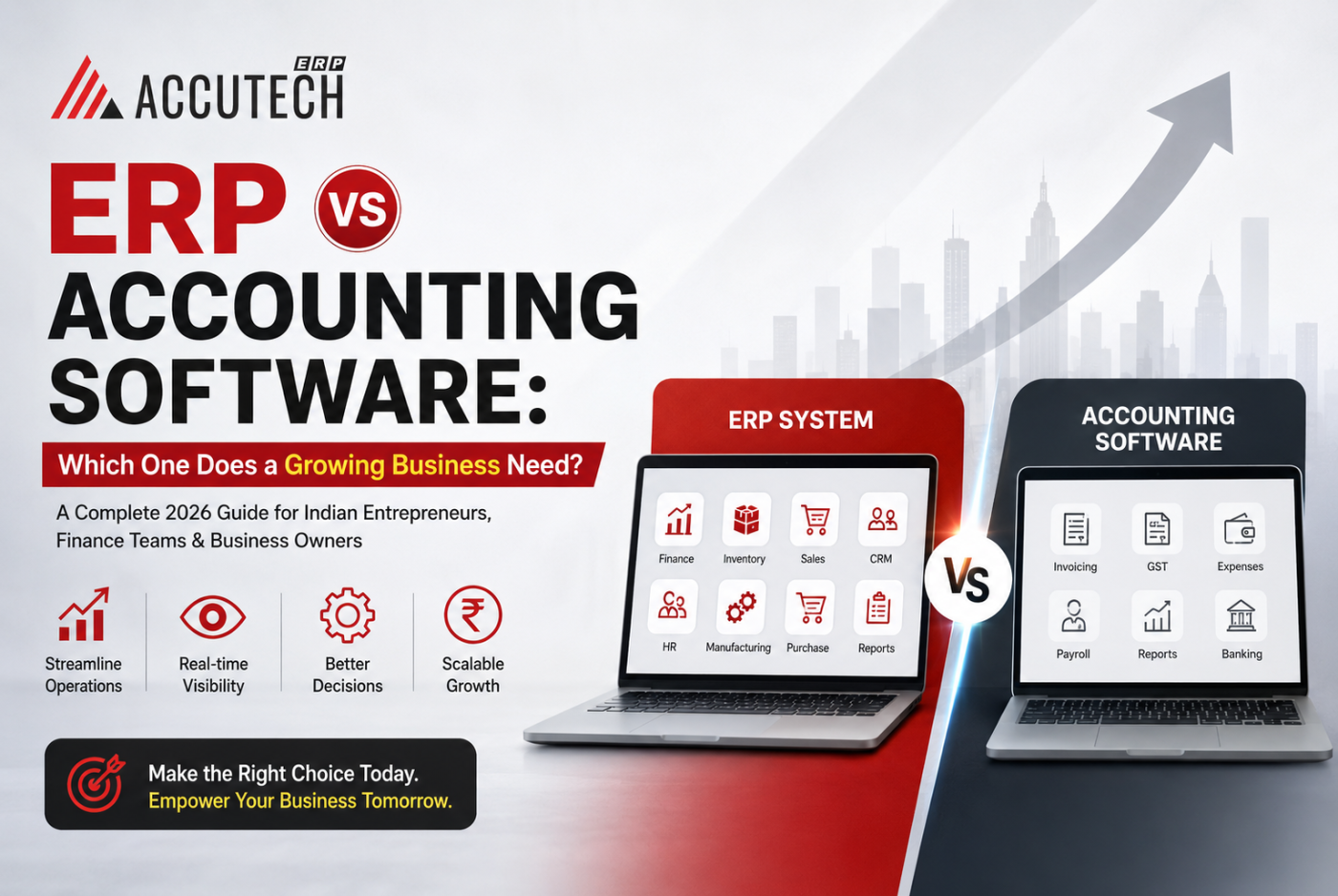
Accounting software vs ERP system differences come down to one fundamental question: How much of your business do you want one platform to handle? Here is a side-by-side breakdown:
|
Feature / Criteria |
Accounting Software |
ERP System |
|
Scope |
Finance & Accounting only |
All business departments |
|
Typical Users |
Accounts & Finance team |
Cross-functional teams across company |
|
Core Modules |
Invoicing, GST, Payroll, Reports |
Finance + Inventory + HR + CRM + Manufacturing |
|
Scalability |
Good for small to mid-size |
Built for scale and rapid growth |
|
Investment Level |
Affordable, subscription-based |
Higher investment, higher ROI |
|
Integration Depth |
Limited external integrations |
Deep cross-module integration |
|
Ease of Use |
Easy to learn, minimal training |
Requires structured training and setup |
|
Data Visibility |
Financial data only |
360-degree business visibility |
|
Best Suited For |
Startups, freelancers, small businesses |
Growing and enterprise-level businesses |
|
GST Compliance |
Yes, standard features |
Yes, with advanced automation |
|
Reporting Type |
Financial statements only |
Financial + operational analytics |
The table makes one thing very clear: accounting software and ERP are not competitors they serve different stages of business growth. What changes is your need, your scale, and your ambition.
Chapter 3: Signs Your Business Has Outgrown Accounting Software
There is a point in every growing business where the software that once felt like a solution starts feeling like a constraint. It does not happen dramatically no alarms go off, no system crashes. It happens quietly. A missed stock entry here. A delayed report there. A frustrated department head asking why their numbers do not match the finance team's numbers. And then one day you realize you are spending more energy managing your software's limitations than actually running your business.
This is the moment thousands of Indian businesses arrive at every year manufacturers, traders, retailers, and service companies alike. It is the clearest signal that your accounting software has done its job well, and that it is now time to seriously explore ERP software benefits for small business solutions that match where your business is genuinely headed.
Check how many of these signs feel personally familiar right now:
1. Your Departments Are Working in Silos
When your sales team does not know what inventory is available, and your procurement team does not know what orders are pending you have a data visibility problem. Accounting software cannot fix this. ERP can, because it connects every department in real time.
2. You Are Managing Multiple Disconnected Software Tools
If your team is running separate systems for billing, inventory, payroll, CRM, and reporting and someone is manually copying data between them you are losing time, making errors, and missing the bigger picture every single day.
3. Compliance Is Getting Increasingly Complicated
As your business grows, so does your compliance burden GST reconciliation, TDS, PF, ESI, import and export documentation, multi-state operations. Accounting software handles basic GST. ERP handles all of it comprehensively and automatically.
4. Reporting Takes Days Instead of Minutes
If getting a clear picture of your business performance requires multiple people pulling data from multiple places, you need centralized business intelligence. That is exactly what ERP provides dashboards and reports in real time.
5. You Are Expanding to New Locations or Product Lines
Multi-branch management, multi-currency transactions, multi-warehouse inventory tracking these are ERP territory. Accounting software simply was not built for this level of operational complexity.
Chapter 4: ERP Software Benefits for Small and Growing Businesses in India
Let us address the elephant in the room. When most Indian small business owners hear 'ERP', they think: "That is for large corporations. I am too small for that." In 2026, this is one of the most outdated myths in the business world. Modern cloud-based ERP software benefits for small business are very real, very accessible, and very affordable. Here is what you actually gain:
Benefit 1: One Platform for Everything
Imagine starting your morning by opening one dashboard that shows you in real time your sales revenue for the day, pending purchase orders, current inventory levels, overdue payments from customers, and HR attendance status. No switching apps, no calling department heads for updates. Just complete clarity at a glance.
That is the daily reality of an ERP user. It replaces spreadsheet chaos with organized, connected data flow across your entire organization.
Benefit 2: Superior Financial Control and Visibility
Yes, accounting software handles your books. But best ERP for growing business in India does something more powerful it connects your financial data to your operational data. You can instantly see which product line is most profitable, which client is costing you more than they are paying, and where you are over-spending month after month.
Benefit 3: Real-Time Inventory Management
For businesses dealing in physical goods whether trading, manufacturing, or retail real-time inventory management is not a luxury, it is a survival need. ERP tracks stock movements automatically, generates reorder alerts, prevents overselling, and eliminates the painful end-of-month counting exercise that wastes everyone's time.
Benefit 4: GST and Tax Compliance, Simplified
India's GST framework is not getting simpler. With e-invoicing mandates, GSTR reconciliation, input tax credit matching, and TDS compliance an ERP built for accounting software India requirements makes compliance automatic rather than stressful. No more last-minute panic before filing deadlines.
Benefit 5: Scalability Without Operational Chaos
The biggest competitive advantage of ERP is that it scales with you. Whether you go from 10 employees to 100, from 1 branch to 10, or from domestic to export operations your ERP grows alongside your business without requiring a complete system overhaul or painful migrations.
Benefit 6: Reduced Operational Costs Over Time
Counterintuitively, investing in ERP often reduces costs significantly. You reduce manual errors, eliminate duplicate data entry, cut redundant software subscriptions, improve procurement efficiency, and reduce order-to-cash cycles. Many businesses in India recover their ERP investment within 12 to 18 months of going live.
Benefit 7: Empowered, Faster Decision Making
When your CEO, operations head, and finance manager all have access to the same accurate, real-time data decisions get faster and smarter. ERP turns your business data from a passive record into an active strategic asset that drives competitive advantage.
Chapter 5: When Accounting Software Is Still the Right Choice
ERP is not right for everyone, and that is perfectly okay. There are businesses where accounting software is not just adequate it is genuinely the ideal solution for their current stage.
You should stick with accounting software if:
- You are a freelancer, consultant, or sole proprietor your financial needs are simple and a full ERP would be overkill.
- You run a micro or very early-stage startup with fewer than 10 employees and basic, single-location operations.
- Your business is in a single location, handles one product or service line, and has no inventory management complexity.
- You are primarily focused on GST compliance, invoicing, and basic financial reporting and nothing more complex than that.
- Your budget is very limited and you cannot yet justify the investment in a full ERP implementation though you should keep it on your 2-year roadmap.
The honest advice: Start with what you need today, but plan for where you will be in two to three years. The best businesses do not just buy software for their current needs they buy for their future ambitions. The moment your complexity outpaces your systems, growth turns into grinding.
Chapter 6: The Indian Business Context - Why This Decision Is Different Here
India is not just another market. It is a unique and complex business ecosystem and choosing software here comes with India-specific considerations that most global comparisons miss entirely.
The GST Complexity Factor
India's multi-tiered GST structure with CGST, SGST, IGST, e-invoicing mandates, e-way bill requirements, and quarterly and annual return reconciliation demands software that is deeply integrated with tax compliance. Both accounting software India and ERP system India solutions must be built for India's specific tax framework. But ERP handles it with far more automation, fewer errors, and much greater depth of integration.
The MSME Digital Transformation Wave
India's 63 million-plus MSME sector is in the middle of a significant digital transformation wave. Government compliance requirements, GST return filing mandates, and export documentation demands are pushing even small businesses toward cloud ERP in India solutions. The question is no longer whether you will digitize it is how thoughtfully and strategically you will do it.
Multi-Location and Multi-State Operational Reality
India's geography means many growing businesses operate across multiple states, each with different tax rates, compliance requirements, and logistics challenges. Managing this complexity with accounting software alone is incredibly difficult and error-prone. ERP was built precisely for this kind of multi-entity, multi-location operational reality.
Manufacturing and Trading Dominance
India is a manufacturing and trading powerhouse from textiles to auto parts, FMCG to pharmaceuticals, chemicals to engineering components. These industries have complex inventory, production planning, quality control, and supply chain needs that accounting software simply cannot address. This is why the demand for the best ERP for growing business in India is exploding particularly in these manufacturing and trading sectors.
Chapter 7: Myths vs Facts - Clearing the Fog
There is a significant amount of misinformation floating around about both accounting software and ERP systems. Let us bust the most common myths, one by one, with clear facts.
Myth 1: ERP is Only for Big Companies
FACT: In 2026, cloud-based ERP software benefits for small business are well-documented and widely available. Modern ERP solutions are designed and priced for businesses of all sizes, including startups and SMEs. The cost barrier that existed a decade ago has largely disappeared with cloud-based subscription models.
Myth 2: Accounting Software Is Enough to Run a Complete Business
FACT: Accounting software manages your finances. It does not manage your inventory, production, HR, or customer relationships. As your business grows in complexity, relying solely on accounting software creates dangerous operational blind spots that competitors without those blind spots will exploit.
Myth 3: ERP Implementation Takes Years and Costs a Fortune
FACT: Modern cloud ERP deployments for mid-size Indian businesses can be implemented in 4 to 12 weeks, not years. With the right implementation partner and a well-scoped project, ERP is faster and more affordable than the horror stories from legacy on-premise implementations that circulate in business conversations.
Myth 4: You Lose All Your Old Data When You Switch to ERP
FACT: A professional ERP implementation always includes a structured data migration process from your existing accounting software. Your historical financial data, customer records, vendor information, and product data all move with you during the migration.
Myth 5: ERP Is Too Complicated for Non-Technical Teams
FACT: Modern ERP interfaces are designed for regular business users accountants, store managers, HR executives not IT professionals. With proper training and good implementation support, your team can use ERP confidently within a few weeks of going live.
Myth 6: All ERP Systems Are Essentially the Same
FACT: There is enormous variation in ERP systems by industry focus, company size suitability, features, India-specific capabilities, and implementation quality. Choosing the best ERP for growing business in India genuinely requires careful evaluation of your industry context, team size, budget, and 3-year growth roadmap.
Chapter 8: How to Choose Between Accounting Software and ERP - A Decision Framework
Confused about which direction is right for you? Use this practical, step-by-step decision framework before making any software commitment.
Step 1: Audit Your Current Pain Points Honestly
Make a list of the top five frustrations your team faces today. Are they all finance-related? Or do they span multiple departments operations, inventory, HR, sales? If your pain is cross-functional, ERP is almost certainly your answer.
Step 2: Project Your Realistic 3-Year Business Vision
Where will your business be in 2027 or 2028? More employees? New locations? New product categories? Export operations? If the honest answer to any of these is yes, plan your software investment for that future, not just your comfortable present.
Step 3: Evaluate Your Full Budget Realistically
Map out the total cost of ownership over three years subscription cost, implementation, training, and ongoing support. Compare this against the value delivered when you understand accounting software vs ERP system differences fully. Most businesses underestimate the hidden cost of not having the right software missed orders, manual errors, delayed decisions, and lost opportunities all have real financial costs.
Step 4: Check Industry Fit Carefully
Some industries have almost no real choice manufacturing, trading, distribution, retail, and hospitality all but require ERP for any serious scale of operations. Pure service businesses like consulting or digital agencies can often remain on accounting software for longer without significant pain.
Step 5: Evaluate the Vendor's India-Specific Expertise
Your software vendor must deeply understand India's GST regime, compliance landscape, and business culture. A cloud ERP India provider with deep local expertise in Indian taxation, business practices, and regulatory requirements will save you months of confusion, rework, and compliance headaches after go-live.
Chapter 9: What to Look for in the Best ERP for Growing Business in India
If you have decided to seriously explore best ERP for growing business in India options, here are the non-negotiable features you must evaluate in every vendor conversation:
- GST-ready and e-invoicing compliant — Fully integrated with India's current and evolving tax framework, including GST auto-reconciliation
- Cloud-based architecture — Access from anywhere, automatic software updates, minimal IT infrastructure requirements
- Multi-branch and multi-company support — Essential for businesses with existing or planned geographic expansion
- Real-time inventory management — Live stock tracking, batch and serial number management, multi-warehouse support
- Complete financial accounting — Full ledger management, bank reconciliation, TDS automation, multi-currency transactions
- HR and payroll automation — Attendance, leave management, PF, ESI, salary processing integrated with finance
- Sales and purchase management — Complete order-to-invoice and purchase-to-payment lifecycle management
- Business intelligence and reporting — Custom dashboards, KPI tracking, and real-time management reports
- Mobile application access — Field sales teams, warehouse staff, and business executives all need reliable mobile access
- Implementation quality and post-go-live support — Vendor must offer hands-on implementation support and dedicated customer success in India
Chapter 10: Real Business Transformations - Stories from the Field
Story 1: The Textile Trader from Surat
Priya runs a textile trading business in Surat. She was using basic accounting software for billing and GST filing, and it worked well for three years. But when she expanded to three warehouses and started selling on multiple e-commerce platforms, chaos set in. Stock levels were consistently wrong, GST reconciliation became a nightmare with multiple sales channels, and customer orders started getting delayed because nobody had a clear view of what was actually available to ship.
After switching to a cloud ERP India solution, her team could see real-time inventory across all three warehouses simultaneously, GST reconciliation with e-commerce platforms became automated, and order fulfillment time dropped by 40%. Her CA told her she had the cleanest books he had seen in years of practice.
Story 2: The Auto Parts Manufacturer from Pune
Vikram's auto component manufacturing unit had 120 employees and was supplying components to three major OEM clients. He was running six different software applications — separate applications for accounting, payroll, production planning, quality control, CRM, and inventory — and none of them communicated with the others.
The ERP software benefits for small business became very real for him when ERP implementation connected all six business functions into one system. Production planning became data-driven rather than guesswork, delivery timelines to OEM clients improved consistently, and his annual audit preparation time went from three weeks of painful data compilation to just three focused days.
Story 3: The Retail Pharmacy Chain Expanding Across Cities
Ananya runs a pharmacy retail chain that grew from 2 outlets to 15 in three years a remarkable achievement that came with equally remarkable operational pain. Accounting software worked well at 2 stores. At 15, it was a management disaster centralized purchasing was impossible to track, pricing inconsistencies appeared between stores, and monthly P&L consolidation for all stores took 10 exhausting days.
ERP centralized her purchasing process, standardized pricing across all 15 outlets, and gave her a single consolidated financial view of the entire chain in real time. She now makes expansion decisions faster, negotiates significantly better supplier terms, and her ambitious expansion to 25 stores is firmly on track.
Chapter 11: The 2026 Trend - Why Cloud ERP Is the New Standard
If you are evaluating accounting software India or ERP options in 2026, there is one market reality you cannot ignore: cloud-based delivery has become the undisputed standard for business software.
A few years ago, businesses had to choose between expensive on-premise ERP installations requiring dedicated server infrastructure and simpler cloud accounting software with limited functionality. Today, the best of both worlds exists cloud-based ERP that offers enterprise-grade functionality at pricing structures designed for growing Indian businesses.
Here is why cloud ERP has become the default choice for forward-thinking Indian businesses:
- Zero hardware investment required - No servers to buy, maintain, or secure in your office
- Automatic regulatory updates - GST rule changes, e-invoicing updates, and new compliance requirements happen automatically without your IT team's involvement
- True work-from-anywhere capability - Business owners and all team members access live business data from home, field, or any branch location
- Pay-as-you-grow pricing flexibility - Start with the modules you need today, add more capabilities as your business complexity increases
- Built-in disaster recovery - Your business data is safe and recoverable even if your physical office experiences hardware failures
- Significantly faster implementation - Cloud ERP goes live in weeks rather than the months required for on-premise deployments
The question for Indian businesses in 2026 is not cloud versus on-premise that debate is settled. The real question is which cloud ERP is purpose-built for your specific industry, compliance requirements, and growth trajectory.
Chapter 12: Making the Move - Your Practical Transition Playbook
Deciding to upgrade your software is one thing. Actually making the transition smoothly, without disrupting your daily operations, is entirely another challenge. Here is your step-by-step practical playbook for a successful transition.
- Audit your current software stack list every system your team depends on today and honestly map the operational gaps
- Define your must-have requirements involve all department heads in this process, not just the finance team
- Research and shortlist 3 to 5 ERP vendors with demonstrable India-specific capabilities and references
- Request product demos focused specifically on your industry workflows, not generic product walkthroughs
- Ask every vendor for references from businesses of similar size and industry vertical
- Evaluate the total cost of ownership over 3 years implementation fees plus training plus annual support costs
- Plan your data migration strategy carefully your existing accounting data must move cleanly and completely
- Set a realistic go-live timeline 6 to 12 weeks is reasonable for most Indian SMEs
- Invest meaningfully in user training the most powerful ERP fails if your people do not know how to use it effectively
- Go live in planned phases start with core modules and add additional functionality over time as your team gains confidence
If you are looking for a solution purpose-built for Indian businesses, Accutech ERP's Advanced Accounting module is a strong starting point. It combines the simplicity that accounting software users expect with the integrated power of a complete ERP system giving growing businesses precisely what they need at every stage of their journey.
Frequently Asked Questions (FAQ)
Here are the questions Indian business owners search for most answered clearly and practically.
Q1. What is the main difference between accounting software and ERP?
Accounting software manages only financial data invoicing, GST, payroll, and financial reports. ERP is a comprehensive platform integrating finance with inventory, HR, sales, manufacturing, and more. The fundamental accounting software vs ERP system differences come down to scope: ERP covers your entire business operations, not just finance.
Q2. Is ERP suitable for small businesses in India in 2026?
Absolutely and emphatically yes. In 2026, cloud-based ERP software benefits for small business are well-established and widely proven across Indian SMEs. Modern ERP solutions are available at affordable subscription models, are designed to be implemented quickly, and scale naturally as your business grows in complexity and size.
Q3. What is the best ERP for growing business in India?
The best ERP for growing business in India depends on your specific industry, team size, operational complexity, and growth goals. Key evaluation criteria include: depth of GST compliance features, cloud architecture quality, inventory management capabilities, HR and payroll integration, multi-branch support, and the quality of local implementation and support services.
Q4. How much does ERP cost for a small business in India?
Cloud ERP solutions for Indian SMEs typically range from approximately Rs. 3,000 to Rs. 15,000 per month depending on the number of users and modules selected. This represents a dramatically more accessible price point compared to the legacy on-premise ERP systems that required heavy capital investment, making ERP a realistic option for serious small and growing businesses.
Q5. Can accounting software handle GST compliance in India?
Yes, most modern accounting software India solutions handle standard GST invoicing, GSTR filing preparation, e-invoicing, and e-way bill generation well. However, as your business grows and GST compliance complexity increases especially with multi-state operations, export transactions, or high-volume reconciliation ERP's integrated and automated compliance management becomes genuinely essential.
Q6. How long does ERP implementation actually take for an Indian SME?
For Indian small and mid-size businesses, a well-planned and properly scoped cloud ERP implementation typically takes 4 to 12 weeks from project kickoff to go-live. Larger or more operationally complex implementations may take somewhat longer. The single most important factor in timeline adherence is choosing an experienced implementation partner with deep India-specific knowledge and methodology.
Q7. Will switching to ERP result in losing my existing accounting data?
No not if the implementation is handled professionally. A proper ERP implementation always includes a structured data migration process from your existing accounting software. Your complete transaction history, customer records, vendor master data, product catalog, and opening financial balances are all migrated as a defined part of the implementation project.
Q8. Can ERP replace my separate payroll software?
Yes, in most cases. Modern ERP systems include a comprehensive HR and payroll module handling attendance management, leave tracking, salary processing, PF and ESI compliance, TDS calculations, and Form 16 generation fully replacing the need for a separate payroll application and eliminating the manual data transfer between systems.
Q9. Which industries in India benefit most from ERP in 2026?
Manufacturing, trading, distribution, retail, pharmaceuticals, food processing, textiles, construction, auto components, and healthcare are among the industries that consistently gain the most significant benefits from ERP in India. These industries have complex inventory management, production planning, regulatory compliance, and multi-entity operational needs that make best ERP for growing business in India a demonstrably strong return on investment.
Q10. How do I know it is genuinely time to upgrade from accounting software to ERP?
The clearest signals are: you are running multiple disconnected software systems for different functions, you have poor cross-departmental data visibility, inventory management has become challenging and error-prone, your compliance complexity is growing with business expansion, you are operating from or planning multiple locations, and you are spending significant time on manual data compilation and preparation for management reporting. If three or more of these apply, it is time to seriously evaluate ERP.
Conclusion: The Right Software Is the Right Investment in Your Future
Let us bring this full circle with the honest perspective this decision deserves.
There is no single universal answer to the ERP versus accounting software question that applies to every business. The right answer is the one that genuinely matches where your business is today and where you have the ambition and plans to take it tomorrow and beyond.
If you are a micro-business or early-stage startup, excellent accounting software India solutions will serve you very well. They are affordable, GST-ready, and easy for small teams to adopt and use effectively.
But if you are a growing business one with multiple departments, inventory management needs, multiple locations, or genuine expansion plans the ERP software benefits for small business are not just attractive features in a sales brochure. They are transformative operational advantages that compound over time as your business grows.
In 2026, the accounting software vs ERP system differences are clearer than ever before. Accounting software is a powerful solution for financial management. ERP is a comprehensive strategy for business growth. One records your past with accuracy. The other builds your future with intelligence.
The businesses that will lead their industries through the rest of this decade are the ones making smart, forward-looking technology investments today. Whether you are actively searching for the best ERP for growing business in India or simply trying to understand whether your current accounting software is holding your growth back the answer always begins with an honest, clear-eyed assessment of where you are and where you genuinely want to go.
Your growth deserves the right foundation. Build it wisely, invest in it deliberately, and let the right software carry your ambitions forward.