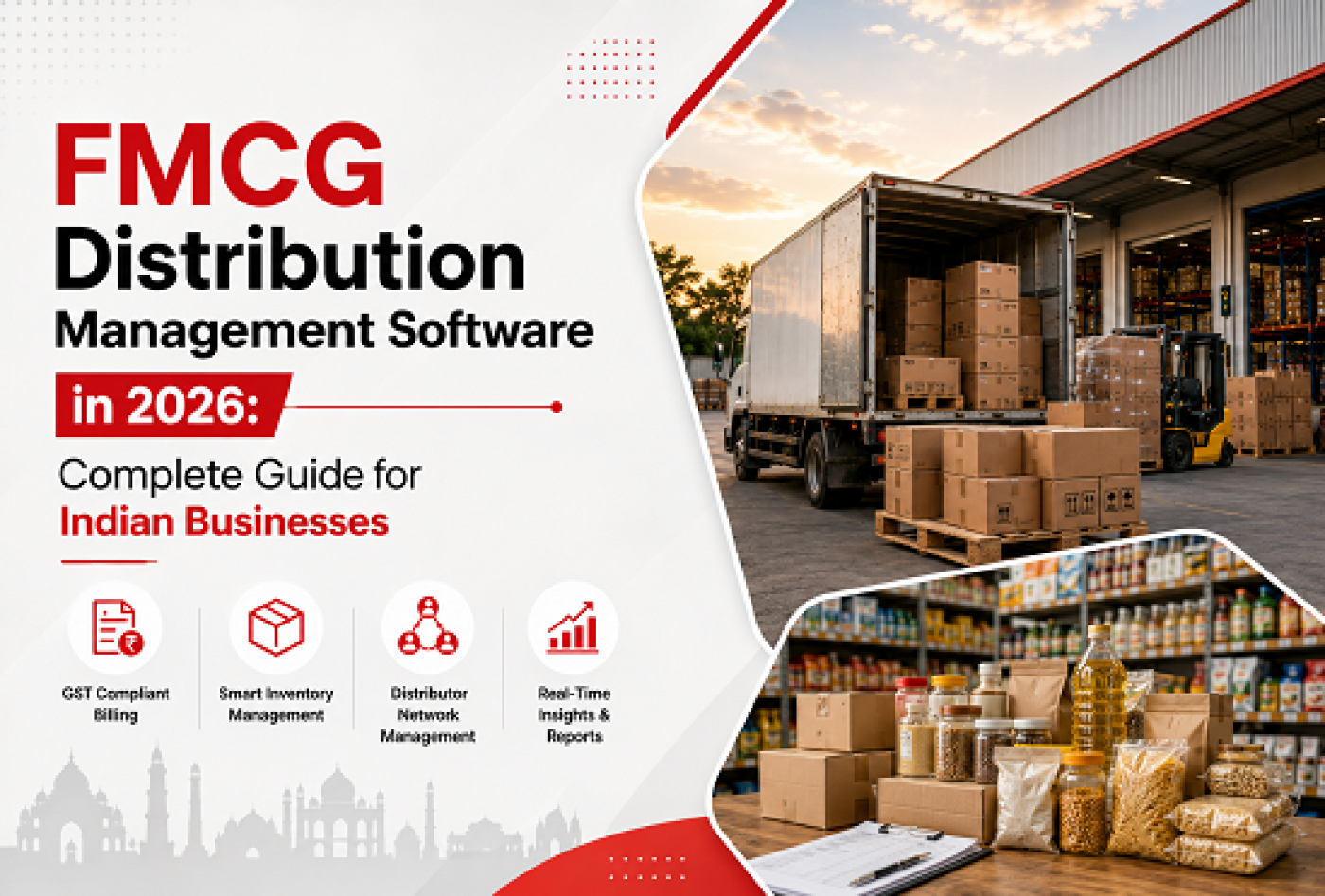
The Fast-Moving Consumer Goods (FMCG) industry in India is experiencing unprecedented growth, yet it faces equally unprecedented challenges. In 2026, FMCG sector growth is driven by rising incomes, urbanization, and increased digital penetration across Tier 2 and Tier 3 cities. However, this growth brings operational complexity that traditional management systems cannot handle.
FMCG distribution has been the backbone of India's consumer goods sector, with thousands of SKUs moving through complex multi-tier distribution networks daily. Distributors juggle inventory management across multiple warehouses, manage relationships with hundreds of retailers, ensure GST compliance, and handle thousands of transactions.
Industry reports show that businesses implementing modern FMCG distribution ERP software experience operational efficiency improvements of 25-35%, cost reductions of 15-20%, and revenue increases of 10-18% within the first year. This comprehensive guide explores everything you need to know about FMCG distribution management software in 2026.
Understanding FMCG Distribution ERP Software: Definitions and Core Concepts
What Is FMCG Distribution ERP Software?
FMCG distribution ERP (Enterprise Resource Planning) software is a specialized, integrated system designed specifically for managing the unique operational requirements of fast-moving consumer goods distributors. Unlike generic ERP solutions built for manufacturing, FMCG distribution software addresses the complete ecosystem of distribution operations.
At the heart of FMCG distribution software lies the Distributor Management System (DMS), which specifically manages the distributor node in your distribution network. A robust DMS handles:
- Real-time inventory tracking with batch-wise and expiry date management
- Accurate billing and taxation with automatic GST calculation
- Collections and credit control with receivables tracking
- Scheme and promotional claim settlement
- Returns, RTV, and reverse logistics management
Key Differences from Traditional Software
Modern FMCG ERP is engineered for speed, flexibility, and real-time visibility. Here's what makes it fundamentally different:
Aspect | Traditional Software | Modern FMCG ERP |
Real-Time Data | Daily or weekly batch processing | Live inventory, sales, and analytics |
Mobile Access | Limited or no mobile support | Full mobile-first design |
GST Compliance | Manual GST calculations | Automated GST with e-invoice support |
Inventory Visibility | Limited visibility | Multi-location real-time tracking |
Critical Challenges Facing FMCG Distributors in India
Understanding real operational challenges helps showcase why modern FMCG distribution software is essential.
1. Inventory Management and Stock Visibility Challenges
FMCG distributors manage thousands of SKUs across multiple warehouses. Without proper visibility, two major problems occur: overstocking in low-demand areas, which ties up capital and increases the risk of product expiry, and stockouts in high-demand regions, which lead to lost sales and damaged retailer relationships.
A reliable FMCG distributor management system provides real-time stock visibility across warehouses, helping businesses maintain the right inventory levels at every location. Many distributors still rely on manual inventory counts or weekly reports, creating significant decision-making gaps. For fast-moving products with short shelf lives, even a two-day delay in inventory visibility can result in expired stock or missed sales opportunities.
2. Complex Billing and GST Compliance
Handling thousands of daily invoices with accurate tax calculations is operationally complex. GST compliance requires proper HSN/SAC classification, accurate tax rate application, monthly GSTR-1 return filing, e-invoice generation, and e-way bill management.
Manual calculations lead to billing errors, revenue recognition issues, and GST compliance penalties. Studies show that 30-40% of FMCG businesses still handle significant portions of their billing manually.
3. Expiry Date Management and Product Waste
FMCG products have limited shelf lives. Without automated expiry tracking, products expire in warehouses (direct financial loss), expired products reach retail shelves (brand damage), and FIFO inventory rotation is manually managed (inefficiencies).
Distributors report that without proper software, expired inventory losses range from 5-15% annually. For a distributor managing ₹100 lakhs in inventory value, this translates to ₹4-14 lakhs in annual losses.
4. Scattered Data and Poor Decision-Making
When sales data lives in Excel sheets, inventory in manual registers, and financial records in separate accounting software, creating unified business intelligence becomes impossible. Distributors can't quickly answer critical questions about customer profitability, product margins, regional performance, or true cash positions.
5. Manual Order Processing and Field Team Coordination
Many distributors still rely on phone calls or manual entry for order processing. This creates delayed order fulfillment, order entry errors, poor field team coordination, and inability to monitor real-time delivery status.
Essential Features Every FMCG Distribution ERP Software Must Have
1. Real-Time Inventory Management with Multi-Location Tracking
A modern FMCG ERP must provide live stock visibility across all warehouses and distribution points, batch-wise and expiry date tracking with automatic alerts, automated FIFO inventory rotation, stock transfer management between locations, and bi-directional sync with retail partner systems.
2. Automated Billing and GST Compliance
The billing module should handle automatic GST calculation based on product HSN/SAC codes, e-invoice generation with digital signatures, e-way bill integration, automatic GSTR-1 and GSTR-3B return preparation, and credit note and debit note management.
3. Customer and Supplier Relationship Management
Manage customer relationships with complete customer master with transaction history, credit limit management and receivables tracking, outstanding receivables and payables reports, and customer profitability analysis.
4. Comprehensive Reporting and Analytics
Effective decision-making requires access to sales and purchase analysis by product region and customer, real-time P&L statements and balance sheets, account ledgers and trial balance reports, stock summaries and movement reports, and HSN-wise sales and tax summaries.
5. Mobile-First Field Operations Support
Modern FMCG operations require field teams to be connected: mobile order placement and confirmation, van sales with offline billing capability, GPS-based delivery tracking, and real-time customer feedback and proof of delivery.
How FMCG Distribution Software Transforms Operations
Implementation of comprehensive FMCG distribution ERP software delivers measurable, tangible benefits across every dimension of business operations.
Operational Efficiency Improvements
Before ERP: A distributor manages 500 SKUs across 5 warehouses. Daily inventory checks require 2-3 hours of staff time. Order processing takes 4-6 hours. Billing involves multiple spreadsheets with 15-20% of invoices requiring corrections.
After ERP: Real-time inventory visibility eliminates manual counts. Order processing becomes instantaneous. Billing is automated with 99.8% accuracy. The distributor reduces inventory checking time to 30 minutes daily, order processing time by 85%, and eliminates billing reconciliation headaches.
Financial Impact: This distributor saves 15-20 staff hours per week equivalent to 2.5-3 full-time positions worth ₹7.5-9 lakhs annually.
Cost Reduction Through Inventory Optimization
Expired inventory waste is reduced dramatically. Distributors moving from manual systems to automated ERP reduce expired inventory losses from 5-15% annually to less than 1%.
Revenue Growth Through Better Visibility
Real-time data enables distributors to identify fast-moving products and adjust inventory, prevent stockouts that result in lost sales, analyze customer profitability and focus on high-value retailers, and respond quickly to regional demand variations. These capabilities typically result in revenue increases of 10-18% within the first year.
GST Compliance and Tax Management in Modern FMCG ERP
GST remains one of the most complex compliance requirements for FMCG distributors in India. Modern ERP software has made GST management significantly more efficient and accurate.
Automatic GST Calculation and Classification
Different products fall under different GST tax brackets (0%, 5%, 12%, 18%, 28%). Modern FMCG ERP software maintains a comprehensive HSN/SAC code database with correct tax rates, automatically applies the correct tax rate during invoice generation, handles interstate sales with IGST automatically, and applies applicable exemptions and concessional rates correctly.
E-Invoice and E-Way Bill Integration
For invoices above ₹50 lakhs, e-invoicing through NRIC is mandatory. FMCG ERP software generates invoices in required JSON format automatically, submits invoices to NRIC and obtains IRN, generates QR codes for e-invoices, and integrates with e-way bill systems for automated generation.
GSTR-1 Return Preparation
GSTR-1 filing is mandatory by the 13th of the succeeding month. Modern FMCG ERP automatically aggregates all invoices, segregates invoices by category, calculates tax amounts correctly, and generates the return in required JSON format for GSTR portal upload.
Inventory Management and Stock Control: A Complete Overview
Inventory is the lifeblood of FMCG distribution. Poor inventory management kills profitability; excellent inventory management drives growth.
Multi-Warehouse Inventory Tracking
Distributors typically operate multiple warehouses and distribution centers. A modern FMCG ERP provides individual stock tracking for each warehouse/location, consolidated stock summaries across all locations, stock transfer management between warehouses, and real-time total stock visibility for master planning.
Expiry Date and Batch Management
For FMCG products with expiry dates, the system tracks manufacturing and expiry dates for each batch, shelf-life remaining for each stock item, automatic alerts when products are nearing expiry, and automated FIFO pick suggestions for picking and packing. This automation ensures that older stock is always used first, minimizing expiry-related losses.
Demand Forecasting and Planning
Advanced FMCG ERP systems analyze historical sales patterns to forecast future demand. This enables accurate purchase planning to reduce overstock/understock, seasonal demand anticipation, identification of slow-moving SKUs for promotional clearance, and optimization of inventory investment for improved working capital management.
Billing and Invoicing: Automating Financial Operations
Billing in FMCG distribution is complex: multiple factors include product pricing, volume discounts, promotional offers, scheme adjustments, GST variations, and payment terms. Manual management creates errors and delays.
Automated Invoice Generation
Modern FMCG ERP generates invoices instantaneously once an order is confirmed. The system automatically retrieves correct product rates, applies applicable volume discounts and promotional schemes, calculates GST correctly, and includes payment terms and applicable charges.
Discount and Scheme Management
Modern ERPs handle volume-based discounts, slab-based pricing, free product schemes, seasonal offers with date-based validity, and customer-specific pricing and schemes. Automated scheme tracking also helps measure scheme ROI.
Credit Notes and Returns Management
Retailers often return unsold inventory or request credit adjustments. Modern ERP systems handle return authorization and tracking, automatic credit note generation, reverse stock adjustments, and customer account adjustments.
Implementation Best Practices and Step-by-Step Guide
Implementing FMCG distribution ERP software is a significant operational undertaking. Success requires proper planning, stakeholder alignment, and careful execution.
Step 1: Assess Current Operations and Define Requirements
Before selecting software: document all business processes, list your customers, suppliers, and product SKUs, identify pain points in current systems, and define success metrics.
Step 2: Select the Right Software Solution
Evaluate solutions based on India-specific features (GST, e-invoicing), FMCG-specific capabilities (expiry management, batch tracking), scalability, ease of implementation, support quality, and total cost of ownership.
Step 3: Plan the Implementation Timeline
A typical implementation involves: Weeks 1-2 soft launch, Weeks 2-4 full configuration, Weeks 5-6 staff training and pilot testing, Week 7 system go-live, and Weeks 8-10 rollout to remaining locations.
Step 4: Migrate Data Carefully
Ensure all customer and supplier master data is complete and accurate, opening balances are correctly imported, historical transaction data is preserved, and data validation is performed to catch errors before go-live.
Step 5: Train Your Staff Thoroughly
Different roles require different training: field sales teams need order placement and delivery tracking training, warehouse staff need inventory management training, billing team needs invoice and discount scheme training, and finance team needs reporting and GST training.
Step 6: Go Live and Monitor
During the first week: have a support team on-call for urgent issues, monitor key metrics, collect feedback from users, and make quick adjustments as needed.
Choosing the Right FMCG Distributor Management System
The market offers several FMCG distribution solutions, each with different strengths. Evaluate based on FMCG expertise, GST readiness, scalability, support quality, mobile access, implementation time, cost structure, and reference customers.
Accutech ERP stands out as a comprehensive solution specifically designed for FMCG distribution in India. It provides integrated modules for inventory management, billing, GST compliance, and financial reporting. The system excels in handling multi-location operations, automated expiry tracking, and seamless GST returns.
MARG ERP is another India-focused solution trusted by thousands of FMCG distributors, known for affordability and strong billing capabilities, particularly popular among small to mid-size distributors.
Frequently Asked Questions
Q1: What is the typical ROI for implementing FMCG distribution ERP software?
Most businesses achieve ROI within 6-12 months after implementation. Benefits come from reduced expiry losses (4-14 lakhs annually), staff cost savings, improved collections, and revenue growth (5-10%).
Q2: How long does implementation typically take?
For a single-location distributor, implementation can be complete within 4-6 weeks. Multi-location deployments may take 3-4 months depending on complexity.
Q3: Is cloud-based FMCG ERP secure for sensitive business data?
Yes, reputable cloud ERP providers use enterprise-grade security with data encryption, multi-factor authentication, and compliance with GDPR and IS 27001 standards.
Q4: Can FMCG ERP integrate with existing systems like Tally or SAP?
Most modern FMCG ERPs can integrate with other systems via APIs or data export/import. Integration capabilities should be confirmed during vendor evaluation.
Q5: What happens to my data if I want to switch FMCG ERP providers?
Your data belongs to you. Reputable providers allow you to export all data in standard formats. Before signing a contract, specifically request data export capabilities.
Q6: Do I need extensive technical knowledge to use FMCG distribution software?
No. Modern FMCG ERP software is designed for business users. Someone should be designated as a 'super-user' for complex configurations. The vendor provides comprehensive training.
Q7: How does FMCG ERP handle multiple sales channels?
Advanced FMCG ERPs support multi-channel operations by tracking inventory across all sales channels in real-time, automatically updating stock for all channels when a sale occurs.
Q8: What are the ongoing costs after initial implementation?
Ongoing costs typically include annual software subscription/maintenance (10-20% of initial software cost), annual support and updates, and occasional training for new staff. A typical distributor might spend ₹50,000-₹1 lakh annually.
Q9: Can FMCG ERP help with seasonal demand management?
Absolutely. Historical data analysis identifies seasonal patterns in sales. You can set up seasonal inventory plans, promotional calendars, and demand forecasts.
Q10: How does FMCG ERP help during GST audits?
FMCG ERP maintains complete audit trails of every transaction with all details. You can instantly generate compliance reports, significantly reducing audit friction and penalties.
Conclusion:
The FMCG distribution landscape in 2026 is fundamentally different from even five years ago. Technology has advanced dramatically, customer expectations have risen, regulatory requirements have become more complex, and competition has intensified. Businesses that still rely on manual processes are at a significant competitive disadvantage.
The evidence is clear: implementing modern FMCG distribution ERP software delivers:
- Operational efficiency improvements of 25-35%
- Cost reductions of 15-20%
- Revenue increases of 10-18%
- Guaranteed GST compliance and audit readiness
- Real-time business visibility and data-driven decision making
If your FMCG distribution business is losing money due to expired inventory, struggling with GST compliance, wasting staff hours on manual billing, or missing growth opportunities it's time to act.
Take the first step toward transformation: Schedule a personalized demo, request a free consultation with FMCG experts, and speak with existing customers about real-world implementation experiences.
The window for optimization is now. Businesses that move quickly will establish competitive advantages. Your FMCG distribution business has tremendous growth potential in 2026. Modern technology can unlock that potential.