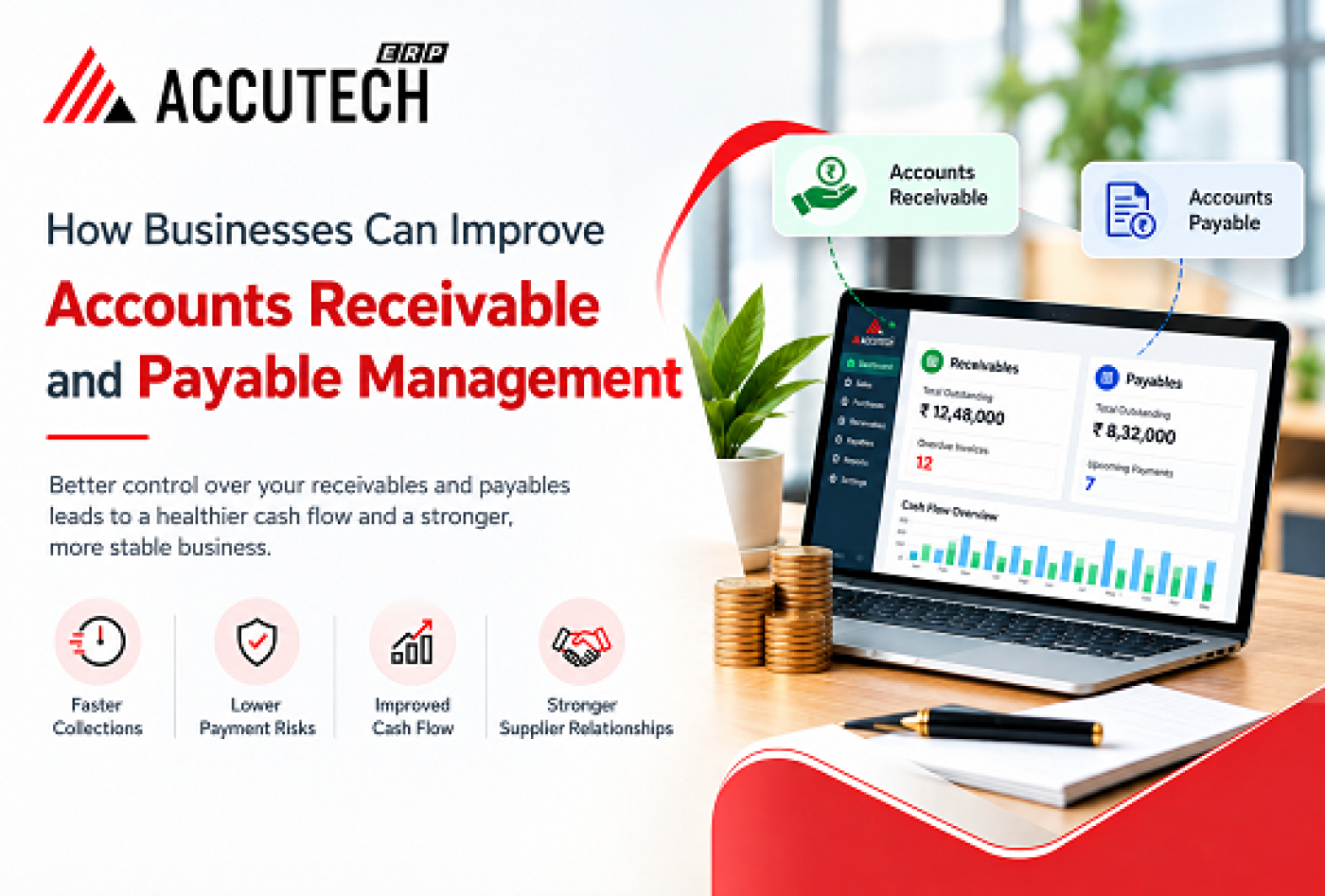
How Businesses Can Improve Accounts Receivable and Payable Management
Cash flow is the lifeblood of any business. Yet, managing receivables and payables remains one of the most time-consuming and error-prone tasks for finance teams worldwide. According to recent industry surveys, businesses waste an average of 20-30 hours per month on manual collection and payment processes.
The typical problem is straightforward: most companies still rely on outdated spreadsheets, fragmented systems, and manual workflows that create bottlenecks, introduce errors, and delay critical financial insights. This directly impacts cash flow, strains supplier relationships, and limits business growth potential.
Modern enterprise solutions have revolutionized how businesses handle their receivables and payables. Businesses evaluating cloud based accounting software in India can now access platforms that automate tedious tasks, provide real-time visibility, and simplify financial management without depending heavily on manual data entry.
This guide explores proven strategies and best practices for optimizing your accounts management using advanced solutions that deliver measurable business results.
Understanding Accounts Receivable and Payable
Before implementing solutions, let's clarify the key components of your financial workflow:
Accounts Receivable (A/R) represents money your customers owe you for delivered goods or services. This includes all invoices issued but not yet paid. Strong receivables management ensures quick payment collection, reduces bad debts, and improves cash flow predictability.
Accounts Payable (A/P) represents money you owe to suppliers and vendors for goods received or services rendered. This includes all purchase invoices received but unpaid. Effective payables management helps you maintain supplier relationships, optimize payment schedules, and capture early payment opportunities.
Together, these two functions form the working capital cycle that directly impacts your business's financial health and operational efficiency.
Why Traditional Management Approaches Fail
Many organizations still manage receivables and payables through outdated methods that create significant operational challenges:
- Manual Data Entry Errors: Spreadsheet-based processes introduce mistakes that cascade through financial reports and tax filings
- Delayed Financial Visibility: Reports become outdated before they're even compiled, leaving no real-time insights
- Payment Tracking Inefficiency: Manual follow-ups miss critical due dates, creating unnecessary cash flow problems
- Compliance Complexity: GST reconciliation and tax reporting become time-consuming and error-prone
- Slow Approval Workflows: Paper-based processes and email approvals create bottlenecks in payment processing
- Limited Growth Capacity: Manual systems break down as transaction volumes increase with business growth
- Relationship Strain: Late payments and billing disputes damage supplier relationships and limit negotiating power
These challenges are one reason growing businesses are shifting toward cloud based accounting software in india to centralize their financial operations and reduce dependency on manual processes.
Modern ERP Solutions: A Better Path Forward
Advanced accounting platforms eliminate these traditional challenges by centralizing all financial processes and automating routine tasks. These integrated systems provide real-time visibility into your complete financial position.
Comprehensive enterprise solutions including best advance accounting ERP software provide integrated accounts management modules that handle everything from invoice creation through payment collection and reconciliation. They connect seamlessly with your entire business ecosystem: sales, inventory, warehousing, GST compliance, and more.
Businesses comparing solutions under top accounting software india should look for platforms that connect accounting with sales, inventory, warehousing, purchasing, banking, and GST compliance.
What differentiates modern solutions from traditional systems:
- Full Transaction Automation: Every invoice, payment, and reconciliation occurs automatically based on business rules you define
- Real-Time Financial Dashboards: Live visibility into aged receivables, payables due, cash position, and key metrics
- Intelligent Workflow Automation: Smart approval chains and payment scheduling that optimize financial operations
- Multi-Location & Multi-Entity: Manage multiple branches or business divisions in one unified platform with consolidated reporting
- Regulatory Automation: GST, tax calculations, and compliance requirements handled automatically with complete audit trails
- Complete Payment Integration: Bank connectivity, payment gateways, and reconciliation built in by default
Essential Features for Financial Excellence
When evaluating accounting solutions, prioritize these critical capabilities:
1. Automated Invoice Generation & Tracking
Modern platforms automatically generate professional invoices the moment you confirm a sale. These invoices are immediately tracked in your receivables system with clear due dates, payment terms, and automated reminders. The system tracks invoice status throughout its lifecycle sent, viewed, partially paid, fully paid giving you complete visibility.
2. Outstanding Balance Analysis & Aging Reports
Advanced reporting tools provide instant visibility into who owes money and payment urgency levels. Aging analysis breaks receivables into aging buckets: 0-30 days, 30-60 days, 60-90 days, and 90+ days. This helps collection teams prioritize efforts on high-risk accounts and reduce days sales outstanding. Businesses choosing cloud based accounting software in India should consider whether the platform provides customer-wise, invoice-wise, salesperson-wise, and age-wise outstanding analysis.
3. Automatic Payment Matching & Reconciliation
When payments arrive, the system automatically matches them against outstanding invoices, applies partial payments, and processes discounts. No more manual reconciliation or wondering which invoice a payment covered. Everything records instantly and reflects immediately in financial reports.
4. Vendor Management & Purchase Integration
Purchasing integrates directly with payables management. When goods are received, the system matches purchase orders, goods receipts, and vendor invoices in one three-way matching process. This prevents duplicate payments, catches billing errors, and ensures you only pay for items actually received.
5. Payment Terms & Discount Optimization
The system tracks payment terms for each vendor and automatically calculates early payment discount opportunities. Smart alerts tell your finance team when paying early becomes cost-effective, helping optimize working capital and capture savings systematically.
6. Compliance & Tax Reporting
Automated GST calculations apply to every transaction based on product classifications and party types. The platform maintains complete audit documentation and prepares tax returns automatically. For Indian businesses, this means seamless GSTR-1, GSTR-2, and GSTR-3B filing without manual compilation or errors.
Cloud-Based Advantages for Indian Businesses
Cloud-based accounting solutions offer transformative benefits for organizations across India:
Dramatic Cost Reduction
Organizations reduce manual processing time by 60-75% after implementation. What required hours of work now takes minutes. A single finance manager can handle 3-4x more transactions, freeing your team to focus on strategic financial planning instead of transaction processing.
Accelerated Cash Conversion
Cloud solutions accelerate collections through automated reminders, real-time payment tracking, and early warning systems for overdue invoices. Companies typically reduce Days Sales Outstanding (DSO) by 10-15 days, converting idle receivables into working capital faster. For many businesses, this means hundreds of thousands of rupees in additional working capital.
Strengthened Supplier Relationships
Automated, reliable payments maintain excellent supplier relationships. Modern platforms help you capture early payment discounts while respecting agreed terms creating win-win scenarios. Strong supplier relationships lead to better pricing, faster delivery, and preferential treatment during supply constraints.
Complete Financial Visibility
Real-time dashboards show your complete financial picture instantly: outstanding receivables by customer, payables coming due, cash position, trends, and metrics. Decision-makers get immediate answers instead of waiting days for reports. This visibility enables better financial planning and faster responses to cash flow challenges.
Risk Mitigation & Compliance
Automated systems identify high-risk receivables and overdue payments before they become problems. Complete audit trails ensure regulatory compliance and simplify audits. Compliance that previously required manual effort becomes automatic and reliable.
Optimizing Your Receivables Process
Even with advanced technology, successful receivables management requires sound practices:
1. Establish Clear Credit Policies
Define credit limits, standard payment terms, and discount policies before extending credit. Your system can enforce these automatically, preventing sales to customers exceeding their credit limits. Clear policies reduce disputes and improve collection rates.
2. Offer Smart Payment Incentives
Early payment discounts (such as 2% for payment within 10 days) significantly accelerate cash collection. Modern systems calculate these discounts automatically and show their impact on cash flow. The discount cost is typically far less than the working capital benefit of faster payments.
3. Automate Invoice Delivery
Don't delay sending invoices. Modern systems send them immediately after order confirmation. Early delivery means customers receive invoices sooner and process payments faster. This simple change can reduce payment cycles by 5-7 days.
4. Maintain Complete Documentation
Your system should automatically maintain comprehensive documentation for every transaction. Complete records eliminate disputes about invoice dates, amounts, or delivery confirmation. This protection is especially valuable during payment disagreements or audits.
5. Implement Proactive Follow-Up
Use automated reminders to follow up with customers before invoices become overdue. Simple reminders often expedite payment without straining relationships. The system can track follow-ups and escalate high-risk accounts for immediate attention.
Streamlining Payables Management
Similarly, optimizing payables requires strategic practices:
1. Centralize Invoice Processing
All vendor invoices should flow through one system. This centralization prevents duplicate payments, ensures consistent tax treatment, and creates complete audit trails. It also enables standardized discount capture and payment term optimization across all vendors.
2. Implement Three-Way Matching
Match purchase orders, goods receipts, and vendor invoices before processing payment. Modern systems automatically flag mismatches, preventing payment for items not received or over-invoiced amounts. This single control prevents significant payment errors and fraud.
3. Optimize Payment Timing
Don't pay invoices before they're due this unnecessarily reduces working capital. Strategic payment scheduling takes advantage of full payment terms while maintaining vendor relationships. This working capital optimization can free significant cash for operations or growth.
4. Capture Discount Opportunities
Systematically track vendor discount opportunities and capture them when the savings exceed your cost of capital. Automated alerts ensure no savings slip through. Many organizations leave tens of thousands of rupees annually on the table by missing discount opportunities.
5. Build Strong Vendor Relationships
Pay reliably and on time. Modern systems enable consistent, reliable payments, helping you maintain strong supplier relationships. Strong partnerships lead to better pricing, priority service, and collaboration during challenges.
Real Business Transformations
Let's examine how organizations achieved significant results:
Manufacturing Excellence: A mid-sized manufacturing company reduced invoice processing time from 8 days to 2 days through automation. By implementing three-way matching for hundreds of monthly vendor invoices, they eliminated duplicate payments, reduced processing errors by 95%, and captured an additional ₹50 lakhs in early payment discounts annually. These savings alone justified the investment within 4 months.
Distribution Optimization: A food distribution company improved Days Sales Outstanding from 45 days to 30 days converting an additional ₹2 crore in receivables into cash within 15 days. Automated payment reminders and aging analysis helped their collection team prioritize effectively. They achieved this improvement within 3 months of implementation.
Compliance Transformation: A pharmaceutical distributor reduced monthly GST compliance time from 20+ hours to 2-3 hours through automation. What previously required manual matching and error correction now runs automatically. They also eliminated penalties and late filing fees, saving ₹5 lakhs annually in compliance costs.
Organizations evaluating top accounting software india should therefore focus on measurable operational improvements rather than selecting software only on the basis of the number of features offered.
Pitfalls to Avoid During Implementation
Organizations that struggle with new systems typically make these preventable mistakes:
Mistake 1: Incomplete Historical Data Migration
Failing to properly migrate historical data creates reporting gaps and reconciliation challenges. Ensure all prior-year transactions are accurately imported with proper opening balances. Incomplete data leads to incorrect reports and financial statement issues for months.
Mistake 2: Insufficient User Training
Users who aren't properly trained won't leverage the system's full capabilities. Invest in comprehensive training programs covering daily workflows, reporting, and compliance functions. Well-trained users maximize adoption and benefits.
Mistake 3: Ignoring Process Redesign
Simply automating existing processes misses the opportunity for improvement. Use implementation as a chance to redesign workflows, eliminate unnecessary steps, and implement best practices. Modern systems enable much more than simply replicating manual processes.
Mistake 4: Skipping Regular Reconciliation
Even automated systems require regular reconciliation. Monthly reviews of receivables, payables, and bank accounts catch errors and maintain data integrity. Reconciliation is a control, not an optional task.
Mistake 5: Poor Communication with Stakeholders
When implementing new systems, communicate changes to vendors and customers. Provide updated payment instructions, PO formats, and invoice requirements. Clear communication smooths the transition and prevents confusion.
Comparison: Manual vs. Modern Accounting Management
Metric | Manual Process | Modern Automated System |
Invoice Processing Time | 8-10 hours per invoice | 2-5 minutes per invoice |
Processing Errors | 3-5% (data entry) | <0.1% (automated matching) |
Report Generation Time | 3-5 days | Real-time access |
Days Sales Outstanding (DSO) | 45-60 days | 30-35 days |
Duplicate Payment Risk | High (2-3%) | Eliminated (automatic) |
Compliance Readiness | Manual, error-prone | Automated, audit-ready |
Scalability | Limited | Unlimited |
Frequently Asked Questions
How do these systems actually improve cash flow?
Modern platforms improve cash flow through multiple mechanisms: automated invoicing delivers bills faster, payment reminders reduce collection time, three-way matching prevents duplicate payments, and real-time aging analysis helps prioritize collections. Combined, these improvements typically reduce DSO by 10-15 days and improve working capital by 15-25% within the first year.
Can these solutions handle multiple business units or locations?
Yes. Modern cloud platforms are built for multi-location operations. You can maintain separate books for each location while generating consolidated reports. The system supports intercompany transactions, automatic consolidation, and location-specific compliance requirements ideal for growing businesses and corporate structures.
How is GST compliance handled automatically?
Automated systems calculate GST on every transaction based on product HSN codes and party classifications. The platform maintains complete transaction documentation, automatically generates GSTR-1, GSTR-2, and GSTR-3B in proper formats, and reconciles input tax credits. Compliance work that traditionally took 20+ hours monthly now takes 2-3 hours with near-zero errors.
What's the typical timeline to recover the investment?
Most organizations see ROI within 6-12 months. Cost savings from reduced manual processing (₹30,000-50,000 annually), early payment discounts (₹20,000-1,00,000 depending on vendor volume), and working capital improvements from faster collections typically exceed implementation costs within 12 months.
How does data migration work from existing systems?
Migration involves several steps: extracting data from your current system, cleansing and transforming data to the new format, importing historical transactions with proper opening balances, running both systems in parallel for validation, then cutting over to the new system. Most implementations take 4-8 weeks with proper planning and vendor support.
What security protections exist for financial data?
Enterprise cloud systems employ bank-grade security: data encryption in transit and at rest, multi-factor authentication, role-based access controls preventing unauthorized access, automated backups, and comprehensive audit trails. Cloud-based systems are typically more secure than on-premises servers because of dedicated security infrastructure. These security features should also be reviewed when choosing cloud based accounting software in India.
Does this system integrate with existing business software?
Yes. Modern solutions integrate with inventory management, CRM platforms, e-commerce systems, and banking platforms. Integration creates a unified ecosystem where sales automatically generate invoices, inventory receipts flow to payables, and bank statements auto-reconcile eliminating manual data re-entry and errors.
How frequently should we monitor financial metrics?
With real-time dashboards, you can review metrics daily. However, formal analysis should occur monthly: DSO trends, aging analysis by customer segment, collection success rates, early payment discount capture, supplier payment performance, and cash flow forecasting. Monthly reviews enable rapid response to emerging issues.
Taking Action: Your Next Steps
Effective receivables and payables management directly impacts your business's financial health and competitive position. Outdated manual processes waste valuable resources, introduce errors, and limit financial performance. Modern solutions automate these critical functions, delivering measurable improvements to your operations.
By implementing advanced accounting technology, organizations achieve:
- 60-75% reduction in manual processing time, freeing finance teams for strategic work
- 10-15 day improvement in cash collection cycles, improving working capital
- Significant cost savings through automation and error elimination
- Complete automation of GST compliance with zero manual filing
- Real-time financial visibility enabling better decision-making
- Risk elimination from duplicate payments and data entry errors
- Scalability to support business growth without system limitations
Businesses considering cloud based accounting software in india should select a platform that combines accounting automation with practical operational controls, reporting, compliance, and integration capabilities.
Similarly, while evaluating top accounting software india, organizations should focus on how effectively a solution supports their actual receivables, payables, taxation, inventory, and reporting workflows.
The right technology partner can transform your financial operations from a source of frustration into a competitive advantage. When you choose the best advance accounting ERP software, you're investing in your company's financial health, operational excellence, and growth potential.
Conclusion
Managing accounts receivable and payable efficiently is essential for maintaining healthy cash flow, reducing financial errors, and supporting long-term business growth. By using the best advance accounting ERP software, businesses can automate routine accounting tasks, improve payment tracking, simplify reconciliation, and gain better control over their financial operations.
Accutech ERP helps businesses manage receivables, payables, accounting, GST compliance, reporting, inventory, and other important financial processes through one integrated platform. For organizations looking for reliable cloud based accounting software in india, Accutech ERP provides the tools required to improve financial visibility, reduce manual work, and manage day-to-day accounting operations more efficiently.
Businesses evaluating top accounting software india should focus on automation, real-time reporting, integration capabilities, ease of use, and scalability. With Accutech ERP, growing businesses can streamline financial workflows, improve operational control, and make faster, more informed business decisions. By bringing essential accounting and business processes together, Accutech ERP supports more organized financial management and sustainable business growth.