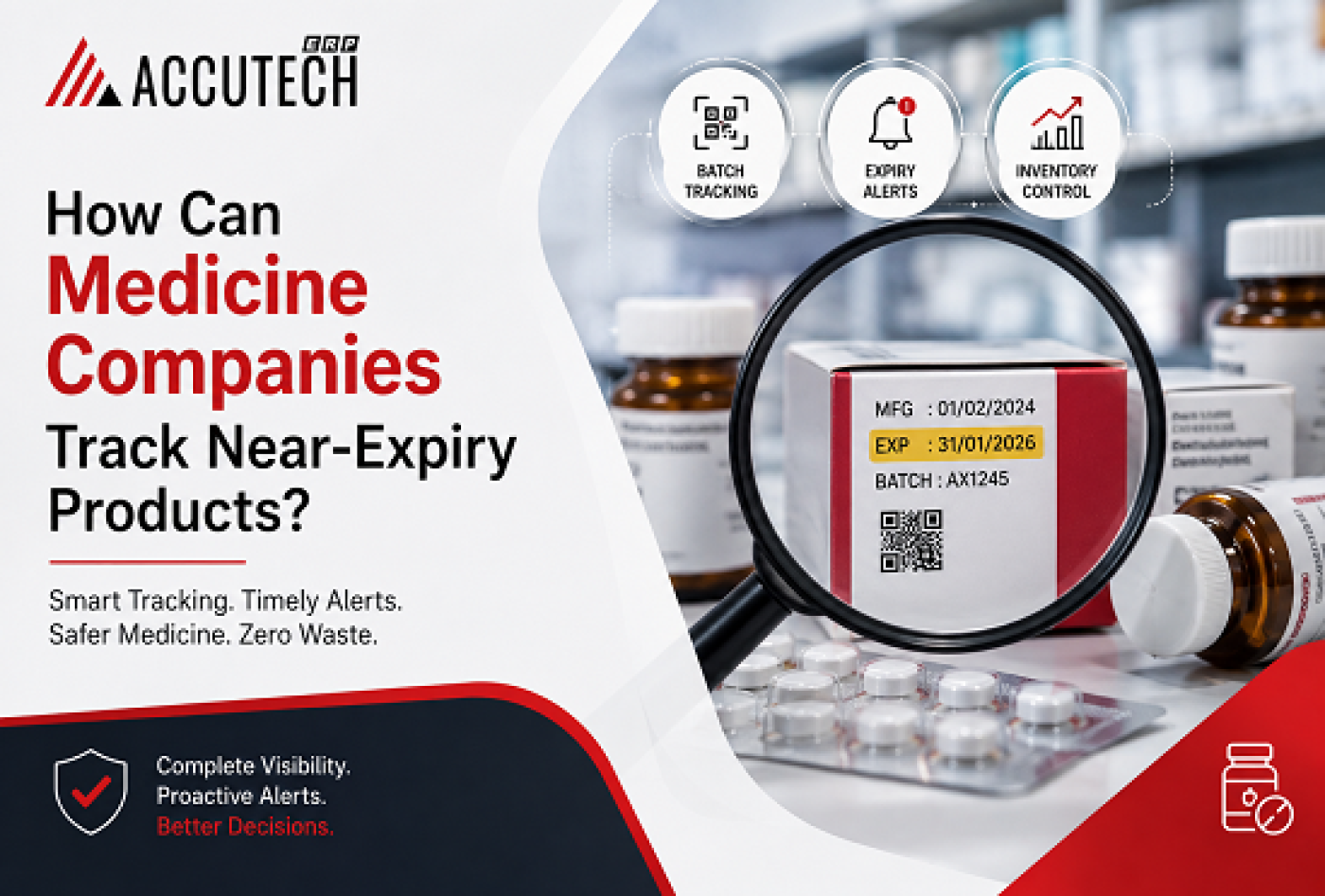
In the pharmaceutical industry, managing product expiry dates isn't just a matter of operational efficiency, it's a critical responsibility that directly impacts patient safety and regulatory compliance. Every day, medicine companies worldwide handle thousands of units across multiple locations, each with its own manufacturing date, batch number, and expiration deadline. The challenge of tracking near-expiry products has become increasingly complex in modern healthcare systems, where a single misstep can lead to expired medications reaching patients, resulting in costly recalls, legal penalties, and irreversible damage to brand reputation.
This comprehensive guide explores how pharmaceutical companies leverage advanced pharma manufacturing software to effectively track and manage near-expiry products. We'll examine the critical role that dedicated software for pharmaceutical company operations plays in preventing product waste, maintaining regulatory compliance, and optimizing inventory management across the entire supply chain.
Whether you're a pharmaceutical manufacturer, distributor, or PCD franchise business, understanding the mechanisms of modern expiry tracking systems will help you transform inventory challenges into competitive advantages. Let's dive deep into the strategies, technologies, and best practices that leading medicine companies implement today.
Why Tracking Near-Expiry Products Matters in Pharmaceutical Operations
The pharmaceutical industry operates under an unprecedented level of scrutiny, where product integrity is non-negotiable. Medicine companies that fail to effectively track near-expiry products face not only financial losses but also endanger patient safety. According to industry data, expired pharmaceutical inventory represents a significant waste concern, with companies losing millions in potential revenue annually through product disposal.
Near-expiry products present unique challenges that manual tracking systems simply cannot handle efficiently. When medicine companies rely on spreadsheets or paper-based records, they expose themselves to human error, delayed notifications, and compliance violations. A single oversight in tracking near-expiry products can trigger cascading consequences:
- Patient Safety Risks: Distributing expired medications to patients compromises treatment efficacy and creates liability issues.
- Financial Losses: Untracked near-expiry inventory may reach waste status, representing lost investment and profit.
- Regulatory Penalties: FDA, EMA, and other regulatory bodies impose severe fines for non-compliance with expiry management requirements.
- Supply Chain Disruption: Improper expiry tracking creates gaps in inventory visibility and planning accuracy.
- Brand Reputation Damage: Product recalls or regulatory actions devastate customer trust and market position.
This is precisely why modern pharmaceutical companies have shifted toward dedicated pharmaceutical ERP systems that automate expiry tracking and provide real-time visibility across their entire inventory network.
Understanding Batch Numbers and Expiry Date Systems
Every pharmaceutical product manufactured carries a unique batch number, an alphanumeric identifier that embeds critical information about its production journey. Batch numbers serve as the foundation of traceability systems, encoding manufacturing dates, facility codes, production run details, and shelf-life information. Understanding how batch numbers work is essential for implementing effective software for pharmaceutical company operations.
Batch numbers typically follow industry-standard formats that enable quick identification of manufacturing timelines and expiration endpoints. For instance, a batch number might reveal that a particular medication was manufactured on January 15th, 2024, and is valid for 36 months, meaning its expiration date is January 15th, 2027. This information forms the backbone of modern expiry tracking systems.
Advanced pharmaceutical ERP technology decodes these batch numbers automatically, extracting manufacturing and expiration dates without manual data entry. This automated extraction eliminates the most common source of tracking errors and transcription mistakes. When medicine companies implement robust batch tracking capabilities through their ERP systems, they create a permanent audit trail linking every batch to its lifecycle milestones.
The Role of Pharma Manufacturing Software in Expiry Management
Pharma manufacturing software represents a paradigm shift in how medicine companies approach inventory management and expiry tracking. Unlike traditional systems, modern pharmaceutical ERP platforms integrate expiry management directly into core business processes from product receiving through final fulfillment. This comprehensive integration ensures that no product escapes expiry monitoring, regardless of its location in the supply chain.
Software for pharmaceutical company operations provides several critical advantages for near-expiry product management:
- Centralized Batch Information: All batch-level data consolidates into a single database, creating a unified source of truth for expiry information across multiple warehouses and distribution centers.
- Automated Monitoring: The system continuously monitors each batch's position in its shelf-life timeline, automatically flagging products as they approach critical expiry thresholds.
- Integration with Receiving: When new stock arrives, pharmaceutical ERP software automatically captures batch numbers and assigns expiry dates through barcode scanning or manual entry, eliminating transcription delays.
- Real-Time Dashboard Visibility: Decision-makers access live dashboards showing expiry status across all locations, enabling rapid response to near-expiry inventory situations.
- Automated Recall Support: If a manufacturer issues expiry date shortening notices, the system can instantly identify all affected batches across the entire operation.
- Compliance Documentation: Medicine companies generate regulatory-ready reports automatically, reducing audit preparation time and ensuring documentation accuracy.
The transformation from manual to software-driven expiry management represents a substantial operational upgrade that directly impacts both profitability and patient safety. Organizations that invest in comprehensive pharmaceutical ERP solutions report significant reductions in expired inventory waste, faster response times to expiry alerts, and improved regulatory compliance records.
Key Features of Software for Pharmaceutical Company Operations
Not all pharmaceutical software solutions offer equivalent capabilities for expiry tracking. The most effective systems include specialized features designed specifically for medicine companies' unique requirements. When evaluating software for pharmaceutical company investments, prioritize these essential capabilities:
Feature | Functionality | Business Impact |
Batch-Level Tracking | Records separate inventory quantities for each batch with unique expiration dates | Enables accurate FEFO implementation and prevents mixing of old and new stock |
Expiry Monitoring | Continuously tracks time remaining until product expiration | Provides early warning for near-expiry products before waste occurs |
Automated Alerts | Sends notifications when products reach expiry thresholds | Ensures critical alerts never slip through compliance protocols |
FEFO Logic | Prioritizes inventory based on expiry dates automatically | Reduces waste and maximizes revenue from inventory |
Barcode Integration | Enables quick scanning and automatic data capture | Reduces errors and accelerates warehouse operations |
Expiry Reports | Generates detailed expiry status and aging reports | Supports compliance and strategic planning |
FEFO (First-Expired-First-Out) Strategy: Implementation and Benefits
The FEFO methodology represents one of the most effective strategies medicine companies employ to manage near-expiry products. Unlike FIFO (First-In-First-Out), which prioritizes based on arrival date, FEFO specifically sequences inventory based on expiration dates. Implementing FEFO requires sophisticated pharma manufacturing software that understands the nuances of batch-level tracking and expiry prioritization.
How FEFO Works in Practice:
Imagine a pharmaceutical distributor receives three shipments of the same medication on different dates:
- Shipment A (received January 2024): Expires July 2027
- Shipment B (received February 2024): Expires December 2027
- Shipment C (received March 2024): Expires June 2027
Under traditional FIFO logic, Shipment A would sell first because it arrived first. However, FEFO recognizes that Shipment C expires before Shipment A, so it prioritizes Shipment C fulfillment instead. Pharmaceutical inventory software automates this logic entirely, ensuring that when an order arrives, the system automatically allocates stock from the batch closest to expiration.
Implementing FEFO through advanced software delivers measurable benefits:
- Reduced Waste: By selling products systematically by expiration date, companies minimize stock that reaches expired status.
- Revenue Protection: Every unit that sells before expiration represents recovered investment that would otherwise become disposal expense.
- Operational Efficiency: Automated FEFO logic eliminates manual prioritization decisions, accelerating fulfillment processes.
- Regulatory Alignment: FEFO compliance demonstrates to regulatory agencies that medicine companies actively manage expiry risks.
Sustainability: Reducing pharmaceutical waste aligns with environmental responsibility goals increasingly important to stakeholders.
Barcode and RFID Technology in Batch Tracking
While software systems provide the intelligence framework for near-expiry product tracking, barcode and RFID technologies serve as the sensory apparatus that feeds real-time data into these systems. Modern pharmaceutical ERP solutions integrate seamlessly with both traditional barcode scanning and emerging RFID identification methods.
Barcode Technology: The Industry Standard
Barcode scanning remains the most widely deployed batch identification method in pharmaceutical operations. When a package arrives at a warehouse, warehouse staff scan the barcode using handheld devices or fixed scanners. The barcode transmits batch number and manufacturing information directly to the pharmaceutical inventory management system. The software automatically decodes this information and assigns the corresponding expiry date based on the manufacturer's shelf-life specifications.
Advantages of barcode integration include low cost, proven reliability, and universal compatibility across pharmaceutical supply chains. Major pharmaceutical manufacturers and distributors rely on barcode standards like GS1-128 and EAN-128, ensuring compatibility across trading partners.
RFID Technology: The Future of Expiry Tracking
RFID (Radio Frequency Identification) technology represents the next evolution in batch tracking capabilities. Unlike barcodes requiring line-of-sight scanning, RFID tags transmit data wirelessly, enabling simultaneous scanning of multiple units without individual handling. Leading medicine companies increasingly implement RFID as part of their digital transformation initiatives.
RFID advantages for expiry management include real-time location tracking, higher reading speeds, capability to function in harsh warehouse environments, and integration with Internet of Things (IoT) sensors that monitor temperature and humidity critical factors in pharmaceutical shelf-life validation.
Real-Time Alerts and Automated Notifications System
The value of pharmaceutical inventory software extends far beyond passive data recording. Modern systems actively monitor inventory status and generate proactive alerts that trigger specific actions before near-expiry products become problematic. These alert systems represent critical infrastructure for pharmaceutical companies committed to operational excellence.
Alert Threshold Configuration:
Advanced software for pharmaceutical companyoperations allows administrators to configure multiple alert thresholds based on business strategy and product characteristics:
- 180-Day Alert: Initiates review of promotional opportunities or bulk sales strategies for near-expiry stock.
- 90-Day Alert: Flags inventory for priority fulfillment and customer outreach for increased sales velocity.
- 30-Day Alert: Activates emergency protocols for final sales attempts, including discounting or donation options.
- 7-Day Alert: Triggers physical verification and documentation of stock status before waste classification.
When configured properly, these alert systems ensure that no near-expiry product escapes management attention. Notifications route to appropriate team members warehouse managers for physical relocation, sales teams for customer outreach, financial teams for loss assessment, and compliance officers for documentation.
Regulatory Compliance: FDA, GMP, and DSCSA Requirements
Pharmaceutical companies operate in a regulatory environment where compliance is non-discretionary. Multiple agencies and standards govern how medicine companies must track, manage, and document near-expiry products. Understanding these requirements is essential for selecting appropriate pharmaceutical ERP solutions.
FDA Requirements:
The FDA mandates that pharmaceutical manufacturers establish and maintain comprehensive expiration date testing programs. The agency requires documentation proving that products maintain stability and quality throughout their labeled shelf-life. Under FDA regulations, companies must implement systems preventing expired or near-expiry products from reaching patients. This requires robust batch tracking, comprehensive auditing capabilities, and permanent documentation of all inventory movements.
GMP (Good Manufacturing Practice) Standards:
GMP standards require pharmaceutical companies to maintain detailed records of all manufacturing batches, including expiration dates and disposition (sold, returned, destroyed). Pharmaceutical ERP systems must generate GMP-compliant reports demonstrating systematic product monitoring throughout the supply chain. Auditors reviewing pharmaceutical operations specifically examine whether batch tracking systems capture expiry data with sufficient granularity and accuracy.
DSCSA (Drug Supply Chain Security Act):
The DSCSA requires pharmaceutical distributors to maintain product traceability at the package level, including batch numbers and expiration dates. The law specifically requires documentation of all product movements through the supply chain, with expiry information captured at each transfer point. Pharmaceutical tracking systems must support DSCSA requirements by capturing and transmitting expiry data through secure, standardized formats compatible with other supply chain participants.
Challenges in Expiry Product Management and Solutions
Despite technological advances, pharmaceutical companies continue facing significant challenges in near-expiry product management. Understanding these obstacles and their solutions helps organizations implement more effective strategies:
Challenge 1: Multi-Location Complexity
Large pharmaceutical organizations operate multiple warehouses, distribution centers, and regional depots. When using disconnected systems or manual tracking, near-expiry products in one location may escape management attention while duplicates exist elsewhere.
Solution: Implementing centralized pharmaceutical ERP software with cloud-based infrastructure ensures that expiry status is visible and manageable across all locations simultaneously, preventing fragmented decision-making.
Challenge 2: Product Mix Variability
Different pharmaceutical products have different shelf-life specifications depending on formulation, packaging, and storage conditions. This variability complicates batch tracking when using generic software systems.
Solution: Specialized pharmaceutical management systems maintain product-specific shelf-life parameters, automatically calculating expiry dates based on each product's unique specifications rather than applying blanket assumptions.
Challenge 3: Manual Data Entry Errors
When warehouse staff manually enter batch numbers and expiry dates into spreadsheets or basic systems, transcription errors inevitably occur. These errors create invisible problems the system shows incorrect expiry dates, leading to either premature disposal of good product or inadvertent distribution of near-expiry inventory.
Solution: Integrating barcode scanning directly with pharmaceutical inventory software eliminates manual data entry, replacing error-prone typing with automated data capture.
Challenge 4: Rapid Inventory Turnover
High-volume pharmaceutical operations process hundreds of batches daily. Manual review of near-expiry status becomes practically impossible at this scale.
Solution: Advanced pharmaceutical inventory systems handle high-volume processing effortlessly, automatically monitoring thousands of batches simultaneously and alerting teams to issues through configurable notification rules.
Best Practices for Optimal Inventory Control
Leading pharmaceutical companies have developed systematic approaches to near-expiry product management that consistently deliver superior results. Implementing these best practices alongside appropriate pharmaceutical ERP systems maximizes effectiveness:
- Establish Clear Expiry Thresholds: Define specific action triggers (180 days, 90 days, 30 days) aligned with your business model and product characteristics.
- Implement Batch-Level Segregation: Physically separate batches with different expiry dates within warehouses, making FEFO fulfillment intuitive for warehouse staff.
- Automate Compliance Reporting: Use pharmaceutical management software to generate regulatory-ready reports automatically, reducing compliance burden.
- Conduct Regular Audits: Perform quarterly physical inventory counts comparing actual stock against system records.
- Train Staff Comprehensively: Ensure warehouse, sales, and management teams understand expiry management procedures and their role in compliance.
- Monitor System Performance: Review alert accuracy and system reliability regularly, making adjustments based on actual patterns.
- Collaborate Across Functions: Create cross-functional teams to discuss near-expiry inventory strategies and problem-solve collectively.
- Plan Inventory Strategically: Use historical expiry data to inform purchasing decisions, reducing over-purchasing of slow-moving products.
Frequently Asked Questions
Q1: What is the difference between batch tracking and lot tracking in pharmaceutical inventory management?
While often used interchangeably, batch and lot refer to slightly different manufacturing concepts. A batch typically represents all products manufactured under identical conditions in a single production run, while a lot refers to a specific quantity of material from a batch allocated for distribution. In practical pharmaceutical operations, batch tracking typically serves expiry management purposes, as all units within a batch share the same manufacturing date and expiry date. Modern pharmaceutical inventory systems use these terms synonymously in most expiry management contexts.
Q2: How does automated expiry tracking reduce pharmaceutical waste?
Automated expiry tracking through pharmaceutical ERP software reduces waste through multiple mechanisms. Real-time visibility enables proactive management of near-expiry inventory before waste occurs. FEFO automation ensures products sell by expiration date, maximizing recovery of near-expiry stock before disposal becomes necessary. Early alerts trigger promotional strategies, bulk sales, or alternative disposition options for near-expiry inventory. Historical tracking data informs more accurate purchasing decisions, reducing over-stock of slow-moving products. Combined, these mechanisms significantly reduce the volume of inventory reaching expired status.
Q3: What regulatory agencies require near-expiry product tracking documentation?
Multiple regulatory agencies require comprehensive near-expiry tracking. The FDA requires documentation of expiry management practices and stability monitoring. National regulatory bodies in countries where pharmaceutical products are distributed also impose expiry tracking requirements. Additionally, DSCSA requirements in the United States specifically mandate batch-level expiry tracking for drug distributors. Pharmaceutical ERP systems must support compliance with all applicable regulatory frameworks in markets where your organization operates.
Q4: Can older pharmaceutical products with approaching expiry dates still be sold?
Yes, products approaching expiry but not yet expired can absolutely be sold, and this represents the core objective of effective near-expiry management. Pharmaceutical inventory systems specifically support this through FEFO logic and near-expiry alerts. Distributors can implement promotional pricing strategies, target specific customer segments, or increase sales velocity for near-expiry inventory. Many pharmaceutical suppliers accept returns of near-expiry products (typically within 3-6 months of expiration) under their return policies. The key is identifying and managing these products proactively through systematic software processes.
Q5: What is the FEFO methodology and why is it important for pharmaceutical inventory?
FEFO stands for First-Expired-First-Out, a systematic approach to inventory prioritization based on expiry dates rather than arrival dates. Under FEFO logic, products closest to expiration are allocated to customers and sold first, regardless of when they arrived in inventory. This ensures maximum revenue recovery from near-expiry products and minimizes disposal losses. Implementing FEFO through pharmaceutical ERP technology requires batch-level tracking and automated prioritization rules in order fulfillment processes. FEFO is especially important for pharmaceutical products, where shelf-life is finite and expired inventory represents pure financial loss.
Q6: How frequently should pharmaceutical companies audit their batch tracking systems?
Regulatory best practices recommend quarterly audits comparing physical inventory counts against system records for all active batch-tracked products. High-volume operations may benefit from more frequent audits (monthly or even weekly for critical products). At minimum, pharmaceutical companies should conduct comprehensive annual audits demonstrating system accuracy and identifying any systematic discrepancies. These audits should verify that batch numbers, manufacturing dates, and expiry dates recorded in the pharma manufacturing software match physical product labels and supporting documentation.
Q7: What technology integration is required between ERP systems and warehouse management?
Effective near-expiry tracking requires close integration between pharmaceutical ERP systems and warehouse management systems (WMS). When receiving products, barcodes must automatically transmit batch information to the ERP system, which assigns expiry dates based on product-specific shelf-life parameters. During order fulfillment, the WMS must respect FEFO prioritization logic defined in the ERP, ensuring warehouse staff selects near-expiry inventory first. Real-time inventory visibility depends on seamless data flow between WMS and ERP when stock moves in the warehouse, the ERP receives immediate updates.
Q8: How do medicine companies handle manufacturer-issued expiry date changes mid-market?
When pharmaceutical manufacturers conduct post-approval stability testing and identify unexpected degradation, they may issue revised expiry dates shorter than originally labeled. Pharmaceutical ERP software enables efficient handling of these situations by allowing bulk updates to batch-level expiry dates. Upon receiving manufacturer notification, administrators can quickly identify all affected batches across all locations, update their expiry dates, and trigger appropriate alerts. This capability is crucial for regulatory compliance, as failure to implement manufacturer-revised expiry dates can result in distribution of products the manufacturer no longer warrants.
Q9: What are typical near-expiry alert thresholds used by pharmaceutical companies?
Alert threshold configurations vary based on product characteristics and business strategy. A typical structure includes: 180-day alert initiating review and planning, 90-day alert triggering promotional strategies and priority fulfillment, 30-day alert activating final sales attempts and documentation protocols, and 7-day alert requiring physical verification before waste classification. For high-value products or those with slow turnover, companies may implement earlier thresholds (270+ days). For fast-moving products with high demand, later thresholds may suffice. Software for pharmaceutical company operations should allow flexible threshold configuration per product category.
Q10: How does batch tracking software prevent expired products from reaching patients?
Pharma manufacturing software prevents expired product distribution through multiple safeguards. First, automated expiry monitoring continuously tracks batch status, alerting teams before expiry occurs. Second, when fulfilling customer orders, the system enforces FEFO logic never suggesting expired batches for allocation. Third, automated validation rules block order processing if expired products would be included in shipments without explicit management override (which logs for audit purposes). Fourth, expiry reports identify any batches already expired, triggering immediate quarantine protocols. Fifth, compliance audits compare system-recommended fulfillment against actual shipments, catching any manual errors violating expiry protocols.
Conclusion:
The question of how medicine companies track near-expiry products has evolved from an operational challenge into a strategic opportunity. Organizations that implement comprehensive pharma manufacturing software and adopt systematic best practices don't just comply with regulations, they create measurable competitive advantages through reduced waste, improved profitability, and enhanced regulatory trust.
The transformation from manual to software-driven expiry management represents one of the highest-ROI investments pharmaceutical companies can make. Reduced product waste, fewer regulatory violations, improved customer satisfaction, and enhanced operational efficiency combine to create financial and reputational value that extends far beyond the software investment.
Whether you're evaluating your first pharmaceutical ERP implementation or optimizing an existing system, remember that effective near-expiry product tracking requires both sophisticated technology and disciplined operational practices. The most successful pharmaceutical organizations view software for pharmaceutical company operations not as a compliance checkbox but as a fundamental component of their operational excellence strategy.
Ready to transform how your pharmaceutical organization manages near-expiry products? Explore comprehensive ERP solutions designed specifically for pharmaceutical manufacturers, distributors, and PCD franchises. Solutions like Accutech ERP provide the batch tracking, expiry monitoring, FEFO implementation, and compliance capabilities that leading medicine companies depend on. Contact our team today to discover how pharma manufacturing software can revolutionize your inventory management and protect both your business and patient safety.