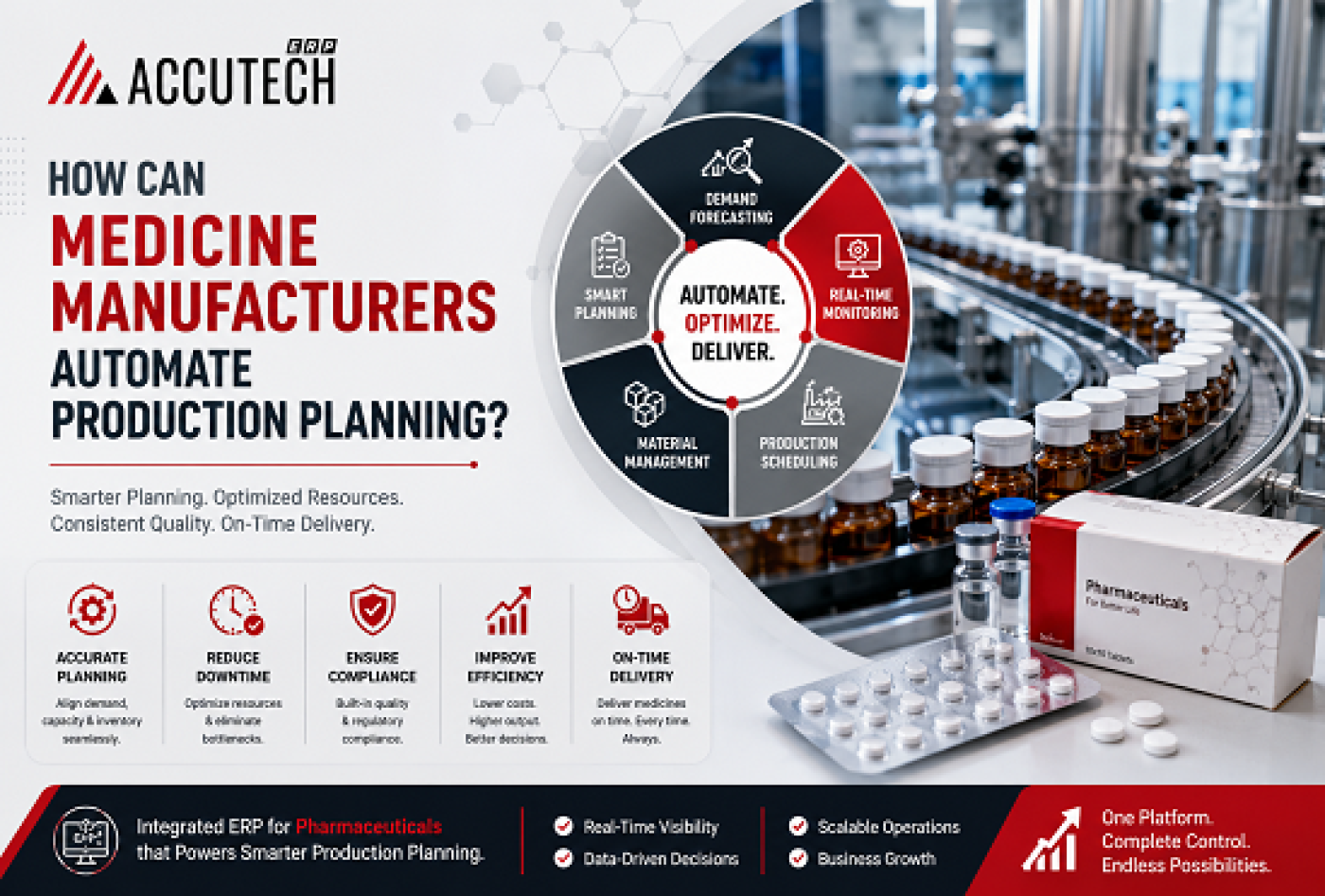
The pharmaceutical industry operates under unprecedented pressure. Medicine manufacturers face complex regulatory requirements, intense competition, and rising patient expectations for product safety and quality. Yet many still rely on fragmented legacy systems and manual spreadsheets that slow production and introduce costly errors.
In 2026, automating production planning is not just an operational advantage it is a business necessity. The right Pharma PCD ERP Software can transform how medicine manufacturers manage everything from raw material procurement to finished product distribution, eliminating bottlenecks and accelerating time-to-market.
This comprehensive guide explores how modern pharmaceutical companies leverage ERP for pharmaceuticals to automate production planning, maintain compliance, and stay competitive. Whether you are a traditional pharma manufacturer, a PCD franchisee, or an operations leader evaluating your technology stack, this article provides actionable insights grounded in real-world implementation experience.
What Is Pharma PCD ERP Software? Understanding the Foundation
Pharma PCD ERP Software is a specialized enterprise resource planning system designed exclusively for pharmaceutical franchise and distribution operations. Unlike generic ERP solutions, this software integrates accounting, inventory management, production planning, sales tracking, and regulatory compliance tools into a single unified platform.
The term “PCD” refers to “Pharma Franchise” or “Pharma Distributorship” models business structures where independent distributors sell pharmaceutical products under a manufacturer’s brand. Pharma PCD ERP Software addresses the unique challenges of this model with specialized features for multi-location coordination, batch management, and distributor relationship management.
By bringing information from different departments together, the system allows production, inventory, quality, sales, and finance teams to work with consistent and updated data.
Key Components of Production Planning Automation
Production planning automation within ERP for pharmaceuticals involves several interconnected modules that work together to improve manufacturing accuracy, resource utilization, and operational efficiency.
1. Demand Forecasting and Planning
Modern Pharma PCD ERP Software analyzes historical sales data, seasonal patterns, and market trends to generate accurate demand forecasts. This forecasting capability enables manufacturers to optimize production schedules, reduce inventory costs by 15–25%, minimize stockouts, and allocate capacity efficiently across products.
Manufacturers can also use forecasts to prepare for seasonal demand, promotional campaigns, changing distributor requirements, and unexpected market fluctuations.
2. Master Production Scheduling (MPS)
The Master Production Schedule is the heart of production automation. It converts demand forecasts into detailed manufacturing orders, considering production capacity, material availability, batch requirements, and regulatory constraints.
Advanced ERP for pharmaceuticals can automatically replan affected schedules when issues arise, helping prevent the cascade effect in which one production delay causes multiple downstream delays.
3. Material Requirements Planning (MRP)
Once the MPS is set, the ERP automatically calculates the exact raw materials and supplies needed. This calculation accounts for the Bill of Materials, current inventory, procurement lead times, scheduled production, and safety-stock requirements.
The system can generate purchase requisitions or orders when required, preventing both excessive inventory and production delays. Purchasing teams can compare available stock, pending orders, approved suppliers, expected deliveries, and planned consumption before procuring additional materials.
4. Capacity Planning and Quality Integration
The system simulates production schedules against available resources and identifies potential bottlenecks before they affect manufacturing. It considers machine availability, workforce capacity, production-line schedules, maintenance requirements, and quality-control resources.
Quality checkpoints can also be embedded throughout the workflow to maintain batch documentation, traceability, testing records, and compliance information required by regulatory authorities.
How ERP for Pharmaceuticals Streamlines Production Workflows
Modern ERP for pharmaceuticals provides shop-floor integration that transforms planned schedules into actual production results. Connected sensors and IoT devices can feed live data into the system, giving production managers real-time visibility into line status, output rates, yield percentages, downtime, and quality parameters.
When issues arise such as an equipment breakdown, quality deviation, or material shortage the system alerts planners immediately. Responsive ERP systems can recalculate schedules, reassign resources, and adjust expected delivery timelines.
This adaptive capacity helps prevent one disruption from affecting multiple production orders. Integrated software also connects production activity with inventory and accounting records, reducing repeated entries and departmental data gaps.
Real-Time Inventory and Demand Forecasting
Maintaining optimal inventory levels is one of pharmaceutical production’s most challenging aspects. A centralized ERP system maintains a single source of truth for inventory across production facilities, warehouses, and distribution centers.
At any moment, authorized users can check total stock by location, batch number, manufacturing date, expiry date, quality status, and reserved quantity.
The system can automatically generate purchase or manufacturing requirements when inventory falls below predefined thresholds. Advanced platforms incorporate demand signals from distributors, retailers, and customers to anticipate inventory needs more accurately.
By incorporating seasonal patterns, market events, previous sales, and current demand, ERP for pharmaceuticalscan generate more reliable forecasts than spreadsheets and disconnected legacy systems.
Batch Tracking and Quality Assurance Integration
In pharmaceutical manufacturing, every batch is a legal and safety entity. Comprehensive Pharma PCD ERP Software maintains electronic batch records containing the Bill of Materials, manufacturing procedures, quality measurements, personnel involved, approvals, and digital signatures required for controlled pharmaceutical operations.
Full-lifecycle traceability means manufacturers can follow any finished product back to every raw material used in its production. During a product recall, this capability enables the rapid identification and retrieval of only the affected batches.
The system tracks material lot numbers from supplier receipt to production consumption, records intermediate products, links finished products to source batches, and monitors their movement through distribution channels.
Quality assurance teams can record inspection results, manage deviations, approve or reject batches, and prevent unapproved products from reaching customers.
ERP Security Pharma: Protecting Sensitive Manufacturing Data
Pharmaceutical manufacturing data is a high-value target for cybercriminals and competitors. Proprietary formulations, manufacturing processes, commercial records, and clinical information can be worth millions. This is why ERP security pharma has become a major priority for the industry.
Leading ERP providers implement multilayered security architecture that includes network protection through firewalls and intrusion detection, application security through secure coding and regular patching, data protection through encryption at rest and in transit, and access control through role-based permissions and multi-factor authentication.
An ERP security pharma system maintains granular access controls, ensuring that each user can only view or modify information relevant to their role. Production managers may access formulations, quality personnel can approve releases, finance staff can view cost data, and distributors can access only their respective orders.
Every access, modification, approval, and deletion should be logged with a timestamp and user identity to create a complete audit trail. These controls reduce the risk of unauthorized formula changes, accidental deletion, credential misuse, and internal information leakage.
The FDA’s 21 CFR Part 11 regulation requires digital systems to provide appropriate integrity, authenticity, and control for electronic records. A compliant ERP security pharma framework supports unique electronic signatures, prevents unauthorized modifications, maintains audit trails, and enables business continuity through secure backups and disaster recovery.
Regular security audits, access reviews, data backups, software updates, and employee awareness training should complement the technical security controls.
Regulatory Compliance and FDA Requirements
Pharmaceutical manufacturing is highly regulated, with strict standards enforced by the FDA, EMA, and other regulatory bodies to ensure patient safety. A comprehensive ERP system embeds compliance requirements directly into production planning and operational workflows.
Good Manufacturing Practices are the regulatory baseline. Modern ERP systems support GMP compliance by documenting and enforcing Standard Operating Procedures, preventing unauthorized deviations from approved formulations, scheduling preventive maintenance, and managing change orders.
Before any batch can be released for distribution, quality personnel must review all manufacturing data and test results. Structured approval workflows ensure that required inspections, reviews, and authorizations are completed and recorded.
The ERP prevents distribution until official quality approval, automatically quarantines failed batches, tracks failure reasons and corrective actions, and maintains historical records for inspection readiness.
Production schedules can also account for quality-hold times, helping manufacturers maintain regulatory compliance without losing visibility into delivery requirements.
Cost Reduction and Efficiency Gains From Production Planning Automation
The business case for production planning automation rests on measurable cost reduction. Integrated production software can help identify unnecessary material purchases, excess stock, avoidable downtime, repeated manual work, and preventable quality failures.
Cost Area | Typical Savings | How Achieved |
Inventory Carrying | 15-25% | Accurate forecasting reduces overstock |
Production Downtime | 20-30% | Optimized scheduling, reduced changeovers |
Quality Issues | 10-20% | Early detection, reduced batch failures |
Manual Work | 30-40% | Automation of routine tasks |
Actual savings depend on the organization’s size, existing processes, production complexity, data quality, and implementation scope. Integrated planning also gives management clearer information about product costs, material consumption, production yields, and operational performance.
Implementation Best Practices
A powerful ERP system is only as effective as its implementation. Pharmaceutical companies have learned that a “big bang” replacement approach can result in operational disruption. Best practices emphasize a measured and iterative approach.
- Conduct a Thorough Current-State Assessment: Map all production workflows, identify manual processes, assess data quality, and understand regulatory requirements.
- Define Clear Business Requirements: Document the specific metrics to be improved, timeline and budget constraints, and integration requirements with existing systems.
- Choose a Vendor With Pharma Expertise: Select a partner with proven pharmaceutical implementations, regulatory knowledge, and comprehensive training support.
- Implement in Phases: Rather than replacing all systems simultaneously, consider a phased implementation starting with accounting, followed by inventory, production planning, and quality management.
- Invest in Data Quality: Allocate sufficient effort to auditing master data, standardizing nomenclature, validating historical records, and creating data-governance policies.
- Prioritize Change Management: Dedicate resources to employee training, communicate the benefits clearly, involve frontline staff, and address concerns early.
- Evaluate Data Protection: Ensure the proposed ERP security pharma framework supports role-based permissions, audit trails, secure backups, electronic records, and disaster recovery.
A phased implementation allows companies to validate processes, train employees, and resolve data issues before expanding the system across the entire organization.
Frequently Asked Questions
Q1: What Is the Difference Between a Pharmaceutical ERP and a Standard ERP System?
Standard ERP systems generally lack industry-specific functionality. A dedicated pharmaceutical solution includes batch tracking, formulation management, regulatory compliance tools, quality workflows, expiry management, and distributor relationship features.
Q2: How Long Does Pharmaceutical ERP Implementation Take?
Implementation timelines vary according to company size and complexity. Small to mid-sized pharmaceutical companies may require 6–12 months for complete implementation, while larger enterprises may need 18–24 months. Regulatory validation can add another 3–6 months.
Q3: Why Is Specialized ERP Security Important for Pharmaceutical Companies?
Pharmaceutical ERP security refers to specialized measures that protect business information from unauthorized access, modification, loss, or cyberattacks. It is critical because pharmaceutical systems may contain proprietary formulations, manufacturing records, patient information, and valuable clinical data.
Q4: Can a Pharmaceutical ERP Integrate With Existing Laboratory Systems?
Yes, leading solutions offer LIMS integration through APIs or prebuilt connectors. This integration automatically transfers quality test results into production records, reduces manual data entry, and helps ensure that batches cannot be released without QA clearance.
Q5: How Does a Pharmaceutical ERP Handle Multi-Location Operations?
Cloud-based systems enable seamless coordination between multiple facilities. Each location can maintain its own inventory and production schedules, while management receives consolidated visibility for centralized demand and production planning.
Q6: What Is the Expected ROI Timeline?
Most pharmaceutical companies can see a positive return on investment within 12–18 months of complete deployment. Initial savings generally come from inventory optimization and reduced manual work, while longer-term value emerges through better compliance, planning, and time-to-market.
Q7: How Does the System Support FDA Compliance?
Compliant systems embed regulatory requirements throughout their design. They support 21 CFR Part 11 controls for electronic records, maintain audit trails, enable batch traceability, and generate required documentation.
Q8: Can the System Support Multiple Formulations for the Same Product?
Yes, advanced platforms support multiple formulations, strengths, and packaging options. The system maintains a separate Bill of Materials for each variant while consolidating demand forecasts and accounting for different labor and material requirements.
Q9: How Are Product Recalls Managed?
The system can identify affected raw-material and finished-product batches and determine which distributors received them. This enables rapid and targeted recall action with complete supporting documentation.
Q10: What Cloud Infrastructure Should a Manufacturer Choose?
Healthcare-compliant cloud providers such as AWS, Microsoft Azure, and Google Cloud can be considered. The selected infrastructure should meet the manufacturer’s security, data-residency, backup, compliance, and availability requirements.
Conclusion:
Pharmaceutical manufacturing in 2026 demands speed, precision, and compliance simultaneously. Medicine manufacturers that rely on legacy systems may find themselves at a competitive disadvantage due to slower time-to-market, higher costs, and frustrated distribution partners.
Pharma PCD ERP Software represents a fundamental shift in pharmaceutical operations. By automating production planning, these systems enable manufacturers to forecast demand, optimize inventory, maintain product quality, ensure compliance, reduce inefficiencies, and improve distributor satisfaction.
The transition requires investment in technology, process redesign, data preparation, and change management. A properly implemented ERP for pharmaceuticals can create lasting value by connecting planning, procurement, manufacturing, quality assurance, inventory, accounting, and distribution.
Reliable ERP security pharma controls ensure that sensitive formulations, electronic records, and operational data remain protected throughout the product lifecycle.
For pharmaceutical manufacturers focused on sustainable growth and operational excellence, this technology can provide long-term strategic and financial benefits. Contact Accutech ERP today for a personalized consultation and comprehensive product demo.