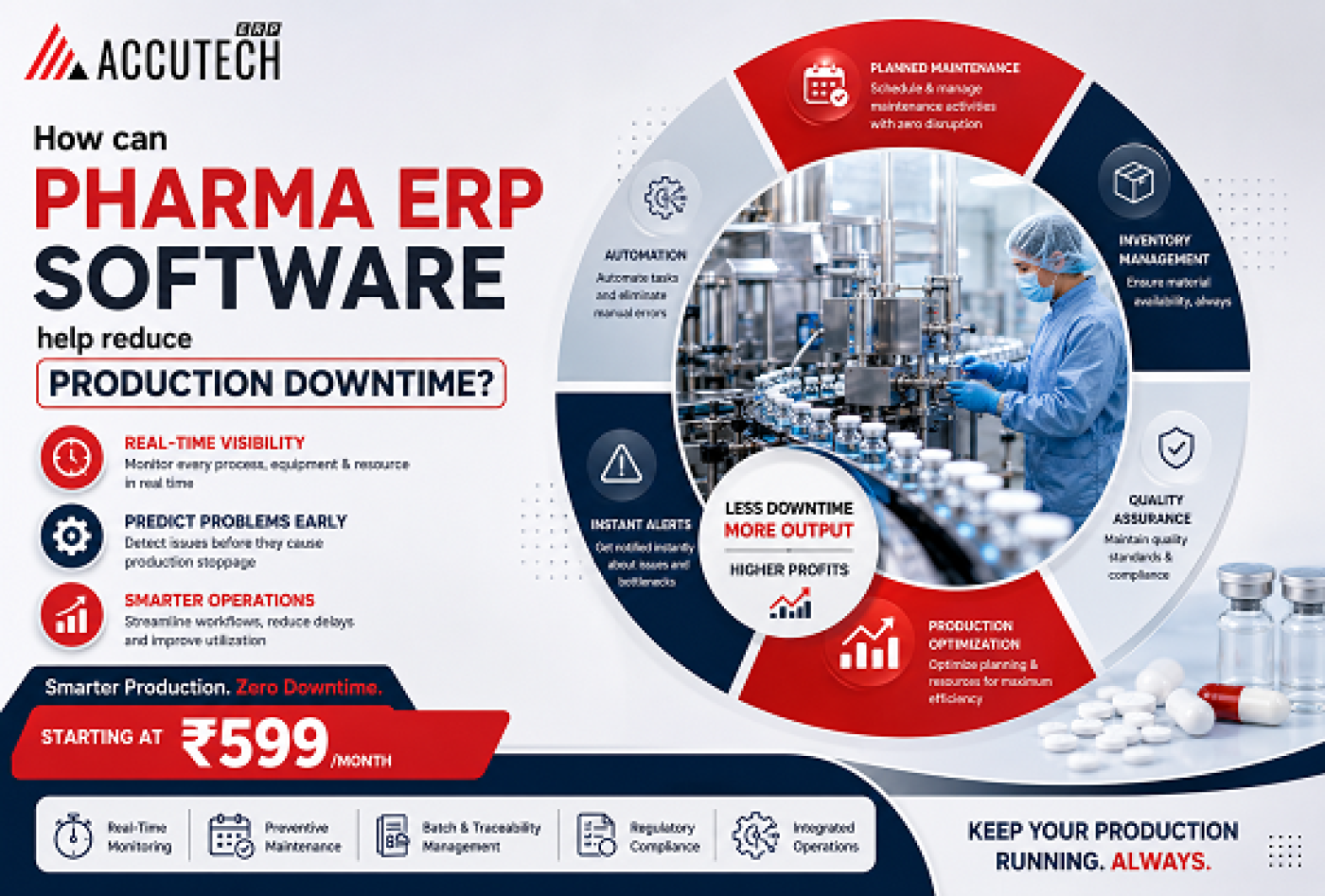
In the pharmaceutical industry, every minute of production downtime translates directly into lost revenue, delayed shipments, and compromised compliance obligations. A manufacturing facility that can produce 10,000 units per hour loses significant revenue with just one hour of unplanned downtime.
Yet many pharmaceutical companies, particularly those operating PCD (Pharma Franchise/Parallel Wholesale Distribution) models, still rely on manual processes and disconnected legacy systems that make it nearly impossible to identify downtime triggers before they become problems.
This is where Pharma PCD ERP Software becomes transformational. By integrating inventory management, production scheduling, quality assurance, supply chain coordination, and real-time monitoring into a single unified platform, modern ERP systems eliminate the friction points that cause unplanned stoppages.
In this comprehensive guide, we explore exactly how pharma ERP software helps reduce production downtime, the specific mechanisms that make this possible, and the measurable business impact you can expect.
2. What Is Production Downtime and Why Does It Matter?
Production downtime refers to any period during which your manufacturing facility is unable to operate at full capacity or cannot operate at all. In pharmaceutical manufacturing, even brief interruptions have severe consequences.
Types of Production Downtime
- Planned Downtime: Scheduled maintenance, equipment calibration, quality audits, regulatory compliance activities, and employee training sessions.
- Unplanned Downtime: Equipment failures, material shortages, quality issues, supply chain disruptions, human errors, and system failures.
- Partial Downtime: Production continues but at reduced capacity due to bottlenecks, resource constraints, or operational inefficiencies.
Why Production Downtime Matters in Pharma
- Regulatory Compliance: Pharmaceutical manufacturing is heavily regulated by FDA, EMA, and local government bodies. Downtime must be documented and reported.
- Patient Safety: Any disruption in production schedules can delay critical medications reaching patients.
- Financial Impact: Beyond immediate lost production, downtime causes revenue loss, increases per-unit manufacturing costs, and strains customer relationships.
- Supply Chain Disruption: When a facility goes down, distributors and retailers face stockouts, damaging brand reputation.
3. The Hidden Costs of Production Downtime
Most pharmaceutical companies only calculate direct production loss. However, the total cost is significantly higher when you account for indirect and hidden expenses.
Cost Category | Impact per Hour |
Lost Production Revenue | ₹1,00,000 |
Idle Labor Costs | ₹10,000 |
Emergency Maintenance | ₹15,000 |
Expedited Shipping | ₹50,000 |
TOTAL COST | ₹1,75,000 |
4. Key Causes of Production Downtime in Pharma Manufacturing
Understanding the root causes of downtime is the first step toward prevention. In pharmaceutical manufacturing, downtime typically stems from these categories:
Equipment-Related Issues
- Machinery Failures: Aging equipment, lack of preventive maintenance, or sudden mechanical failures.
- Calibration Errors: When calibration drifts, batches must be rejected or reworked.
- Changeover Time: Switching production lines requires setup time, cleaning, and quality checks.
Supply Chain and Material Issues
- Raw Material Shortages: When suppliers fail to deliver on time, production must halt.
- Packaging Delays: Delays in receiving bottles, blister packs, or labels can freeze production lines.
- Inventory Mismanagement: Poor tracking leads to ordering too late or running out of stock.
Quality and Compliance Issues
- Quality Control Failures: Products that do not meet standards must be reworked or discarded.
- Documentation Gaps: Missing batch records delay product release and regulatory approval.
- Regulatory Audits: Unscheduled compliance audits can halt production during inspections.
System and Data Issues
- System Failures: Legacy systems crashing, database errors, or network outages prevent data access.
- Inaccurate Data: Spreadsheet errors and manual data entry mistakes lead to wrong decisions.
- Lack of Real-Time Visibility: Without live monitoring, problems are discovered too late.
5. How Pharma PCD ERP Software Prevents Production Downtime
Modern pharma PCD ERP software addresses each downtime category through integrated, intelligent solutions:
Real-Time Production Monitoring and Alerts
Pharma ERP systems continuously track production metrics output rates, cycle times, resource utilization, and quality indicators and instantly alert managers to anomalies. Early detection means faster fixes and minimal impact on output.
Predictive Maintenance Management
ERP systems track equipment performance data and failure patterns. Advanced systems use predictive algorithms to forecast when maintenance is needed. This shifts from reactive to proactive maintenance with minimal disruption.
Integrated Inventory and Supply Chain Management
The pharmaceutical accounting software component maintains real-time visibility of raw materials, APIs, packaging materials, and work-in-progress inventory. Production planners know exactly what is available and when deliveries arrive.
Optimized Production Scheduling
ERP systems analyze demand forecasts, available resources, equipment capacity, and material availability to create optimized production schedules. This minimizes changeover times and prevents resource conflicts.
Quality Control Automation
Pharma ERP integrates quality management systems that automate testing protocols and ensure batch records are accurate. Quality checks happen in parallel with production rather than after.
Centralized Information Hub
All stakeholders production managers, supply chain, quality, finance, and executives access the same real-time data. Communication breakdowns disappear when everyone sees the same information.
6. Real-World Benefits: Cost Savings and Efficiency Gains
Downtime Reduction: 40-60%
Companies moving from manual to ERP-managed operations typically reduce unplanned downtime by 40-60%. What previously meant 10-15 stoppages per month drops to 4-6.
Production Efficiency Increase: 25-35%
Optimized scheduling and better resource utilization push overall equipment effectiveness (OEE) from 60-65% to 80-85%.
Labor Productivity: 20-30% Improvement
Staff spend less time on manual coordination and troubleshooting. The same headcount produces more output with better job satisfaction.
Quality Improvement: 15-25% Reduction in Defects
Better equipment maintenance, automated quality checks, and reduced rework mean fewer defective batches.
Financial Impact Overview
Benefit Category | Annual Impact |
Prevented Downtime Revenue | ₹1,26,00,000 |
Inventory Cost Reduction | ₹20,00,000 |
Labor Productivity Gains | ₹30,00,000 |
Quality Improvement Savings | ₹15,00,000 |
Total First-year Benefit
| ₹1,91,00,000 |
7. Implementing Pharma ERP: Best Practices
The biggest mistake companies make is assuming ERP implementation is purely technical. Success requires organizational change management, clear strategy, and disciplined execution.
Step 1: Assess Current State
Understand your current pain points, measure baseline downtime metrics, and define what success looks like. Conduct a detailed process audit to identify bottlenecks.
Step 2: Select the Right Solution
Choose a solution specifically designed for pharmaceutical manufacturing and PCD operations. Look for industry-specific features, scalability, cloud-based architecture, and integration capabilities.
Step 3: Design Phased Implementation
Run parallel processing with old and new systems simultaneously. Implement by department or product line rather than big-bang deployment. Schedule major cutover during planned maintenance windows.
Step 4: Comprehensive Training
Staff must understand why the change is happening and how to work with the new system. Provide role-specific training and create power users in each department.
Step 5: Monitor and Optimize
The first 90 days are critical. Daily monitoring of KPIs identifies issues quickly. Continuous process improvement means adjusting configurations as you identify inefficiencies.
8. Comparison: Manual vs. ERP Operations
To illustrate the transformation, here is how typical scenarios play out in traditional vs. ERP environments:
Scenario | Manual Process | ERP System |
Material Shortage | Operator notices mid-shift. 2-3 hours delay before procurement responds. 48 hours to receive. Production halts. | System predicts 5 days before stockout. Auto purchase order. Delivery confirmed 2 weeks ahead. Zero downtime. |
Equipment Issue | Equipment running slow. Not noticed until end-of-shift. Maintenance next day. 8-hour repair. 8 hours lost. | Real-time detection within 30 minutes. Maintenance alerted. Repair during next break. 30 minutes downtime. |
Quality Issue | QC after batch complete. Fails. Batch rejected. 24 hours rework plus dependent batch impact. | QC integrated into production. Issue detected in-process. Production adjusted. Defect rate 0.5% vs 2%. |
9. Common Mistakes to Avoid
Mistake #1: Viewing ERP as Technology Project Only
ERP is an organizational transformation. Failure to invest in change management and training leads to underutilized systems and disappointing results.
Mistake #2: Preserving All Legacy Processes
ERP works best when you optimize processes to match best practices embedded in the software. Trying to replicate old workflows defeats the purpose.
Mistake #3: Inadequate Planning
Rushing into implementation without proper data cleanup, process mapping, or testing leads to data integrity issues.
Mistake #4: Underestimating Training
One-time training is insufficient. Ongoing education, refresher training, and mentoring are necessary for success.
Mistake #5: Not Measuring Impact
If you do not measure downtime reduction, productivity, quality, and cost savings, you will not know whether ERP is delivering value.
Mistake #6: Ignoring System Integration
If your ERP cannot integrate with equipment systems, existing accounting software, or distributor systems, you create new bottlenecks.
10. Frequently Asked Questions
Q1: How much downtime reduction can we expect?
Most companies see 40-60% reduction in unplanned downtime within 6-12 months of full implementation. Results vary based on current baseline, industry, company size, and implementation quality.
Q2: How long until we see ROI?
For most pharmaceutical companies, ROI materializes within 18-24 months. Companies implementing efficiently can achieve ROI within 12-18 months. Quick wins often appear within 6 months.
Q3: Is cloud-based ERP secure?
Modern cloud-based pharmaceutical accounting software uses enterprise-grade security including data encryption, regular audits, and compliance certifications (ISO 27001, SOC 2). Cloud systems are often more secure than on-premise solutions.
Q4: Can ERP help with regulatory compliance?
Yes. Pharma ERP automates document management, maintains audit trails, ensures batch records are complete, flags compliance issues, and generates regulatory reports (GSTR1, GSTR2A).
Q5: Can one ERP handle multiple locations?
Yes. Modern cloud-based pharma PCD ERP software handles multi-location operations, multiple companies within a group, and complex franchise models. Single ERP provides centralized visibility with local autonomy.
Q6: How does accounting software help downtime reduction?
When downtime occurs, costs automatically get captured idle labor, delayed revenue, expedited shipping. Integrated accounting lets you measure true financial impact and justify downtime prevention investments.
Q7: What support should we expect?
Choose vendors providing implementation support, training, ongoing technical support, regular updates, and access to user communities. For mission-critical operations, vendor support quality directly impacts your success.
Q8: Can we customize the ERP?
Most enterprise pharma ERP solutions allow significant customization through configuration. However, over-customization makes future upgrades harder. Adapt processes to the software when possible.
Q9: What is the typical implementation cost?
For mid-sized pharmaceutical companies (₹5-50 crore revenue), expect ₹20-80 lakhs. Larger enterprises might spend ₹1-3 crore. Cloud-based solutions typically have lower upfront costs. Most vendors offer flexible pricing.
Q10: How long does implementation take?
The typical range is 4-9 months for mid-sized companies. Smaller implementations take 2-3 months. Larger enterprises with multiple locations take 12-18 months. Phased implementations are often faster than big-bang approaches.
11. Conclusion
Production downtime in pharmaceutical manufacturing is not an inevitable cost of doing business; it is a symptom of fragmented, disconnected systems and manual processes.
By implementing comprehensive pharma ERP software that integrates inventory management, production scheduling, quality assurance, supply chain coordination, and real-time monitoring, you create an environment where downtime is prevented.
The question is not whether you can afford to implement pharma PCD ERP software, it is whether you can afford not to. Your competitors are moving to integrated systems. Every day you delay is another day of preventable downtime costing revenue and damaging customer relationships.