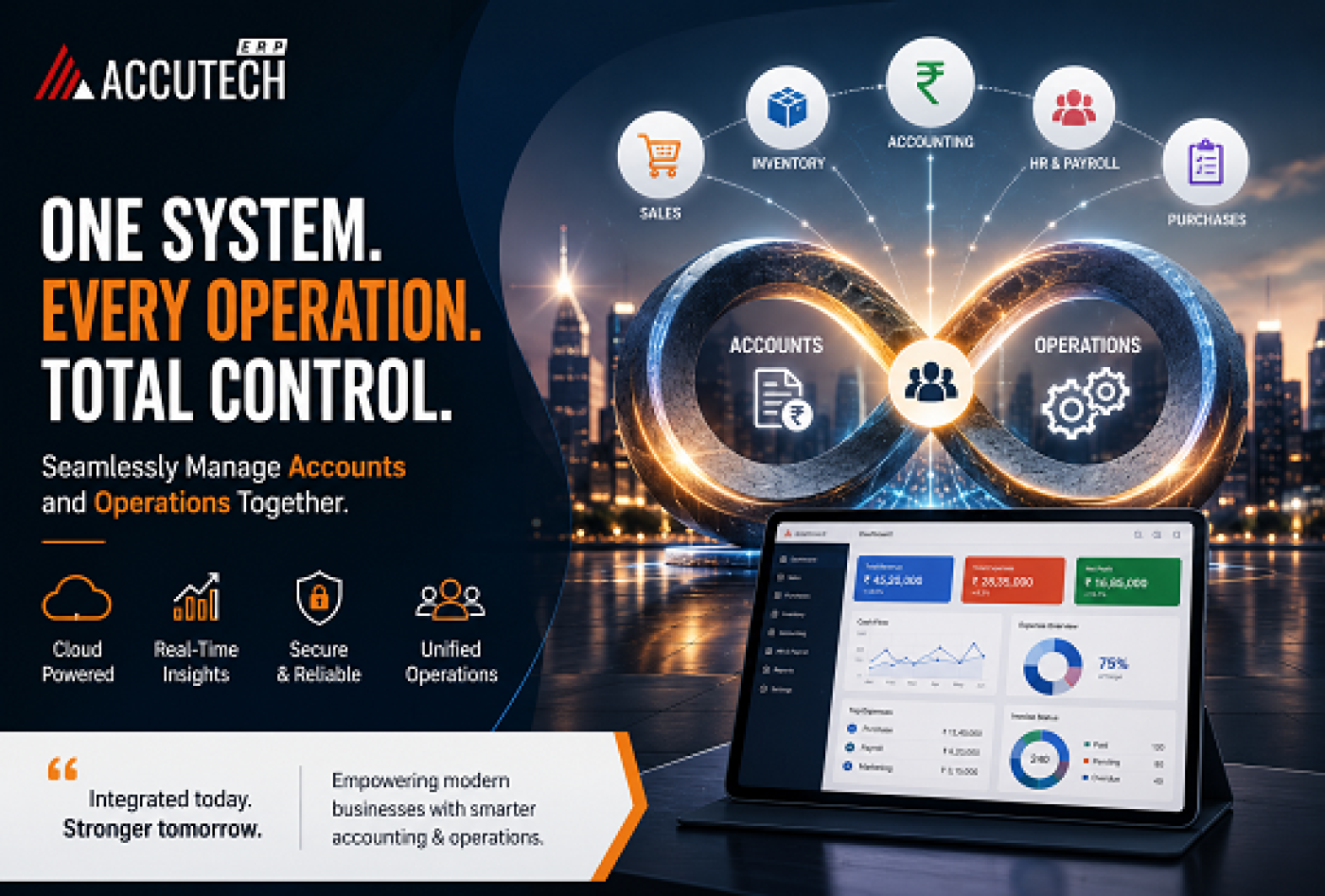
In today’s fast-paced digital economy, businesses can no longer afford disconnected systems for accounting and operations. Managing finances in one tool and operations in another leads to inefficiencies, errors, and missed growth opportunities.
This is where Cloud-Based ERP comes in.
Modern businesses whether startups, SMEs, or enterprises are rapidly adopting cloud ERP systems to integrate accounting, inventory, sales, HR, and operations into one unified platform. Especially in India, the rise of cloud accounting software India solutions is transforming how companies operate.
In this guide, we’ll explore how businesses handle accounts and operations together using cloud ERP, why it’s essential, and how solutions like Accutech ERP are leading this transformation.
What is Cloud-Based ERP?
Cloud-Based ERP is a software solution hosted on the cloud that allows businesses to manage all core operations including accounting, inventory, sales and procurement through a single platform.
Unlike traditional systems, cloud ERP:
- Works online (no installation required)
- Provides real-time data access
- Scales with business growth
- Enables remote work
It is the backbone of modern business management.
Why Businesses Need Integrated Accounting & Operations
Many businesses still use separate tools for:
- Accounting (e.g., billing software)
- Inventory management
- CRM
- Payroll
This leads to:
- Data duplication
- Manual errors
- Lack of real-time insights
- Delayed decision-making
Key Problem:
Disconnected systems = Slow growth + Poor efficiency
Solution:
Cloud ERP accounting systems unify everything.
How Cloud ERP Combines Accounting and Operations
Cloud ERP connects all departments into a single system.
Example Workflow:
- Sales Order Created
- Inventory Automatically Updated
- Invoice Generated
- Payment Recorded in Accounting
- Financial Reports Updated in Real-Time
Integrated Modules:
- Accounting & Finance
- Inventory Management
- Sales & CRM
- Purchase & Procurement
- HR & Payroll
This ensures seamless data flow across departments.
Key Features of Cloud ERP Accounting Systems
1. Real-Time Financial Tracking
- Profit & loss reports
- Cash flow monitoring
- Balance sheets
2. Automated Accounting
- Auto journal entries
- GST compliance (India-specific)
- Invoice generation
3. Inventory Integration
- Stock updates linked to sales
- Warehouse tracking
4. Multi-User Access
- Role-based permissions
- Remote accessibility
5. Cloud Data Security
- Encrypted data storage
- Backup & recovery
6. Analytics & Reporting
- Business insights dashboards
- Predictive analysis
Benefits of Using Cloud Accounting Software in India
The demand for leading cloud accounting software India is rapidly increasing due to:
Cost Efficiency
- No expensive hardware
- Subscription-based pricing
GST Compliance
- Easy tax filing
- Automated GST calculations
Scalability
- Suitable for startups to enterprises
Accessibility
- Access from anywhere, anytime
Improved Decision Making
- Real-time insights
Reduced Errors
- Automation minimizes manual mistakes
Cloud ERP vs Traditional ERP
|
Feature |
Cloud ERP |
Traditional ERP |
|
Deployment |
Online |
On-premise |
|
Cost |
Low upfront |
High investment |
|
Accessibility |
Anywhere |
Limited |
|
Maintenance |
Automatic updates |
Manual updates |
|
Scalability |
High |
Limited |
|
Implementation Time |
Fast |
Slow |
Step-by-Step: How Businesses Implement Cloud ERP
Step 1: Identify Business Needs
- Accounting requirements
- Inventory complexity
- Team size
Step 2: Choose the Right ERP
- Look for cloud ERP accounting features
- Ensure GST compliance (India)
Step 3: Data Migration
- Import existing financial data
- Clean and organize data
Step 4: Training Employees
- Provide onboarding sessions
- Assign roles and permissions
Step 5: Go Live
- Start with core modules
- Expand gradually
Step 6: Monitor & Optimize
- Track performance
- Improve workflows
Best Practices for Using Cloud ERP
- Use dashboards daily for insights
- Automate repetitive tasks
- Regularly update financial data
- Train staff continuously
- Integrate with other tools
Common Mistakes to Avoid
Choosing ERP without scalability
Ignoring employee training
Poor data migration
Not using analytics features
Over-customization
Real-World Use Cases
1. Retail Business
- Tracks inventory in real-time
- Automates billing
2. Manufacturing Company
- Manages production + accounting
- Reduces operational delays
3. Service-Based Business
- Tracks invoices and payments
- Manages client data efficiently
Why Choose Accutech ERP
If you’re looking for a powerful Cloud-Based ERP, Accutech ERP offers:
Unified accounting & operations
Advanced cloud ERP accounting features
Scalable for growing businesses
User-friendly interface
Reliable support
Featured Snippet Opportunities
- What is Cloud-Based ERP?
- Benefits of cloud accounting software India
- Cloud ERP vs traditional ERP
- How ERP integrates accounting and operations
People Also Ask (PAA)
- What is cloud ERP accounting?
- Which is the best cloud accounting software in India?
- How does ERP improve business efficiency?
- Is cloud ERP secure?
- Why do SMEs need ERP?
FAQs
1. What is Cloud-Based ERP?
Cloud-based ERP is an online software that integrates accounting and business operations into one system.
2. How does cloud ERP help accounting?
It automates financial processes, reduces errors, and provides real-time insights.
3. Is cloud accounting software safe?
Yes, it uses encryption and secure cloud storage.
4. What is the best cloud accounting software in India?
There are many options, but leading cloud accounting software India includes solutions like Accutech ERP.
5. Can small businesses use ERP?
Yes, cloud ERP is ideal for SMEs due to affordability and scalability.
6. How much does cloud ERP cost?
It depends on features and users but is generally subscription-based.
7. Does cloud ERP support GST?
Yes, most Indian ERP systems support GST compliance.
8. How long does ERP implementation take?
Typically 2–8 weeks depending on complexity.
9. Can ERP integrate with other tools?
Yes, modern ERP systems offer integrations.
10. What industries benefit from ERP?
Retail, manufacturing, healthcare, finance, and more.
Conclusion
Modern businesses need speed, accuracy, and efficiency and disconnected systems can’t deliver that.
Cloud-Based ERP is no longer optional; it’s essential.
By integrating accounting and operations into one platform, businesses can:
- Save time
- Reduce costs
- Improve decision-making
- Scale faster
If you want to stay competitive in 2026 and beyond, adopting a reliable cloud ERP solution like Accutech ERP is the smartest move.