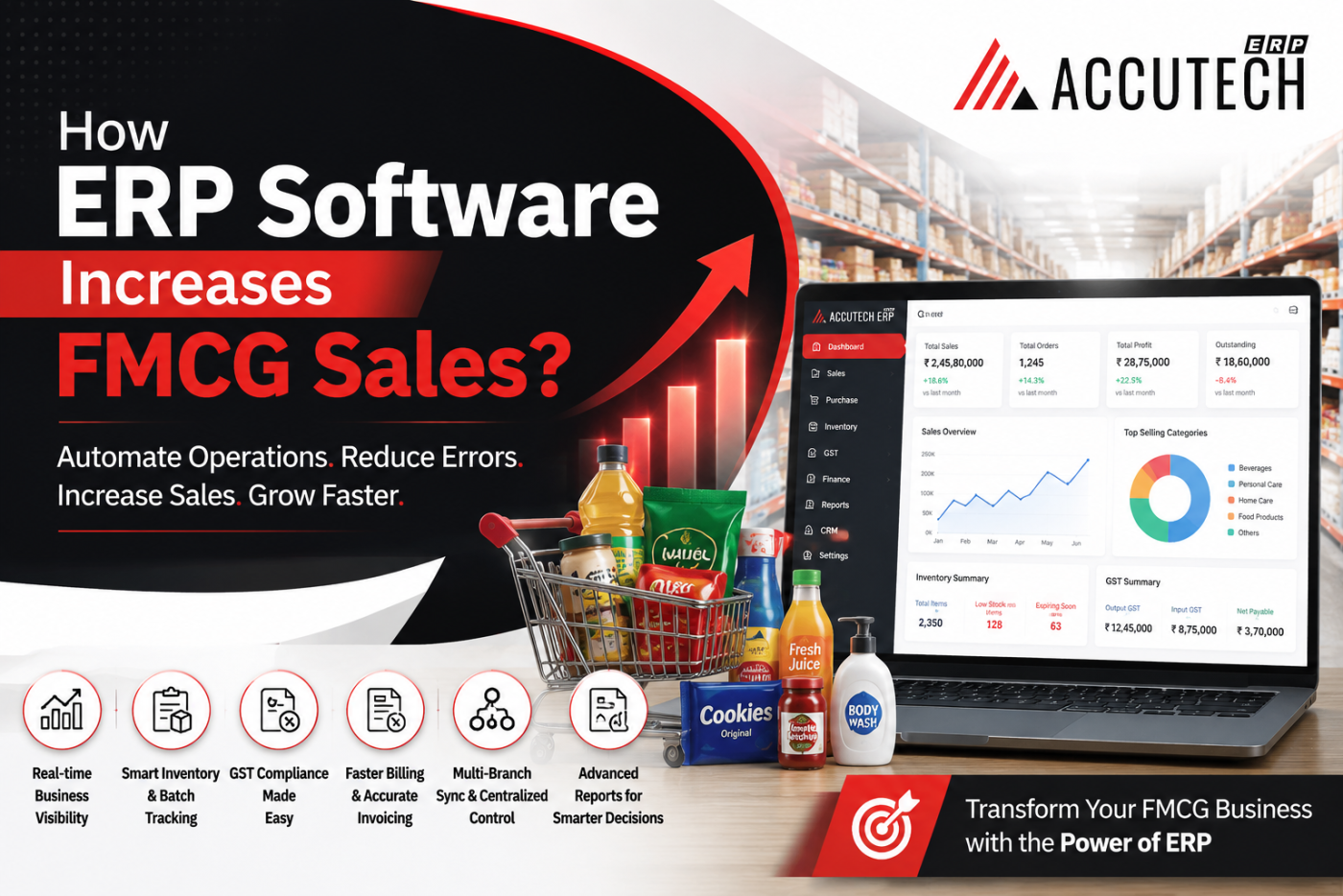
If you're running an FMCG distribution business in 2026, you're probably juggling dozens of responsibilities at once. You're managing inventory across multiple branches, tracking expiry dates, calculating GST on complex product categories, monitoring distributor payments, and trying to keep your sales team coordinated all while competitors are moving faster than ever.
The question isn't whether you need to modernize anymore. The real question is: what's the cost of waiting?
In today's hypercompetitive FMCG market, the difference between businesses that grow and those that stagnate often comes down to one fundamental choice: staying stuck with manual processes and outdated accounting methods, or embracing modern ERP software that automates operations and provides real-time business visibility.
This comprehensive guide explains exactly how ERP software transforms FMCG sales, improves operational efficiency, and helps distributors, wholesalers, retailers, and SMEs compete in 2026. We'll explore the real problems you face, why traditional accounting methods fail, and how a modern cloud based ERP solution like Accutech ERP can fundamentally change your business trajectory. Whether you're struggling with inventory mismatches, slow billing processes, GST compliance headaches, or simply lack the real-time visibility to make smart business decisions, this guide will show you the path forward.
The Real Problems Fmcg Distribution Businesses Face Today
Let's be honest: if you've been in the FMCG distribution business for more than a few years, you know the pain points intimately.
Manual Accounting Mistakes and Human Errors
Every business owner handling FMCG distribution accounting knows the frustration. Someone enters a purchase amount incorrectly in an Excel sheet. A distributor payment is recorded twice. An invoice is created with the wrong tax percentage. These aren't catastrophic failures, they're daily occurrences that silently drain profitability and create reconciliation nightmares.
When you're managing thousands of transactions monthly across multiple distribution channels, the probability of errors skyrockets. And discovering these mistakes weeks later, after financial reports are finalized, means you're making business decisions based on inaccurate data.
Slow Billing and Invoice Processing
Modern retail demands speed. When your sales team receives an order at 3 PM, customers expect an invoice by 4 PM. But when billing is manual or dependent on slow billing and accounting software, you're losing sales opportunities. Customers get frustrated with invoice delays. Your finance team spends hours creating invoices instead of focusing on strategy.
For FMCG distribution businesses managing hundreds of orders daily, slow billing creates bottlenecks throughout the entire operation. Sales teams can't follow up quickly. Collections teams can't start payment reminders promptly. You're essentially operating in slow motion while the market demands speed.
Stock Mismatch and Inventory Discrepancies
You order 1,000 units of a product. Your system says you have 850. Physical count reveals 780. Where did 70 units go? Did someone record a sale incorrectly? Was there a receipt error? Was there theft?
These inventory mismatches happen constantly without a robust inventory and accounting software system. And they have real consequences: you overstocking slow-moving items while understocking fast movers, leading to lost sales and excess inventory costs.
Expiry and Batch Tracking Problems
FMCG products have expiry dates. Batch tracking is critical. Imagine discovering that you've been distributing expired products to retail partners. Beyond the legal liability, imagine the reputational damage. Or discovering six months later that you sold 500 units of a batch that should have been pulled off shelves two months ago.
Without automated batch-wise stock management and expiry tracking built into your ERP system, you're managing this information through manual records, spreadsheets, or basic accounting systems that weren't designed for this complexity.
GST Compliance and Tax Filing Complexity
GST has transformed Indian business taxation. But it's also created unprecedented complexity for FMCG distributors. You might be selling to retailers in different states, each with different tax implications. You're managing intra-state and inter-state sales. E-way bills are required. E-invoicing standards are evolving. GST filing deadlines are unforgiving.
One GST accounting mistake gets flagged by tax authorities. You're spending weeks explaining the discrepancy, gathering documents, and amending returns. Meanwhile, an automated GST accounting software and proper ERP system would have prevented the error in the first place.
Delayed Reporting and Lack of Real-Time Visibility
Here's something many business owners admit privately: they don't actually know their current profitability. They don't know which products are generating profit and which are losing money. They don't have real-time sales figures from all branches. Financial reports come out 10-15 days after month-end because someone needs to manually compile data from multiple sources.
By the time you get visibility into your business performance, two weeks have passed. Market conditions have shifted. Competitive dynamics have changed. You're making decisions based on outdated information.
Multi-Branch Confusion and Sync Issues
Running FMCG distribution across multiple branches means multiple inventory locations, multiple accounting records, and the nightmare of data synchronization. Branch A says it has 500 units. Branch B says it has 300 units. Head office records show 750 units. Who's right?
Without a centralized accounting ERP system connecting all branches, you're essentially running multiple separate businesses that don't communicate with each other. Product transfers between branches create accounting nightmares. Customer allocation becomes chaotic. Pricing inconsistencies emerge.
Distributor and Retailer Payment Tracking
Managing payments from hundreds or thousands of distributors and retailers is complex. Who paid their last invoice? Who's overdue by 30 days? Who needs a payment reminder? When did Branch C's largest distributor last pay?
Without automated payment tracking and real-time reporting, this crucial information sits in someone's head or scattered across multiple documents. Collections efforts become haphazard. Cash flow forecasting is impossible.
Inventory Overstocking and Understocking
Accurate demand forecasting is an art and a science. Stock too much, and you're tying up capital in slow-moving inventory. Stock too little, and you're losing sales and disappointing retail partners. Most FMCG distributors get this balance wrong regularly because they're making stocking decisions based on gut feel, past experience, or incomplete data—not intelligent business analytics.
An ERP system with smart analytics helps you understand purchase and sales trends, identify which products are seasonal, and optimize inventory levels accordingly.
Sales Team Coordination Problems
Your sales team operates across multiple locations. They're not all in the office. Some are visiting retail partners. Some are managing distributor relationships. Without a real-time system showing current inventory, pricing, and customer order history, sales teams are working with outdated information. They promise delivery dates they can't meet because they don't know actual inventory. They offer prices without understanding current margins.
Why Traditional Accounting Methods Fail For Fmcg Businesses In 2026
Let's talk honestly about Excel, Tally-only workflows, manual bookkeeping, offline systems, and non-integrated software. These were fine in 2015. They're not sufficient anymore.
Excel Spreadsheets Reach Their Limits
Excel is powerful. It's flexible. It's familiar. And it's completely inadequate for managing complex FMCG distribution operations at scale. Here's why: Excel files aren't real-time. If someone is updating a spreadsheet while you're looking at it, you're seeing outdated information. Excel has no built-in user access controls—anyone with the file can change anything. There's no audit trail tracking who changed what and when.
Most critically, Excel doesn't talk to other systems. You can't automatically pull data from your invoicing system into your accounting spreadsheet. You can't have inventory updates flow automatically into financial reports. You're manually transferring data, retyping numbers, and introducing errors at every step.
Tally-Only Workflows Create Silos
Tally is exceptional accounting software for small businesses. But it has limitations for growing FMCG distribution operations. Tally doesn't provide true cloud access—you're accessing it through workarounds at best. Tally's multi-user capabilities are limited compared to modern cloud ERP systems. Tally's reporting capabilities, while adequate for traditional accounting, don't provide the business intelligence that distributors need for competitive advantage.
When you're managing FMCG distribution, you need to see customer-wise sales reports, product-wise profitability, distributor performance, inventory turnover rates, and branch-wise comparisons. These aren't traditional accounting reports; they're business intelligence. Tally makes them difficult.
Manual Bookkeeping Is a Bottleneck
Hiring experienced accountants or bookkeepers is expensive. Keeping them in the office manually entering transactions, reconciling accounts, creating reports, and filing taxes is inefficient. As your business grows, manual bookkeeping becomes a genuine limitation on growth. You'd need to hire more and more accounting staff just to keep up with transaction volume.
Even worse, manual processes are slower. A transaction entered manually today might not appear in accounting records until tomorrow. Your finance team doesn't discover errors until monthly reconciliation. Decisions are delayed. Opportunities are missed.
Offline Systems Create Access Nightmares
You can't access your accounting system from home. You can't check real-time inventory from a retail store visit. Your sales team can't look up customer account balance while negotiating a deal. Your CFO can't review financial statements during a weekend strategic planning session.
In 2026, offline systems aren't just inconvenient; they're competitive disadvantages. Your competitors with cloud-based ERP systems are making faster decisions. They're responding to market changes more quickly. They're providing better customer service because they have information at their fingertips.
Non-Integrated Software Creates Double Work
Most businesses use multiple software systems. Tally for accounting. Separate invoicing software. Separate inventory management. Separate CRM for customer tracking. These systems don't talk to each other. So you're entering data multiple times. A customer order goes into the invoicing system, then someone manually enters it into inventory tracking, then someone enters it into accounting. The same data is being entered three times.
This creates obvious problems. If data is entered differently in different systems, you have inconsistencies. Your accounting records don't match your inventory records. Your customer database is out of sync with your sales records. You're never working with reliable, unified information.
The Modern Erp Solution: Features Every Fmcg Business Should Demand
The accounting and ERP software landscape has evolved dramatically. If you're evaluating solutions for your FMCG distribution business, here are the essential features you should demand.
Cloud Access and Remote Operations
Your accounting and inventory system should be accessible from anywhere with internet connectivity. Your CFO should be able to check financial statements from home. Your sales team should be able to check customer balances from retail stores. Your warehouse manager should be able to update inventory from mobile devices. This is non-negotiable in 2026.
Cloud access means your business isn't dependent on a single office location or computer. It means you can add remote team members without infrastructure challenges. It means disaster recovery is built-in—if your office loses power, your operations continue seamlessly.
Real-Time Inventory Management
Inventory visibility should be instantaneous. When someone receives goods at the warehouse, inventory updates immediately. When a sale is processed, stock is automatically reduced. When you transfer inventory between branches, the system updates across all locations simultaneously. This real-time synchronization prevents overselling, reduces stock discrepancies, and enables accurate inventory reports.
Your inventory system should show you current stock at every location. It should alert you to slow-moving items that are tying up capital. It should help you identify items that need reordering. For FMCG distributors, real-time inventory management directly translates to higher sales and lower losses.
Automated GST Billing and Tax Calculation
Your billing and accounting software should handle GST complexity automatically. When you create an invoice, the system should automatically determine the correct tax rate based on product category, customer location, and transaction type. GST amounts should be calculated without manual intervention. Tax liability should be calculated automatically for GST filing.
In 2026, GST automation is essential. A single GST error can trigger audit complications. An automated system eliminates that risk and saves your accounting team hours of manual calculation and verification.
Smart Invoicing and Payment Management
Invoice creation should take seconds, not minutes. Your system should pull customer details, payment terms, and product information automatically. It should calculate totals, apply any applicable discounts, and calculate taxes. It should generate professional invoices that you can deliver to customers immediately.
The invoicing system should also support payment reminders. When an invoice becomes overdue, the system should generate reminders automatically. This reduces manual collection efforts and improves cash flow. Your accounting team shouldn't be manually tracking who needs payment follow-ups; the system should do it.
Barcode Support and Batch-Wise Stock Management
Modern FMCG operations depend on barcodes. When you receive goods, you scan barcodes and stock is updated automatically. When you pick items for an order, you scan them. When goods arrive at a retail partner, they scan them. Barcodes ensure accuracy and speed up every transaction.
Your ERP system should support barcode scanning natively. It should allow you to manage inventory at the batch level, not just by product. For each product batch, you should track batch number, manufacturing date, expiry date, quantity received, and quantity sold. This granular inventory control is critical for FMCG businesses where batch management and expiry tracking are essential.
Expiry and Shelf-Life Tracking
Your system should track when each batch expires. It should alert you well before expiry dates arrive. When you create a sales order, it should prioritize selling batches closest to expiry first. This prevents expired inventory from accidentally being distributed and protects your reputation.
For pharmaceutical distributors and food distributors, expiry tracking isn't optional—it's critical for compliance and brand protection.
Mobile Access and Field Operations
Your accounting and inventory system should work on mobile devices. Your warehouse manager should be able to process goods receipt from a mobile device in the warehouse. Your sales team should be able to check customer balances, create orders, and see product information from the field. Your delivery team should be able to confirm delivery through a mobile app.
Mobile access means your business doesn't require everyone to be in an office to get work done. It enables faster operations and better field communication.
AI Automation and Intelligent Workflows
Modern ERP systems use AI and automation to handle routine tasks. Recurring invoices should be generated automatically. Payment reminders should be triggered automatically based on configured rules. Inventory reordering should be suggested based on intelligent forecasting. Expense categorization should happen automatically based on machine learning.
This automation isn't about replacing humans; it's about eliminating tedious manual work so your team can focus on strategy and growth.
Multi-User Access and Role-Based Permissions
Your accounting system should support multiple simultaneous users without conflicts. Different team members should have different access levels. Your warehouse manager shouldn't have access to financial statements. Your accounting team shouldn't have authority to create sales orders above certain limits. Your CFO should have access to everything.
Role-based permissions ensure data security while enabling collaboration. Your team can work on the same system without worrying about unauthorized access.
Multi-Branch Management and Centralized Control
If you operate multiple branches, your ERP system should unify them under one platform. Inventory from all branches should be visible in a single view. Financial data from all branches should consolidate automatically. You should be able to generate branch-wise comparisons instantly.
Centralized control means you're running one integrated business, not multiple separate operations. This dramatically simplifies accounting, improves decision-making, and enables coordinated growth.
Smart Dashboards and Visual Analytics
Numbers in spreadsheets are hard to digest. Smart dashboards present key information visually. You should see your current inventory value at a glance. You should see sales trends through charts. You should see outstanding customer receivables instantly. You should see profit margins by product category visually.
These visual dashboards help you understand your business at a glance and identify issues that need attention.
Business Analytics and Reporting Capabilities
Your ERP system should generate reports automatically. You should have monthly profit and loss statements. You should have balance sheet reports. You should have GST liability reports for filing. You should have customer-wise sales reports. You should have product-wise profitability reports.
These reports shouldn't require manual compilation or data transfer. They should be generated automatically from your operational data.
Automated Financial Reports and Ledger Management
Ledger management should be automatic. When you create an invoice, accounts receivable is updated automatically. When you record a purchase, accounts payable is updated. When you record a payment, cash and payable accounts are updated. Your accounting team shouldn't be manually posting entries to ledgers.
Monthly financial statements should be generated automatically. Your profit and loss statement should reflect all transactions. Your balance sheet should balance automatically. These automated reports enable faster financial analysis.
The Benefits Of Cloud-Based And Erp-Enabled Accounting Systems
Understanding the features is one thing. Understanding the actual business benefits is another.
Remote Access and Distributed Teams
When your accounting system is cloud-based, you're not limited by office infrastructure. You can hire accounting talent from anywhere. Your CFO can work from home several days a week. Your assistant can process invoices while traveling. Your remote branch managers can have full access to accounting systems.
This flexibility reduces overhead. You can potentially reduce office space. You can hire the best talent regardless of geography. You can enable better work-life balance for your team.
Faster Business Operations and Accelerated Growth
Manual processes are slow. Automated processes are fast. When invoice creation is automated, you can process orders faster. When inventory updates are real-time, you can fulfill orders more quickly. When financial reports are generated automatically, you can make business decisions faster.
For FMCG distributors, speed translates directly to competitive advantage. You can serve customers faster than competitors stuck with manual processes. You can respond to market opportunities more quickly.
Real-Time Synchronization and Data Consistency
With cloud-based accounting software, all systems are synchronized in real-time. When inventory is updated in the warehouse, it's reflected in accounting immediately. When an invoice is created, customer account balance updates instantly. When a payment is recorded, it's visible across all systems.
This real-time synchronization eliminates the delays and inconsistencies that plague businesses using multiple disconnected systems.
Centralized Business Control and Visibility
When all your data is in one cloud-based system, you have unprecedented control and visibility. You can see your entire business from one dashboard. You can access any information instantly. You can track performance in real-time.
This centralized visibility is powerful for management. You know what's happening in your business without asking multiple people for reports. You can identify issues and opportunities instantly.
Faster Decision-Making with Data-Driven Insights
Good decisions require accurate information. Cloud-based ERP systems provide that information instantly. You don't need to wait for reports. You don't need to guess based on incomplete data. You have comprehensive, accurate information available immediately.
This enables faster decision-making. When you see that inventory of a particular product is dangerously low, you can order more immediately. When you see a sales trend emerging, you can adjust strategy quickly. When you see a customer account approaching credit limits, you can address it proactively.
Improved Team Productivity and Reduced Manual Work
Your accounting team spends less time on data entry, reconciliation, and manual report creation. They spend more time on analysis, strategy, and value-added work. Your sales team spends less time chasing information and more time selling. Your warehouse team spends less time on paperwork and more time on operations.
This improved productivity delivers real financial value. You can accomplish more with fewer people. You can invest in growth instead of additional accounting staff.
Better Customer Service and Faster Response Times
With real-time customer information, you can provide better service. When a customer calls with a question, your team can answer instantly rather than saying "Let me check and call you back." When you see payment issues developing, you can address them proactively. When you see a customer wanting to increase orders, you can accommodate quickly because you have visibility into inventory.
Better customer service strengthens relationships and increases customer loyalty.
How Automation Saves Time And Reduces Accounting Errors
Automation is one of the most compelling reasons to adopt a modern cloud-based ERP solution. Let's look at specific examples.
Automated Billing and Invoice Generation
Instead of manually creating invoices, your system generates them automatically. When a sales order is confirmed, an invoice is generated instantly. Quantities, prices, and tax amounts are pulled from your database. The invoice is formatted professionally and ready to send to customers.
This saves your accounting team hours weekly. For businesses processing hundreds of invoices monthly, automation represents dozens of hours of labor monthly.
Automated Purchase Entry and Goods Receipt
When you receive goods from a supplier, instead of manually entering purchase details into your accounting system, you scan a barcode or upload a receipt. The system matches it to your purchase order. Quantities are updated in inventory. Accounting entries are created automatically.
This eliminates manual entry errors and speeds up the goods receipt process dramatically.
Automated GST Calculation and Compliance
Instead of manually calculating GST on each invoice, your system calculates it automatically based on the product category, customer location, and transaction type. When it's time to file GST returns, your system has already calculated your tax liability.
For GST accounting software, automation is crucial. Manual GST calculation is error-prone and time-consuming. Automation eliminates errors and makes compliance straightforward.
Automated Invoice Management and Payment Tracking
Instead of manually tracking which invoices are paid and which are outstanding, your system maintains this information automatically. When a payment is received, it's matched to an invoice automatically. When an invoice becomes overdue, the system flags it for follow-up.
This gives your collection efforts a dramatic boost. You never miss an outstanding invoice or forget to follow up on overdue accounts.
Automated Payment Reminders and Collections
Your system can send automated payment reminders to customers on configured schedules. When an invoice is 30 days overdue, a reminder is sent automatically. When it's 45 days overdue, an escalated reminder is sent. This reduces the manual effort required for collections while improving payment timeliness.
Automated Inventory Updates and Stock Adjustments
Every transaction that affects inventory triggers automatic updates. Sales reduce inventory. Receipts increase inventory. Transfers between branches update both locations simultaneously. Adjustments for damaged goods are recorded.
This automatic updating eliminates manual inventory reconciliation challenges and keeps your records accurate.
Automated Financial Reports and Financial Statements
Your accounting system generates your financial statements automatically. Profit and loss, balance sheet, cash flow statement—all generated from your operational data with no manual compilation required.
This saves hours of accounting work monthly and ensures your financial statements are accurate and timely.
Automated Ledger Posting and Account Reconciliation
Every transaction is posted to the appropriate ledger accounts automatically. Your accounts receivable reflects all invoices and payments. Your accounts payable reflects all bills and payments. Your inventory accounts reflect all transactions. Your cash accounts reflect all money movements.
This automation eliminates manual posting errors and makes month-end reconciliation significantly easier.
Gst, Taxation, Inventory, Billing, And Compliance Challenges In Fmcg Distribution
FMCG distributors face unique challenges in these critical areas.
GST Filing and E-Invoicing Compliance
GST filing deadlines are unforgiving. You have specific windows to file returns. Errors in GST calculations create audit risk. E-invoicing requirements continue to evolve. An automated billing and accounting software handles these complexities.
Your system should calculate GST correctly on every transaction. It should maintain comprehensive GST records. It should facilitate e-invoicing compliance. It should generate GST return filings automatically.
E-Way Bills and Interstate Commerce
Inter-state FMCG distribution requires e-way bills. E-way bill generation needs to be quick and accurate. Your system should integrate with e-way bill portals. When you create a sales order for interstate delivery, your system should facilitate e-way bill generation automatically.
Tax Compliance Across Multiple Jurisdictions
FMCG distributors often sell across multiple states with different tax regulations. Your system needs to understand these variations. It should apply the correct tax rates for each jurisdiction. It should maintain separate compliance records for each state.
Inventory Reconciliation Complexity
Physical inventory counts should match system records. When they don't, you need to investigate and reconcile the differences. Your accounting ERP system should facilitate reconciliation by providing detailed transaction histories and variance analysis.
Batch-Wise Tracking and Compliance
Every batch needs to be tracked separately in compliance with regulations. Your system should track batch numbers, manufacturing dates, expiry dates, and quantities for each batch. When you sell items, you should be able to generate batch-wise sales reports for compliance and quality assurance.
Multi-Tax Product Management
Different products might be subject to different tax rates. A food product might be tax-free while a processed good is taxed. Your system needs to correctly classify products and apply appropriate tax rates. For FMCG distribution, this is more complex than general business.
Financial Reporting Requirements
You need accurate financial statements for tax filing, lender requirements, and strategic planning. Your accounting ERP system should generate these reports automatically and accurately.
Multi-User And Multi-Branch Accounting Challenges
Growing FMCG businesses face specific challenges managing multiple branches and multiple users.
Branch Synchronization and Data Consistency
When you have multiple branches, synchronizing data is challenging. When Branch A transfers inventory to Branch B, both branches need to update their records. When Branch A's sales are recorded, head office accounting needs to be updated. Without a centralized system, this synchronization is manual, slow, and error-prone.
A cloud-based accounting ERP system synchronizes all branches automatically. When Branch A updates inventory, all other branches see the change immediately. When any branch makes a sale, accounting is updated instantly.
User Access Control and Permissions Management
Different team members need different access levels. Your warehouse manager needs inventory access but shouldn't see financial data. Your accounting team needs access to invoice details but shouldn't be able to create orders. Your CFO needs access to everything.
Setting up these permission levels manually is tedious and error-prone. A proper accounting software solution should have built-in role-based permission structures that you can configure easily.
Centralized Accounting with Distributed Operations
You want accounting centralized at head office while operations are distributed across branches. This requires a system that can consolidate information from distributed locations while maintaining operational autonomy at each location.
A cloud-based accounting ERP solution enables this balance. Each branch operates using the same system, ensuring consistency. But each branch has operational autonomy. Head office has complete visibility without micromanaging operations.
Data Duplication Issues and Redundancy Prevention
Without proper accounting software, you might have information stored in multiple places. Customer data might be in a CRM, accounts receivable, and a spreadsheet. Product information might be in inventory software, accounting software, and a catalog. This duplication creates inconsistencies.
A unified accounting ERP system eliminates duplication. Customer information is stored once. Product information is stored once. Every team member accesses the same current information.
Sales Monitoring and Performance Tracking Across Branches
You want to compare sales performance across branches. Which branch is most profitable? Which is growing fastest? Which has inventory issues? A cloud-based accounting ERP system makes these comparisons simple. You can generate branch-wise sales reports, profitability comparisons, and performance analytics instantly.
Remote Team Management and Distributed Accounting
Your accounting team might be spread across multiple locations. One accountant might work from the head office. Another might handle branch accounting remotely. A cloud-based system enables this distributed model. Everyone accesses the same system. Everyone is working with current information. Collaboration is seamless.
How Accutech Erp Solves These Business Problems
After understanding the challenges FMCG distributors face and the capabilities modern ERP systems should provide, let's discuss how Accutech ERP specifically addresses these needs.
Accutech ERP is a modern cloud-based ERP solution built specifically for distributors, wholesalers, FMCG businesses, pharma companies, retailers, and SMEs. It combines powerful functionality with ease of use, making it an intelligent choice for growing distribution businesses.
A Modern Cloud-Based Architecture
Accutech ERP operates on cloud infrastructure, meaning you access it from anywhere with internet connectivity. Your accounting data is secure in the cloud. Your team can work remotely. You have automatic backups and disaster recovery built-in.
This cloud architecture means you're not dependent on office infrastructure. You can scale up or down based on your business needs. You don't need to worry about maintaining servers or managing IT infrastructure.
Built Specifically for FMCG Distribution Businesses
Unlike generic accounting software, Accutech ERP understands FMCG distribution. It's built with batch-wise stock management. It includes expiry tracking natively. It handles GST complexity automatically. It supports barcode operations. It understands the unique accounting needs of distributors and wholesalers.
When you use Accutech ERP, you're not adapting a generic system to your business; you're using a system designed for your business.
Easy to Use Interface for Non-Technical Business Owners
Accutech ERP doesn't require IT expertise to operate. Business owners and accounting staff can use it intuitively. The interface is designed for people who understand business but aren't software experts.
This ease of use means faster adoption. Your team gets productive with the system quickly. You don't need extensive training. You don't need dedicated IT staff managing the software.
Scalable Architecture for Growing Businesses
Accutech ERP scales with your business. Whether you currently operate one branch or plan to expand to ten branches, Accutech ERP handles it. Whether you currently process 100 invoices monthly or 10,000, the system scales smoothly. As your team grows from five users to fifty users, Accutech ERP accommodates the growth.
GST-Ready and Tax Compliance Focused
Accutech ERP has GST automation built-in. When you create an invoice, GST is calculated automatically. When you need to file GST returns, your system has already compiled the necessary information. E-invoicing compliance is built-in. Multi-state tax variations are handled automatically.
This GST-focused approach eliminates one of the biggest pain points for FMCG distributors.
Inventory-Focused with Batch and Expiry Management
Accutech ERP puts inventory at the center. Batch-wise stock management is native to the system. Expiry tracking is automatic. Barcode support is included. When you receive goods, you can track them at the batch level. When you sell goods, the system prioritizes selling batches closest to expiry.
For FMCG and pharma distributors, this inventory-focused approach is essential.
Real-Time Reporting and Business Intelligence
Accutech ERP provides real-time dashboards and reports. You see your current inventory levels. You see sales trends. You see profit margins. You see outstanding receivables. You see branch-wise performance. All this information is available in real-time.
This real-time visibility enables better decision-making and faster response to market changes.
How Accutech ERP Increases Sales Efficiency
Accutech ERP enables your sales team to work faster and smarter. Your team can check customer balances instantly. They can see current inventory and pricing. They can confirm availability before promising delivery. They can create orders in seconds rather than hours.
Faster order processing means faster delivery. Quick confirmations mean satisfied customers. Real-time inventory visibility means no promised deliveries you can't fulfill.
How Accutech ERP Reduces Stock Losses
Accutech ERP reduces stock losses through multiple mechanisms. Real-time inventory tracking prevents overselling. Batch and expiry management prevents expired products from being distributed. Barcode verification prevents receiving errors. Role-based permissions prevent unauthorized inventory adjustments.
For FMCG distributors where margins are thin, reducing stock losses directly improves profitability.
How Accutech ERP Improves Reporting and Financial Visibility
Instead of waiting days for financial reports, you get real-time visibility. You know your current profit margins. You know which products are profitable. You know which branches are performing well. You can access this information instantly rather than waiting for manual compilation.
This financial visibility enables smarter business decisions. You can identify underperforming areas quickly. You can capitalize on opportunities faster than competitors.
How Accutech ERP Automates Operations and Reduces Manual Work
Accutech ERP automates routine tasks. Invoicing is automated. Payment reminders are automated. Inventory updates are automated. Financial reports are automated. Your team spends less time on manual work and more time on strategy.
Reduced manual work translates to cost savings and improved productivity.
How Accutech ERP Improves Financial Visibility and Cash Flow Management
With real-time accounts receivable information, you know exactly where you stand with customer payments. You can forecast cash flow accurately. You can identify payment trends and issues quickly.
Better cash flow visibility means better working capital management. You can optimize your cash position. You can make better financial decisions.
How Accutech ERP Manages Multiple Branches Effortlessly
Instead of managing multiple separate accounting systems for different branches, you have one unified system. All branches use Accutech ERP. All data is synchronized automatically. You can see the complete business picture while each branch operates with local autonomy.
Multi-branch management becomes seamless instead of chaotic.
Why Accutech Erp Is Ideal For Different Business Models
Different FMCG businesses have different needs. Accutech ERP serves all of them effectively.
For FMCG Distributors and Wholesalers
Accutech ERP is designed for distribution. It handles the unique accounting and operational needs of wholesale operations. Batch management. Expiry tracking. Multi-customer relationships. Order processing at scale. Multi-branch operations. Accutech ERP handles all of it.
For FMCG distribution accounting software, Accutech ERP delivers the specialized functionality you need.
For Retail Chains and Multi-Location Retailers
Retail chains need synchronized inventory across locations. Accutech ERP provides that. It also provides point-of-sale integration capabilities. You can run retail operations from a single accounting platform.
For Pharmaceutical Distributors
Pharma distributors require strict batch tracking and expiry management. Regulatory compliance is critical. Accutech ERP's inventory-focused approach is perfect for pharma distribution. It maintains comprehensive batch records. It flags expiring inventory automatically. It generates compliance reports easily.
For Small and Medium Enterprises Expanding Rapidly
SMEs often start with basic accounting software and outgrow it. Accutech ERP grows with you. It starts simple enough for small operations but scales to handle larger enterprises. As you add branches, add users, increase transaction volume, Accutech ERP scales seamlessly.
For Multi-Location Distribution Networks
If you operate a network of distribution centers, Accutech ERP unifies them. Inventory visibility across the entire network. Pricing consistency across locations. Centralized financial control with distributed operations. Accutech ERP enables the multi-location structure that modern distribution networks need.
Smart Reporting And Business Insights Through Accutech Erp
Accutech ERP transforms your data into actionable business intelligence.
Real-Time Dashboards and Key Performance Indicators
Your CFO logs in to Accutech ERP and sees a comprehensive dashboard. Current inventory value. Today's sales. Outstanding receivables. Top-performing products. Underperforming branches. Cash position. All visible at a glance.
These real-time dashboards help you understand your business instantly. You don't need to ask for reports. You can see performance metrics immediately.
Profit Analysis by Product and Category
Which products are most profitable? Which are barely breaking even? Which categories are your growth drivers? Accutech ERP analyzes profitability at the product level.
You can see that Product A is generating 30% margins while Product B is only 8%. This insight helps you optimize your product mix. You can focus on high-margin products. You can discontinue low-margin items. You can adjust pricing strategically.
Product-Wise Sales Reports and Trend Analysis
Accutech ERP generates detailed product-wise sales reports. You see sales volume for each product. You see sales trends over time. You see seasonal patterns. You see which products are accelerating and which are declining.
This visibility helps you manage inventory better. You can identify products that need aggressive promotion. You can identify products with declining demand that you should reduce inventory for.
Outstanding Receivables and Collection Reports
Accutech ERP shows you exactly who owes you money. How much is each customer owing? How overdue are they? Who needs collection attention? These reports help you prioritize collection efforts.
You can see that one customer is owed 50 days past due while another is only 5 days overdue. You can prioritize collection efforts accordingly.
Stock Valuation and Inventory Analytics
Accutech ERP calculates your inventory value automatically. It tracks valuation using methods like FIFO or LIFO. It provides inventory turnover analysis. It identifies slow-moving inventory that's tying up capital unnecessarily.
These inventory insights help you optimize working capital. You can reduce inventory levels for slow-moving items. You can increase inventory for fast-moving products. You can improve cash flow.
Financial Analytics and Profitability Insights
Beyond basic accounting reports, Accutech ERP provides financial analytics. You see profitability trends. You see cost structure analysis. You see operating efficiency metrics. You see how your business is performing financially.
These analytics inform strategic decisions. You can see when profitability is declining and investigate why. You can identify efficiency opportunities.
Purchase and Sales Trends
Accutech ERP tracks your purchase and sales patterns over time. You see seasonal trends. You see growth trends. You see how products perform in different seasons.
This trend analysis helps you forecast better. You can prepare for seasonal demand swings. You can anticipate inventory needs. You can smooth out supply chain disruptions.
Decision-Making Intelligence and Strategic Insights
Accutech ERP transforms operational data into strategic intelligence. You don't just see what happened last month. You see trends, patterns, and opportunities. You see which markets are growing and which are declining. You see which customer segments are most profitable.
This intelligence informs better strategic decisions. You can allocate resources more effectively. You can enter new markets with more confidence. You can adjust strategy based on data rather than intuition.
Importance Of Data Security And Backup In 2026
Your business data is incredibly valuable. Your customer information. Your transaction history. Your financial records. Your competitive information. All of this needs protection.
Cloud Security and Infrastructure Protection
Accutech ERP operates on secure cloud infrastructure. Your data is protected by enterprise-grade security. Data centers have physical security. Network security is comprehensive. Your data is protected from external threats.
This level of security is typically beyond what individual businesses can implement on their own. By using Accutech ERP's cloud infrastructure, you get security you couldn't reasonably achieve independently.
Data Encryption and Information Privacy
Your data is encrypted in transit and at rest. When data travels from your computer to Accutech ERP's servers, it's encrypted. When it sits in Accutech ERP's database, it's encrypted. Even if someone somehow accessed the data, they couldn't read it without encryption keys.
This encryption protects your information from unauthorized access.
User Permissions and Access Control
Accutech ERP's role-based permission system ensures only authorized people access specific information. Your accounting team can see accounting data but not HR information. Your sales team can see customer data but not financial statements. Your warehouse team can see inventory but not pricing information.
This granular access control protects sensitive information from unauthorized access.
Automatic Backup and Disaster Recovery
Accutech ERP automatically backs up your data continuously. If something happens to one server, your data exists on backup servers. If something happens to one data center, your data exists in other data centers.
This backup architecture means your data is never lost. If disaster strikes, Accutech ERP can restore your business quickly.
Protection Against Data Loss and Cyber Threats
Between automatic backups, encryption, and infrastructure security, your data is protected against most threats. Hardware failures don't threaten your data because of backups. Hackers can't access your data because of encryption and access controls. System failures don't cause data loss because of redundancy.
Compliance and Regulatory Requirements
Accutech ERP is designed to help businesses comply with regulations. It maintains audit trails. It preserves transaction history. It generates compliance reports. It supports GST requirements, labor regulations, and other compliance needs.
By using Accutech ERP, you're taking compliance seriously. You're maintaining records that regulators expect. You're prepared if audits occur.
Scalability For Growing Businesses
Accutech ERP is designed for growth. You don't need to outgrow your accounting system as your business expands.
Supporting Business Expansion and Multiple Branches
As your business grows and you add branches, Accutech ERP scales with you. Adding a branch doesn't require changing your accounting system. The new branch uses Accutech ERP just like existing branches. Data synchronizes automatically.
Supporting Higher Transaction Volumes
As your business processes more invoices, more inventory transactions, and more financial activity, Accutech ERP handles it. The system doesn't slow down when processing 100 invoices daily versus 1,000. It scales smoothly.
Managing Larger Inventory and Product Catalogs
As your inventory grows from hundreds of SKUs to thousands, Accutech ERP manages it. The system tracks detailed information for each product and batch. Performance doesn't degrade.
Supporting Larger Customer Databases and Relationships
As your customer base grows, Accutech ERP's customer management capabilities scale. You can manage relationships with 100 customers or 10,000 customers efficiently.
Advanced Reporting and Analytics as You Grow
As your business becomes more complex, you need more sophisticated analysis. Accutech ERP provides increasingly sophisticated analytics and reporting as your business grows. You're not limited by the system as you become a more complex business.
Adaptable to Different Business Models and Markets
As your business evolves, Accutech ERP adapts. If you start as a wholesaler and expand into retail, Accutech ERP adapts. If you expand from local to national distribution, the system scales. If you add new product lines, the system accommodates them.
Manual Accounting Vs Erp Automation: A Detailed Comparison
Let's compare manual accounting methods with Accutech ERP directly across key dimensions.
Speed and Operational Efficiency
Manual Accounting: Creating an invoice manually takes 10-15 minutes. The accountant gathers order details, customer information, and pricing. They manually calculate totals and taxes. They format the invoice. They send it. Processing 100 invoices monthly takes dozens of hours.
Accutech ERP: Creating an invoice takes 2-3 minutes. Details are pulled automatically. Calculations happen instantly. The invoice is formatted and ready. Processing 100 invoices takes a few hours of light administrative work.
Winner: Accutech ERP speeds up operations dramatically.
Accuracy and Error Rates
Manual Accounting: Manual entry introduces errors. A tax percentage is entered incorrectly. A customer address is copied wrong. An amount is mistyped. These errors are discovered during reconciliation, sometimes weeks later.
Accutech ERP: Tax percentages are configured once and applied automatically. Customer information is stored once and pulled automatically. Amounts are entered once and calculated automatically. Errors are dramatically reduced.
Winner: Accutech ERP delivers superior accuracy.
Reporting Speed and Financial Visibility
Manual Accounting: Creating monthly financial statements requires gathering data from multiple sources. The accountant exports data from various systems. They reconcile discrepancies. They manually compile reports. This process takes days or weeks.
Accutech ERP: Financial statements are generated automatically. P&L, balance sheet, and cash flow are available within hours of month-end.
Winner: Accutech ERP provides real-time visibility.
Inventory Tracking Accuracy
Manual Accounting: Inventory is tracked through spreadsheets or basic software. Updates happen manually. Physical count discrepancies require investigation. Expiry dates are tracked through separate systems or manual records. Batch tracking is difficult.
Accutech ERP: Inventory is tracked automatically at the batch level. Updates happen in real-time. Expiry dates are tracked automatically. Batch information is comprehensive. Discrepancies are minimal.
Winner: Accutech ERP delivers superior inventory management.
GST Management and Tax Compliance
Manual Accounting: GST calculations are performed manually or through spreadsheets. This is error-prone. GST filing requires gathering data and compiling returns manually. E-invoicing compliance requires separate systems or manual processes.
Accutech ERP: GST is calculated automatically. GST filing data is compiled automatically. E-invoicing compliance is built-in. Tax compliance is significantly simplified.
Winner: Accutech ERP simplifies tax compliance dramatically.
Multi-User Support and Collaboration
Manual Accounting: Multiple people working on spreadsheets creates version control nightmares. Someone opens a file, makes changes, and closes it. Another person opens the same file, not seeing the changes, and makes conflicting changes. Data becomes inconsistent.
Accutech ERP: Multiple users work simultaneously in the same system. Changes are synchronized automatically. Version control is automatic. Collaboration is seamless.
Winner: Accutech ERP enables true multi-user collaboration.
Scalability and Growth Support
Manual Accounting: As your business grows, manual processes become bottlenecks. You need more accounting staff. Your spreadsheets become unwieldy. Your systems break under increased volume.
Accutech ERP: The system scales effortlessly. You can add branches, users, and transaction volume without fundamental changes.
Winner: Accutech ERP scales with your business.
Real-Time Business Visibility and Decision-Making
Manual Accounting: Business owners see financial information after significant delays. They make decisions based on incomplete or outdated information.
Accutech ERP: Business owners see real-time information. They understand current performance. They make better decisions.
Winner: Accutech ERP provides real-time visibility.
The Future Of Erp And Accounting Software In 2026
The accounting and ERP software landscape continues to evolve. Understanding future trends helps you make smart investments today.
AI-Powered Accounting and Intelligent Automation
Artificial intelligence is transforming accounting. AI can categorize expenses automatically. AI can identify unusual transactions. AI can forecast financial outcomes. AI can extract information from documents automatically.
Accutech ERP is incorporating AI capabilities to automate increasingly sophisticated tasks. This trend will accelerate in coming years.
Predictive Analytics and Forecasting Capabilities
Beyond analyzing what happened, accounting systems will predict what will happen. Predictive analytics will forecast cash flow. They'll predict inventory needs. They'll forecast sales trends. This predictive capability helps businesses plan better.
Mobile-First and Mobile-Native Solutions
More accounting and ERP work happens outside the office. Mobile devices are becoming primary work tools. Accounting software must work excellently on mobile devices, not just on computers.
Accutech ERP's mobile capabilities reflect this future trend. Your team can work from anywhere using mobile devices.
Cloud-First and Cloud-Native Business Models
The shift to cloud continues. Cloud-based systems are more secure, more scalable, and more flexible than on-premise systems. Businesses that haven't migrated to cloud-based accounting will face competitive disadvantages.
Automation-Driven Workflows and Minimal Manual Work
The vision is accounting systems that require minimal manual input. Transactions are captured automatically. Invoices are created automatically. Payments are recorded automatically. Reconciliation happens automatically. Humans focus on analysis and strategy while systems handle operations.
Smart Inventory Management and Demand Forecasting
Inventory management is becoming increasingly sophisticated. Systems use historical sales data, seasonal patterns, and market trends to forecast demand accurately. Inventory is optimized automatically rather than managed manually.
For FMCG distributors, advanced inventory forecasting is invaluable. It reduces overstock. It reduces stockouts. It optimizes working capital.
Integrated Business Ecosystems and Interconnected Systems
Rather than standalone accounting software, the future features interconnected business systems. Your accounting system connects to your CRM. Your inventory system connects to your supply chain. Your financial system connects to your HR system. All systems share data seamlessly.
This integration enables end-to-end business visibility and optimization.
Conclusion: Modernizing Your Fmcg Business With Accutech Erp
We've covered significant ground in this comprehensive guide. Let's bring it all together and look forward to your business's future.
The reality facing FMCG distribution businesses in 2026 is straightforward: the competitive landscape has shifted. Businesses that modernize their operations gain significant advantages over those that don't. Speed, accuracy, visibility, and automation aren't nice-to-haves anymore; they're competitive requirements.
The manual accounting methods that worked adequately five years ago are no longer sufficient. Excel spreadsheets, traditional Tally workflows, and offline accounting systems create operational bottlenecks. They prevent you from seeing your business clearly. They waste your team's time on manual work. They reduce your ability to respond quickly to market changes.
Modern cloud-based ERP solutions like Accutech ERP represent a different approach. Instead of working around accounting system limitations, you use a system designed for FMCG distribution. Instead of spending hours on manual work, you spend minutes with automation. Instead of waiting for financial reports, you see real-time information. Instead of struggling with GST complexity, you have automation handling compliance.
The benefits are tangible. Better accuracy means better financial information and better decisions. Real-time inventory tracking means fewer stock-outs and less overstock. Automated GST handling means compliance confidence. Multi-branch management means unified operations without chaos. Faster order processing means happier customers. Improved reporting means strategic clarity.
Beyond these immediate operational benefits, modernizing to a cloud-based ERP solution positions your business for future success. You're building on a platform that scales with your growth. You're using technology that evolves with market demands. You're adopting systems that incorporate latest innovations automatically.
Consider the path forward: You can continue with manual processes, spreadsheets, and traditional accounting software. You'll survive. But you'll be slower than competitors. You'll make more mistakes. You'll have less visibility. You'll struggle with GST compliance. You'll find it increasingly difficult to attract and retain talented team members who expect modern tools.
Alternatively, you can embrace modern ERP technology. You can invest in a cloud-based solution designed for FMCG distribution. You can enjoy faster operations, better accuracy, real-time visibility, and automated compliance. You can scale your business without proportionally increasing your accounting overhead.
For FMCG distribution accounting software, Accutech ERP represents a modern, intelligent choice. It's not just about adopting new technology; it's about positioning your business competitively in a rapidly evolving market. It's about freeing your team from manual work so they can focus on strategy. It's about seeing your business clearly so you can make smart decisions.
The transition to modern ERP is significant, but it's not as daunting as you might think. Accutech ERP is designed for easy adoption. It's intuitive for non-technical users. It doesn't require extensive IT infrastructure. You can implement it faster than you expect.
The question isn't whether you should modernize; it's when. The longer you wait, the further you fall behind competitors who've already made the transition. The cost of delay is measured in lost sales, missed opportunities, and unnecessary operational complexity.
We invite you to explore how Accutech ERP specifically can transform your FMCG distribution business. Connect with our team. See a demonstration of the system in action. Understand how Accutech ERP handles your specific challenges. Discover how your business can operate faster, more accurately, and more profitably.
The future of FMCG distribution belongs to businesses that embrace modern technology intelligently. It belongs to companies that prioritize accuracy, speed, and visibility. It belongs to organizations that leverage automation to free their teams for strategic work.
Let Accutech ERP be your partner in that transformation. Contact us today to learn more or request a personalized demonstration of how we can help your business thrive in 2026 and beyond.
Frequently Asked Questions About Erp For Fmcg Distribution
Businesses researching ERP solutions often have similar questions. Here are detailed answers to the most common inquiries about cloud based ERP systems, GST accounting software, and inventory management for FMCG distributors.
1. What specific problems does an ERP solution solve for FMCG distributors?
An ERP for FMCG distribution companies addresses multiple critical challenges. First, it eliminates manual accounting errors that occur when using spreadsheets or basic accounting systems. Second, it provides real-time inventory visibility across multiple locations, preventing overstock and stockouts. Third, it automates GST billing and tax compliance, removing the risk of calculation errors and late filings. Fourth, it enables real-time reporting so business owners understand current profitability, sales trends, and cash flow immediately rather than waiting for manual report compilation.
Additionally, a business accounting solution eliminates the coordination challenges of multi-branch operations. All branches use the same system, ensuring consistency while maintaining operational autonomy. Customer payment tracking becomes automated. Sales team productivity improves because they have instant access to inventory, customer balance, and pricing information. For growing businesses, an ERP system removes the need to hire proportional accounting staff for each increase in transaction volume.
2. How does Accutech ERP specifically handle GST compliance and billing?
GST accounting software must handle multiple tax scenarios correctly. Accutech ERP is specifically designed for GST compliance. When you create an invoice, the system automatically determines the correct tax rate based on product category, customer classification, and transaction type. Tax amounts are calculated precisely. E-invoicing compliance is built into the system.
For GST filing, Accutech ERP compiles all necessary information automatically. You see your tax liability calculated in real-time. When it's time to file returns, your system has already prepared the data. Multi-state operations are handled seamlessly; if you sell across states, the system automatically manages different tax regimes. This removes the GST compliance anxiety that plagues many FMCG business owners.
3. What inventory management capabilities should an FMCG business expect from cloud accounting software?
Inventory and accounting software should provide batch-wise stock management, real-time inventory tracking, expiry date monitoring, and barcode support. Accutech ERP provides all of these. Each batch of each product is tracked separately with its own manufacturing date, expiry date, quantity received, and quantity sold.
When you receive goods, you scan barcodes and inventory updates automatically. When you create a sales order, the system prioritizes batches closest to expiry, preventing expired goods from being distributed. You see current inventory levels for every product at every location instantly. When you need to understand inventory turnover, valuation, or identify slow-moving products, Accutech ERP provides comprehensive analytics.
The system prevents the inventory discrepancies that plague businesses using manual systems. Physical counts match system records because the system tracks every transaction accurately.
4. How does multi-branch accounting work in a cloud-based ERP system?
Accounting ERP systems designed for multi-branch operations like Accutech ERP provide centralized control with distributed operations. Each branch uses the same system. When Branch A updates inventory, all other branches see the change immediately. When any branch records a sale, accounting is updated in real-time.
Branch transfers are handled automatically. If Branch A transfers 100 units to Branch B, Branch A's inventory decreases by 100 and Branch B's increases by 100 simultaneously. Head office has complete visibility into all branch operations through unified dashboards and reports.
You can compare branch performance instantly. You can see which branches are most profitable. You can identify branches with operational issues. You can make strategic decisions about resource allocation based on accurate branch-level performance data.
5. What advantages does a cloud ERP solution offer over traditional on-premise or Tally-based accounting systems?
Cloud ERP solutions offer multiple advantages over traditional systems. First, accessibility—you access your system from anywhere with internet connectivity. Your team can work remotely. Your CFO can review financial statements from home. Your sales team can check information from customer sites.
Second, scalability—cloud systems grow with your business without infrastructure investments. You don't need to buy servers. You don't need IT infrastructure. You simply scale your cloud subscription as you grow.
Third, security—cloud providers invest heavily in security infrastructure that most individual businesses can't afford. Your data is encrypted, backed up automatically, and protected against threats.
Fourth, maintenance—cloud providers handle all system updates, security patches, and maintenance. You don't need dedicated IT staff managing the system.
Traditional systems like Tally provide good accounting functionality, but they lack cloud advantages. They're accessed from specific computers, not from anywhere. They don't scale as easily. Security depends on your infrastructure investments. You need IT staff managing the system.
6. How does mobile access to accounting and inventory systems benefit FMCG sales and operations teams?
Mobile ERP access transforms how FMCG businesses operate. Your sales team can access customer information, check inventory, create orders, and confirm pricing from retail locations using mobile devices. Instead of returning to the office to process orders, they process them on-site. This speeds up order processing and improves customer service.
Your warehouse team can access inventory information, process goods receipt, and manage stock movements from mobile devices. Your delivery team can confirm deliveries and collect signatures through mobile apps. Your field supervisors can monitor operations without being office-bound.
Mobile access means your team members are more productive because they're not limited to office computers. It means business processes move faster. It means better customer service.
7. What role does AI and automation play in modern accounting systems, and how does Accutech ERP incorporate these capabilities?
AI and automation transform accounting from a manual, time-consuming process to an intelligent, efficient process. AI can categorize transactions automatically. AI can extract information from documents. AI can identify unusual transactions. AI can forecast outcomes based on historical patterns.
Accutech ERP incorporates AI-driven automation in multiple areas. Invoice creation is automated. Payment reminders are sent automatically based on configured rules. Expense categorization happens through machine learning. Inventory reordering is suggested based on intelligent forecasting. Financial reports are generated automatically.
This automation frees your accounting team from manual work. Instead of spending time entering transactions and creating reports, they spend time on analysis and strategy. This improves productivity and reduces costs.
8. How does automated e-invoicing and e-way bill generation work in a modern ERP system?
E-invoicing and e-way bill generation are regulatory requirements for FMCG distributors. Modern ERP systems like Accutech ERP integrate with e-invoicing portals and e-way bill systems. When you create a sales invoice, the system generates the e-invoice automatically in the correct format. The e-invoice is submitted to authorities automatically.
When you create a sales order for interstate delivery, the system facilitates e-way bill generation. You provide delivery details, and the system generates the e-way bill automatically. This eliminates manual form filling and ensures compliance with evolving regulations.
For businesses managing hundreds of invoices and e-way bills monthly, this automation removes administrative burden and ensures compliance consistently.
9. What data security and protection features should businesses expect from a cloud-based accounting solution?
Data security is paramount in cloud-based systems. Accutech ERP employs multiple security layers. First, data encryption—data is encrypted in transit and at rest. Second, access control—role-based permissions ensure only authorized users access specific information. Third, automatic backups—your data is backed up continuously. If something happens to one server, backup copies exist on other servers.
Fourth, audit trails—all changes are logged. You can see who accessed what information and when. Fifth, disaster recovery—if something catastrophic happens, Accutech ERP can restore your complete data from backups quickly. Sixth, compliance—Accutech ERP maintains standards and certifications for data protection.
For a business accounting solution managing sensitive financial and customer information, these security features are essential.
10. How does real-time reporting and business analytics capability help FMCG business owners make better decisions?
Real-time reporting transforms decision-making. Instead of waiting for monthly reports compiled weeks after month-end, you see current information instantly. You see today's sales. You see current inventory levels. You see outstanding receivables. You see current profitability.
When you see an issue developing, you can address it immediately instead of discovering it during monthly review. When you see an opportunity emerging, you can capitalize on it quickly. When you make strategic decisions, you're using current data rather than outdated information.
Financial management software with comprehensive analytics helps you understand not just what happened, but why. You can see which products are profitable, which markets are growing, which customers are most valuable. This insight informs strategy. You can allocate resources more effectively. You can adjust business approaches based on data rather than intuition.
11. What does the implementation and onboarding process look like for a cloud-based ERP system like Accutech ERP?
Implementation timelines vary based on business complexity, but Accutech ERP is designed for relatively rapid implementation. First, you configure the system with your company information, customer list, product information, and accounting structure. This phase typically takes 1-2 weeks.
Second, you upload historical data. This is when you enter your current inventory levels, outstanding customer balances, and supplier balances. This phase typically takes 1-2 weeks.
Third, you train your team. Accutech ERP is designed for easy learning, so your team becomes productive relatively quickly. Training typically takes 2-3 weeks.
Fourth, you go live. You start using Accutech ERP for your business operations. Your team transitions from old systems to the new system. This phase typically takes a few days to a week.
The entire process from decision to full operation typically takes 4-8 weeks depending on complexity. Accutech ERP provides comprehensive support throughout implementation.
12. How does automated billing and invoicing improve cash flow and reduce collection challenges?
Automated billing and accounting software accelerates your entire sales-to-cash process. When a sales order is confirmed, an invoice is generated immediately. The customer receives the invoice the same day instead of waiting for manual invoice creation. Payment due dates start ticking immediately.
Automated payment reminders track invoices automatically. When an invoice becomes overdue, the system reminds the customer automatically. You don't need to manually track who needs payment follow-up. This consistent reminder process improves payment discipline. Customers pay on time because reminders are regular and automatic.
Real-time outstanding reports show exactly who owes money and how overdue they are. Collection efforts become focused on genuinely overdue accounts rather than scattered across all customers. Collections improve. Cash flow accelerates.
Faster invoicing and better collections directly improve cash flow. You're converting sales into cash more quickly.
13. What should FMCG businesses look for when evaluating different ERP software options?
When evaluating ERP software for FMCG distribution accounting, consider several factors. First, is the system designed for FMCG? Generic accounting software doesn't understand batch tracking, expiry management, or distributor-specific workflows. Second, does it provide cloud access? Cloud-based systems offer flexibility and scalability that on-premise systems can't match.
Third, how is GST handled? GST management should be automated, not manual. Fourth, does it support multi-branch operations? If you operate multiple locations, the system should unify them seamlessly. Fifth, what mobile capabilities exist? Your field team needs mobile access.
Sixth, what reporting capabilities exist? Can you generate the reports you need? Seventh, what about integration? Does the system integrate with other business tools? Eighth, what's the user experience like? Can non-technical staff learn it easily?
Ninth, what's the pricing model? Does it work for your business size? Tenth, what support is available? If you have questions, can you get help easily?
14. How does inventory syncing across multiple branches prevent stockouts and overstock situations?
Inventory syncing in a cloud-based ERP system like Accutech ERP ensures that all branches are always working with current information. When Branch A sells inventory, the system reduces Branch A's inventory and updates head office inventory records instantly. When Branch B needs inventory, head office knows current levels at Branch A and can arrange a transfer.
This real-time synchronization prevents the situations where one branch overstock while another experiences stockout. It enables intelligent inventory allocation across the business. You can use sales and inventory data to forecast demand and allocate inventory appropriately across branches.
Additionally, you can see slow-moving inventory across all branches and consolidate it in one location for clearance sales. You can see fast-moving items across branches and ensure adequate stock at each location. This optimization improves working capital efficiency.
15. What future capabilities should FMCG businesses expect from ERP and accounting software as the industry evolves?
The ERP industry continues to evolve. Businesses should expect increasingly sophisticated AI and automation. Predictive analytics will become standard, helping businesses forecast demand, cash flow, and financial outcomes. Mobile-first design will become universal, with systems optimized for mobile devices rather than just adapted for mobile.
Integration with other business systems will deepen. Your accounting system will automatically share data with CRM systems, HR systems, supply chain systems, and other business tools. This integration will provide complete end-to-end visibility.
Blockchain and cryptocurrency features may emerge, though their adoption depends on business need. Sustainability tracking may be integrated, helping businesses monitor environmental impact alongside financial performance.
For the foreseeable future, cloud-based, AI-powered, mobile-accessible, integrated business systems are the direction the industry is moving. Businesses adopting these capabilities today are positioning themselves well for the future.
These FAQs address the most common questions businesses have when evaluating ERP solutions for FMCG distribution. If you have additional questions, we encourage you to contact Accutech ERP directly for personalized answers to your specific business situation.