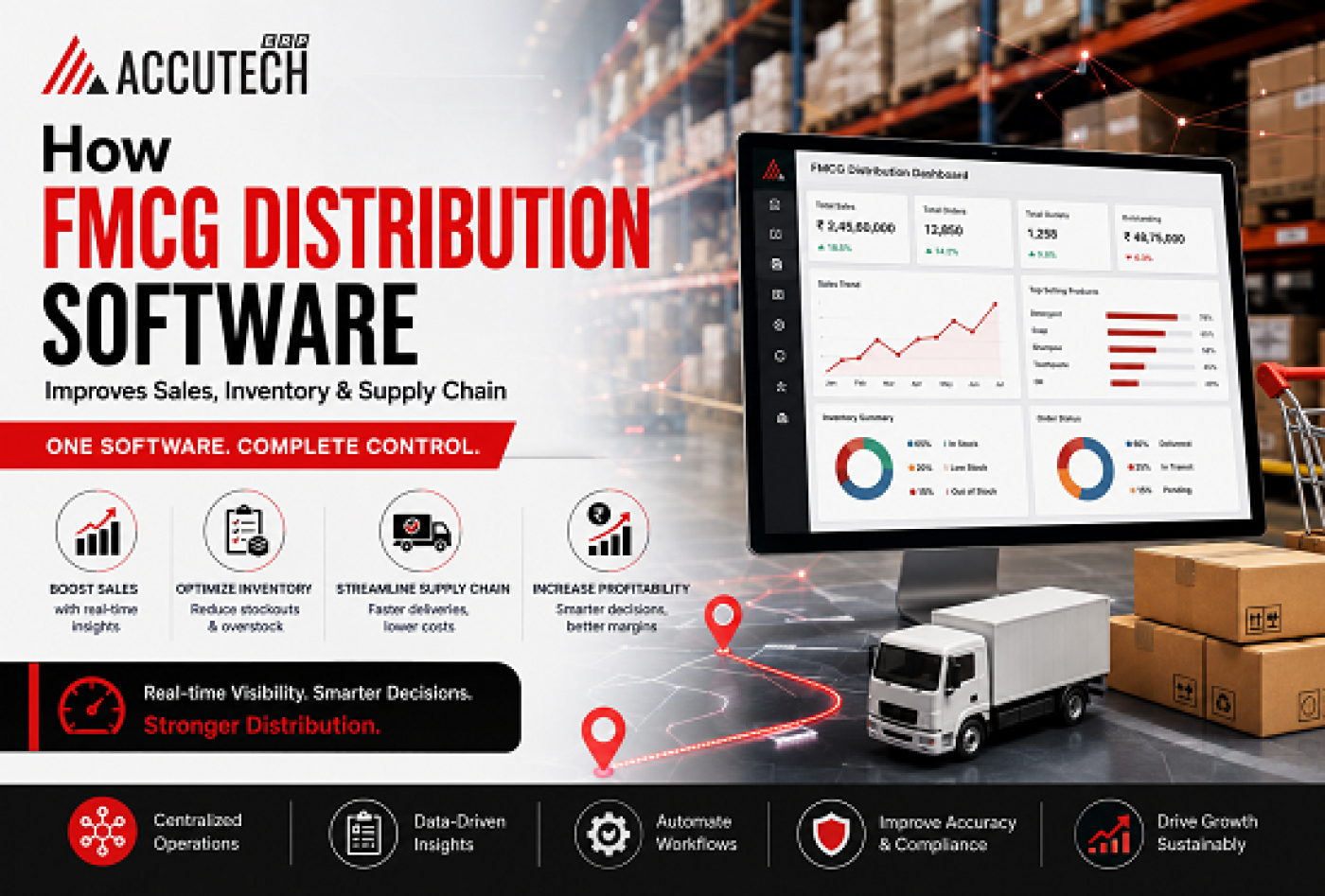
Running a fast-moving consumer goods distribution business feels like juggling fire sometimes. One moment you're managing inventory levels across multiple warehouses, the next you're tracking sales patterns, coordinating with retailers, and ensuring products reach shelves exactly when they're needed. Then there's the supply chain a complex web of suppliers, logistics partners, and distribution channels that demand constant attention and coordination.
If you're reading this, you've probably experienced the headache of manual distribution processes. Papers piling up, spreadsheets that won't sync, inventory counts that don't match reality, and sales data that arrives too late to make decisions. You're managing growth, but the systems holding you back are making it harder, not easier.
Here's the reality in 2026: successful FMCG distribution businesses have moved beyond legacy systems. They've discovered that the right FMCG distribution software isn't just a nice-to-have it's essential for survival and growth.
I want to walk you through something that changed the game for hundreds of distribution companies just like yours. This isn't theory; it's practical insight into how modern FMCG management software reshapes the entire way you operate. We'll explore real challenges, proven solutions, and concrete benefits that translate directly to your bottom line.
Understanding the FMCG Distribution Challenge
Before we talk solutions, let's be honest about the problem. FMCG distribution is inherently complex. Unlike manufacturing where you produce specific quantities, or services where you control delivery timing, FMCG operates in a realm of constant variables.
Why Traditional Distribution Management Falls Short
Think about what your sales team actually does every day. They're managing relationships with hundreds of retailers, handling returns, tracking payments, and trying to predict demand for products with shelf lives. Meanwhile, your warehouse team is receiving shipments, managing stock rotations, handling recalls if needed, and preparing orders for dispatch. And your supply chain team is coordinating with manufacturers, managing transportation logistics, and trying to keep costs down.
Now imagine trying to do all of this with disconnected systems. Your inventory data lives in one spreadsheet, sales information in another and financial data in yet another. By the time information flows between departments, it's already outdated.
This creates several cascading problems:
- Inventory Misalignment - You either have too much stock (tying up capital and risking expiration) or too little (losing sales and disappointing retailers)
- Poor Sales Visibility - You can't see real-time sales trends, making demand forecasting a guessing game
- Inefficient Supply Chain - Without integrated data, you can't optimize routes, consolidate shipments, or negotiate better rates with logistics partners
- Compliance Headaches - Manual tracking makes it nearly impossible to maintain proper batch tracking, expiration date management, and regulatory compliance
- Customer Relationship Breakdown - Retailers get frustrated with delayed orders, inventory issues, or payment discrepancies
- Cash Flow Problems - Outstanding receivables aren't tracked properly, and you lose visibility on payment terms and collection priorities
This isn't just operational inefficiency it's money leaving your business every single day.
The Power of Integrated FMCG Distribution Business Software
Here's where things change. When companies implement proper FMCG ERP software, they're not just automating tasks they're fundamentally transforming how their business operates.
What Modern FMCG Distribution Software Actually Does
An integrated FMCG distribution software solution connects every part of your business into a single, unified system. Think of it as the nervous system of your operation—all information flows through one channel, ensuring everyone has access to the same truth at the same moment.
Let me break down what this means in practical terms:
Real-Time Inventory Management
Forget nightly inventory reconciliations. Modern FMCG management software tracks inventory movements as they happen. When a warehouse assistant scans a barcode and moves 100 units of toothpaste to a bin, the system updates instantly. When a retailer receives an order and scans it in their store, your system knows it. This real-time visibility means you're never working with outdated numbers.
The impact? You maintain optimal stock levels not too much, not too little. You know exactly which products are slow movers and which are flying off shelves. You can spot seasonal trends before they become problems. And you never accidentally oversell because the system prevents it.
Integrated Sales & Route Management
Your sales team gets equipped with tools that make their job dramatically easier. They can check inventory availability before promising anything to a retailer. They can submit orders through mobile apps whether they're in the office or visiting a client. They get alerts when retailers haven't ordered in a while or when stock is running low.
Route optimization features ensure deliveries happen efficiently. Instead of random routes that waste fuel and time, the system calculates optimal paths. Drivers spend more time selling and less time sitting in traffic.
Supply Chain Visibility & Optimization
You suddenly have a bird's-eye view of your entire supply chain. You know where each shipment is, when it's arriving, and what resources it needs. This visibility enables better decisions consolidating shipments to save on transportation, negotiating better rates with logistics partners based on actual volume data, and preventing bottlenecks before they happen.
Financial Control & Profitability
One of the most underrated benefits: automated financial tracking. Every transaction flows into your accounting system automatically. You see profitability by product, by retailer, by region, and by sales representative. This data-driven insight lets you identify which customers are truly profitable and which are eating your margins.
Real-World Impact: How FMCG Distribution Improves Your Core Metrics
Let me get specific about what happens when you implement FMCG distribution business software. These aren't hypothetical benefits they're results we see consistently.
Sales Growth & Market Penetration
When you have real-time data about what's selling and where, something remarkable happens. Your sales team stops guessing. They know exactly which products are performing in each region, which retailers are under-stocked, and which territory has the most potential.
A typical scenario: A regional sales manager notices that in one territory, energy drinks are selling 40% faster than the national average. Simultaneously, they see that three major retailers haven't ordered in two weeks. With this intelligence, they contact those retailers immediately with targeted data showing local demand. Result? Three new orders that night, and energy drink sales up 60% in that territory within a month.
This isn't unusual it's what happens when you transition from reactive management to data-driven selling.
Expected Impact: 15-25% increase in sales within the first 6 months for most companies
Inventory Efficiency & Working Capital Improvement
This benefit directly affects your balance sheet. Instead of maintaining inventory "just in case," you maintain exactly what you need based on actual patterns. Slow-moving products move faster through the supply chain (reducing carrying costs and expiration risk). Fast-moving products are consistently available (reducing stockouts).
We've seen companies reduce inventory levels by 20-30% while simultaneously improving their out-of-stock situations. How? By removing the buffer stock that was necessary in a chaotic system.
Consider the math: If you're carrying ₹50 lakhs in inventory and you reduce it by 25%, that's ₹12.5 lakhs freed up. That capital can now work for you elsewhere in the business marketing, new products, or simply improving cash flow.
Expected Impact: 20-30% reduction in inventory carrying costs, 10-15% improvement in inventory turnover
Operational Cost Reduction
Eliminates a surprising amount of waste in operations. No more manual data entry (which means fewer errors and less wasted time). No more printing and filing endless forms. No more chasing down information because it lives in someone's spreadsheet that didn't get updated.
Distribution costs drop through optimized logistics. Administrative costs drop through automation. Returns processing becomes streamlined. Compliance becomes automatic rather than manual.
Expected Impact: 10-20% reduction in operational expenses
Customer Satisfaction & Retention
Here's something fascinating: When you implement FMCG distribution software, your retail customers immediately notice the difference. Orders arrive on time. Stock levels are consistent. Invoices are accurate. Payment processing is smooth. This reliability builds trust.
Retailers start preferring to work with you because you're more reliable than competitors using manual systems. They place larger orders. They cooperate on promotional activities. They provide better feedback because they know you'll act on it.
The retention benefit is massive it's much cheaper to keep existing customers happy than to constantly replace them.
Expected Impact: 15-20% improvement in customer retention, increased order sizes
Key Features of Enterprise-Grade FMCG ERP Software
Not all FMCG ERP software solutions are created equal. The difference between a basic inventory tracker and a true enterprise solution is enormous. Let me walk through what separates the good from the great.
Inventory & Warehouse Management
An enterprise FMCG distribution software manages the entire lifecycle of inventory. This includes multi-warehouse inventory tracking with real-time updates across locations, lot and batch tracking for compliance and quality control, expiration date management with automatic alerts and rotation recommendations, cycle counting to maintain accuracy without full inventory shutdowns, barcode and RFID integration for fast accurate goods movement, damaged goods and waste tracking for better cost control, and pick and pack optimization to improve order fulfillment speed.
What this means practically: When a retailer submits an order, the system instantly knows which warehouse has that product, whether it meets freshness requirements, and routes it optimally. The warehouse team picks the order in the most efficient sequence. No more searching for products or worrying about expiration dates.
Sales Order Management & Delivery Tracking
A robust system handles the entire order-to-delivery lifecycle with centralized order management from multiple sales channels, real-time inventory checking before order confirmation, automated order routing to the right warehouse, mobile delivery apps with proof of delivery and customer signatures, return management fully integrated into the system, and order history for each customer enabling better relationship management.
The impact here is remarkable. When a sales representative takes an order, they have absolute certainty that the order can be fulfilled. They're not making promises they can't keep. The retailer isn't receiving surprises or partial shipments. Deliveries happen on schedule with full visibility.
Demand Forecasting & Planning
Modern FMCG management software uses historical data and algorithms to predict future demand including seasonal trend analysis, promotional impact modeling, cohort analysis to see which customer segments buy what, predictive reordering that suggests when to order from manufacturers, and alert systems that flag unusual patterns or opportunities.
This transforms procurement from guesswork into science. You order exactly what you need exactly when you need it. Manufacturers love dealing with businesses that have predictable, accurate forecasts and they often reward this with better pricing.
Financial & Profitability Analysis
Understanding profitability goes beyond simple revenue minus costs, including product-level profitability showing which items are truly profitable, customer-level profitability revealing which retailers are valuable vs. which are draining resources, territory performance analysis showing which regions are performing well, contribution margin tracking accounting for all costs including logistics, commission calculations automated and accurate, and financial reconciliation happening automatically.
Imagine knowing that while a particular retailer represents 10% of your revenue, they only contribute 2% of your profit because of high service costs and slim margins. That data alone can transform strategic decisions.
Myths vs. Facts about FMCG Distribution Software
Let me address some common misconceptions I hear regularly.
Myth #1: "It's Just Expensive Inventory Software"
The Reality: Modern FMCG ERP software is a complete business management platform. Yes, inventory management is a component, but it also handles sales, supply chain, finance, customer relationships, and strategic analytics. It's not inventory software with some extras it's a unified business brain.
The investment covers multiple departments and multiple business functions. When you calculate ROI, you're not measuring it against a ₹5 lakh inventory system you're measuring against thousands of hours of manual work, inefficiencies across multiple departments, and missed opportunities.
Myth #2: "Implementation Takes Months and Derails Operations"
The Reality: Modern FMCG distribution business software is designed for rapid implementation. We've seen successful implementations in 4-8 weeks for mid-sized distributors. The key is having a clear plan, dedicated team members, and realistic expectations.
Yes, there's a learning curve. Yes, you need to invest time in data migration and training. But the disruption is temporary, and the gains compound quickly.
Myth #3: "You Need to Change Your Entire Business Process"
The Reality: Good FMCG management software is flexible. It adapts to your business, not the other way around. If you have established processes that work, they can often be maintained while gaining the benefits of automation and visibility.
That said, sometimes the software does reveal that certain processes are inefficient. A good implementation partner will help you identify opportunities to improve, but it's always your choice.
Myth #4: "Small Distributors Can't Benefit"
The Reality: Actually, smaller distributors often see the biggest relative benefits. When you're managing distribution with spreadsheets and paper, moving to a coordinated system creates dramatic improvements. The same software that serves large enterprises scales down elegantly for smaller operations.
Smaller teams with less administrative support benefit most from automation and real-time visibility.
Implementation Strategy: Making FMCG Distribution Software Work for You
Having the best software in the world only helps if you implement it effectively. Let me share what successful implementations look like.
Step 1: Honest Assessment of Current State
Before you buy anything, understand your current situation. How much time do employees spend on manual tasks? Which processes are causing the most frustration? What data do decision-makers truly need (but currently don't have)? Where are the biggest inefficiencies creating costs? What are your growth aspirations?
This assessment determines what you actually need in FMCG distribution software. What features matter most varies by business.
Step 2: Define Success Metrics
Before implementation, decide what success looks like. This might include specific sales growth targets, inventory reduction goals, customer retention improvements, operational cost reductions, delivery accuracy targets, or cash flow improvements.
These metrics guide the implementation and let you measure whether the software is delivering value.
Step 3: Choose the Right Partner
Not all FMCG erp software providers are equal. The right partner should specialize in FMCG distribution (not a generalist who handles everything), have proven implementation experience with businesses similar to yours, offer strong training and ongoing support, provide a product roadmap showing planned improvements, and be willing to understand your specific needs rather than forcing a one-size-fits-all approach.
Step 4: Smart Phased Rollout
The best implementations usually start with core modules. Phase 1 implements inventory and warehouse management to get your foundation right. Phase 2 adds sales order management and basic reporting. Phase 3 implements financial integration and advanced analytics. Phase 4 integrates additional modules like manufacturing if needed.
This phased approach means people aren't overwhelmed, you can measure improvements at each step, and you can adjust course if needed.
Step 5: Continuous Optimization
Software implementation isn't a one-time event. Successful businesses continuously optimize with monthly reviews of system usage and data quality, quarterly analysis of whether metrics are improving, periodic training updates for new users, regular review of bottlenecks or challenges, and proactive identification of features you should be using but aren't.
Comparison: Manual vs. Automated FMCG Distribution
Let me paint a picture showing the difference between managing distribution with legacy systems versus modern FMCG management software.
Scenario: A new order comes in from a major retail client for 5,000 units of a product
Manual Process:
Sales rep calls warehouse to check availability. Warehouse manager checks physical location and spreadsheet (which may be outdated). Warehouse manager calls back with information. Sales rep enters order into system manually. Someone prints order and routes to warehouse. Warehouse manually picks items (potentially wrong units if data was wrong). Warehouse updates spreadsheet manually. Invoicing happens much later through manual entry. Retailer calls later because they haven't received tracking information. Back and forth communication ensues. Several days later, order finally delivers. Invoicing errors aren't caught for weeks.
Automated Process with FMCG distribution software:
Sales rep checks system, sees real-time inventory. Confirms order immediately with confidence. Order automatically routes to optimal warehouse. Warehouse receives digital pick list optimized for efficiency. Barcode scanning ensures right products picked. Delivery app notifies retailer of shipment and provides tracking. Proof of delivery captured automatically. Invoice generated and sent automatically. Financial data flows to accounting system. Entire process complete within hours.
The difference isn't just speed it's reliability, accuracy, and customer satisfaction.
Choosing Your FMCG Distribution Software: What to Look For
When evaluating FMCG distribution business software, consider these factors:
Scalability & Growth Readiness
Your business will grow. The software needs to grow with you. Can it handle 10x your current transaction volume? Multiple warehouses or distribution centers? New product lines? Expansion into new territories? Integration with additional retail partners?
Integration Capabilities
Your FMCG management software shouldn't exist in isolation. It needs to integrate with your accounting and financial systems, banking platforms for payment reconciliation, transportation and logistics platforms, e-commerce platforms if you sell directly, and retail partners' systems ideally.
Mobile & Remote Functionality
In 2026, a field-based workforce is standard. Does the software offer robust mobile apps for sales and delivery teams? Offline functionality for areas with poor connectivity? Real-time synchronization? Push notifications for important updates?
Data Security & Compliance
FMCG distribution involves significant financial transactions and sensitive business data. Is data encrypted both in transit and at rest? Are regular security audits conducted? Is there compliance with relevant regulations? Are there backup and disaster recovery systems? What's the access control and audit trail?
Support & Training
Even the best software needs support. What's included in implementation support? What's the ongoing support model? Are training resources comprehensive? Is there a user community for peer support? What's the response time for critical issues?
Frequently Asked Questions
Q1: How long does it typically take to see ROI from implementing FMCG distribution software?
Most companies see positive ROI within 6-12 months. Early gains typically come from efficiency improvements (reduced manual work, fewer errors) and inventory optimization. Longer-term gains come from sales improvements and strategic insights. Some companies see payback in just 4-5 months if they're currently dealing with significant inefficiencies.
Q2: What if our business operates across multiple locations? Can FMCG ERP software handle that?
Absolutely. Enterprise FMCG ERP software is specifically designed for multi-location operations. You get centralized visibility across all locations while maintaining location-specific operational management. This actually creates major advantages in supply chain optimization and inventory allocation across locations.
Q3: How does FMCG management software handle expiration dates and product recalls?
Modern software includes batch and lot tracking, so every unit is traceable back to its manufacture date. The system automatically alerts you about upcoming expirations, manages rotations, and can quickly identify affected units in a recall situation. This compliance capability is critical for FMCG businesses.
Q4: Can sales teams really use FMCG distribution software in the field?
Yes. Mobile apps allow sales teams to check inventory, submit orders, see customer history, and access promotional materials right from the field. Many teams find that accurate information improves their selling effectiveness because they're not making promises they can't keep.
Q5: What happens with historical data when we migrate to a new FMCG distribution software system?
Good implementation partners handle data migration carefully. Historical data is migrated so you can analyze trends and maintain audit trails. Some data may be archived or summarized to keep the active system responsive, but you maintain access to what you need.
Q6: Is FMCG management software suitable for seasonal businesses?
Yes, in fact it's particularly valuable for seasonal businesses. The demand forecasting features help you anticipate seasonal peaks and prepare inventory accordingly. You avoid being caught off-guard or over-stocking for seasons where demand is lower.
Q7: How does FMCG distribution software improve cash flow?
Multiple ways: Better inventory management ties up less working capital. Automated invoicing and payment tracking mean you collect outstanding payments faster. Real-time profitability analysis helps you focus on high-margin products and customers. These combine to significantly improve cash position.
Q8: Can we customize FMCG distribution business software to match our specific workflows?
Good software finds the balance between flexibility and standardization. You can typically customize significantly, but you need to be selective. Customizing too much makes updates and support difficult. A good partner helps you find the right balance.
Q9: What kind of training do teams need for FMCG ERP software?
Most systems require 1-2 days of training per module. Power users need more. The best implementations include documentation, video training, and ongoing support. After 2-3 weeks, most teams are confident. After 2-3 months, they can't imagine working without it.
Q10: How often do you need to update FMCG management software?
Cloud-based systems typically update automatically in the background you see improvements without any effort. On-premise systems might require scheduled updates. Either way, modern software is designed to minimize disruption from updates.
The Future of FMCG Distribution: Staying Competitive in 2026
The FMCG landscape continues evolving. Here's what's changing and how your software needs to evolve with it:
Omnichannel Retail
Retailers are no longer physical stores they're omnichannel entities selling through physical locations, e-commerce platforms, apps, and more. FMCG distribution software needs to manage distribution across all these channels with unified inventory visibility.
Sustainability Tracking
Modern retailers and consumers care about supply chain sustainability. Your software should track carbon footprints, enable sustainable packaging options, and provide transparency about supply chain practices.
Advanced Analytics & AI
Basic reporting is table stakes now. Leading FMCG management software includes AI-powered demand forecasting, anomaly detection (spotting problems before they become critical), and prescriptive recommendations.
Real-Time Visibility for Retail Partners
Top distributors are providing real-time inventory visibility to retail partners through APIs and portals. This level of transparency builds trust and enables collaborative planning.
Making the Decision: Is It Time for FMCG Distribution Software?
Ask yourself these questions:
- Are you currently losing sales opportunities because you can't fulfill orders reliably?
- Is your inventory either too high (tying up cash) or too low (causing stockouts)?
- Are you spending too much time on manual administration that could be automated?
- Do your decision-makers lack real-time data they need?
- Are your retail customers complaining about order accuracy or timeliness?
- Is cash flow tighter than it should be for your revenue level?
- Are you struggling to scale operations without proportionally increasing headcount?
If you answered "yes" to more than two of these, you're probably ready for FMCG distribution business software.
Conclusion
The FMCG distribution landscape in 2026 belongs to businesses that can operate with speed, accuracy, and intelligence. Manual systems, spreadsheets, and disjointed platforms are increasingly a competitive liability, not just an inefficiency.
Implementing enterprise-grade FMCG distribution software isn't about technology for technology's sake. It's about freeing your team from administrative burden so they can focus on growth. It's about making better decisions based on real data. It's about building reliability that differentiates you from competitors. It's about improving profitability not through cutting corners, but through intelligent optimization.
The companies leading their FMCG categories today aren't doing it because they have access to better products. They're winning because they have better visibility, faster decision-making, and more reliable operations. That's what integrated FMCG management software delivers.
The question isn't whether you need this technology it's how long you can afford to wait while your competitors implement it first.