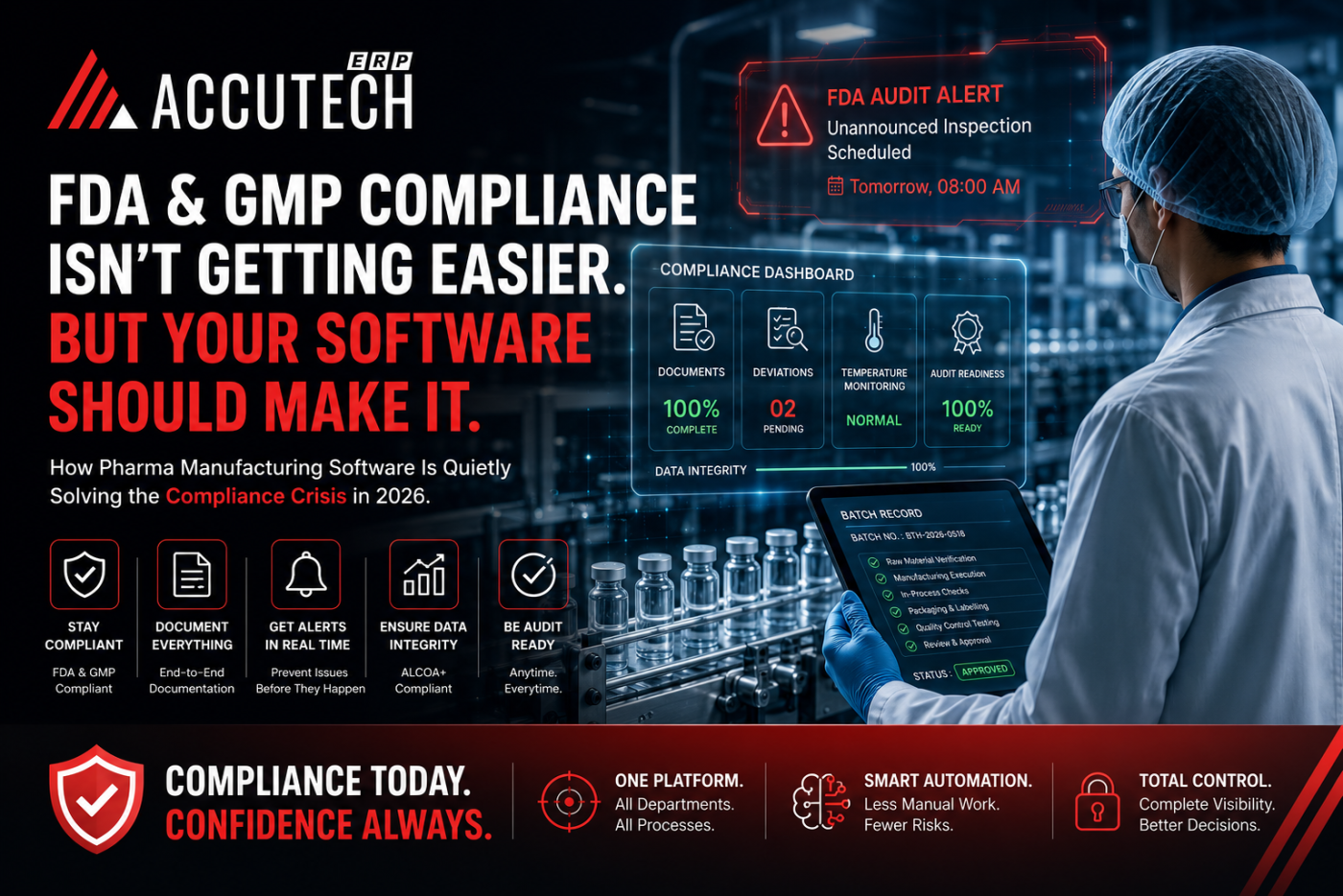
Imagine this. It's 2 AM and your quality assurance manager gets an urgent call. The FDA has scheduled an unannounced inspection for 8 AM. The plant floor is buzzing. Documents need to be located. Batch records need to be verified. Equipment calibration logs need to be in order. And somewhere in a pile of spreadsheets and paper files, the deviation reports from last quarter are missing.
This is not a hypothetical nightmare. This is the daily reality for hundreds of pharmaceutical companies that still rely on manual processes, outdated ERP tools, or disconnected systems to manage their compliance requirements. And in 2026, with the FDA tightening its enforcement actions and global GMP regulations evolving faster than ever, the stakes have never been higher.
The good news? A new generation of pharma manufacturing software is changing the game. It's not just digitizing paperwork. It's creating intelligent, automated compliance ecosystems that make FDA audits less stressful, GMP adherence more consistent, and regulatory reporting almost effortless. In this guide, we're going to walk through everything you need to know from the basics of FDA and GMP compliance to how the right software can protect your license, your reputation, and ultimately your patients.
Whether you're a compliance officer, a plant manager, a business owner running a pharma PCD franchise, or someone just beginning to explore digital transformation in your pharmaceutical manufacturing unit this guide is for you.
Understanding FDA and GMP Compliance: Why It's More Critical Than Ever in 2026
Before we dive into software, let's get grounded. FDA (Food and Drug Administration) compliance in the pharmaceutical industry refers to following the regulations set by the FDA for the development, manufacturing, testing, and distribution of drugs and medical products. GMP which stands for Good Manufacturing Practice is the set of guidelines and regulations that ensure pharmaceutical products are consistently produced and controlled according to quality standards.
In simpler terms: FDA tells you what's acceptable. GMP tells you how to do it right.
What Has Changed in 2026?
The pharmaceutical compliance landscape in 2026 looks quite different from even three years ago. Here's what's driving the urgency:
- The FDA has increased the frequency and scope of both domestic and international inspections following several high-profile drug recalls.
- WHO GMP guidelines have been updated with more stringent documentation requirements for data integrity.
- ICH Q10 and Q12 guidelines now demand lifecycle management documentation for pharmaceutical products.
- Electronic records and e-signatures (21 CFR Part 11) compliance has become non-negotiable.
- Supply chain transparency and traceability are under intense scrutiny due to counterfeit drug incidents.
The result? Pharmaceutical companies that relied on Excel sheets and manual batch records are now scrambling. Regulatory warning letters have increased. FDA 483 observations citing poor documentation practices are more common. And companies that receive import alerts or consent decrees face crippling financial and reputational damage.
This is exactly where GMP compliance software steps in as not just a convenience but a strategic necessity.
The Real Cost of Non-Compliance: A Story from the Shop Floor
Let's talk about Ramesh. He runs a mid-sized pharmaceutical manufacturing unit in Baddi, Himachal Pradesh. His company produces around 40 different formulations tablets, capsules, syrups and supplies to PCD franchise partners across 12 states. Business was growing, and he was proud of what he'd built.
Then came the state drug inspector's visit. What started as a routine visit turned into a nightmare. The inspector found discrepancies in batch manufacturing records some entries were incomplete, calibration logs for two machines were months overdue, and the temperature logs for the cold storage unit had a 72-hour gap. No alarms had gone off. No alerts had been generated. Nobody had noticed.
The manufacturing license was suspended for 45 days pending rectification. The cost? Over ₹60 lakh in lost production, recall logistics, and regulatory consulting fees. And that's not counting the damage to trust with his franchise partners.
Ramesh's story is not unique. It's being repeated across pharmaceutical companies of all sizes — large multinationals, mid-sized generics manufacturers, and small PCD franchise operations. The common thread is always the same: compliance was manual, tracking was reactive, and technology was an afterthought.
Today, after implementing a proper pharma ERP software solution, Ramesh's team gets automatic alerts before calibrations are due, batch records are auto-populated and locked after review, and temperature deviations trigger real-time notifications. His last two inspections were smooth. The auditors actually complimented the documentation system.
What Exactly Is Pharma Manufacturing Software? A Beginner-Friendly Explanation
If you're new to the concept, here's the simplest way to understand it: pharma manufacturing software is a digital platform specifically designed for pharmaceutical companies to manage all their manufacturing operations, quality processes, and regulatory compliance requirements in one centralized system.
Think of it as the nervous system of your pharmaceutical plant. It connects every department production, quality control, procurement, warehouse, HR, and finance and ensures that data flows seamlessly, decisions are made on real-time information, and regulatory requirements are automatically tracked and documented.
Core Modules Typically Found in Pharma Manufacturing Software
- Batch Manufacturing Records (BMR): Digital creation, management, and archiving of batch records according to GMP guidelines.
- Quality Management System (QMS): Manage SOPs, deviations, CAPA (Corrective and Preventive Actions), change control, and audits.
- Equipment and Calibration Management: Track equipment qualification, calibration schedules, and maintenance history.
- Inventory and Material Management: Full traceability of raw materials, intermediates, and finished goods from receipt to dispatch.
- Laboratory Information Management System (LIMS): Manage QC testing, out-of-specification (OOS) investigations, and certificate of analysis generation.
- Regulatory Compliance Tracking: 21 CFR Part 11 compliant e-signatures, audit trails, and document version control.
- HR and Training Management: Track personnel qualifications, training records, and competency assessments.
- Production Planning and Scheduling: Optimize production schedules based on demand forecasts, material availability, and equipment capacity.
When all these modules work together within a single pharma ERP software ecosystem, the result is a fully integrated, audit-ready, compliance-first manufacturing environment.
How Pharma Manufacturing Software Directly Addresses FDA Compliance Requirements
The FDA's compliance framework covers a broad spectrum. Let's break down the most critical areas and show exactly how technology addresses each one.
1. 21 CFR Part 211 — Current Good Manufacturing Practice
This regulation governs the manufacture, processing, packing, and holding of finished pharmaceuticals. Compliance requires complete records for every batch, validated equipment, trained personnel, and controlled laboratory conditions.
How software helps: GMP compliance software automates batch record creation using master batch templates, ensures no steps are skipped during manufacturing, enforces electronic sign-offs at critical control points, and maintains complete audit trails all in line with 21 CFR Part 211 requirements.
2. 21 CFR Part 11 — Electronic Records and Electronic Signatures
This is one of the most frequently cited areas of non-compliance in FDA warning letters. Part 11 requires that electronic records be as trustworthy and reliable as paper records, and that electronic signatures be uniquely attributable to individual users.
How software helps: A compliant pharma manufacturing software system provides unique user IDs, password-protected access controls, time-stamped electronic signatures, and immutable audit trails that cannot be altered or deleted. Every action in the system is logged who did it, when, and why.
3. Data Integrity — The ALCOA+ Framework
The FDA's data integrity guidance requires that all data be Attributable, Legible, Contemporaneous, Original, and Accurate plus complete, consistent, enduring, and available. Manual systems almost always fail at least one of these criteria.
How software helps: Digital systems capture data at the point of entry, prevent backdating, lock records after approval, and store them in a secure, redundant infrastructure. This is the foundation of ALCOA+ compliance that modern pharma ERP software is built upon.
4. Recall Management and Product Traceability
The FDA requires pharmaceutical companies to have robust systems for identifying and recalling products that may be defective or unsafe. This requires complete traceability knowing exactly which raw material lot went into which batch, which batch went to which distributor, and where the product is right now.
How software helps: Pharma production management software creates a digital chain of custody from supplier to patient, making recall execution rapid and precise. Instead of days of manual searching, a recall map can be generated in minutes.
Going Deeper: How GMP Compliance Software Transforms Day-to-Day Operations
GMP compliance isn't a once-a-year audit exercise. It's a daily discipline. Every shift, every batch, every cleaning cycle, every temperature reading is part of the GMP story. And when you're running a manufacturing operation at scale, maintaining this discipline manually is nearly impossible without errors.
Standard Operating Procedures (SOPs) — Living Documents, Not Forgotten Files
In a GMP-compliant operation, SOPs are the backbone. They define how every activity must be performed. But here's the problem with paper or static digital SOPs: they get outdated, different departments use different versions, and there's no way to prove that the person performing the task actually read and understood the SOP.
GMP compliance software transforms SOPs into living, version-controlled documents. When an SOP is updated, the system automatically notifies all relevant personnel, requires acknowledgment sign-offs, archives the old version, and prevents use of outdated procedures. It's the difference between compliance as hope and compliance as certainty.
CAPA Management — Closing the Loop on Quality Issues
Corrective and Preventive Action (CAPA) is one of the most important and most mismanaged aspects of pharmaceutical quality systems. Every deviation, out-of-specification result, customer complaint, or audit finding should trigger a structured CAPA process root cause analysis, corrective actions, verification of effectiveness, and closure.
Manual CAPA tracking typically involves endless email chains and spreadsheets. Things fall through the cracks. Actions remain open for months. Root causes are never properly investigated. Regulators notice.
With pharma manufacturing software, every CAPA is tracked in a structured workflow with assigned owners, deadlines, escalation alerts, effectiveness checks, and complete audit trails. The system won't let a CAPA close unless all required steps are completed.
Equipment Management — From Reactive to Predictive
Equipment failures during production cause batch failures, lost materials, and potential safety issues. GMP requires that all manufacturing equipment be properly qualified, calibrated, and maintained. The FDA routinely flags companies whose equipment logs are incomplete or show gaps in calibration schedules.
Pharma production management software maintains a complete equipment register with installation qualification (IQ), operational qualification (OQ), and performance qualification (PQ) records. It automatically generates calibration due reminders, links equipment to the batches it was used in, and tracks maintenance work orders. In 2026, some advanced platforms even integrate with IoT sensors for real-time equipment condition monitoring.
Environmental Monitoring — Because Conditions Matter
Temperature, humidity, pressure differentials, and microbial counts in manufacturing areas are all critical GMP parameters. Deviations can compromise product quality and patient safety. Manual monitoring is error-prone and often reactive — you discover the deviation after the damage is done.
Modern GMP compliance software integrates with environmental monitoring systems to capture real-time data, set threshold alerts, automatically trigger investigations when deviations occur, and maintain the complete monitoring history that regulators expect to see.
Pharma ERP Software vs. Generic ERP: Why Industry-Specific Matters
This is a question we hear constantly: "We already have SAP/Oracle/Tally. Why do we need specialized pharma software?" It's a fair question. Let's answer it honestly.
Generic ERP systems are powerful financial and operational tools. They manage accounting, HR, procurement, and basic inventory very well. But they were not built with pharmaceutical regulatory requirements in mind. They don't natively understand batch manufacturing records, GMP documentation hierarchies, 21 CFR Part 11 e-signature requirements, or the concept of in-process quality checks.
Key Differences: Generic ERP vs Pharma ERP Software
- Batch Record Management: Generic ERP has none; Pharma ERP has full digital BMR with in-process controls.
- 21 CFR Part 11 Compliance: Generic ERP requires expensive customization; Pharma ERP is built-in natively.
- CAPA and Deviation Management: Generic ERP not supported; Pharma ERP has structured quality event workflows.
- LIMS Integration: Generic ERP requires third-party tools; Pharma ERP is integrated or natively included.
- Regulatory Reporting: Generic ERP requires manual preparation; Pharma ERP auto-generates regulatory reports.
- Audit Readiness: Generic ERP is reactive; Pharma ERP has continuous audit trail and readiness dashboards.
The bottom line: pharma ERP software is not an upgrade from generic ERP it's a fundamentally different category of tool designed for the unique regulatory and operational demands of pharmaceutical manufacturing.
Pharma PCD Franchise Operations: Compliance Challenges and How Software Helps
The pharma PCD (Propaganda Cum Distribution) franchise model has exploded in India. With thousands of franchise partners operating across the country, compliance management has become one of the most complex challenges for pharma manufacturers.
For the manufacturer, every product that leaves the plant and goes into the PCD distribution network must meet GMP standards. Quality failures at any point in this chain whether at the manufacturing unit or in the distribution and storage process can result in regulatory action against the entire company.
How Pharma Production Management Software Addresses PCD Compliance
- Complete batch traceability: Every batch manufactured for PCD distribution is fully traceable with manufacturing records, QC results, and distribution history.
- Franchise-specific labeling and packaging compliance: Manage multiple brand names, franchise partner codes, and state-specific labeling requirements.
- Expiry date management: Automatic FEFO (First Expired, First Out) enforcement to prevent expired stock from entering the market.
- Recall capability: Identify within minutes which franchise partners received a specific batch if a recall is required.
- Complaint management: Structured product complaint intake, investigation, and closure processes connected to QMS.
For companies like those powered by Accutech ERP's pharma manufacturing software, the PCD module is specifically designed to handle the unique needs of franchise operations while keeping the entire quality and compliance system in perfect alignment.
Myths vs. Facts: What People Get Wrong About Pharma Compliance Software
There are a lot of misconceptions floating around about pharmaceutical software and compliance technology. Let's clear them up.
Myth 1: "Compliance software is only for large pharmaceutical companies"
Fact: Small and mid-sized pharma manufacturers actually have the most to gain from GMP compliance software. Large companies have dedicated compliance teams. Smaller companies often operate with lean staff where one person wears multiple compliance hats. Software amplifies the capability of small teams by automating routine compliance tasks.
Myth 2: "We pass audits fine with our current paper system"
Fact: Passing yesterday's audit doesn't mean you'll pass tomorrow's. FDA and CDSCO inspectors are increasingly trained to detect data integrity issues in paper-based systems. Gaps in sequential page numbers, consistent handwriting under different names, and backdated entries are red flags that paper systems make easy to create accidentally or deliberately.
Myth 3: "Implementing pharma software takes years and disrupts operations"
Fact: Modern cloud-based pharma ERP software solutions can be deployed in phases, starting with the highest-priority compliance modules. A phased implementation approach minimizes disruption while delivering compliance benefits quickly. Many companies see ROI within the first audit cycle.
Myth 4: "Software can't handle the complexity of our unique processes"
Fact: Purpose-built pharma production management software is configurable for different dosage forms (solid, liquid, sterile), different regulatory jurisdictions (FDA, EMA, WHO, CDSCO), and different manufacturing models (in-house, contract, PCD). The best solutions are built with pharmaceutical operations in mind from the ground up.
Myth 5: "The software does the compliance for us"
Fact: Software enforces compliance processes, captures evidence, and eliminates human error in documentation. But people still make the decisions, perform the manufacturing steps, and take responsibility for quality. Software is the infrastructure for compliance the people are the culture.
The Tangible Benefits of Investing in Pharma Manufacturing Software: A Business Case
Beyond regulatory compliance, pharma manufacturing software delivers measurable business value. Let's look at the numbers.
1. Dramatic Reduction in Compliance Preparation Time
Companies that switch from paper-based systems to digital GMP compliance software typically report a 60–80% reduction in time spent preparing for regulatory audits. When all records are digital, searchable, and audit-trail protected, inspection preparation that used to take weeks now takes days or hours.
2. Reduction in Batch Failures and Rejections
In-process quality checks built into digital batch records catch errors in real time before they become batch failures. Companies using automated manufacturing execution systems report significant reductions in batch rejection rates. Even a 1–2% improvement in batch yield can represent substantial cost savings.
3. Faster Time to Market
With integrated pharma ERP software, production planning, material procurement, and batch scheduling are optimized. Bottlenecks are identified and addressed proactively. Companies typically see 15–25% improvement in production throughput after implementing comprehensive pharma ERP solutions.
4. Lower Risk of Costly Regulatory Actions
An FDA warning letter costs, on average, between 1M–5M to resolve (including remediation, consultants, and lost production). A consent decree can cost tens of millions. A good pharma manufacturing software system is not an expense it's insurance against catastrophic regulatory failure.
5. Better People, Better Processes
When compliance is automated and enforced by software, your quality and production staff spends less time on administrative paperwork and more time on value-added activities improving processes, training, problem-solving, and innovation. It's a cultural shift from compliance as a burden to compliance as a foundation for excellence.
How to Choose the Right Pharma Manufacturing Software for Your Business
With the number of solutions available in the market today, choosing the right pharma ERP software can feel overwhelming. Here's a practical framework.
Step 1: Define Your Compliance Requirements
Are you manufacturing for the Indian market (CDSCO), export to the US (FDA), Europe (EMA), or global WHO markets? Each has slightly different requirements. Your software must be configurable for your specific regulatory environment.
Step 2: Assess Your Current Pain Points
Where does your current system break down? Is it documentation? Equipment management? Inventory traceability? Identify your top three pain points and make sure the software you select has proven capability in exactly those areas.
Step 3: Evaluate Industry-Specific Features
Look for software built by people who understand pharmaceutical manufacturing — not generic software adapted for pharma. Check for built-in GMP compliance software features like 21 CFR Part 11 compliance, GMP documentation workflows, and pharmaceutical-grade audit trails.
Step 4: Check Implementation Support and Training
Software is only as good as its implementation. Look for vendors who provide dedicated implementation support, user training, and ongoing technical assistance. The best pharma production management software vendors become long-term compliance partners, not just software sellers.
Step 5: Consider Scalability
Your business will grow. Your software must grow with it — handling more products, more users, more facilities, and evolving regulatory requirements. Cloud-based pharma ERP software is generally more scalable and easier to keep updated than on-premise solutions.
2026 Technology Trends Shaping Pharma Compliance Software
The pharma compliance technology landscape is evolving rapidly. Here are the trends that forward-thinking pharmaceutical companies are already embracing in 2026.
AI-Powered Risk Prediction
Advanced GMP compliance software platforms are now incorporating AI models that analyze historical batch data, equipment performance trends, and environmental monitoring patterns to predict quality risks before they occur. This predictive quality management approach is becoming a key differentiator for leading pharma manufacturers.
IoT Integration for Real-Time Monitoring
Sensors embedded in manufacturing equipment, cold chain logistics, and clean rooms now feed real-time data directly into pharma manufacturing software systems. Any deviation triggers immediate alerts, automatic record-keeping, and if necessary, equipment shutdowns preventing contamination or quality failures before they escalate.
Blockchain for Supply Chain Integrity
Blockchain-based track and trace systems are being integrated with pharma production management software to create immutable supply chain records. From raw material sourcing to final distribution, every hand-off is recorded in a tamper-proof digital ledger the ultimate answer to counterfeit drug concerns.
Cloud-First Architecture
Cloud-based pharma ERP software eliminates the need for expensive on-premise infrastructure, enables remote access for multi-site operations, provides automatic software updates with the latest regulatory compliance features, and ensures disaster recovery and data backup. In 2026, cloud-first is no longer just a preference it's a strategic advantage.
Mobile-First Compliance Tools
Shop floor operators, quality inspectors, and warehouse staff now use mobile apps connected to the central pharma manufacturing software platform. Electronic batch records can be completed on tablets. Deviations can be reported instantly from anywhere on the production floor. Approvals can be given via mobile with full audit trail integrity.
Practical Guidance: Building a Compliance Culture Alongside Technology
Technology is a tool. Culture is the foundation. The most powerful GMP compliance software in the world will underperform in an organization where compliance is seen as a burden rather than a value. Here's how to build both simultaneously.
Leadership commitment is non-negotiable. If the management team treats compliance as a checkbox exercise, the shop floor will too. Leaders must visibly champion quality through their words, their resource allocation decisions, and their personal involvement in quality reviews.
Involve operators in system implementation. The people who will use pharma manufacturing software every day should be part of the configuration and testing process. Their insights will make the system more practical and increase adoption rates dramatically.
Make training continuous, not one-time. Regulatory requirements evolve. Software features are updated. Refresher training and competency assessments should be scheduled regularly, and the software's training management module should track this automatically.
Celebrate quality wins. When a batch is manufactured with zero deviations, when a CAPA is closed effectively, when an audit yields zero observations celebrate it publicly. Positive reinforcement builds the quality culture that technology alone cannot create.
Review compliance metrics monthly. Use the reporting capabilities of your pharma ERP software to hold monthly quality management reviews looking at open CAPAs, deviation trends, OOS rates, calibration compliance, and training completion. Data-driven quality management is the foundation of continuous improvement.
Frequently Asked Questions (FAQ Schema Ready)
Q1: What is GMP compliance software and why do pharmaceutical companies need it?
GMP compliance software is a specialized digital system that helps pharmaceutical manufacturers adhere to Good Manufacturing Practice regulations by automating documentation, tracking deviations, managing SOPs, and maintaining audit trails. Pharmaceutical companies need it because manual systems are error-prone, fail to meet modern data integrity requirements, and cannot scale with the increasing complexity of regulatory expectations.
Q2: How does pharma ERP software differ from regular ERP systems?
Pharma ERP software is purpose-built for pharmaceutical operations and includes native features like batch record management, 21 CFR Part 11 compliant electronic signatures, QMS workflows, LIMS integration, and GMP documentation management. Regular ERP systems lack these pharmaceutical-specific features and would require extensive, expensive customization to meet regulatory requirements.
Q3: Can small pharma manufacturers afford and benefit from pharma manufacturing software?
Absolutely. Cloud-based pharma manufacturing software is available at subscription pricing that makes it accessible for small and mid-sized manufacturers. The ROI is often achieved within the first year through reduced compliance preparation time, lower risk of regulatory actions, and improved batch yields. Small manufacturers benefit disproportionately because they typically have lean compliance teams who can be greatly amplified by automation.
Q4: What is 21 CFR Part 11 and how does pharma software help comply with it?
21 CFR Part 11 is the FDA regulation that governs the use of electronic records and electronic signatures in the pharmaceutical industry. It requires that electronic records be as trustworthy as paper records and that signatures be uniquely attributable and non-repudiable. GMP compliance software addresses this through unique user credentials, time-stamped e-signatures, immutable audit trails, and access controls.
Q5: How long does it take to implement pharma production management software?
Implementation timelines vary based on the size of the organization and the number of modules being implemented. A phased approach typically begins with core pharma production management software modules (batch records, QMS) and can be live within 8–16 weeks. Full enterprise implementation including all modules may take 6–12 months. Cloud-based solutions generally deploy faster than on-premise systems.
Q6: Is pharma manufacturing software suitable for PCD franchise operations?
Yes. Pharma manufacturing software with PCD-specific modules manages franchise-specific labeling, batch allocation to franchise partners, product traceability in the distribution network, expiry date management, and complaint handling. It ensures that the manufacturer maintains complete regulatory compliance across all franchise operations.
Q7: What should I look for when evaluating GMP compliance software vendors?
Evaluate vendors based on: pharmaceutical industry expertise and customer references, native compliance features without expensive customization, scalability for future growth, quality of implementation support and training, data security and cloud infrastructure reliability, regular updates aligned with evolving regulatory guidance, and the vendor's own quality management practices. The best GMP compliance software vendors operate as long-term compliance partners.
Q8: How does pharma software help during an FDA inspection?
During an FDA inspection, pharma ERP software allows instant retrieval of any batch record, SOP, calibration log, training record, or CAPA. Investigators can be shown complete electronic records with full audit trails. Cross-referencing between related documents is instantaneous. The system can generate summary compliance reports on demand. This dramatically reduces inspection time and the risk of missing or incomplete records.
Conclusion: The Future of Pharma Compliance Is Already Here
We're living in a fascinating and demanding time for the pharmaceutical industry. Regulatory expectations have never been higher. Patient safety has never been more closely tied to data integrity. And the gap between companies that embrace pharma manufacturing software and those that don't has never been wider.
The pharmaceutical manufacturers who will thrive in 2026 and beyond are not necessarily those with the largest plants or the biggest budgets. They are the ones who have built quality and compliance into the DNA of their operations supported by intelligent GMP compliance software, empowered by pharma ERP software, and guided by smart pharma production management software that turns compliance from a cost into a competitive advantage.
Think back to Ramesh's story. He didn't just buy software he bought peace of mind, operational confidence, and the ability to walk into any regulatory inspection with his head held high. That's what the right technology partner can deliver.
If you're running a pharmaceutical manufacturing operation and you're still relying on manual processes, disconnected spreadsheets, or generic software to manage your compliance requirements, the time to change is now before the next inspection, before the next batch failure, before the next compliance gap becomes a regulatory crisis.
Your patients deserve compliant medicines. Your business deserves a compliant future. And your team deserves tools that make doing the right thing easier than doing the wrong thing. That's exactly what world-class pharma manufacturing software delivers.