It's 10 AM on a Tuesday morning. Your sales team just received three urgent orders from your biggest retail partners. One customer needs 2,000 units of your best-selling beverage. Another needs 500 cases of snacks. The third is requesting 300 packs of your premium product line. These are high-margin orders that could make your week. But here's the problem: nobody knows if you actually have this stock.
Your warehouse manager says you have inventory. Your distribution team isn't sure. Your ERP system shows one number. Your physical count shows another. By the time you figure out what's actually in stock, two hours have passed. Your customers have already called competitors. You've lost approximately ₹50,000 in revenue and this happens multiple times per week.
This is the harsh reality for thousands of FMCG businesses across India that operate without real-time inventory visibility. They're bleeding money through lost sales, excess inventory, waste, and operational inefficiency. And most don't even realize how much the problem is costing them.
The fast-moving consumer goods industry operates under unique pressures that make real-time inventory visibility not just beneficial, it's essential. Unlike other industries where inventory might sit for months, FMCG products have brief shelf lives. Demand fluctuates wildly. Retail relationships are fragile. Margins are thin. Competition is fierce. One mistake is a stockout when you have inventory, or excess stock that expires can cost you thousands of rupees and damage customer relationships irreparably.
But what if you could see every unit of inventory across your entire distribution network at any moment? What if you could answer a customer's "Do you have stock?" question in seconds instead of hours? What if you could optimize your inventory so precisely that you eliminate both stockouts and waste?
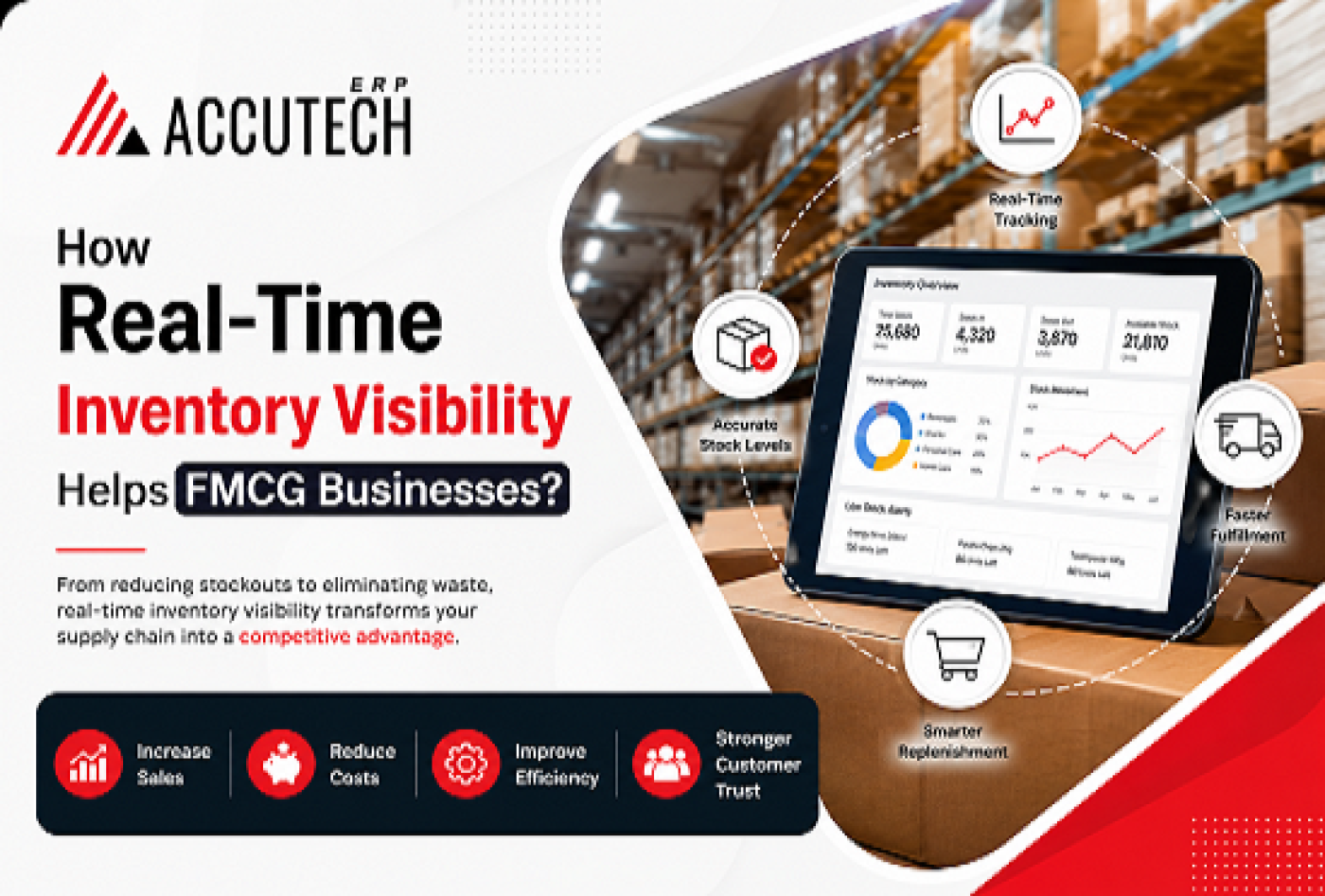
That's exactly what real-time inventory visibility delivers. In this comprehensive guide, we'll explore how FMCG Distribution ERP Software with real-time inventory tracking transforms distribution operations, eliminates the guesswork, and turns your supply chain into a competitive advantage. More importantly, we'll show you the exact financial impact of the revenue increase, cost reduction, and profitability improvement you can expect.
The FMCG Distribution Challenge: Why Inventory Visibility Matters More Than Ever
To understand why real-time inventory visibility is so critical for FMCG businesses, you need to understand the unique characteristics of the industry. FMCG which stands for Fast-Moving Consumer Goods encompasses everything from beverages and packaged foods to personal care products, toiletries, and household items. These are products that sell quickly, have razor-thin margins, and face intense competition.
The Velocity Challenge
Speed defines the FMCG business. A beverage that's on the shelf today might be gone by tomorrow. A snack product that flies off retail shelves Friday might need emergency restocking Monday. A seasonal product that wasn't selling in March suddenly becomes hot in summer. This velocity is different from manufacturing or B2B business where inventory might move monthly or quarterly.
This speed creates a massive challenge for inventory management. Traditional systems that update once daily or require manual counting become obsolete almost immediately. By the time you know you're out of a popular product, you've already lost days of sales. The opportunity has passed.
The Complexity of Multi-Channel Distribution
FMCG businesses don't just have one warehouse. They have multiple distribution centers, numerous retailers, independent shops, wholesalers, e-commerce platforms, and third-party logistics partners. You might have stock in your central warehouse, in a regional distributor's facility, in transit to a retail chain, and physically on retailer shelves simultaneously. Tracking all of this without real-time visibility becomes nearly impossible.
A typical medium-sized FMCG company might have:
- 2-3 central warehouses
- 8-12 regional distribution centers
- Relationships with 50-200 smaller distributors
- Direct delivery to 500-5,000 retail outlets
- Multiple third-party logistics providers
- 200-2,000 different SKUs across categories
Without real-time visibility, you're flying blind across this complex network. You don't know where your inventory is. You can't tell customers where a product is available. You can't make optimal reordering decisions. You're managing a distributed empire with a control system from the 1990s.
The Shelf-Life Imperative
Unlike durable goods that can sit indefinitely, most FMCG products have expiration dates. A dairy product expires in 30 days. A beverage in 6 months. A packaged snack in 12 months. The challenge is managing stock across your entire distribution network so that products near expiration date get sold before they go bad.
The math is brutal: if 10% of your inventory expires and becomes waste, that's 10% of your revenue that generates zero profit; it just generates loss. For a ₹100 crore FMCG company, that's ₹10 crore in annual waste. That could be the difference between 5% and 15% profit margins.
Real-time visibility allows you to identify aging inventory before it reaches expiration. You can flag products that need priority sales attention. You can adjust pricing to move aging stock. You can prevent waste by ensuring the product reaches consumers while it's still good.
The Margin Squeeze
FMCG operates on notoriously thin margins. A typical FMCG company might have gross margins of 20-40%, but after distribution costs, warehousing, logistics, and other overhead, net margins often fall to just 3-8%. This means small inefficiencies create big problems.
Consider the impact: if poor inventory management causes you to miss just 5% of potential sales, that's revenue lost directly to the bottom line. That lost 5% in sales might represent a 20-30% reduction in profit. Suddenly, inventory visibility isn't a nice optimization; it's the difference between a profitable quarter and a loss.
The Customer Relationship Factor
In FMCG, your retail partners are everything. A major retail chain carries your products on valuable shelf space. If you frequently disappoint them with stockouts not having a product when they need it they'll simply replace you with a competitor's brand. That lost shelf space might never come back.
Real-time inventory visibility helps you protect these critical relationships. You can fulfill orders reliably. You can communicate accurately about availability. You can work with retailers as a true partner, not a frustrating vendor. This reliability translates to shelf space, which translates to volume, which drives profitability.
The Current Pain: What Happens Without Real-Time Visibility
Before we explore solutions, let's be very specific about the problems that plague FMCG businesses operating without real-time inventory visibility. These aren't hypothetical challenges they're happening right now, costing real money.
Problem #1: The Stockout Revenue Killer
You have inventory. You have customers who want to buy. But somehow, sales don't happen. Why? Because your system says you're out of stock.
This happens constantly in FMCG businesses with poor visibility. A warehouse counts inventory manually once per week. The count says you have 1,000 units. But 300 units were already committed to pending orders. 200 units are damaged and unusable. 150 units are in the quality check area. So you actually only have 350 units available. But your sales system shows 1,000 units available for sale. A customer orders 800 units. You confirm the order. Then you realize you can't fulfill it. Customer cancels. Another customer orders from your competitor instead.
The consequences of this are severe:
- Lost revenue from unfulfilled orders
- Damaged customer relationships
- Customer switching to competitors
- Retail partners losing faith in your reliability
- Brand damage if stockouts are frequent
Industry research shows that FMCG companies lose 4-12% of potential sales revenue due to stockouts. For a company with ₹50 crore annual revenue, that's ₹2-6 crore in lost sales annually. This is the single biggest financial impact of poor inventory visibility.
Problem #2: The Overstocking Trap
The flip side of stockouts is overstocking. When you don't know your actual inventory levels, you order defensively. You don't want to face the embarrassment of stockouts, so you order extra "just in case." This ties up capital that could be used elsewhere. It increases storage costs. And in FMCG, it guarantees that some stock will expire before it sells.
Here's what happens: You think you have less inventory than you actually do. So you place a purchase order for 5,000 units. A week later, you discover you already had 3,000 units in stock from a previous order you forgot about. Now you have 8,000 units for a product that sells 1,500 units per month. That excess inventory sits in your warehouse or distributor warehouses, aging. Six months later, it's near expiration. You mark it down 50% to sell it quickly. You just sacrificed ₹10-15 lakhs in profit to avoid having it expire completely.
The financial impact:
- 20-30% of working capital tied up in excess inventory
- Additional storage and handling costs
- 5-12% of inventory expires and becomes waste
- Slow-moving inventory marks down, reducing margins
- Cash flow pressure from capital tied up
Problem #3: The Manual Labor Nightmare
Without real-time visibility, people become your inventory management system. Someone has to:
- Physically count inventory at each location
- Update records manually with the counts
- Reconcile counts from different locations
- Answer "Do we have stock?" questions all day
- Resolve discrepancies when systems don't match
- Call distributors to get their inventory levels
- Update spreadsheets and send reports
This is expensive, error-prone work. A typical FMCG company might have 5-10 people spending significant time on inventory management that could be automated. At ₹50,000 per person per month, that's ₹25-50 lakhs annually in payroll for activities that a good software system could handle automatically.
More importantly, these people aren't doing revenue-generating work. They're doing administrative work because the systems don't provide visibility.
Problem #4: The Decision-Making Paralysis
Without real-time visibility, decision-making becomes difficult or impossible. Consider these questions that FMCG leaders frequently need to answer:
- Which products are actually performing best? (You think X, but it might be Y)
- How much inventory should we maintain across our network?
- Which locations are running low and need emergency resupply?
- Are we overstocked in some locations and understocked in others?
- What's our actual inventory turnover rate?
- How much of our inventory is aging and at risk of expiration?
Without real-time data, you're guessing at these questions. Your decisions are based on outdated information. The result is suboptimal decisions that cost money.
Understanding Real-Time Inventory Visibility: How It Actually Works
Now that we've established why real-time visibility is so critical, let's explore how it actually works. This isn't complex or mysterious it's elegant technology applied to solve a real business problem.
The Foundation: Automated Data Capture
At the heart of real-time inventory visibility is automated data capture. Instead of people manually counting and recording inventory, the system captures data automatically through multiple methods:
Barcode Scanning: When products are received, picked, packed, or shipped, they're scanned. The barcode tells the system exactly what product it is, and the system automatically updates inventory.
Point-of-Sale Integration: When a product sells at retail, the POS system (cash register) records the sale. This data flows directly into your inventory system, so you see the sale reflected immediately.
Warehouse Management Systems: Modern warehouses use WMS (Warehouse Management Systems) to track all inventory movements. When a product is moved, the system knows about it instantly.
IoT Sensors: For high-value or temperature-sensitive products, IoT sensors can track location and conditions automatically.
The result: inventory data updates in real-time as transactions occur. You don't wait for manual counts. You don't rely on memory or spreadsheets. The system knows.
The Central Nerve Center: Cloud-Based Database
All this data flows into a central cloud-based database. This database is the single source of truth for your inventory. When someone asks "Do we have stock?", the answer comes from this centralized system.
Why cloud? Because cloud systems:
- Are accessible from anywhere (India or abroad)
- Scale automatically as your inventory data grows
- Are more secure than on-premise systems
- Don't require expensive IT infrastructure
- Update automatically with new features
The Intelligence Layer: Smart Algorithms
Real-time visibility goes beyond just showing current inventory levels. The best systems apply intelligence to the data:
Demand Forecasting: AI/ML algorithms analyze sales history, seasonal patterns, and external factors to predict future demand. This tells you how much inventory you'll need.
Automatic Reordering: Based on forecasts and current stock levels, the system can automatically suggest or create purchase orders. If a distributor is running low and demand is increasing, the system flags it.
Aging Inventory Alerts: The system knows expiration dates. It flags products approaching expiration and suggests actions (mark down, promote, or liquidate).
Optimized Inventory Levels: The system calculates the exact inventory level each location should maintain to balance stockout risk against carrying costs.
The Access Point: User-Friendly Dashboards and Mobile Apps
All this data and intelligence would be worthless if people couldn't access it easily. That's why modern FMCG Distribution ERP Software includes user-friendly dashboards and mobile apps.
A sales representative can pull out a smartphone, tap the app, and instantly see:
- Is the product in stock?
- How many units are available?
- Where can I source it from?
- How quickly can I deliver it?
A warehouse manager can see:
- Current inventory by product and location
- Products that need to be picked and shipped today
- Low-stock items that need attention
- Incoming shipments and their ETAs
An executive can see:
- Total inventory value across the network
- Sales performance by product and location
- Inventory turnover metrics
- Predictive demand for the next quarter
The Financial Impact: Concrete Numbers Behind Real-Time Visibility
We've established the problems and explained the solution. But the real question is: what's the financial impact? How much money will real-time inventory visibility actually make for your business? Let's look at specific numbers.
Sales Revenue Impact: Recovering Lost Opportunities
As mentioned earlier, FMCG companies lose 4-12% of potential sales due to stockouts. This is the single biggest opportunity for improvement.
Consider a company with ₹50 crore annual revenue:
- Current situation: 8% of potential sales lost to stockouts
- Lost revenue: ₹50 crore × 8% = ₹4 crore annually
- Average profit margin: 6%
- Lost profit from stockouts: ₹4 crore × 6% = ₹24 lakhs annually
With real-time inventory visibility:
- Stockouts reduced to 2% of potential sales
- Recovered sales revenue: ₹50 crore × 6% = ₹3 crore annually
- Recovered profit: ₹3 crore × 6% = ₹18 lakhs annually
But this only includes stockouts. Real-time visibility also enables:
- Larger average order sizes from increased fulfillment capability
- Better responsiveness to market opportunities
- Improved customer retention leading to repeat business
Total sales impact: 8-15% increase in revenue = ₹4-7.5 crore for our example company.
Waste Reduction: Eliminating the Profit Drain
The second major financial opportunity is waste reduction. Many FMCG companies don't realize how much inventory expires and becomes waste.
- Without real-time visibility: 8-12% of inventory expires and becomes waste
- With real-time visibility: 1-3% of inventory expires and becomes waste
For our ₹50 crore company:
- Average inventory level: ₹10 crore at any given time
- Current waste: ₹10 crore × 10% = ₹1 crore annually
- With real-time visibility: ₹10 crore × 2% = ₹20 lakhs annually
- Waste reduction: ₹80 lakhs annually
Working Capital Optimization: Freeing Up Cash
Real-time visibility enables you to optimize inventory levels across your entire network. Instead of maintaining excess stock "just in case," you can operate with the minimum inventory needed.
This improvement in inventory turnover has direct cash flow benefits:
Inventory turnover improvement: 15-25% (typical improvement)
For a ₹50 crore company with ₹10 crore average inventory:
- Previously: inventory turns 5x per year
- With optimization: inventory turns 6-6.25x per year
- Cash released: ₹50-100 lakhs (this is working capital freed up)
This freed-up capital can be redeployed to growth initiatives, reducing financing costs, or paying down debt.
Operational Cost Reduction: Eliminating Manual Work
Beyond the revenue and waste benefits, real-time visibility dramatically reduces operational costs:
- Reduced manual inventory counting and reconciliation
- Fewer people needed for inventory management (reduction of 30-50%)
- Lower clerical and administrative costs
- Reduced errors and rework
For a company spending ₹50 lakhs annually on inventory management staff:
Savings: ₹15-25 lakhs annually
Total Financial Impact Summary
For our example ₹50 crore FMCG company:
- Recovered sales revenue: ₹4-7.5 crore (8-15% increase)
- Additional profit from sales: ₹24-45 lakhs
- Waste reduction: ₹80 lakhs
- Operational cost reduction: ₹15-25 lakhs
- Working capital freed up: ₹50-100 lakhs
- Total annual financial benefit: ₹169-250+ lakhs
- Typical ROI: 12-18 months (software implementation costs approximately ₹30-50 lakhs for a company of this size)
Real-World Success: How Actual Companies Transformed Their Operations
The numbers are compelling, but nothing beats real examples of how FMCG management software transformed actual businesses.
Case Study 1: Regional Beverage Distributor – From Chaos to Control
- Company Profile: A regional beverage company with ₹75 crore annual revenue, 9 warehouses, 150 distributors, 5,000+ retail outlets, and 800 SKUs.
- The Challenge: With growth of 20% annually, their operations had become chaotic. They had no visibility into where inventory actually was. Sales reps were getting contradictory information about stock availability. Distributors would demand emergency shipments because they didn't know what they had. The central warehouse would ship stock that was already promised to another distributor. Customers experienced frequent stockouts. The company was bleeding market share to better-organized competitors.
- The Solution: They implemented FMCG distribution business software with real-time visibility across all 9 warehouses and distributor locations.
Results After 6 Months:
- Sales increased 18% due to reduced stockouts
- Inventory waste reduced from 11% to 3% of inventory
- Days inventory outstanding improved from 45 to 32 days
- Distributor satisfaction scores increased 40%
- Warehouse staff productivity increased 35%
- Month-end inventory reconciliation time decreased from 1 week to 1 day
Financial Impact: Additional ₹14 crore in revenue, ₹3.2 crore waste reduction, and ₹50 lakhs operational savings. Total annual benefit: approximately ₹5 crore. ROI: 7 months.
Case Study 2: Packaged Foods Company – Scaling Without Growing Back Office
- Company Profile: A packaged foods manufacturer with ₹100 crore revenue, 3 manufacturing plants, 12 distribution centers, 200 wholesalers, and 15,000 retail points.
- The Challenge: The company's ambition was to grow 30% year-over-year. But their finance team realized that to manage the additional inventory across a more complex distribution network, they'd need to hire 15-20 additional back-office staff. This would add ₹1.5-2 crore annually in costs, directly eating into profit margins.
- The Solution: Instead of hiring more people, they implemented an advanced FMCG ERP software system with real-time inventory visibility and AI-driven demand forecasting.
Results Over 12 Months:
- Revenue grew 32% (ahead of target)
- Back-office headcount decreased by 8% (through attrition)
- Inventory accuracy improved to 98.5%
- Order fulfillment rate improved from 88% to 96%
- Working capital freed up: ₹4.5 crore
Financial Impact: The company achieved growth without adding back-office costs. In fact, they reduced costs. They freed up ₹4.5 crore working capital that funded expansion. They captured market share from competitors who couldn't match their service levels. Annual benefit: approximately ₹7 crore.
Case Study 3: Personal Care Brand – Turning Data Into Growth Strategy
Company Profile: A personal care company with ₹60 crore revenue, 25 SKUs, 6 distribution centers, 120 regional distributors.
The Challenge: They had real-time inventory visibility but weren't leveraging it strategically. They had the data but not the insights to drive decisions.
The Solution: They built analytics on top of their real-time inventory system to identify:
- Which SKUs were truly profitable
- Which distributors were underperforming
- Which geographic markets had untapped potential
Results:
- Discontinued 3 unprofitable SKUs (they were 12% of inventory but -5% of profit)
- Increased investment in top-performing SKUs
- Restructured distributor incentives to align with profitability
- Entered 2 new high-potential geographic markets
Financial Impact: Through portfolio optimization and strategic expansion, they increased profit margins from 6.5% to 8.2%. That's an additional ₹1.1 crore in profit on the same revenue base. Revenue also grew 15% in new markets.
Implementation: Making Real-Time Inventory Visibility a Reality
Understanding the benefits is one thing. Successfully implementing real-time inventory visibility is another. Let's walk through how to do it right.
Phase 1: Assessment and Planning (4-6 weeks)
Before buying software, understand your current state:
- How many distribution locations do you operate?
- How many SKUs do you manage?
- What systems are currently in place? (Accounting, order management, warehouse systems)
- What data is currently captured? (When, where, how?)
- What are the biggest pain points?
- What's your budget? What's your timeline?
This assessment determines what kind of system you need and how complex implementation will be.
Phase 2: Solution Selection (2-4 weeks)
When evaluating FMCG distribution software options, look for:
- Real-time data updates (not daily or hourly batches)
- Multi-location visibility and control
- Strong reporting and analytics
- Mobile access for field teams
- Integration with your existing systems
- Scalability for future growth
- Strong customer support
Request demos. Talk to current customers. Understand the costs (software, implementation, training).
Phase 3: Implementation (8-16 weeks)
Start with your highest-volume location (pilot location) to test and learn.
- Get detailed training for all users before going live
- Clean up master data (product codes, locations, customer records) before loading
- Set up integrations with existing systems systematically
- Run parallel operations during transition (old system + new system simultaneously)
- Validate that data accuracy is 98%+ before going live
Phase 4: Optimization and Scaling (Ongoing)
After pilot location stabilizes:
- Use real-time data to refine demand forecasts
- Develop reports highlighting improvement opportunities
- Adjust workflows based on actual usage learnings
- Roll out to additional locations sequentially
Critical Success Factors:
- Leadership commitment (real-time visibility changes how people work; you need executives driving adoption)
- Staff training and change management (users need to understand why this matters)
- Data quality focus (the system is only as good as your data)
- Realistic timeline (don't rush; typically 3-6 months for good results)
- Strong partnership with your software vendor (they should be invested in your success)
Common Questions and Answers About Real-Time Inventory Visibility
Q1: Will this work for our multi-tier distributor network?
Absolutely. In fact, distributor networks benefit most from real-time visibility. The system shows you:
- What inventory each distributor is holding
- What they're selling (sell-through data)
- When they need to reorder
- Where you have inventory to send them from
This transparency strengthens distributor relationships and prevents stockout situations.
Q2: What about product shelf-life management?
This is built into good FMCG management software. The system:
- Tracks expiration dates for all products
- Flags aging inventory 30 days before expiration
- Suggests pricing strategies to move aging stock
- Alerts when inventory will expire if not sold
- Enforces FIFO (First In, First Out) rules automatically
Q3: How does this integrate with our existing systems?
Good FMCG ERP software integrates with:
- Accounting/ERP systems (like Tally or SAP)
- CRM and sales order systems
- POS systems at retail locations
- Warehouse management systems
- Transport and logistics systems
Integration happens through APIs and data connectors, so your existing investments aren't wasted.
Q4: What about data security and privacy?
Reputable cloud FMCG software providers maintain enterprise-grade security:
- Data is encrypted in transit and at rest
- Role-based access controls (you decide who sees what)
- Regular security audits and compliance certifications
- Automated daily backups with disaster recovery
- Compliance with data protection regulations
Cloud solutions typically have better security than on-premise systems.
Q5: Can small FMCG businesses benefit from this?
Yes. While benefits scale with size, even small businesses gain significant value:
- Better inventory accuracy frees up working capital
- Reduced waste improves profitability when margins are thin
- Faster inventory turnover improves cash flow
- Better customer fulfillment drives growth
Cloud-based solutions make enterprise inventory management accessible to businesses of all sizes.
Conclusion:
The FMCG industry operates in an environment of constant pressure. Product lifecycles are short. Customer expectations are high. Competition is relentless. Margins are thin. In this environment, the ability to see and manage your inventory in real-time isn't a competitive advantage, it's a competitive requirement.
Businesses that operate with real-time inventory visibility are winning. They're capturing sales their competitors are losing. They're eliminating waste that competitors are writing off. They're optimizing inventory that competitors are tying up in excess stock. They're making data-driven decisions while competitors are guessing.
The financial opportunity is substantial. For a ₹50 crore FMCG company, real-time inventory visibility can deliver:
- ₹4-7.5 crore in recovered sales revenue
- ₹80 lakhs from waste reduction
- ₹50-100 lakhs in freed-up working capital
- ₹15-25 lakhs in operational cost savings
That's a combined annual financial benefit of ₹169-250+ lakhs. The software typically pays for itself in 12-18 months. After that, it's pure profit.
But beyond the financial numbers, there's a strategic benefit. Real-time inventory visibility enables you to:
- Build stronger retail partnerships through reliability
- Make faster, better-informed strategic decisions
- Scale your business without proportional cost increases
- Respond faster to market opportunities and threats
- Create a culture of data-driven decision making
The question isn't whether to implement real-time inventory visibility. The question is: how quickly can you implement it before your competitors do?
If you're still managing inventory manually, through spreadsheets, or with outdated systems, you're operating with a massive handicap. You're leaving money on the table every single day. Your competitors who have implemented real-time visibility are eating your lunch.
The time to act is now. FMCG Distribution ERP Software with real-time inventory visibility is the difference between a business that's thriving in 2026 and a business that's struggling to compete.