Imagine this: It's 3 AM, and you're still manually reconciling invoices in a worn-out Excel spreadsheet. Your accountant has called three times this week asking for clarification on payment records. Your GST filing deadline is in five days, and you're not even sure if your numbers are correct. Meanwhile, your competitor just switched to cloud-based accounting software and is processing their quarterly reports in just two hours.
If this scenario sounds familiar, you're not alone. Most small and medium-sized enterprise (SME) owners in India face this exact challenge every single month. The good news? The solution is simpler than you think.
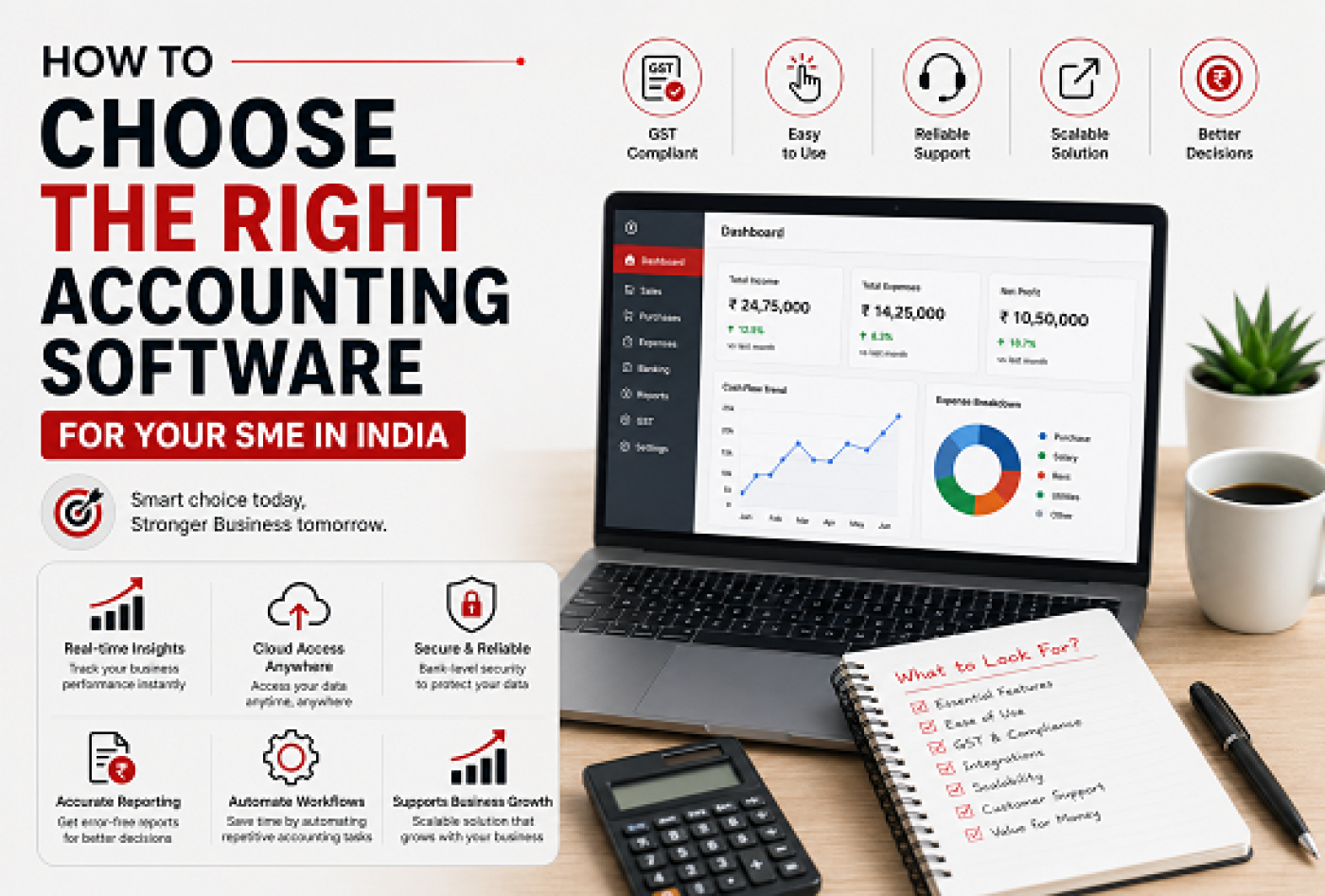
Choosing the right accounting software isn't about finding the most expensive or feature-rich option. It's about finding the perfect fit for your unique business needs, one that saves you time, reduces errors, and helps you make better financial decisions.
In this comprehensive guide, we'll walk you through everything you need to know about selecting the best accounting software in India. Whether you're currently using manual accounting methods or looking to upgrade from a basic system, this guide will empower you to make an informed decision that transforms how you manage your business finances.
The Current State of SME Accounting in India: Why Change Is Essential
According to recent industry reports, approximately 78% of Indian SMEs still rely on manual or semi-automated accounting processes. This statistic is both surprising and concerning because it highlights a massive gap between available technology and actual adoption.
- The consequences of outdated accounting methods are serious:
- Time-intensive manual processes that keep you working late into the night
- Human errors that lead to compliance issues and potential penalties
- Inability to track business performance in real-time
- Cash flow management becomes guesswork rather than data-driven decisions
- Difficulty in meeting GST, TDS, and other statutory filing requirements
But here's the encouraging part: The best accounting software in India has become remarkably affordable, user-friendly, and specifically designed for Indian regulatory requirements. The barrier to adoption isn't cost or complexity anymore, it's simply knowing which solution fits your specific business needs.
Step 1: Understanding Your Unique Business Needs
Before you start comparing software features, you need to take a step back and honestly assess your business. This is the foundation of making the right choice. Think of it like buying a car you wouldn't drive off the lot with a sports car if you need a family sedan.
Ask Yourself These Critical Questions:
- What is your annual revenue, and how quickly are you growing?
- How many transactions do you process monthly?
- How many users need access to your accounting system?
- Are you operating across multiple locations or GST jurisdictions?
- Do you need integration with your existing business tools?
- What's your team's technical proficiency level?
- Are you operating an e-commerce business, manufacturing, services, or retail?
- Do you require multi-currency or international payment tracking?
These questions aren't just theoretical exercises; they directly influence which accounting software in India will be the right fit for you. A freelancer with one GST registration has completely different needs from a manufacturing business operating across five states.
Real-Life Success Story: How Priya Transformed Her Fashion E-commerce Business
Priya started her online fashion business from her apartment in Bangalore in 2020. For the first two years, she managed everything in Excel inventory tracking, customer orders, invoices, everything. By 2022, her business had grown to ₹12 lakhs in annual revenue, but Priya was exhausted.
"I was spending 15 hours every week just on accounting and record-keeping," she recalls. "I missed my family's dinners, didn't have time for business strategy, and kept making silly mistakes with GST calculations."
Then she switched to a cloud-based accounting ERP solution designed specifically for Indian SMEs. Within two weeks:
• Her month-end reconciliation time dropped from 8 hours to 45 minutes
• She caught a ₹2,30,000 double-billing error that Excel had hidden
• Her GST filing became 100% automated and error-free
• She gained real-time visibility into her profit margins by product category
Today, Priya spends just 2-3 hours per week on accounting and recently expanded her business to two warehouses across India. "The software investment was the best decision I made for my business," she says.
The moral of Priya's story? The right accounting software doesn't just save time it transforms how you can run and grow your business.
Step 2: Understand the Types of Accounting Software Available
Not all accounting software is created equal. There are different categories, each designed for specific business needs. Understanding these categories is crucial to narrowing down your options.
Basic Accounting Software (Entry-Level)
These solutions focus on fundamental accounting functions: invoicing, expense tracking, and basic reporting. They're typically cloud-based and very user-friendly.
- Good for: Freelancers, very small businesses, startups just starting out
- Price range: ₹500-2,000 per month
- Learning curve: Minimal - most people can use them within a day
- Limitations: Limited customization, basic reporting, no inventory management
Mid-Range Accounting Software
These solutions combine essential accounting with inventory management, GST compliance, and multi-user capabilities. They're the sweet spot for growing SMEs.
- Good for: SMEs with ₹5-50 lakhs annual revenue, small teams
- Price range: ₹2,000-8,000 per month
- Learning curve: Moderate - requires some training but highly intuitive
- Advantages: GST-compliant, inventory tracking, multiple user access, integration options
Enterprise-Grade Accounting ERP
These are comprehensive solutions that integrate accounting with inventory management, CRM, manufacturing, and multiple business functions into one unified platform.
- Good for: SMEs with ₹50+ lakhs revenue, multi-location operations, manufacturing/wholesale
- Price range: ₹10,000-50,000+ per month
- Learning curve: Steeper - typically requires formal training
- Advantages: Complete business integration, advanced analytics, scalability, enterprise-level support
For most Indian SMEs, mid-range accounting software in India offers the perfect balance of features, affordability, and ease of use. It's powerful enough to grow with your business but not so complex that you need a dedicated IT team to manage it.
Step 3: Must-Have Features for Indian SMEs
Not every feature matters for every business, but certain features are non-negotiable if you're operating in India. These are the regulatory and operational requirements that every serious SME accounting solution must meet.
GST Compliance & Tax Filing
This is absolutely non-negotiable. Your accounting software must:
- Automatically categorize transactions according to GST slabs
- Generate GSTR-1 (outward supplies) and GSTR-2 (inward supplies) automatically
- Produce GST reports for monthly/quarterly filing
- Track and report HSN/SAC codes correctly
- Handle reverse charge mechanism and ITC properly
Invoice & Billing Features
- Create professional, GST-compliant invoices
- Support for both English and regional language invoicing
- Recurring invoice functionality for subscription businesses
- Payment tracking and reminder automation
- E-invoice generation (as per current India protocols)
Inventory Management
- Track stock levels in real-time across locations
- Automatic purchase order generation based on stock levels
- Serial number and batch tracking for manufacturers
- Stock reconciliation and variance tracking
- Integration between purchases, sales, and inventory
Financial Reporting & Analytics
- Real-time dashboard with key financial metrics
- Profit & loss statements by product/customer/location
- Balance sheet and cash flow statements
- Profitability analysis by business segment
- Customizable reports for different stakeholders
Integration Capabilities
Your accounting software should integrate with:
- E-commerce platforms (Shopify, WooCommerce, etc.)
- Payment gateways (Razorpay, PayU, etc.)
- Banking platforms for automated reconciliation
- Your existing CRM or customer database
- Payroll systems if you have employees
- Expense management tools
Myths vs. Facts: Common Misconceptions About Accounting Software
|
MYTH |
FACT |
|
Accounting software is too complicated for small businesses |
Modern accounting software for SMEs is designed with simplicity in mind. Most users can become proficient within a few hours of training. |
|
It's too expensive for SMEs |
Cloud-based solutions cost ₹2,000-8,000/month for SMEs. Compare this to hiring an extra accountant (₹20,000-40,000/month) and the ROI becomes obvious. |
|
We need to change our entire business process to fit the software |
Leading accounting and billing software india is flexible. Most good solutions adapt to your current processes rather than forcing you to change them. |
|
Switching to new software will cause chaos and data loss |
Professional migration services ensure seamless data transfer. Most SMEs report smooth transitions with zero data loss. |
|
Cloud-based accounting is not secure or compliant |
Cloud solutions offered by leading providers are more secure than local servers, with encrypted data, backup systems, and compliance certifications. |
|
We must have software installed on our local computers |
Cloud accounting allows access from anywhere, anytime, on any device—a massive advantage for modern businesses with remote teams. |
Step 4: How to Successfully Implement New Accounting Software
Choosing the software is just the first step. Successful implementation requires planning and execution. Here's your implementation roadmap:
Month 1: Planning & Preparation
- Audit your current processes and identify pain points
- Gather all historical financial data (at least 12 months)
- Define user access roles and permissions
- List all integrations you'll need
- Create a change management plan for your team
- Schedule software training for all users
Month 2: Data Migration & Configuration
- Set up accounts, cost centers, and ledger structure
- Configure GST settings for your business type
- Integrate with existing business tools
- Perform test data migration with historical records
- Validate all data accuracy after migration
- Run mock month-end close cycles
Month 3: Go-Live & Optimization
- Switch to the new system on the first day of a month
- Monitor daily for any issues or discrepancies
- Provide intensive support during the first month
- Collect feedback from users and optimize workflows
- Generate and review first month-end reports
- Make refinements before the next quarter
Step 5: Evaluating Vendors - What Questions to Ask
The software is only as good as the vendor supporting it. Here are the critical questions to ask before signing any contract:
- How long have you been serving the Indian SME market?
- How many SMEs in my industry use your solution?
- Can you provide references from businesses similar to mine?
- What's your track record with data security and compliance?
- How do you handle software updates without disrupting my business?
- What is your data recovery and backup strategy?
- Can I upgrade or downgrade my subscription plans?
- What's included in your support package is it 24/7?
- Do you offer training for my team? Is it included in the price?
- What happens to my data if I decide to switch vendors?
- How do you handle GST rule changes and regulatory updates?
- Are there any hidden costs I should know about?
Understanding the Real Benefits: Beyond Just Saving Time
When you invest in quality accounting software, the benefits extend far beyond just saving a few hours per week. Here are the real, measurable benefits that impact your bottom line:
Tangible Financial Benefits
Better cash flow management: You can see exactly what's owed to you and when, reducing payment delays by an average of 15-20 days.
Reduced accounting errors: Automated reconciliation prevents costly mistakes. Most SMEs catch errors worth ₹1-5 lakhs in their first year of using proper software.
Faster month-end close: Reduce your month-end process from 3-4 days to 4-6 hours, freeing up your accountant to focus on strategic analysis.
Working capital optimization: Real-time inventory and receivables data help you optimize working capital often improving cash flow by 20-30%.
Operational Efficiency Benefits
Process automation: Eliminate repetitive, manual data entry. Your team can focus on strategy rather than data management.
Scalability: As your business grows, your software grows with you. You're not constantly outgrowing your tools.
Better decision-making: Real-time dashboards and reports give you the data you need to make informed business decisions quickly.
Compliance & Risk Reduction
Guaranteed GST compliance: No more anxiety about GST filings. Automated compliance reduces risk of penalties by eliminating human error.
Audit-ready records: Your books are always audit-ready with complete audit trails and compliance documentation.
Regulatory confidence: As Indian regulations evolve (TDS, e-invoicing, etc.), leading software solutions update automatically to stay compliant.
Frequently Asked Questions:
Q1: Which is the best accounting software in India for my SME?
The "best" software depends on your specific needs, but look for solutions that specifically mention:
• Designed for Indian SMEs and GST compliance
• Cloud-based with 24/7 support
• Integration capabilities with your current tools
• Strong positive reviews from businesses similar to yours
• Transparent pricing with no hidden costs
We recommend requesting 15-20 day free trials from 2-3 vendors and testing them with your actual data before deciding.
Q2: Is cloud-based accounting software secure enough for my business?
Absolutely. Enterprise-level cloud solutions are actually MORE secure than local servers because they:
• Use military-grade encryption for data in transit and at rest
• Have redundant backup systems across multiple geographic locations
• Have dedicated security teams monitoring for threats 24/7
• Comply with international standards (ISO 27001, SOC 2, etc.)
• Have disaster recovery protocols that no small business could afford locally
Your data is safer in the cloud than it would be on your office computer.
Q3: How long does it take to implement new accounting software?
Most successful implementations take 4-12 weeks depending on your business complexity:
• Micro businesses (0-50 transactions/month): 2-4 weeks
• Small businesses (50-500 transactions/month): 6-8 weeks
• Growing businesses (500-2000+ transactions/month): 8-12 weeks
This timeline includes data migration, team training, testing, and go-live. Most vendors also provide post-go-live support for 30 days.
Q4: Can I try the software before buying?
Yes! Most leading accounting software in India offers free trials (typically 15-30 days). Use this time to:
• Import sample or real data
• Train your team
• Generate reports you need
• Test integrations
• Create invoices and bills like you actually would
Never sign a long-term contract without testing the software thoroughly first.
Q5: What if I need more advanced features as my business grows?
This is why scalability is so important. When evaluating software, always ask about upgrade paths. Can you move from a basic plan to an advanced plan? From accounting-only to accounting + inventory to full ERP?
Choose a vendor with a clear product roadmap and proven ability to support growing businesses. This prevents costly migrations later.
Q6: Will switching to new software disrupt my current operations?
Not if you plan properly. Professional vendors provide:
• Parallel running periods (using both old and new systems temporarily)
• Seamless data migration with zero loss
• Intensive support during transition
• Team training before go-live
Most businesses report smooth transitions with minimal disruption, especially if implemented at the beginning of a month or quarter.
Q7: What's the real cost of accounting software?
Total cost of ownership typically includes:
• Monthly subscription: ₹2,000-10,000 depending on features
• Implementation/setup: ₹10,000-50,000 (one-time)
• Training: ₹5,000-20,000 (one-time)
• Integration/customization: ₹5,000-30,000 (one-time)
• Annual total for SME: ₹40,000-150,000 in year 1
Compare this to the cost of hiring an additional accountant (₹2,40,000-4,80,000/year) and the ROI becomes crystal clear.
Q8: Do I need to install software on my computers or is cloud-based really enough?
Cloud-based is not just enough—it's superior for modern SMEs. Benefits include:
• Access from anywhere (office, home, during travel)
• No installation hassles or system compatibility issues
• Automatic updates and backups
• Easier collaboration among team members
• Works on any device (desktop, tablet, smartphone)
The only reason to choose on-premise is if you have strict regulatory requirements or zero internet connectivity (extremely rare in 2026).
Finding Your Perfect Match: A Solution Built for Indian SMEs
After evaluating your needs, assessing your requirements, and understanding what matters most for your business, you might find yourself looking for a solution that truly understands the Indian SME landscape. A solution that combines powerful functionality with affordability and support specifically designed for businesses like yours.
Accounting ERP Software represents exactly this kind of solution. Built specifically for Indian SMEs, it offers:
- Complete GST compliance with automated GSTR filing
- Real-time invoicing and billing with professional templates
- Integrated inventory management for businesses that track stock
- Beautiful, actionable dashboards that actually help you understand your business
- Seamless integration with popular payment gateways and e-commerce platforms
- Dedicated support team that understands Indian business context
- Transparent pricing with no hidden fees
- Free trial period so you can test before committing
The solution has helped hundreds of Indian SMEs transform their accounting from a necessary evil into a strategic advantage. Whether you're a growing e-commerce business, a manufacturing unit, a service provider, or a traditional retailer, there's a configuration designed for your specific needs.
Discover how Accounting ERP Software can transform your business. Visit Accutech ERP to explore the solution that's right for your SME.
Final Thoughts: Your Accounting Software Journey
Choosing the right accounting software for your Indian SME is one of the best investments you can make in your business. The right solution will:
- Save you countless hours every month
- Reduce costly errors and compliance risks
- Provide the financial insights you need to grow strategically
- Scale with your business as you expand
- Give you and your team more time to focus on what actually grows your business
The software landscape has matured tremendously. What was once a luxury for large corporations is now accessible, affordable, and essential for every SME that wants to compete effectively.
Don't let outdated accounting methods hold back your business growth any longer. Take the time now to evaluate your needs, test different solutions, and choose the one that aligns with your vision for your business. Your future self probably working much less on accounting and more on strategy will thank you.