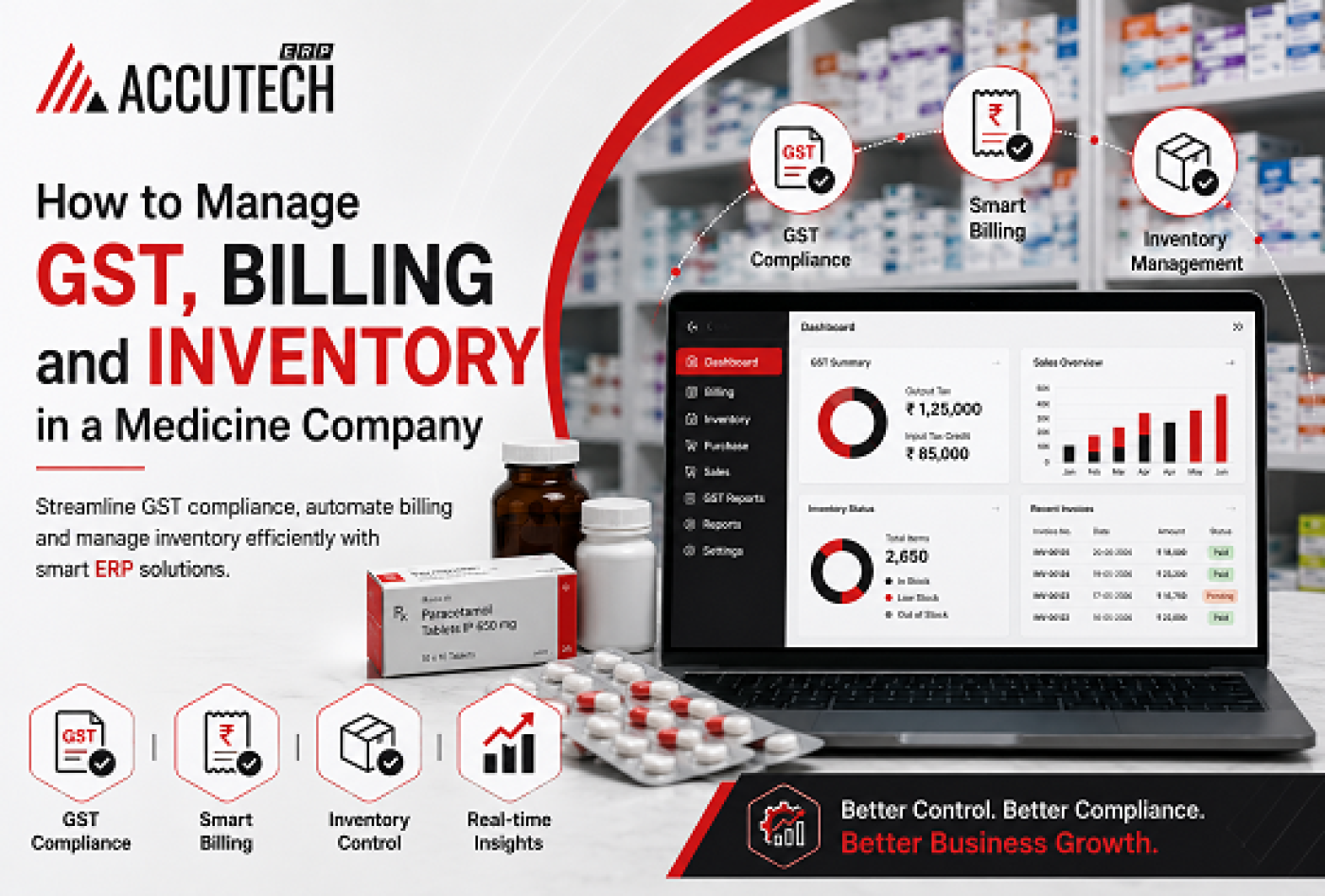
The pharmaceutical industry in India operates within a highly regulated framework that demands precision, compliance, and transparency at every operational level. Whether you're running a medicine distribution company, managing a retail pharmacy, or manufacturing pharmaceutical products, mastering the trifecta of GST (Goods and Services Tax) compliance, billing management, and inventory control is non-negotiable.
In 2026, the complexity of managing these three critical functions has become more sophisticated than ever. Manual spreadsheets and legacy systems are no longer viable solutions for modern pharmaceutical businesses. This is where pharmaceutical accounting software becomes indispensable. A robust pharma ERP platform integrates GST compliance, automated billing systems, and real-time inventory tracking into a unified ecosystem that eliminates silos, reduces errors, and accelerates decision-making.
According to industry reports, pharmaceutical companies that implement dedicated pharma software experience a 40-60% reduction in compliance errors, 35% faster billing cycles, and 25% improvement in inventory turnover rates. This comprehensive guide will walk you through everything you need to know about managing GST, billing, and inventory in a medicine company, and how to leverage the right business management solution to achieve operational excellence.
Understanding GST Compliance In The Pharmaceutical Industry
GST Fundamentals for Medicine Companies
The Goods and Services Tax (GST) regime, implemented in India on July 1, 2017, fundamentally transformed how pharmaceutical businesses handle taxation. Unlike the pre-GST era where different states applied varying tax rates and businesses had to navigate complex compliance procedures, GST established a unified tax system across India. For pharmaceutical companies, GST compliance is a multi-layered responsibility.
Medicine products typically fall under specific GST slabs based on their classification. Essential medicines (Schedule H) attract 5% GST, while prescription medicines range from 5%-12% depending on formulation and usage. Over-the-counter (OTC) and wellness products are taxed at 12%-18%, and medical devices range from 5%-18% based on device classification.
Why GST Compliance is Critical for Pharmaceutical Businesses
GST compliance is not just a legal obligation it directly impacts your bottom line. Proper GST documentation ensures you can claim Input Tax Credit (ITC) on purchases, reducing your overall tax burden. Non-compliant invoices can lead to rejected returns and penalties. Timely and accurate GSTR-1, GSTR-2A, and GSTR-3B filing is mandatory. GST requires complete documentation for every transaction. Non-compliance can result in penalties ranging from ₹10,000 to ₹25,000+ per violation.
The Complexity of Multi-State Operations
For pharmaceutical distributors operating across multiple states in India, GST compliance becomes exponentially more complex. Each state has different regulations, and the inter-state supply of medicines involves additional compliance layers. This is precisely why specialized pharma software has become essential it automatically manages state-wise GST rates, generates compliant invoices, and maintains detailed transaction records across all locations.
Importance Of Billing Management For Medicine Companies
Challenges in Traditional Billing Systems
Manual billing processes have plagued pharmaceutical businesses for decades. The traditional approach where accountants manually create invoices in spreadsheets or basic software introduces numerous risks: Human Error - Manual data entry leads to invoice inaccuracies that cause disputes with customers; Time-Consuming - Creating invoices manually takes hours per day, delaying payment collection; Inconsistent Tax Calculation - Different accountants may calculate taxes differently; Lost Invoices - Paper-based or unorganized digital systems make tracking difficult; Payment Delays - Without proper tracking, following up on pending payments becomes chaotic.
How Automated Billing Transforms Operations
Modern pharma software solutions automate the entire billing cycle. When you transition from manual to automated billing through an integrated pharma system, you immediately gain several advantages: Instant Invoice Generation - Create and send invoices in seconds; GST-Compliant Invoices - Software automatically applies correct GST rates; Payment Tracking - Know exactly which invoices are paid and which are pending; Automated Reminders - System sends payment reminders to customers automatically.
Real-World Impact: A Case Study
A mid-sized pharmaceutical distributor in North India was managing billing for over 500 retail pharmacy customers using spreadsheets. They spent 15-20 hours weekly on billing alone. After implementing an integrated management solution with automated billing capabilities, they reduced billing time to just 2 hours per week, eliminated invoice errors by 99%, and improved payment collection by 35% within three months. This demonstrates the transformative power of modern solutions.
Inventory Management: Critical For Pharmaceutical Operations
Why Inventory Management is Different in Pharma
Pharmaceutical inventory management operates under constraints that don't apply to other industries. Unlike retail businesses selling apparel or electronics, medicine companies must contend with: Expiry Management - Medicine products have fixed shelf lives (typically 2-5 years). Expired stock becomes dead inventory and represents total loss; Batch Tracking - Regulatory compliance requires tracking every batch number for recall purposes; Cold Chain Requirements - Some medicines require specific temperature conditions during storage and transportation; Regulatory Compliance - Pharmacy licenses limit the quantity of controlled medicines you can stock; Demand Forecasting - Pharmaceutical demand varies by season and is influenced by medical emergencies.
Critical Inventory Metrics for Pharmaceutical Businesses
To run a successful pharmaceutical business, you need to monitor key inventory metrics: Stock-Out Rate (% of time item is unavailable) should be less than 5%; Inventory Turnover (times inventory sold annually) ideally targets 6-12 times per year; Expiry Loss Rate (% of inventory that expires) should remain below 2%; Days Inventory Outstanding (average days to sell inventory) should be 30-45 days.
The Cost of Poor Inventory Management
Poor inventory management in pharmaceutical businesses directly translates to financial losses. A pharmacy with ₹50 lakh inventory and 3% expiry rate loses ₹1.5 lakh annually. Excess inventory ties up capital that could be used for other business needs. Stock-outs lead to lost sales and disappointed customers who may switch to competitors. Storing slow-moving medicines while fast-moving items are out of stock creates operational inefficiencies.
How Pharma Software Optimizes Inventory
Modern pharma inventory software with advanced inventory features offers intelligent solutions: Real-Time Stock Visibility - Know exactly how many units you have at each location; Expiry Alerts - Get automatic notifications when medicines are approaching expiry dates; Batch Tracking - Track every batch from purchase to sale for complete compliance; FIFO Automation - System automatically applies First-In-First-Out (FIFO) to minimize expiry loss; Reorder Point Alerts - Automatic alerts when inventory falls below safe levels.
How Pharmaceutical Accounting Software Solves These Challenges
Understanding Pharma Accounting Systems
This purpose-built system is an Enterprise Resource Planning (ERP) solution designed specifically for the unique needs of medicine companies, pharmacies, and pharmaceutical distributors. Unlike generic accounting software, the solution includes built-in features for batch tracking, expiry management, and billing processes that comply with industry regulations and market demands.
The Integrated Approach
The power of this software lies in its integrated approach. Instead of using separate systems for accounting, billing, and inventory, a unified pharma ERP platform ensures: Single Source of Truth - One database for all information across accounting, billing, and inventory; Automatic Synchronization - When you sell a product, the invoice is generated, GST is calculated, and inventory is updated simultaneously; Real-Time Reporting - All reports reflect current data instantly; Reduced Manual Work - Eliminating data entry reduces errors by up to 95%.
Key Features Of Modern Pharma Software Solutions
Essential Features in Pharma Management Systems
As you evaluate different pharma software options, look for non-negotiable features: Accounting & Finance modules with double-entry accounting, ledger management, trial balance, P&L statements; GST Compliance features with auto GST calculation, GSTR filing, ITC tracking; Billing & Invoicing capabilities with GST-compliant invoices, batch billing, payment tracking; Inventory Management with stock tracking, batch management, expiry tracking, reorder alerts, FIFO automation; Reporting & Analytics with real-time dashboards, custom reports, sales analytics; Security & Access with role-based access control, data encryption, audit trails.
Cloud-Based vs. On-Premise Deployment
When selecting a pharmaceutical management platform, the deployment model is critical. Cloud-based solutions offer accessibility from anywhere with the internet, lower initial costs through subscription models, provider-handled updates, easy scalability, and enterprise-grade security. On-premise solutions provide local network access only, require higher initial investment, need your IT team for maintenance, demand additional hardware for scaling, and place security responsibility on your organization.
For most pharmaceutical companies, cloud-based pharma software offers superior advantages. It provides accessibility for field sales teams, requires zero IT maintenance, scales automatically as your business grows, and includes automatic updates with the latest GST regulations.
Best Practices For Managing GST In Medicine Companies
Practice 1: Maintain Detailed Documentation
GST compliance begins with meticulous documentation. Every transaction must be documented with supporting invoices. For pharmaceutical companies, this includes: Purchase invoices from suppliers with GST invoice format; Sales invoices to customers that are GST-compliant; Credit and debit notes; Bank statements matching transactions; HSN/SAC codes for all products; GSTR-2A and GSTR-1 reconciliation records.
Practice 2: Correct HSN/SAC Classification
The Harmonized System of Nomenclature (HSN) codes for medicines are critical. Common HSN codes for pharmaceuticals include: 3002 - Blood, blood fractions, and immunological products; 3004 - Medicaments containing alkaloids (narcotics); 3005 - Other pharmaceutical products; 3006 - Pharmaceutical preparations; 3822 - Diagnostic test kits. Misclassifying products can lead to incorrect GST application and compliance issues.
Practice 3: Regular GSTR Reconciliation
Monthly reconciliation between your records and GSTR-2A is essential. Use automation software to automatically match invoices and identify discrepancies. This prevents blocked ITC claims, mismatch penalties, compliance notices from GST authorities, and confusion during GST audits. Regular reconciliation is the cornerstone of GST compliance.
Billing Best Practices For Pharmaceutical Distributors
Best Practice 1: Standardize Invoice Templates
Every invoice must comply with GST standards. Ensure your chosen pharma solution generates invoices with: Invoice number and date; Company GSTIN; Customer GSTIN (if registered); HSN/SAC codes for each item; Quantity, rate, and amount; Taxable value and GST amount separated; Total amount in words; Invoice signature/authorization. Standardization ensures compliance and reduces disputes.
Best Practice 2: Implement Payment Terms Clearly
Pharmaceutical distributors often extend credit to retail pharmacies. Unclear payment terms create cash flow problems. Use the system to: Specify payment terms on every invoice (Net 30, Net 45, etc.); Automatically track overdue invoices; Generate payment reminders; Apply early payment discounts if applicable; Maintain customer-wise aging reports.
Best Practice 3: Batch Billing for Efficiency
Instead of creating individual invoices for each order, use the system's batch billing feature to: Consolidate multiple orders from a customer into a single invoice; Generate invoices for all outstanding orders at month-end; Apply bulk discounts systematically; Send invoices to multiple customers simultaneously. This significantly improves operational efficiency.
Inventory Optimization Strategies For Pharma Retail
Strategy 1: ABC Analysis for Inventory Classification
Not all medicines have equal importance. Use ABC analysis with pharma inventory software to classify products: Category A (High Value, Lower Volume) - High-margin, fast-moving medicines requiring frequent reorders. Examples include antibiotics and diabetes medications. Stock level: Higher (90 days supply). Recheck: Daily.
Category B (Medium Value, Medium Volume) - Regular sellers with moderate margins. Stock level: Medium (60 days). Recheck: Weekly.
Category C (Lower Value, Slow Moving) - Niche or specialized medications with slow turnover. Stock level: Lower (30 days). Recheck: Monthly.
Strategy 2: Implement FIFO (First-In-First-Out)
Expiry losses are a significant drain on pharmaceutical retail profitability. FIFO ensures older stock is sold first, minimizing waste. Modern inventory software automates FIFO by: Tracking batch numbers and expiry dates; Automatically marking older batches for sale first; Alerting staff when expiry is approaching; Generating wastage reports; Preventing expired products from being sold.
Strategy 3: Implement Safety Stock Levels
Safety stock protects against unexpected demand spikes or supplier delays. Calculate your safety stock as: Safety Stock = Z-score × Standard Deviation of Demand × Lead Time Variability. For a pharmacy with average daily sales of 5 units and 7-day delivery time: Safety Stock = 5 units × 7 days = 35 units (approximately 1 week's buffer). The system can calculate this automatically based on historical demand data.
Common Mistakes To Avoid
Mistake #1: Delaying Software Implementation
Many pharmaceutical businesses continue manual processes until they grow. This strategy backfires because: Manual processes create data inconsistencies that become harder to fix at scale; GST compliance gaps accumulate, leading to larger penalties; Legacy data is difficult to migrate into proper systems; You miss out on efficiency gains that compound over time. Action: Implement specialized business software early, even if you're currently small. Cloud-based solutions scale affordably.
Mistake #2: Ignoring Expiry Management
"It won't expire soon" is a dangerous assumption. Pharmaceutical inventory is dynamic, and unexpected stock movements can cause expirations. Action: Set expiry alerts at 180 days (6 months) before expiration, not 30 days. Use the system to track and report on expiry risk proactively.
Mistake #3: Not Reconciling GST Records Regularly
Companies wait until the GST filing deadline to reconcile, discovering mismatches too late to correct properly. Action: Reconcile your records with GSTR-2A every month, not quarterly. Use the software's reconciliation module to automate this process.
Mistake #4: Overshooting Inventory Without Demand Data
Ordering excess inventory based on intuition rather than data leads to expiry waste and cash flow problems. Action: Use the software's sales analytics to understand demand patterns. Order based on historical data, seasonal trends, and forecasts.
Mistake #5: Not Leveraging Batch Billing
Creating individual invoices for every order is time-consuming and increases error risk. Action: Use the system's batch invoicing feature to consolidate orders and create multiple invoices at once.
Frequently Asked Questions (FAQs)
Q1: What is the difference between pharmaceutical accounting software, pharma ERP, and general accounting software?
General accounting software handles basic bookkeeping but lacks pharmaceutical-specific features like batch tracking and expiry management. Pharma ERP systems are comprehensive enterprise solutions suitable for large manufacturing companies. A specialized pharma accounting system is specifically designed for distributors, retailers, and mid-sized companies, offering the perfect balance of features and affordability.
Q2: How does pharma software help with GST compliance?
The software automatically applies correct GST rates based on product classification and customer type, maintains GST-compliant invoices, tracks ITC eligibility, and generates GSTR-1 and GSTR-3B returns automatically. It also performs monthly reconciliation with GSTR-2A to identify mismatches early, preventing compliance issues and penalties.
Q3: Can the platform handle multiple locations?
Yes. Modern pharmaceutical management platforms support unlimited locations with centralized control. You can manage inventory, billing, and accounts from a single dashboard. Each location can have separate stock levels and GST compliance records while maintaining consolidated financial reports.
Q4: How long does implementation take?
Cloud-based pharmaceutical business software typically takes 2-4 weeks for full implementation. This includes data migration, team training, and process setup. For small operations, it can be done in 1-2 weeks.
Q5: Is my data safe in cloud-based software?
Yes. Reputable solution providers use enterprise-grade security with AES-256 encryption, ISO 27001 certification, and regular security audits. Cloud providers maintain redundant servers for disaster recovery and automatic backups.
Q6: What features should I look for in a pharmaceutical management system?
Essential features include GST compliance automation, batch tracking with expiry management, FIFO inventory management, automated billing with payment tracking, multi-location support, real-time reporting dashboards, role-based access control, and bank integration capabilities.
Q7: How much does a pharmaceutical management solution cost?
Cloud-based pharma solutions typically cost ₹3,000-15,000 per month depending on features, number of users, and locations. This is significantly lower than traditional ERP solutions. Most providers offer free trials to help you evaluate before purchasing.
Q8: Can I migrate my existing data?
Yes. Pharma software providers handle data migration from spreadsheets and legacy systems. They typically import your existing customer data, supplier information, and product catalogs.
Q9: Is pharma software suitable for small pharmacies?
Absolutely. Cloud-based pharma software is designed to scale from small pharmacies to large distribution networks. You pay only for what you use, making it cost-effective for businesses of all sizes.
Q10: What support is available after implementation?
Most pharma software providers offer 24/7 customer support, video training tutorials, documentation, regular feature updates, and technical assistance for integration and troubleshooting.
Conclusion
The pharmaceutical industry is undergoing rapid digital transformation. Businesses still relying on manual processes for GST compliance, billing, and inventory management are at a significant competitive disadvantage. They face higher operational costs, compliance risks, and missed opportunities for growth.
Implementing pharmaceutical accounting software is no longer a luxury; it has become a business necessity. Solutions like Accutech ERP help pharmaceutical businesses streamline GST compliance, automate billing, manage inventory, track batches and expiry dates, and access real-time business reports from a unified platform. Companies adopting digital systems report fewer compliance errors, faster billing cycles, improved inventory turnover, reduced expiry losses, better visibility into business performance, quicker decision-making, and increased customer satisfaction through accurate billing and timely order processing.