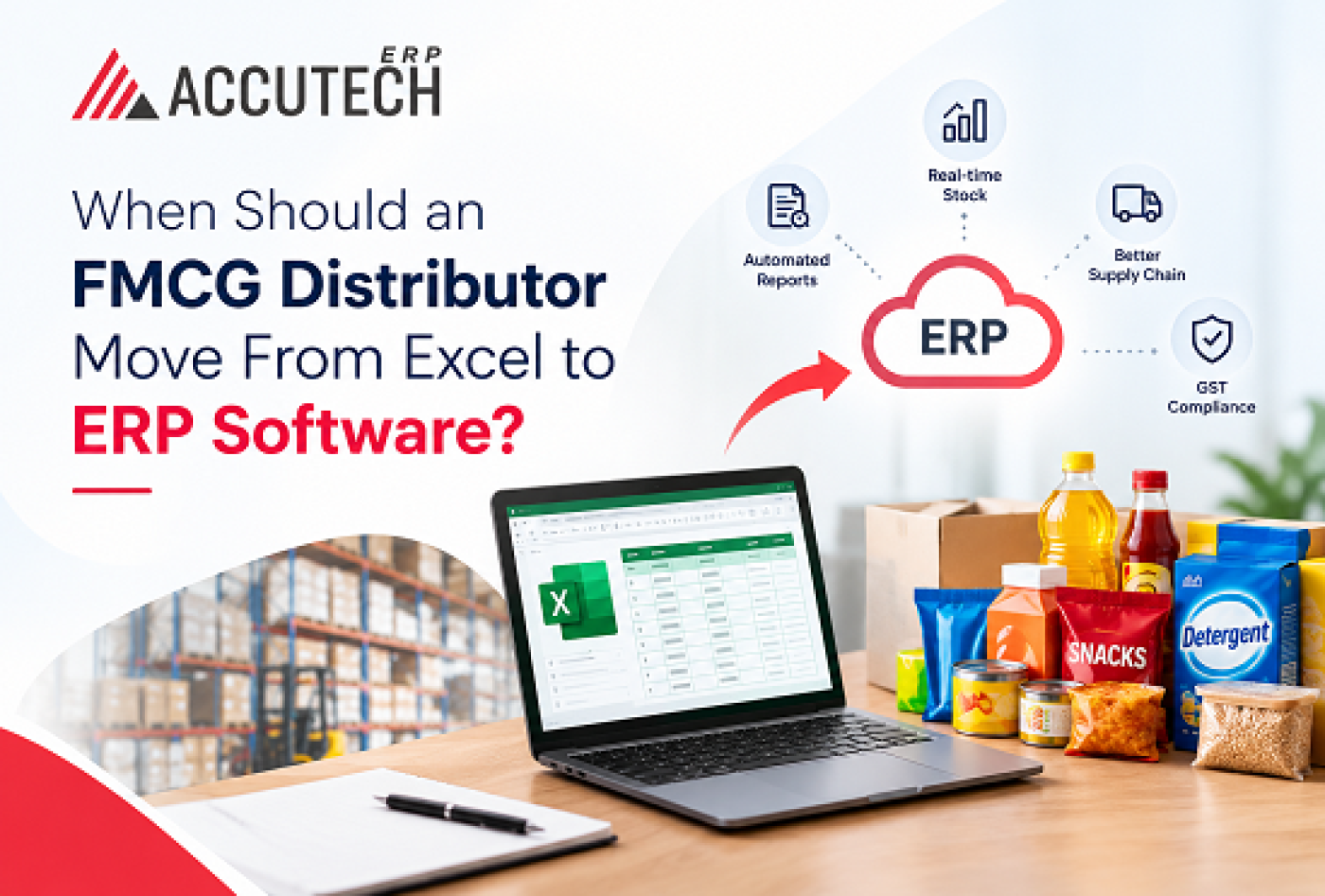
When Should an FMCG Distributor Move From Excel to ERP Software?
If you're running a FMCG distribution business and still relying on spreadsheets to manage inventory, billing, and accounting, you're not alone. However, this approach has become increasingly problematic as businesses scale. The real question isn't whether you need to migrate to an ERP system, it's when you should make the transition.
Modern FMCG distribution demands real-time visibility, automated compliance, and seamless multi-location management. Excel, despite its flexibility, simply cannot provide the robustness, security, and scalability that today's distributors require. A dedicated FMCG Distribution ERP Software solution has emerged as the industry standard for businesses looking to streamline operations, reduce manual work, and gain competitive advantage in a fast-moving market.
This comprehensive guide will help you understand when and why your distribution business should migrate from Excel to dedicated software solutions, the tangible benefits you'll gain, and how to implement the transition successfully. Whether managing a single warehouse or multiple locations across regions, modern ERP platforms provide the infrastructure needed for contemporary distribution management.
Why Excel Falls Short for Modern Distribution Operations
Excel has long been the default tool for small to mid-sized businesses managing distribution. It's affordable, familiar, and requires minimal training. However, as distribution businesses grow and expand operations, the limitations become increasingly apparent and create significant operational challenges.
Core Limitations of Spreadsheet-Based Management:
- Manual Data Entry Errors: Every keystroke introduces potential for human error, leading to inaccurate inventory counts, miscalculated billing, and financial discrepancies that compound over time.
- Lack of Real-Time Visibility: Spreadsheets are static documents. When multiple users work on different versions, you lose track of actual inventory levels and current sales data.
- No Audit Trail: Without automated logging, it's impossible to track who changed what, when, and why critical for compliance and investigating discrepancies in financial records.
- Limited Scalability: As your distribution network expands across multiple locations, spreadsheets become unmanageable with thousands of SKUs and complex data relationships.
- Data Security Risks: Excel files lack enterprise-grade security features, leaving sensitive financial and customer data vulnerable to unauthorized access and breaches.
- Manual GST Compliance: Calculating taxes, preparing GSTR returns, and maintaining compliance through spreadsheets is time-consuming and highly error-prone.
- Poor Reporting Capabilities: Creating meaningful reports from raw data requires significant manual manipulation, limiting your ability to make data-driven decisions.
- No Vendor Integration: Spreadsheets operate in isolation, making supplier coordination and automated ordering extremely difficult.
These limitations don't just slow operations, they directly impact profitability through lost productivity, compliance risks, and missed opportunities. When choosing between Excel and ERP for FMCG distribution companies, businesses often discover they've outgrown spreadsheet capabilities far sooner than anticipated.
Critical Signs Your Business Needs ERP Solution
Recognizing when to transition from spreadsheets to a dedicated system is crucial for maintaining operational efficiency. Here are unmistakable indicators that your business has outgrown spreadsheet-based management:
1. Managing Multiple Locations and Warehouses
If your distribution network spans multiple cities or states, spreadsheets become ineffective. Managing inventory across different warehouses and synchronizing stock levels through files is nearly impossible. Selecting ERP for FMCG distribution companies solves this by providing centralized control with real-time visibility across all locations.
2. Frequent Inventory Discrepancies
If your physical stock counts don't match spreadsheet records regularly, and reconciliation takes days or weeks, it's time for an upgrade. Recurring discrepancies indicate manual entry errors and lack of automated tracking problems that dedicated systems eliminate through automated inventory management.
3. GST Compliance is Consuming Resources
Manually calculating taxes, preparing GSTR-1 and GSTR-2A returns, and maintaining audit trails through spreadsheets is tedious and risky. If your accounting team spends significant time on compliance tasks, implementing FMCG Distribution ERP Software with built-in tax features will dramatically reduce this burden.
4. Billing Errors and Discount Management Issues
Managing bulk billing, multiple pricing tiers, promotional discounts, and credit terms across hundreds of customers through spreadsheets is error-prone. Proper billing software for FMCG distributor operations should be automated, calculating taxes correctly and tracking promotional offers consistently.
5. Lack of Real-Time Business Insights
When you can't instantly answer critical business questions like 'What were our sales last week?' or 'Which products have the highest margins?', you're operating without proper visibility. Modern systems provide instant, comprehensive reports enabling smarter business decisions.
6. Fragmented Customer and Supplier Information
If customer details, credit terms, order history, and supplier information are scattered across multiple spreadsheets and emails, you're losing valuable business intelligence. Centralized data management is essential for building strong business relationships.
7. Administrative Team Spends Excessive Time on Manual Tasks
If data entry, invoice creation, and report generation consume most of your administrative staff's time, automation through an integrated system will free your team to focus on strategic initiatives and customer service improvements.
Understanding Enterprise Resource Planning for Distribution
Enterprise Resource Planning (ERP) designed for distribution is an integrated business management system specifically built for fast-moving consumer goods businesses. Unlike generic spreadsheets, FMCG Distribution ERP Software consolidates all critical functions accounting, inventory management, billing, sales tracking, purchase management, and compliance into a unified platform.
Core Functions Include:
- Real-Time Inventory Tracking: Monitor stock levels across multiple warehouses with automatic reorder alerts and expiry date tracking for perishable products.
- Automated Billing and Invoicing: Generate accurate invoices with proper tax calculations, discount management, and comprehensive credit control.
- Tax Compliance: Automate GST calculations, GSTR return preparation, and e-invoicing requirements for regulatory compliance.
- Sales and Purchase Order Management: Streamline order processing, track status in real-time, and manage returns efficiently.
- Financial Reporting and Analytics: Generate comprehensive reports on sales, profits, outstanding balances, and business trends instantly.
- Customer and Supplier Data: Maintain detailed records, transaction history, and payment terms for all business partners.
- Multi-Location Support: Manage operations across multiple branches with centralized control and consolidated reporting.
- Security and Audit: Maintain complete transaction records with role-based access controls and data encryption.
Unlike billing software for FMCG distributor focused solely on invoicing, comprehensive systems address every aspect of operations from procurement to delivery. They're built specifically for FMCG requirements, including high-volume transactions, complex discount structures, and strict regulatory compliance.
KEY BENEFITS AND BUSINESS IMPACT
The decision to transition from spreadsheets to FMCG Distribution ERP Software isn't just about technology it's about transforming your entire business operation. Here are concrete benefits you'll experience:
1. Increased Operational Efficiency
Automation eliminates repetitive manual work, reducing time spent on data entry, invoice generation, and reconciliation. Your administrative team can focus on customer relationship management, strategic planning, and business development activities.
2. Enhanced Accuracy and Data Integrity
Automated calculations and centralized data entry minimize human errors. Systems ensure consistent, accurate information across all departments, leading to reliable financial statements and inventory counts you can trust.
3. Real-Time Visibility and Decision-Making
Access instant reports on inventory levels, sales performance, outstanding receivables, and profitability. This real-time visibility enables faster, more informed business decisions that directly impact your bottom line.
4. Improved Cash Flow Management
Track outstanding receivables and payables automatically. Modern systems provide visibility into credit terms, aging reports, and payment status, helping you manage working capital more effectively.
5. Seamless Regulatory Compliance
Automated tax calculations and GSTR return generation reduce compliance risk and administration burden. Your business stays audit-ready with complete documentation and traceable transactions.
6. Scalability Without Operational Strain
Add new locations, increase SKU counts, and expand customer base without system capacity concerns. Integrated platforms grow with your business, supporting expansion seamlessly.
7. Stronger Business Relationships
Centralized customer data, complete order history, and transaction records enable personalized service, faster response times, and improved relationship management that strengthen partnerships.
8. Enhanced Data Security
Enterprise-grade security features, role-based access controls, and encrypted storage protect sensitive business information from unauthorized access and security breaches.
REAL-WORLD COMPARISON: SPREADSHEETS VS. MODERN SYSTEMS
Let's examine how spreadsheets and integrated systems handle typical distribution scenarios:
Inventory Management:
Spreadsheet Approach: Manual updates, prone to errors, limited visibility across locations
ERP System: Real-time tracking with automatic alerts when stock falls below minimum levels
Invoice Generation:
Spreadsheet Approach: Time-consuming, manual tax calculations, frequent errors
ERP System: Automated invoicing with tax compliance built-in, ensuring accuracy
Report Generation:
Spreadsheet Approach: Hours of manual data compilation and formatting
ERP System: Instant comprehensive reports with advanced analytics
Tax Compliance:
Spreadsheet Approach: Manual calculations, prone to errors, time-intensive filing
ERP System: Fully automated with return support and audit trails
Multi-Location Operations:
Spreadsheet Approach: Separate files for each location, inconsistent data
ERP System: Centralized control with consolidated reporting across branches
HOW INTEGRATED SOFTWARE STREAMLINES OPERATIONS
Understanding how ERP systems deliver specific operational improvements helps appreciate their business value:
Inventory Optimization
Systems track stock across multiple warehouses in real-time, automatically suggesting reorders based on sales velocity and minimum stock levels. This prevents both stockouts that cost sales and overstocking that ties up capital, while providing intelligent forecasting.
Billing Automation
Billing software for FMCG distributor operations within an integrated platform automatically calculates prices, applies discounts and promotional schemes, computes taxes, and generates professional invoices. This reduces billing errors and accelerates the order-to-cash cycle significantly.
Sales and Purchase Order Management
From order creation through delivery tracking, systems manage the complete order lifecycle. You get visibility into pending orders, can track delivery status in real-time, and manage returns efficiently.
Financial Reporting and Analytics
Generate comprehensive financial reports instantly profit and loss statements, balance sheets, sales trends, product profitability, and customer analysis. These insights enable strategic decision-making and performance monitoring.
Regulatory Compliance and Management
Automated tax calculations, GSTR return preparation, e-invoicing support, and comprehensive audit trails ensure your business remains compliant with all statutory requirements. No more manual compliance work consuming administrative resources.
IMPLEMENTATION STRATEGY: MIGRATION ROADMAP
Transitioning from spreadsheets to an integrated system requires careful planning. Here's a proven step-by-step approach:
Step 1: Assess Current Operations
Document how you currently manage inventory, billing, reporting, and compliance. Identify pain points, manual processes, and data quality issues. This assessment helps select a solution addressing your specific needs.
Step 2: Define Clear Objectives
Establish what you want to achieve: reduce manual tasks, improve accuracy, enable multi-location management, or streamline regulatory compliance. Clear objectives guide selection and strategy.
Step 3: Select the Right Solution
Evaluate options based on features, ease of use, scalability, support, and pricing. Look for systems addressing FMCG-specific needs, offering strong tax compliance features, and providing robust multi-location support.
Step 4: Prepare Your Data
Clean and organize existing data from your spreadsheets. Address duplicates, standardize formats, and ensure accuracy. This preparation is crucial for successful data migration.
Step 5: Plan Your Migration
Decide whether to implement gradually (by department) or all at once. Determine cutover dates, train your team, and establish parallel running periods where both systems operate simultaneously.
Step 6: Train Your Team
Comprehensive training ensures your team uses the system effectively. Provide role-specific training: accounting staff learn financial modules, warehouse staff learn inventory management, sales staff learn order processing.
Step 7: Execute the Migration
Migrate historical data to the new system. Validate all data transferred correctly, conduct thorough testing, and address any issues before going live.
Step 8: Monitor and Optimize
After implementation, monitor system performance, gather user feedback, and make adjustments. Ongoing optimization maximizes value and ROI.
FREQUENTLY ASKED QUESTIONS
Q1: What makes the best billing software for FMCG distributor operations?
The best solution is part of a comprehensive ERP platform. It should automate invoice generation, calculate taxes accurately, manage discounts and schemes, support multiple pricing tiers, and maintain credit controls. Integrated billing connects seamlessly with inventory, accounting, and compliance functions.
Q2: How do systems handle multi-location operations?
Integrated platforms provide centralized management of multiple warehouses and branches. You get real-time visibility into inventory across all locations, can track inter-warehouse transfers, manage separate accounting books if needed, and generate consolidated or location-specific reports.
Q3: How is tax compliance ensured?
Modern systems automate tax calculations based on product classification, automatically apply correct rates, maintain invoice-level audit trails, and support GSTR-1 and GSTR-2A return preparation. Some support e-invoicing requirements, significantly reducing compliance risk.
Q4: What's the typical implementation timeline?
Timelines vary based on business complexity and data volume. Typically, small to medium-sized distributors can go live in 2-4 months with proper planning. Larger organizations may need 4-6 months or longer.
Q5: How much does implementation cost?
Pricing models vary widely from per-user licensing to monthly subscriptions to one-time implementation fees. Cloud-based solutions typically offer more flexibility with lower upfront costs. Consider total ROI through reduced manual work, fewer errors, and better decision-making.
Q6: Can existing spreadsheet data be migrated?
Yes, most systems support data migration from spreadsheets and other sources. However, clean and prepare your data first address duplicates, standardize formats, and ensure accuracy. Many vendors provide data mapping tools and migration assistance.
Q7: What support and training is provided?
Quality vendors provide comprehensive pre-implementation training, ongoing technical support, and periodic updates. Look for role-specific training modules, video tutorials, documentation, and responsive customer support channels.
Q8: How quickly will ROI be realized?
Most businesses begin seeing benefits within 2-3 months through reduced manual work and improved accuracy. Significant operational savings typically appear within 6-12 months.
Q9: Which features should we prioritize?
Prioritize based on your business challenges. If inventory accuracy is the priority, focus on real-time tracking. If tax compliance is burdensome, prioritize automated workflows. Good systems excel in accounting, inventory, billing, and reporting.
Q10: How does it improve customer relationships?
Integrated platforms centralize customer information, maintain complete transaction history, track credit limits and payment terms, and enable personalized communication. Better data management leads to stronger relationships and increased loyalty.
Conclusion:
The transition from spreadsheets to a comprehensive ERP system is no longer optional for growing distributors; it's essential for remaining competitive. The indicators are clear: spreadsheet-based management cannot keep pace with modern FMCG distribution demands.
If your business shows any of the critical signs discussed multiple locations, inventory discrepancies, tax compliance challenges, billing errors, or lack of real-time insights you've already identified your need for better systems. The question is no longer 'if' but 'when' and 'how'.
FMCG Distribution ERP Software delivers measurable benefits: operational efficiency through automation, accuracy through centralized data management, visibility through real-time reporting, compliance through automated workflows, and scalability for future growth. These benefits translate directly to improved profitability and competitive advantage.
The implementation process, while requiring upfront effort and planning, is manageable with the right vendor and approach. Most businesses regret only one thing: not implementing sooner. Accutech ERP can help FMCG distributors move from spreadsheet-based processes to a more connected and efficient ERP system.