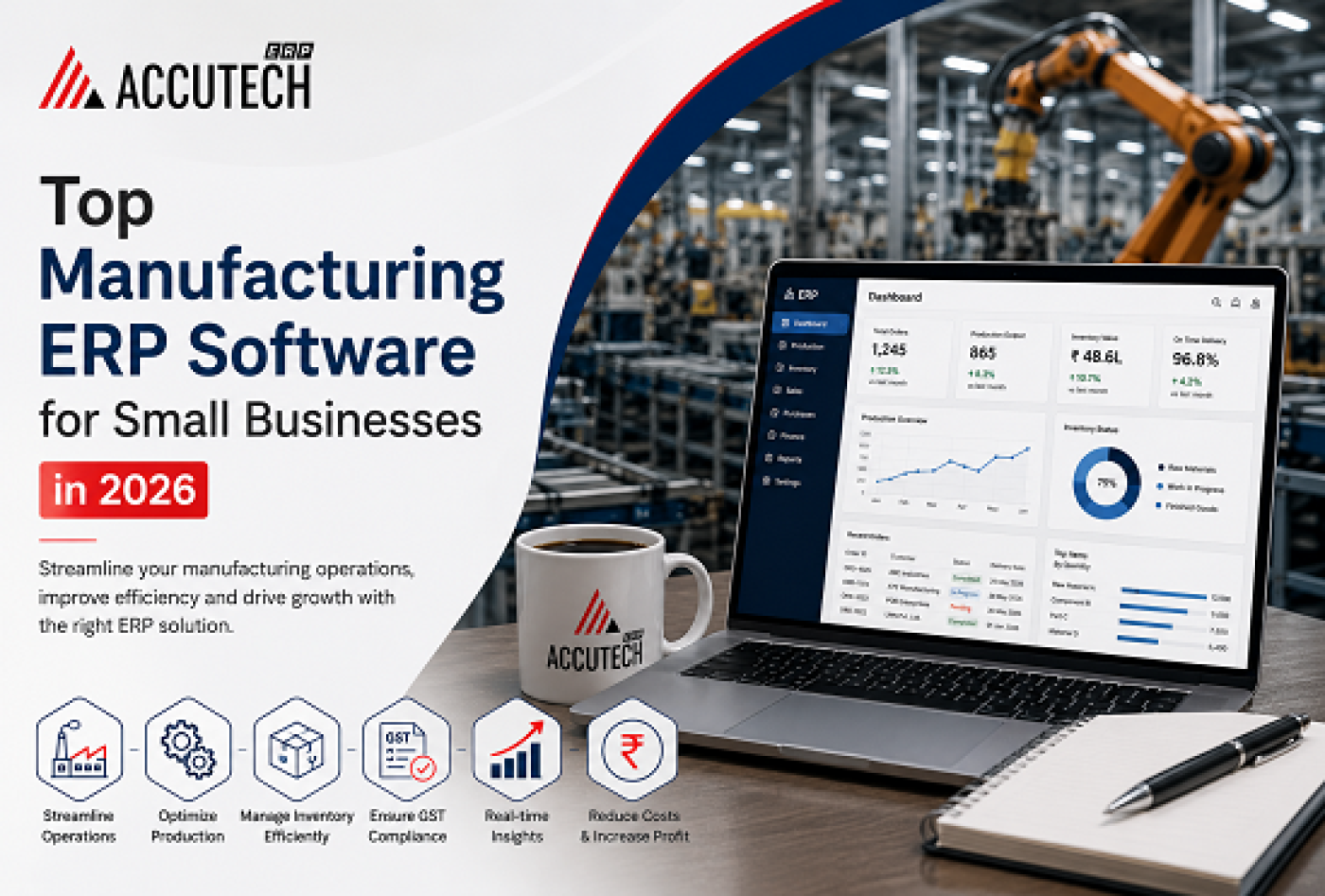
The manufacturing landscape in India has undergone a dramatic transformation. Small and medium-sized manufacturers (SMBs) are no longer competing on scale alone; they are competing on agility, accuracy, and operational intelligence. This is where cloud-based ERP software becomes not just an option, but a necessity.
In 2026, the ability to manage operations efficiently across multiple departments from inventory and production planning to billing and GST compliance can make or break a manufacturing business. Manual spreadsheets and disconnected systems are costing manufacturers valuable time, money, and accuracy.
According to recent industry reports, small manufacturers adopting cloud-based ERP software can improve operational efficiency by up to 35%, reduce inventory carrying costs by 20–25%, and enhance customer service capabilities. For businesses operating in India’s complex GST environment, ERP software has also become indispensable for accurate compliance and reporting.
Choosing the right cloud based ERP software for small business can help manufacturers centralize their operations, automate routine processes, improve inventory visibility, and make faster, data-driven decisions.
This comprehensive guide explores the top manufacturing ERP software solutions available in 2026, with a special focus on cloud-based options tailored for Indian small businesses.
Understanding Cloud-based ERP Software in India
What is Cloud-Based ERP Software?
Cloud-based ERP software is a business management solution hosted on cloud servers, accessed through web browsers and mobile applications, rather than installed on local machines. Unlike traditional on-premises ERP systems, cloud solutions offer flexibility, scalability, and automatic updates without requiring extensive IT infrastructure.
For small manufacturing businesses, cloud ERP means: Lower initial investment (no expensive servers), Access from anywhere anytime (desktop, tablet, mobile), Automatic security updates and backups, seamless integration with other cloud applications, and scalability as your business grows.
Why India Needs Specialized ERP Solutions
India's business environment is unique. The complexity of GST (Goods and Services Tax) regulations, varied state-level compliance requirements, multi-currency transactions, and diverse payment methods require ERP solutions specifically designed for Indian businesses.
A generic global ERP solution won't cut it. Your manufacturing ERP must support real-time GST invoice generation, handle multiple HSN/SAC codes, generate GSTR-1 and GSTR-2A reports, support local payment gateways, and accommodate multi-branch operations.
Key Features Every Manufacturing ERP Must Have
- Comprehensive Inventory Management - Track raw materials, work-in-progress, and finished goods across multiple locations with real-time visibility.
- Production Planning & Scheduling - Create production schedules, manage batch orders, and track production progress in real-time to optimize resource utilization.
- GST-Compliant Billing & Invoicing - Generate GST-compliant invoices, maintain HSN/SAC codes, calculate tax obligations accurately, and support e-invoicing (e-way bills).
- Financial Management & Accounting - Automated accounts payable/receivable, expense tracking, profit & loss statements, balance sheets, and cash flow management with bank feed integration.
- Multi-User Access with Role-Based Permissions - Support multiple users with customizable permissions so finance staff, production managers, and executives see only their relevant data.
- Real-Time Reporting & Analytics - Dashboards and reports that update in real-time enable quick decision-making with customizable KPI monitoring.
- Mobile Accessibility - Access inventory updates, production status, and critical reports from smartphones and tablets for field teams.
- Integration Capabilities - Seamless integration with banking platforms, e-commerce sites, payment gateways, and third-party logistics ensures smooth data flow.
Top Manufacturing ERP Solutions for Small Businesses
Accutech ERP: The Indian Advantage
Accutech ERP stands out as a purpose-built solution for Indian manufacturers and distributors. Unlike generic global platforms, Accutech understands India's unique business needs.
Key Strengths:
• GST-Ready: Real-time GST invoice generation, GSTR-1 and GSTR-2A support
• Manufacturing-Focused: Batch management, expiry tracking, production planning
• Multi-Branch Management: Operate multiple businesses from one platform
• Affordable Pricing: Designed for small business budgets, no hidden costs
• Quick Implementation: Go live in weeks, not months
• Excellent Support: Dedicated team and free training
• Best For: Small to medium-sized manufacturers in India, distributors, retailers, and FMCG businesses.
• Pricing: Starts at affordable subscription models with no capital expenditure. Free 30-day trial available.
Why Accutech ERP Stands Out for Manufacturing
Accutech ERP is built around Indian tax laws, manufacturing practices, and business workflows. This Indian-first approach enables automatic GST calculations, batch management, compliance with Indian e-commerce requirements, and seamless local payment integrations.
Streamlined for Manufacturing: Accutech includes production planning, batch management, quality control tracking, bill of materials (BOM) management, and real-time inventory tracking across raw materials, work-in-progress (WIP), and finished goods.
Affordable Pricing: Unlike expensive enterprise solutions, Accutech offers flexible subscription pricing that grows with your business. Its affordability, GST-ready features, and integrated accounting capabilities make it a strong choice for businesses searching for the best cloud based accounting software India has to offer. You can start small and scale your operations without renegotiating complex contracts.
Quick Implementation: Implementation takes weeks rather than several months, helping businesses minimize disruption to their daily operations.
Dedicated Support: Accutech’s support team understands local business challenges and provides practical business guidance, not just technical assistance.
Implementation Roadmap: From Selection to Go-live
Successful ERP implementation requires structured planning across four phases:
Phase 1: Discovery & Planning (Weeks 1-3)
• Audit current business processes
• Identify key stakeholders and users
• Define success metrics and KPIs
• Gather requirements from each department
• Create implementation timeline
Phase 2: Configuration & Setup (Weeks 4-8)
• Configure system according to requirements
• Set up user accounts and permissions
• Create master data (products, vendors, customers)
• Test integrations with existing systems
• Train core team members
Phase 3: Data Migration & Testing (Weeks 9-11)
• Migrate historical data from legacy systems
• Validate data accuracy and completeness
• Conduct user acceptance testing (UAT)
• Document deviations and fixes
• Train all end users
Phase 4: Go-Live & Stabilization (Week 12 onwards)
• Execute cutover from legacy systems
• Monitor system performance closely
• Provide immediate support to users
• Validate all critical processes work correctly
• Conduct post-implementation review
Pro Tip: Many successful implementations run parallel operations (old system + new system) for 2-4 weeks to ensure data accuracy and reduce risk.
GST Compliance and Tax Management Features
For Indian manufacturers, GST compliance isn't optional it's mandatory. Your ERP software must handle:
• GST Invoice Generation: Automatically generate GST-compliant invoices with all required fields
• HSN/SAC Classification: Proper classification under Harmonized System of Nomenclature codes
• Tax Calculation: Accurate CGST, SGST, IGST calculations based on item classification
• GSTR-1 Filing: Automatic generation of sales tax returns with minimal manual intervention
• GSTR-2A Reconciliation: Match supplier invoices with GSTR-2A records
• Reverse Charge Mechanism: Handle reverse charge transactions automatically
• E-Way Bill Integration: Generate e-way bills directly from shipping orders
• Audit Trail: Maintain complete audit trail for compliance and tax investigations
Accutech ERP's Tax Management: Real-time GST calculations with automatic rate updates, batch invoice generation for bulk billing, detailed GST summary reports, support for composite dealers and SEZ units, and ITC (Input Tax Credit) tracking.
Cost Savings: Automated GST management reduces compliance costs by eliminating manual work, reducing errors, and preventing penalties.
ROI and Cost-benefit Analysis
The investment in manufacturing ERP typically pays for itself within 12-24 months.
Direct Cost Savings:
• Inventory Reduction: 15-25% reduction through better forecasting and planning
• Labor Efficiency: 20-30% reduction in manual data entry and reconciliation
• Elimination of Paper: Significant reduction in printing and storage costs
• Reduced Shrinkage: 5-10% reduction in inventory loss
Indirect Cost Savings:
• Faster Order Processing: 20-30% reduction in order-to-delivery time
• Improved Cash Flow: Faster invoicing and payment collection
• Compliance Confidence: Reduced risk of GST penalties and audit issues
• Better Decision-Making: Real-time data enables smarter, faster decisions
For a typical small manufacturer with ₹50-100 lakhs annual revenue:
• Annual Software Cost: ₹30,000 - ₹80,000
• Implementation Cost: ₹50,000 - ₹100,000 (one-time)
• Expected Annual Savings: ₹3-5 lakhs
• ROI: 150-300% in Year 1, with continued savings
The investment is not just financially sound, it's essential for competitiveness.
Common Mistakes to Avoid When Implementing ERP
Mistake #1: Insufficient PlanningDon't rush into implementation. Poor planning leads to scope creep, delays, and cost overruns. Take time to understand current processes and define clear objectives.
Mistake #2: Choosing Wrong SolutionDon't select based on brand reputation alone. Your solution should fit your specific business needs. A solution perfect for retailers may be inefficient for manufacturers.
Mistake #3: Inadequate User TrainingUsers who don't understand the system revert to old methods. Invest in comprehensive training, documentation, and ongoing support.
Mistake #4: Poor Data QualityGarbage in, garbage out. Ensure legacy data is clean, consistent, and complete before migration. Spend time validating data.
Mistake #5: Over-CustomizationExtensive customization delays implementation and increases costs. Adapt your processes to fit the software where possible.
Mistake #6: Inadequate Support PlanningPlan for issues and ensure vendor support is accessible when needed. Don't assume things will work smoothly after go-live.
Frequently Asked Questions
Q1: How long does it take to implement cloud-based ERP for manufacturing?
For small businesses, implementation typically takes 8-12 weeks including discovery, configuration, data migration, testing, and training. Accutech ERP is designed for quick implementation and many customers go live in 6-8 weeks.
Q2: What about data security in cloud-based ERP?
Reputable cloud ERP providers implement enterprise-grade security with encrypted data transmission and secure data centers. Accutech ERP stores data on secure Indian servers, complying with local data residency requirements.
Q3: Can we migrate from our current system without losing data?
Yes, with careful planning. Professional data migration services can transfer your historical data accurately. Most ERP providers offer data migration support as part of implementation.
Q4: What if we need customization for our unique processes?
Most modern ERPs offer configuration options without requiring coding. Accutech ERP allows extensive customization through configuration, custom fields, and workflow adjustments.
Q5: How much will cloud-based ERP cost for our small manufacturing business?
Small businesses typically pay ₹500-2,000 per user per month. Accutech ERP offers affordable pricing specifically designed for small businesses with no hidden costs.
Q6: Do we need IT staff to manage cloud ERP?
Cloud ERP reduces IT burden since the vendor manages servers, updates, and backups. You need minimal IT staff, just someone to manage user accounts and handle occasional technical issues.
Q7: Can cloud ERP handle multiple currencies and GST rates?
Yes. Accutech ERP handles multiple GST rates (0%, 5%, 12%, 18%, 28%), different HSN/SAC codes, and supports multi-currency transactions if your business operates internationally.
Q8: What happens to our data if the ERP vendor shuts down?
Reputable vendors have data backup and export guarantees. Most contracts include provisions for data access and export in case of service termination. Always verify this in your service agreement.
Q9: How do we ensure user adoption and minimize resistance?
User adoption requires comprehensive training, clear communication about benefits, and ongoing support. Involve users early in selection and provide hands-on training before go-live.
Q10: Can we start with basic modules and add more later?
Absolutely. Many businesses start with accounting and inventory, then add manufacturing, CRM, and advanced analytics later. Cloud ERP's modularity makes this easy.
Conclusion:
The manufacturing landscape in 2026 demands operational excellence. Small businesses can no longer compete on manual processes and disparate systems. Cloud-based ERP software levels the playing field, enabling small manufacturers to operate with the efficiency and visibility previously reserved for larger enterprises.
The question isn't whether you need ERP software, it's which solution best fits your specific needs, budget, and growth trajectory.
For small manufacturers in India, cloud-based ERP solutions offer affordable entry points without massive capital investment, GST compliance built into core functionality, scalability to grow with your business, real-time visibility into operations, significant cost savings and efficiency improvements, and better decision-making through data analytics.
Accutech ERP specifically addresses the needs of small Indian manufacturers with purpose-built features, affordable pricing, and dedicated support.