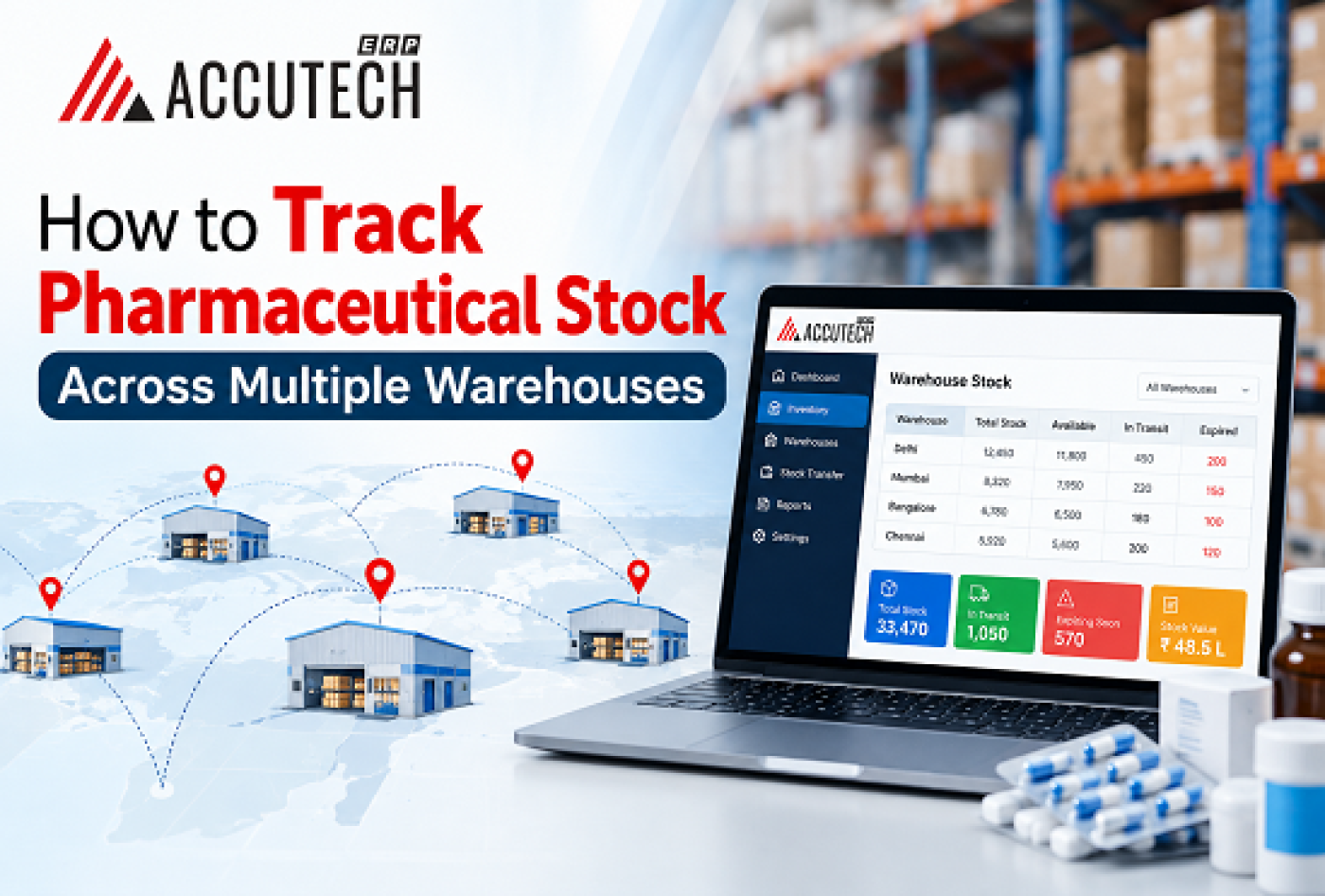
How to Track Pharmaceutical Stock Across Multiple Warehouses
Pharmaceutical companies operating across multiple warehouses face a unique challenge: maintaining precise inventory control while ensuring regulatory compliance, preventing stockouts, and optimizing supply chain efficiency. Whether you're managing a pharma PCD franchise, distributing medical products, or running a pharmaceutical manufacturing operation, tracking stock across multiple locations can quickly become overwhelming without the right systems in place.
In India's growing pharmaceutical sector, where Pharma PCD business models dominate the distribution landscape, the ability to track inventory in real-time across numerous warehouses has become a competitive necessity. According to recent industry reports, pharmaceutical companies using dedicated ERP solutions report 25% improvement in stock accuracy rates and significantly reduced inventory wastage.
This comprehensive guide explores how Pharma PCD ERP Software transforms multi-warehouse stock management, why pharmaceutical manufacturing software has become essential, and how modern accounting software for pharmaceutical companies ensures compliance while improving operational efficiency. By the end of this article, you'll understand exactly how to implement a system that works for your business.
Understanding Multi-Warehouse Pharmaceutical Stock Management
Multi-warehouse pharmaceutical stock management refers to the process of monitoring, controlling, and organizing inventory across geographically dispersed storage facilities. For pharma businesses, this isn't just about knowing how many units you have in stock, it's about tracking every individual batch, serial number, expiration date, and storage condition.
When you're running a pharmaceutical manufacturing operation or managing a Pharma PCD franchise with multiple distribution centers, you're dealing with:
• Different product variants and formulations
• Varying stock levels at each location
• Regulatory compliance requirements
• Temperature-sensitive storage needs
• Batch-wise allocation and expiry management
• Supply chain coordination between locations
The traditional approach using spreadsheets or disconnected systems creates silos that lead to data inconsistencies, delayed decision-making, and compliance risks. This is where a Pharma-focused ERP solution becomes invaluable.
With modern pharma accounting solutions, you can consolidate all warehouse data into one centralized system that provides real-time visibility. This allows you to make informed decisions about stock allocation, reordering, and distribution without the delays that come with manual reporting.
Key Challenges in Tracking Pharma Inventory Across Multiple Locations
Pharmaceutical businesses operating across multiple warehouses encounter several complex challenges:
Stock Visibility and Data Silos: When each warehouse operates independently, getting an accurate picture of total inventory becomes nearly impossible. Different locations may have different counting methods, different update frequencies, and different data formats. This creates blind spots that lead to overstocking in one location and stockouts in another.
Regulatory Compliance Pressure: Pharmaceutical products are among the most regulated products globally. Businesses must track manufacturing dates, expiry dates, batch numbers, and serial numbers with perfect accuracy. Failure to maintain proper records can result in hefty penalties, recalls, or loss of licenses. Accounting platforms for pharma businesses must handle these complexities seamlessly.
Expiry Date Management: Pharma products have limited shelf lives. Managing expiration dates across multiple warehouses manually is tedious and error-prone. You risk selling expired products or writing off expired inventory that could have been sold both costly scenarios.
Cold Chain Integrity: Many pharmaceutical products require specific temperature ranges. Monitoring temperature conditions across multiple warehouses while maintaining detailed audit trails demands specialized pharmaceutical manufacturing software.
Demand Forecasting Errors: Without accurate historical data from all locations, predicting demand becomes guesswork. This leads to either excessive stock (tying up capital) or insufficient stock (losing sales).
Coordination and Communication Gaps: When warehouse managers work with different systems or outdated information, coordination breaks down. Orders get duplicated, deliveries get delayed, and customer satisfaction suffers.
Cost Inefficiency: Manual processes, redundant inventory, and poor distribution optimization inflate operational costs significantly.
How Pharma PCD ERP Software Solves Stock Tracking Problems
Pharma PCD ERP Software eliminates these challenges by creating an integrated ecosystem where all warehouses operate as part of a single, connected system. Here's how:
Centralized Inventory Hub: Instead of checking multiple systems or spreadsheets, your entire PCD pharma ERP system provides one unified dashboard showing real-time stock levels across all warehouses. You instantly know which products are available where, enabling faster decision-making.
Automated Data Collection: Modern pharmaceutical ERP platform integrates with barcode scanners, RFID systems, and handheld devices. Every stock movement receiving, issuing, adjustment, or transfer is automatically recorded with timestamp and user authentication. This eliminates manual data entry errors and creates an audit trail for compliance.
Batch and Serial Number Tracking: The software tracks inventory at the batch level, maintaining separate records for each production batch. This is crucial for recall management and regulatory compliance. Pharmaceutical manufacturing software ensures you can instantly identify affected products across all warehouses during recalls.
Expiry Date Management: Automatic algorithms track expiration dates and alert you when products are approaching their shelf-life expiry. The ERP solution for pharma PCD businesses can prioritize expiring stock for sale or return, preventing wastage.
Multi-Location Transfer Optimization: The system calculates optimal stock transfers between warehouses based on demand patterns, expiry dates, and warehouse capacity. This reduces carrying costs while ensuring stock availability where needed.
Compliance Ready: Accounting software for pharmaceutical companies includes built-in compliance features like GST return generation (GSTR-1, GSTR-2A, GSTR-3B), regulatory reporting, and detailed audit trails. You're always audit-ready.
Core Features of Modern Pharmaceutical Manufacturing Software
A comprehensive pharma distribution ERP should include these essential features:
Product Management Module
• HSN code classification and categorization
• Batch-wise product tracking with serial numbers
• Multiple unit of measure (MUM) support
• Product rate lists and pricing management
• Manufacturer and owner information
• Packing material tracking
Warehouse Management Functions
• Multi-warehouse inventory tracking
• Stock adjustment and reconciliation
• Transfer orders between locations
• Receiving and putaway processes
• Barcode and RFID integration
• Location-wise stock visibility
Transaction Processing
• Purchase orders and invoices
• Sales orders and billing
• Return management (purchase and sales returns)
• Stock transfer documentation
• Performa invoices
• Automated journal entries
Reporting and Analytics
• Product-wise sales and purchase reports
• Party-wise transaction details
• Staff-wise performance tracking
• Profitability analysis by product and party
• Stock aging and movement reports
• Expiry stock summaries
Compliance and Regulatory Features
• GST return filing integration
• Tax liability calculations
• Financial statement generation (P&L, Balance Sheet)
• Account ledger and trial balance
• TDS tracking and reporting
Full audit trails
The best pharmaceutical accounting system bundles all these features into an intuitive interface that doesn't require extensive training.
Real-Time Inventory Visibility: The Game-Changer
Real-time inventory visibility is perhaps the most transformative benefit of implementing Pharma PCD ERP Software. Here's why it matters:
Instant Decision-Making: Instead of waiting for end-of-day reports, warehouse managers and business owners can check current stock levels anytime. If a customer requests urgent delivery, you immediately know which warehouse has inventory and can commit confidently.
Demand-Driven Transfers: When one warehouse runs low on a popular product while another has excess stock, the system alerts you to opportunities for inter-warehouse transfers. This optimizes stock distribution without requiring manual analysis.
Preventing Stockouts and Overstock: Real-time data prevents both stockout situations (where customers can't be served) and overstock situations (where capital is wasted on slow-moving inventory). Both directly impact profitability.
Customer Service Excellence: With accurate inventory information at your fingertips, you can promise faster delivery times and reliable stock availability. This builds customer loyalty in the competitive pharma distribution space.
Reducing Carrying Costs: By optimizing stock levels based on real-time demand data, you reduce the total inventory value you need to maintain. For pharmaceutical manufacturing software used in Pharma PCD businesses, this translates to significant cash flow improvement.
Mobile Access: Modern specialized pharma ERP system offers mobile apps that allow warehouse staff and managers to access inventory information from anywhere. A supervisor at one warehouse can coordinate with another location instantly.
GST Compliance and Accounting Software for Pharmaceutical Companies
For pharmaceutical businesses in India, GST compliance is non-negotiable. The penalties for non-compliance are severe, and the filing process is complex. Accounting software for pharmaceutical companies must handle GST seamlessly:
Automated Tax Categorization: Products are automatically categorized under the correct HSN codes and tax rates. This ensures every transaction is compliant from the moment it's entered.
GSTR Return Automation: Instead of manually preparing tax returns, the software generates GSTR-1 (sales), GSTR-2A (purchases), and GSTR-3B (monthly return) automatically based on your transactions. This saves hours of work and eliminates errors.
Input Tax Credit (ITC) Management: The software matches your purchased goods with GST invoices and automatically claims eligible ITC. No more leaving money on the table.
Compliance Audit Trail: Every transaction is logged with complete details date, party, product, tax rate, HSN code, invoice number. This audit trail proves you've maintained compliance if audited.
Multi-State Operations: If your Pharma PCD franchise operates across states, the software tracks inter-state transactions separately for proper IGST/SGST/UTGST classification.
Financial Reporting: Generate financial statements that are GST-compliant and ready for audit. Profit & Loss statements, Balance Sheets, and Trial Balance reports are produced in the format tax authorities expect.
Batch, Serial Number, and Expiry Date Tracking
Batch and serial number tracking is fundamental to pharmaceutical distribution. Here's how modern integrated pharma ERP platform handles this critical function:
Batch-Level Recording: When you receive goods, the system captures the manufacturing batch number. Every subsequent transaction stock transfer, sale, return is recorded against the specific batch. This granular tracking enables swift recalls if needed.
Serial Number Management: For high-value or controlled pharmaceutical products, serial numbers are tracked individually. The system ensures each unit's serial is recorded at receiving, verified at delivery, and impossible to duplicate.
Expiry Date Priority: The software applies FIFO (First In, First Out) logic with expiry date awareness. Older batches and those closer to expiry are prioritized for sale or return automatically.
Return Management: When a batch needs to be returned to the manufacturer due to quality issues or damage, the system tracks the entire return process from initiation to clearance. Accounting software for pharmaceutical companies maintains detailed records for credit notes and financial settlement.
Recall Execution: In case of a product recall, you can instantly identify all affected batches across all warehouses. Generate a recall list showing affected customers and quantities for immediate notification.
Regulatory Reporting: Regulatory bodies often request batch-wise details during audits. The system generates batch reports instantly, proving compliance and easing the audit process.
Expiry Stock Reports: Monthly reports highlight expiring stock, allowing you to take corrective action whether selling at discount or processing returns before wastage occurs.
Integration Between Warehouses: Best Practices
Effective multi-warehouse management requires coordinated processes. Here are best practices when implementing ERP system for pharmaceutical businesses:
Standardized Processes Across Locations: All warehouses should follow the same procedures for receiving, storing, picking, and shipping. Consistency enables efficient data consolidation and reduces errors.
Master Data Synchronization: Product lists, party information, pricing, and tax codes should be synchronized across all locations. A single change in the system updates everywhere automatically.
Central Authority Model: One team should manage the overall inventory strategy while warehouse managers execute locally. This prevents conflicting decisions about stock allocation.
Regular Reconciliation: Monthly or quarterly physical counts should be reconciled against the system. The pharma-focused ERP solution makes this reconciliation process efficient by highlighting discrepancies automatically.
Communication Protocol: Use the system's built-in messaging and alert features to communicate between warehouses. When stock is transferred, receiving confirmation should be immediate.
Performance Monitoring: Compare metrics across warehouses inventory turnover, stock accuracy, cycle time, damage rates. Identify best practices from top performers and replicate them.
Scalability Planning: As your pharma business grows, adding new warehouses should be straightforward. Choose a pharma manufacturing ERP solution that scales without expensive additional licensing.
Cold Chain Management and Temperature Monitoring
Many pharmaceutical products, vaccines, biologics, and certain formulations require temperature control. Cold chain management is a critical differentiator for quality PCD pharma ERP system:
Temperature-Based Location Setup: The system allows you to designate warehouse locations based on temperature requirements ambient (25°C), cool room (2-8°C), or specialized conditions. Stock is automatically routed to appropriate locations.
Continuous Monitoring Integration: Integration with IoT sensors provides continuous temperature monitoring. Alerts are triggered if conditions deviate from acceptable ranges.
Audit Trail for Cold Chain: Complete audit trail showing temperature data, alarms, corrective actions, and approvals. This documentation is essential for regulatory compliance and customer assurance.
Product Damage Tracking: If cold chain integrity is compromised, the system allows you to record the incident, identify affected units, and process appropriate returns or adjustments.
Compliance Reporting: Generate cold chain compliance reports for internal management and regulatory agencies. Show that products were stored under proper conditions throughout their journey.
Cost Savings and ROI of Implementing Pharma ERP Software
Implementing Pharma PCD ERP Software requires investment, but the return can be substantial:
Cost Reductions Achieved:
• Labor Costs: Automation reduces manual data entry and reporting by 60-70%, freeing staff for value-added activities.
• Inventory Carrying Costs: Better stock optimization reduces average inventory value by 20-30%.
• Wastage Reduction: Improved expiry management and stock rotation reduce wastage significantly.
• Write-offs: Fewer inventory inaccuracies mean fewer unaccounted losses.
Revenue Improvements:
• Faster Order Processing: Reduced cycle time means you can serve more orders within the same timeframe.
• Improved Stock Availability: Fewer stockouts mean higher sales conversion.
• Better Pricing: Detailed profitability data allows strategic pricing decisions.
• Customer Retention: Faster, more reliable service builds customer loyalty.
Compliance Benefits:
• Avoided Penalties: GST compliance reduces audit disputes and penalties.
• Faster Audit Resolution: Complete audit trails speed up tax and regulatory audits.
• Improved Licensing: Better compliance makes it easier to maintain operating licenses.
ROI Timeline: Most pharmaceutical ERP platform implementations show positive ROI within 12-18 months. After that, the benefits of compound operations become more efficient, customer satisfaction improves, and profitability increases.
Common Mistakes in Multi-Warehouse Stock Management
Avoid these pitfalls when managing multiple warehouse locations:
Inadequate Training: Implementing ERP solution for pharma PCD businesses without proper training leads to under-utilization. Staff revert to old methods, and the system doesn't deliver promised benefits.
Data Quality Neglect: "Garbage in, garbage out." If initial data entry is sloppy, all subsequent reports are unreliable. Invest time in clean data migration.
Inconsistent Processes: Allowing different warehouses to operate with different procedures creates confusion and data inconsistency. Standardize everything upfront.
Ignoring System Alerts: The software flags issues expiry dates, stock discrepancies, unusual patterns. Ignoring these alerts defeats the purpose of having the system.
Inadequate Password/Access Control: Pharmaceutical products are valuable. Poor access control enables theft and fraud. Use role-based access controls religiously.
Insufficient Backup and Disaster Recovery: If your system fails, can you recover? Ensure your pharma distribution ERP vendor has robust backup and recovery procedures.
Overloading Too Fast: Trying to do everything at once leads to mistakes. Implement finance and accounting software for pharma businesses module-by-module, starting with core inventory management.
Lack of Integration Planning: If your new system doesn't integrate well with existing software (bank accounts, CRM, E-commerce), you'll maintain parallel systems forever.
Implementation Strategy for Pharma Businesses
Here's a proven approach to implementing specialized pharma ERP system successfully:
Phase 1: Planning and Assessment (Weeks 1-4)
• Document current processes and pain points
• Define requirements and prioritize features
• Select the right integrated pharma ERP platform vendor
• Allocate budget and resources
• Create project timeline and milestones
Phase 2: Data Preparation (Weeks 5-8)
• Audit existing data for accuracy
• Clean and organize data
• Establish master data standards
• Create product hierarchy and HSN mappings
• Prepare opening balances for all locations
Phase 3: Setup and Configuration (Weeks 9-12)
• Configure locations and warehouses
• Set up user roles and security
• Define transaction types and workflows
• Configure reports and alerts
• Customize forms for your business needs
Phase 4: Testing (Weeks 13-16)
• Conduct parallel runs with old and new systems
• Validate reports and data accuracy
• Test integration points
• Train super-users and key staff
• Identify and fix issues
Phase 5: Go-Live (Week 17+)
• Cutover from old to new system
• Monitor closely in first days/weeks
• Address issues quickly
• Provide support to end users
• Document lessons learned
Phase 6: Optimization (Ongoing)
• Gather feedback from users
• Refine processes based on real-world usage
• Unlock advanced features
• Explore additional modules
• Plan for scalability as business grows
Throughout implementation, maintain focus on your core objective: achieving reliable multi-warehouse stock tracking with pharmaceutical manufacturing softwarethat ensures compliance while improving operational efficiency.
Frequently Asked Questions (FAQs)
Q1: What exactly is Pharma PCD ERP Software and how does it differ from regular inventory management software?
Pharma PCD ERP Software is specifically designed for pharmaceutical distribution and manufacturing businesses. Unlike generic inventory software, it includes pharmaceutical-specific features like batch tracking, expiry date management, HSN classification, temperature monitoring, and integrated GST compliance. It combines inventory, accounting, and reporting into one system, whereas regular software often treats these separately. PCD pharma ERP system understands the unique regulatory requirements of pharmaceutical businesses in India and globally.
Q2: How does real-time inventory tracking improve operational efficiency across multiple warehouses?
Real-time tracking enables instant visibility of stock at each location. When a customer order arrives, you immediately know which warehouse can fulfill it fastest. If one warehouse is low on a product while another has excess, transfers can be arranged quickly. Real-time data eliminates the need for manager calls and email coordination. Decisions that previously took hours can be made in minutes. This faster responsiveness reduces customer wait times, increases order fulfillment rates, and minimizes stockout situations where potential sales are lost.
Q3: Is it really possible to track batch numbers and expiry dates across multiple locations automatically?
Yes, absolutely. The modern pharmaceutical ERP platform tracks inventory at the batch level, not just by product. Every movement of goods receiving, transfer, or sale is tagged with the specific batch number. Expiry dates are automatically monitored, and the system can alert you when products are approaching expiration. During recalls, you can instantly identify which batches are affected across all warehouses and the customers who received them. This level of traceability is essential for pharmaceutical business compliance and consumer safety.
Q4: How does accounting software for pharmaceutical companies ensure GST compliance automatically?
Accounting software for pharmaceutical companies incorporates GST rules and rates into the system. When you make a sale or purchase, the correct HSN code and tax rate are applied automatically. All transactions are recorded with proper classifications. When GST returns are due, the software generates GSTR-1, GSTR-2A, and GSTR-3B automatically based on your transaction data. This eliminates manual calculation errors and ensures you're always compliant. The system also maintains audit trails proving you've followed proper procedures.
Q5: What's the typical implementation timeline for ERP solution for pharma PCD businesses?
A typical implementation timeline is 16-20 weeks from planning to full go-live. This includes 4 weeks for planning, 4 weeks for data preparation, 4 weeks for setup and configuration, 4 weeks for testing, and 1-2 weeks for cutover and stabilization. However, timelines vary based on the complexity of your operations, number of locations, and data quality. Many businesses start with a pilot location and expand gradually, which can extend the timeline but reduces implementation risk.
Q6: Can pharma distribution ERP integrate with existing systems we already use?
Yes, modern specialized pharma ERP systems should integrate well with banking systems, payment gateways, E-commerce platforms, and other business applications. Most systems offer API integrations or standard interfaces. However, integration complexity varies. During vendor selection, specifically ask about integration capabilities and get references from businesses similar to yours. A good implementation partner can bridge gaps and create custom integrations if needed.
Q7: What kind of support and training does Accutech ERP provide after implementation?
Comprehensive training is essential for successful integrated pharma ERP platform adoption. Quality vendors provide: initial training for all users, super-user training for power users, video tutorials and documentation, ongoing support through helpdesk and live chat, periodic webinars for advanced features, and annual training refreshers. Accutech ERP specifically offers end-user training, manager training, and administrator training as part of their implementation package.
Q8: How much does an ERP system for pharmaceutical businesses typically cost, and what should be included in the price?
Pharma-focused ERP solution pricing varies widely based on number of users, locations, and features. Cloud-based solutions typically cost between ₹10,000-50,000 monthly for small businesses and more for larger enterprises. The price should include software licensing, implementation support, data migration, initial training, and ongoing support. Compare different vendors carefully, the cheapest option isn't always the best. Consider total cost of ownership including training time, change management, and potential customizations needed.
Q9: What happens if there are data discrepancies between what the system shows and physical stock count?
Discrepancies happen, especially during transitions to new systems. PCD pharma ERP system provides reconciliation tools to identify differences. The system shows the system count vs. physical count side-by-side. You can then research the difference: was there a missed transaction, damage, or theft? Once identified, you enter adjustment vouchers to correct the system. Regular cycle counting (rather than annual counts) helps catch discrepancies early. Over time, as processes are refined, discrepancies typically decrease significantly.
Q10: Can pharmaceutical manufacturing software manage cold chain and temperature requirements effectively?
Yes, advanced pharmaceutical ERP platforms integrate with temperature monitoring sensors and IoT devices. The system designates warehouse locations by temperature requirement (ambient, cool, frozen). Stock is routed to appropriate locations based on product requirements. Continuous monitoring alerts you to temperature deviations immediately. Complete audit trails document cold chain integrity. This is essential for vaccines, biologics, and temperature-sensitive formulations where chain of custody and storage conditions are critical compliance requirements.
Conclusion:
Managing pharmaceutical stock across multiple warehouses is complex, but it doesn't have to be chaotic. With the right Pharma PCD ERP Software like Accutech ERP, you can transform this challenge into a competitive advantage.
The businesses succeeding in today's pharmaceutical market aren't those with the largest inventory, they're those with the most intelligent inventory. They know exactly what they have, where they have it, when it expires, and how fast it's moving. With Accutech ERP, businesses can make accurate forecasts, fulfill orders quickly, and maintain better compliance across multiple warehouse locations.
Implementing accounting software for pharmaceutical companies such as Accutech ERP is an investment in your business's future. You'll achieve better operational control, improved financial visibility, faster decision-making, and stronger regulatory compliance. Your team will be freed from manual administrative work to focus on strategic business growth.
The question isn't whether you can afford to implement ERP solutions for pharma PCD businesses, it's whether you can afford not to. Solutions like Accutech ERP help pharmaceutical businesses stay competitive by improving stock visibility, warehouse coordination, and overall operational efficiency.
If you're running a pharma business or managing multiple warehouse locations, it's time to take action. Start by auditing your current stock management processes. Identify where information gaps, delays, and errors are costing you money. Then, evaluate solutions like Accutech ERP's Pharma PCD module specifically designed for your business needs.
The best time to implement better systems was yesterday. The second-best time is today.
Take action now. Request a demo of Pharma PCD ERP Software from a trusted vendor. See firsthand how pharmaceutical manufacturing software can streamline your operations, ensure compliance, and improve profitability. Your warehouse managers, accountants, and business partners will thank you for the clarity and control that come with real-time, accurate stock tracking.