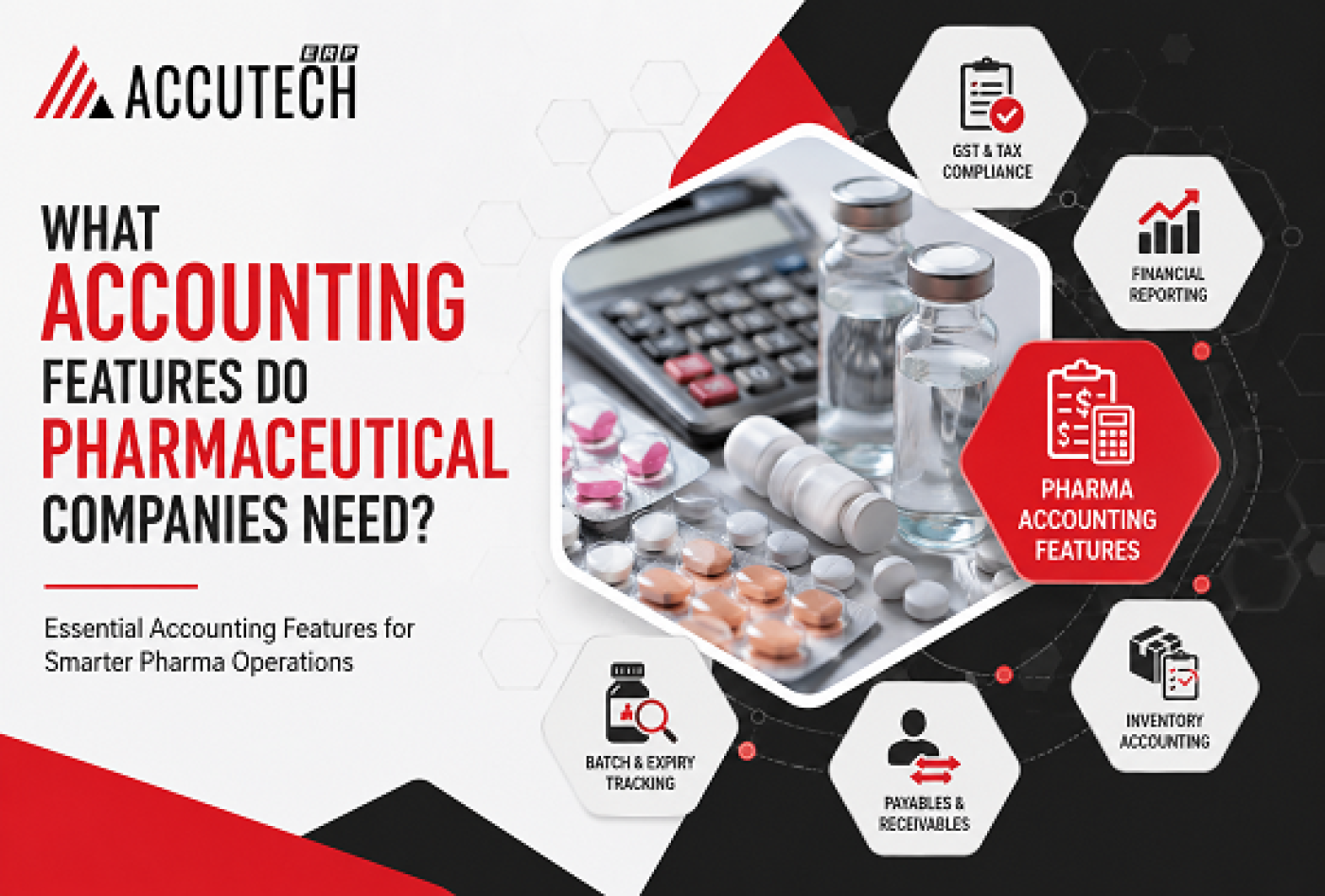
Running a pharmaceutical operation means navigating a landscape of complexity unlike any other industry. From managing precise inventory by batch number to ensuring regulatory compliance and maintaining financial accuracy, the operational demands are intense. This is why specialized solutions have become indispensable.
Unlike general-purpose accounting tools, pharmaceutical accounting software is specifically designed to address the unique needs of drug manufacturers, distributors, and franchisors. Whether you're operating as a small pharmacy or managing a large-scale PCD (Pharma Franchise Distribution) network, the right software for pharmaceuticals can transform how you manage finances, inventory, and compliance.
In this comprehensive guide, we'll explore the critical accounting features that pharmaceutical companies need to thrive in 2026. We'll break down what makes accounting software for pharmaceutical companies different, why these features matter, and how they directly impact your bottom line.
Understanding Your Industry's Unique Accounting Needs
The pharmaceutical industry operates under regulatory scrutiny that most other sectors don't experience. Government agencies, tax authorities, and drug control departments monitor your operations closely. Every transaction must be traceable, every batch must be documented, and every financial decision must align with strict compliance standards.
Unlike general retail or standard manufacturing, pharmaceutical businesses deal with products that have inherent risks and regulatory classifications. A single medicine might exist in multiple formulations, strengths, and batch variations. Each variation requires separate tracking for accounting, inventory, and compliance purposes.
Key operational challenges facing your industry:
- Batch Identity Management: Every medicine batch must retain its unique identity throughout its lifecycle—from procurement through customer delivery.
- Expiration Tracking: Expired inventory represents direct financial loss. Automated expiry monitoring prevents this waste.
- Complex Compliance Requirements: GST structures, narcotics scheduling, Schedule H regulations, and TDS compliance demand precision.
- Distributed Operations: Managing stock across multiple locations while maintaining consolidated financial records is operationally complex.
- Profitability by Product Mix: Understanding which medicines drive margins directly impacts your pricing and procurement strategies.
Core Financial Management Capabilities
When evaluating pharmaceutical accounting software or accounting software for pharmaceutical companies, understanding the fundamental features is crucial. These aren't nice-to-have extras; they're the backbone of daily operations.
General Ledger Architecture
Your system needs a sophisticated general ledger designed for medicine distribution, manufacturing, and sales operations. This means pre-configured account structures for raw materials, finished goods, work-in-progress inventory, cost of goods sold, distribution expenses, and regulatory compliance costs.
Advanced pharmaceutical accounting software includes hierarchical account structures that automatically categorize transactions based on business rules, eliminating manual classification errors.
Purchase and Sales Processing
Your system must handle the complete purchase-to-pay and order-to-cash cycles. This includes purchase orders, invoices, returns, and credit/debit notes with automatic calculation of landed costs. Landed cost tracking—which includes freight, insurance, and import duties—is critical for accurate profitability analysis.
Additionally, purchase management should include supplier performance tracking, bulk buy optimization, and automated reorder calculations based on consumption patterns.
Receivables and Payables Management
Track customer payment behavior and supplier payment cycles with aging analysis and automated notifications. Your system should provide visibility into outstanding amounts by customer, product category, and sales channel.
Payables management should automate supplier payment scheduling, identify early-payment discounts, and implement approval workflows for authorization controls.
Tax Compliance and Regulatory Filing
GST compliance represents one of the most critical operational requirements for your business. In India, pharmaceutical companies must file GSTR-1, GSTR-2A, and GSTR-3B returns with absolute accuracy to avoid penalties and audit complications.
Why Automated Tax Compliance Matters
Manual tax preparation creates multiple failure points—transcription errors, calculation mistakes, and missed deadlines. Your system should automate the entire process:
- Automatic tax rate assignment based on product HSN codes and customer location
- GSTR-1 generation showing all supplies with correct tax classification
- GSTR-2A reconciliation identifying supplier invoice discrepancies
- GSTR-3B preparation with accurate liability calculations and ITC adjustments
- e-Way bill generation for inter-state shipments
Automated tax compliance reduces filing time from days to hours while eliminating audit penalties. This directly impacts your cash flow and operational efficiency.
Batch-Level Inventory Control
Batch tracking is perhaps the most differentiating feature between general accounting software and specialized pharmaceutical accounting software. Every medicine manufactured or purchased must maintain its unique batch identity throughout its lifecycle.
Essential Batch Management Capabilities
- Batch-Wise Stock Ledgers: Track opening inventory, purchases, sales, and closing balance for each batch separately, ensuring complete traceability.
- Automated Expiry Monitoring: Calculate days remaining until expiration and trigger alerts at critical intervals (90 days, 60 days, 30 days).
- First Expiry First Out (FEFO): Automatically prioritize older batches for sale, minimizing medicine wastage and financial losses.
- Recall Support: Instantly identify all customer transactions related to a recalled batch, enabling rapid response.
- Batch Profitability Analysis: Calculate profit margins per batch, revealing which production runs or purchases are most profitable.
Multi-Warehouse and Multi-Location Operations
Few pharmaceutical businesses operate from a single location. Whether managing a PCD distribution network with multiple franchisees or operating regional manufacturing and distribution centers, your system must handle complex multi-location scenarios.
Critical Multi-Location Features
- Real-Time Stock Visibility: View total inventory across all locations simultaneously, preventing stockouts at one location while excess inventory exists elsewhere.
- Inter-Location Transfers: Move stock between warehouses with automatic tracking and financial reconciliation.
- Location-Specific Pricing: Support different selling prices at different locations based on local market conditions and demand patterns.
- Consolidated Financial Reporting: Combine results from multiple locations into unified P&L statements and balance sheets.
Financial Intelligence and Real-Time Dashboards
Speed of decision-making separates successful pharmaceutical companies from those struggling to adapt. Real-time financial visibility enables rapid responses to market opportunities and operational challenges.
Essential Reports for Operational Excellence
- Daily Sales Performance: Track revenue by product, customer, location, and sales team member to identify underperforming categories.
- Stock Position Reports: View batch-wise, location-wise, and category-wise inventory with expiry status.
- Product Profitability: Analyze margin performance by medicine, revealing which products drive business value.
- Customer Payment Analysis: Identify overdue accounts requiring collection attention.
- Supplier Payment Status: Optimize payment timing to capture early-payment discounts.
- Cash Flow Projection: Forecast cash requirements for the next 90 days to prevent liquidity constraints.
Audit Trail and Regulatory Readiness
Pharmaceutical operations face intense regulatory scrutiny from multiple agencies. Your accounting system must maintain detailed documentation of every transaction and change, supporting rapid audit response.
Compliance Requirements
- Comprehensive Audit Logs: Document every transaction with user identity, timestamp, and modification details.
- Narcotics Tracking: For businesses handling scheduled substances, maintain regulatory compliance records.
- TDS Management: Automatically calculate and track Tax Deducted at Source for vendor payments.
- Period Closure Controls: Prevent modifications to locked financial periods.
- Form Generation: Auto-produce required regulatory forms for annual tax filings.
Implementation Mistakes to Avoid
Organizations frequently make costly errors when selecting and implementing accounting solutions. Learning from these mistakes can save significant time and expense:
Mistake #1: Deploying General-Purpose Accounting Tools
Generic accounting systems work initially but eventually create operational bottlenecks. They lack batch tracking, expiry management, and industry-specific compliance features. This approach saves money upfront but costs far more through inefficiencies and compliance failures.
Mistake #2: Underestimating Tax Compliance Complexity
Without automated compliance features, you'll spend countless hours quarterly preparing tax returns and risk expensive penalties. Always prioritize built-in tax compliance automation.
Mistake #3: Ignoring Implementation Timeline
Some solutions require months of customization and data migration, creating operational disruption. Prioritize vendors offering rapid deployment and phased implementation.
Mistake #4: Overlooking Security and Access Controls
Pharmaceutical data sensitivity demands enterprise-grade security with role-based access controls, encryption, and automated backups.
Strategic Implementation Approach
Selection is just the beginning. Successful implementation requires disciplined planning and execution.
Pre-Implementation Phase
- Document Current Processes: Record how existing systems function and identify inefficiencies.
- Design Account Structure: Work with finance teams to create appropriate chart of accounts.
- Map Integration Points: Identify systems (GST portals, banks, e-commerce) requiring integration.
Execution Phase
- Pilot Deployment: Test with a small team or single location before full rollout.
- Data Migration: Carefully transfer historical batch and inventory data.
- Team Training: Provide comprehensive training across finance, operations, and inventory teams.
Post-Launch Optimization
- Performance Monitoring: Track financial close time, inventory accuracy, and tax filing efficiency.
- Continuous Updates: Maintain current versions and adapt to regulatory changes.
- Process Refinement: Conduct monthly reviews to identify improvement opportunities.
Frequently Asked Questions
Q1: How do specialized systems differ from general accounting software?
Specialized solutions include batch tracking, expiry management, FEFO logic, and built-in GST compliance. General accounting software cannot adequately address these pharmaceutical-specific requirements.
Q2: Why is batch tracking so critical?
Batch tracking enables complete traceability from manufacture to customer, supporting rapid recall management and regulatory compliance. It also enables batch-wise profitability analysis for strategic decision-making.
Q3: Can systems handle multi-location operations effectively?
Yes. Professional solutions designed for multi-warehouse operations provide centralized visibility, inter-location transfers, location-specific pricing, and consolidated reporting.
Q4: How does automated tax compliance work?
The system automatically calculates appropriate taxes, generates compliant returns (GSTR-1, GSTR-2A, GSTR-3B), and produces supporting documentation. This eliminates manual calculations and filing errors.
Q5: What reports are most valuable?
Daily sales summaries, batch-wise stock ledgers, product profitability, customer aging, supplier aging, and cash flow forecasts provide the most actionable insights.
Q6: Are cloud-based solutions secure?
Modern cloud solutions employ enterprise-grade security including encryption, automated backups, role-based controls, and SSL/TLS protocols. Cloud often provides superior security compared to on-premise systems.
Q7: What's the typical implementation timeline?
Cloud-based solutions with pre-configured modules typically require 2-4 weeks for small-to-medium businesses. Choose vendors offering quick deployment and phased implementation options.
Q8: Which integrations are most important?
Direct integration with GST portals for return filing and banking systems for reconciliation are essential. API support for other business systems provides additional value.
Q9: What support should vendors provide?
Comprehensive onboarding training, documentation, video resources, and 24/7 support are baseline expectations. Priority support and regular compliance training add significant value.
Q10: How does this investment improve profitability?
Benefits include accelerated decision-making through real-time visibility, reduced waste through expiry and FEFO management, accurate profitability analysis, and 60-70% reduction in tax compliance effort. Most organizations recover their investment within 6-12 months.
Conclusion:
The pharmaceutical industry's operational complexity demands equally sophisticated systems. Generic solutions create bottlenecks and compliance risks that undermine your competitive position.
By choosing specialized pharmaceutical accounting software whether for small pharmacy operations or large-scale PCD distribution networks you're making an investment in operational excellence, regulatory compliance, and financial clarity. The right software for pharmaceuticals automates tedious manual processes, eliminates accounting errors, and provides real-time insights that drive strategic decisions.
The question isn't whether you need pharmaceutical accounting software. The question is: which solution will best serve your specific business model, growth trajectory, and compliance requirements?
Ready to transform your pharmaceutical business operations with Accutech ERP? Explore a solution designed specifically for pharmaceutical accounting needs. Request a demonstration of Accutech ERPto see how it can streamline inventory management, simplify GST compliance, and accelerate financial close processes.