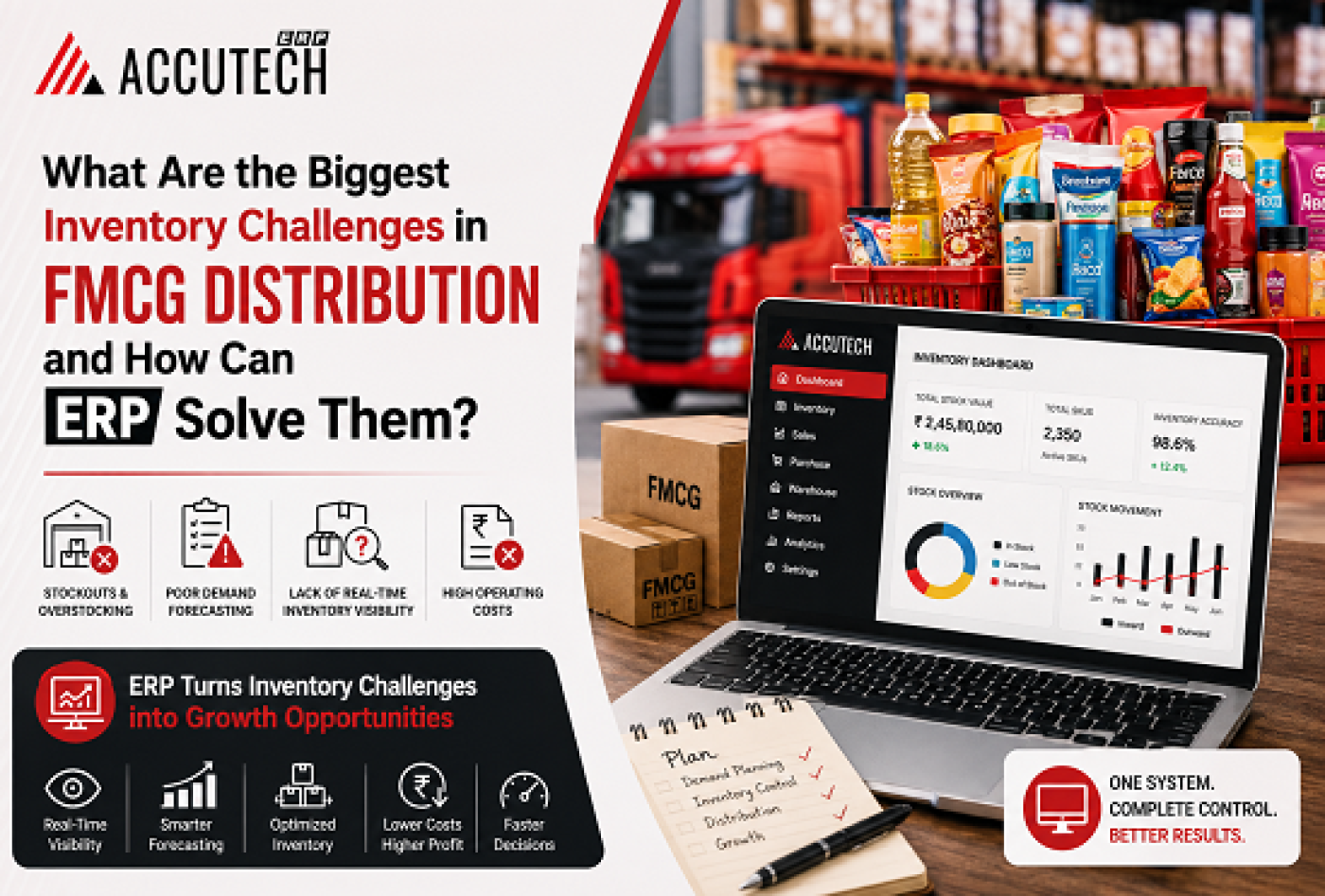
The FMCG (Fast-Moving Consumer Goods) distribution sector is one of the most challenging and dynamic industries globally. In 2026, FMCG distributors are managing increasingly complex operations: handling thousands of SKUs, coordinating across multiple warehouses, meeting tight delivery schedules, and maintaining profitability in a highly competitive market.
Recent industry data reveals a concerning trend: approximately 72% of FMCG companies struggle with poor inventory management, resulting in missed sales opportunities, excess stock write-offs, and operational inefficiencies. These challenges don't just impact cash flow they directly affect customer satisfaction, employee productivity, and competitive positioning.
The root cause? Most businesses still rely on outdated, fragmented systems to manage their distribution operations. Spreadsheets, manual tracking, and disconnected software create information silos that make it nearly impossible to react quickly to market changes. This is where modern ERP for FMCG distribution comes into play.
An integrated ERP for FMCG distribution companies provides end-to-end visibility, automates critical processes, and delivers real-time insights that transform how businesses operate. This comprehensive guide explores the biggest inventory challenges FMCG distributors face and demonstrates how FMCG distribution software solutions solve these problems with concrete, proven strategies.
Real-Time Inventory Visibility Across Multiple Locations
The Challenge
Managing inventory across multiple warehouses, distribution centers, and retail outlets is one of the most persistent problems in FMCG distribution. Without real-time visibility, distributors face a cascade of operational issues:
- Stock Mismatches: Physical inventory doesn't match system records, leading to unavailable products when customers need them
- Overstocking in Some Locations: Excess inventory ties up capital and increases holding costs, particularly problematic with perishable goods
- Stockouts in High-Demand Zones: While some warehouses overflow, others run out of critical SKUs, frustrating retailers and losing sales
- Dead Stock Accumulation: Products sit unsold, expiring or becoming obsolete, resulting in significant write-offs
- Manual Count Errors: Reliance on periodic physical counts leads to inaccuracies and information gaps
A practical example: A major beverage distributor manages stock across 15 warehouses across three regions. Using spreadsheets and phone calls to track inventory, they discovered that one warehouse held 8 months of stock for a particular SKU while another ran critically low. By the time they rebalanced, the high-demand region had already lost 12% of potential sales to competitors.
How the ERP System Solves This
Modern FMCG distribution software provides instant, warehouse-to-warehouse visibility. Here's what changes:
- Real-Time Stock Updates: Every transaction sale, return, transfer, receipt instantly updates inventory levels across all locations
- Automated Reorder Points: The system triggers purchase orders automatically when stock falls below preset thresholds, preventing stockouts
- Multi-Location Transfers: Redistribute excess inventory from overstocked warehouses to high-demand zones with a few clicks, optimizing working capital
- Warehouse-Level Reporting: Drill down into specific locations to identify aging stock, slow-moving items, and redistribution opportunities
- ABC Analysis: Classify products by importance and usage patterns, enabling smarter inventory allocation decisions
The result? FMCG distribution companies implementing ERP solutions typically achieve 20-30% improvement in inventory accuracy within the first three months, leading to better stock availability and reduced capital locked in excess inventory.
Demand Forecasting and Stock Optimization
The Challenge
FMCG products face highly unpredictable demand patterns. Seasonal fluctuations, unexpected promotional campaigns, weather changes, and shifting consumer preferences create a "bullwhip effect" where small changes in consumer demand create larger and larger fluctuations upstream in the supply chain.
Distributors who rely on manual forecasting or historical averages struggle to anticipate these demand spikes:
- Over-Ordering During Promotions: Forecasts are too conservative, leading to sudden stockouts when a promotion succeeds
- Excess Post-Campaign Inventory: Conversely, distributors over-prepare for promotions, left with unsold stock after the campaign ends
- Wasted Production Capacity: Manufacturing teams can't adjust production timing, leading to inefficient runs
- Cash Flow Disruptions: Unpredictable orders tie up working capital unpredictably
How ERP for FMCG Distribution Companies Solves This
Advanced ERP systems leverage historical sales data, market trends, and predictive analytics to forecast demand accurately:
- Demand Planning Analytics: Analyze 12-24 months of historical data to identify seasonality, trends, and promotional lift
- Promotional Planning Integration: Link promotion calendars directly to inventory planning, triggering automatic stock increases when campaigns launch
- Segmented Forecasting: Different SKUs, customer segments, and regions receive customized forecasts based on their unique patterns
- Collaborative Forecasting: Retail partners' Point-of-Sale (POS) data feeds into your forecast, eliminating guesswork
- What-If Scenario Analysis: Test different promotional strategies in the system before committing inventory
Implementation Example: A snack food distributor implemented demand forecasting within their FMCG distribution software. For their flagship chip brand, they previously ordered based on "gut feel" and historical patterns. With ERP-driven forecasting, they now predict demand within 8% accuracy for regular periods and 12% for promotional windows, a dramatic improvement that reduced inventory carrying costs by 18% while improving order fulfillment from 94% to 98%.
Batch Management and Expiry Date Tracking
The Challenge
Unlike durable goods, FMCG products have finite shelf lives. Products expire, lose efficacy, or become unsafe for consumption. Manual batch tracking creates a perfect storm of problems:
- Expired Goods Selling to Retailers: Products past their expiry reach retail shelves, damaging brand reputation and creating legal liability
- Write-Offs Due to Expired Inventory: 3-7% of FMCG inventory is typically written off as expired a direct hit to profitability
- Regulatory Non-Compliance: Batch tracking failures result in failed audits and regulatory penalties
- Manual FIFO Management: "First-In-First-Out" inventory rotation requires constant manual oversight, error-prone and time-consuming
- Recall Nightmares: When product quality issues emerge, tracing affected batches manually can take days or weeks
How ERP for FMCG Distribution Solves This
Professional FMCG distribution software automates batch and expiry management with precision:
- Automated Batch Tracking: Every receipt captures batch numbers and manufacturing/expiry dates automatically
- FIFO Enforcement: The system automatically picks oldest batches first when fulfilling orders, ensuring expired products never leave your warehouse
- Expiry Alerts: Real-time notifications trigger when products approach expiry, giving time to plan promotions or clearance sales
- Batch-Level Visibility: Drill down to see exactly which batches are in which locations, quantities, and days remaining until expiry
- Rapid Recall Execution: When a quality issue arises, identify exactly which batches are affected and where they're located in seconds
Real-World Impact: A dairy products distributor reduced expired inventory write-offs from 5.2% to 0.8% of total inventory after implementing the system. Automated FIFO rotation eliminated manual errors, and automated alerts prevented 98% of near-expiry products reaching retail shelves. The improvement alone recovered ₹4.2 Lakh annually in reduced write-offs.
Supply Chain Coordination and Logistics Management
The Challenge
FMCG distribution involves coordinating multiple stakeholders: suppliers, manufacturers, wholesalers, retailers, and logistics partners. Each operates with fragmented information, creating delays, miscommunications, and missed opportunities:
- Visibility Gaps: Suppliers don't know when you need inventory; logistics partners don't know exactly what's loading until delivery
- Delayed Deliveries: Without end-to-end tracking, customers don't know when orders arrive, reducing their service plans
- Route Inefficiency: Delivery routes are manually planned, missing optimization opportunities that could reduce fuel costs by 15-25%
- Double-Booking Issues: Sales teams promise deliveries that logistics can't fulfill due to capacity constraints, damaging customer relationships
- Inventory in Transit Unknown: Products shipped to retailers aren't tracked effectively, creating blind spots in supply chain visibility
How ERP for FMCG Distribution Solves This
Integrated ERP systems provide end-to-end supply chain visibility and control:
- Vendor Portal Integration: Suppliers access real-time inventory levels and automated replenishment orders, reducing lead times by 25-40%
- Order-to-Delivery Tracking: Every order is tracked from fulfillment through last-mile delivery, with real-time status updates to customers
- Route Optimization: Integrated logistics modules suggest optimal delivery routes based on geography, vehicle capacity, and time windows, reducing transport costs by 15-20%
- Capacity Planning: Delivery capacity is tied to inventory availability, preventing over-promising and service failures
- Inventory in Transit Visibility: Products moving between locations are tracked, providing accurate insights into available-to-promise inventory
GST Compliance and Tax Management
The Challenge
India's GST regime, implemented in 2017, revolutionized tax compliance but created unprecedented complexity for FMCG distributors. Multi-rate taxation, input tax credit (ITC) management, and monthly return filing create significant compliance burden:
- Manual Return Filing: Preparing GSTR-1, GSTR-2, and reconciliation requires consolidating data from multiple systems, taking 5-7 days per month
- ITC Misclassification: Wrong HSN codes or GST rates on invoices result in ITC denial and audit scrutiny
- Multi-Rate Complexity: Different products taxed at 0%, 5%, 12%, and 18% rates; tracking which rate applies to which item manually is error-prone
- E-Way Bill Generation: Each inter-state shipment requires unique e-way bills; manual generation creates bottlenecks
- Audit Risk: Without proper audit trails and documentation, tax authorities flag inconsistencies
How ERP for FMCG Distribution Companies Solves This
Modern FMCG distribution software includes comprehensive GST compliance modules:
- HSN-Based Tax Mapping: Products are mapped to correct HSN codes automatically; GST rates applied consistently across all transactions
- Automated GST Invoice Generation: Invoices include all required GST fields; QR codes and auto-populated details reduce manual entry errors
- GSTR-1 Auto-Population: Monthly sales data flows directly into GSTR-1 returns with a single click, reducing preparation time from days to hours
- ITC Reconciliation: GSTR-2A data is automatically reconciled against purchase invoices, flagging discrepancies for investigation
- E-Way Bill Integration: E-way bills are auto-generated for shipments based on invoice details, eliminating manual steps
- Complete Audit Trail: Every transaction is traceable through the system, supporting audit readiness
Impact: A distributor managing ₹50 Crore annual sales saved 80 hours per month on GST compliance work after implementing the ERP system. Automated GSTR filing eliminated ITC denials, recovering an average of ₹3.5 Lakh in previously missed input tax credits monthly.
Automated Billing and Scheme Management
The Challenge
FMCG sales involve complex billing structures: multiple customer types (retail, wholesale, institutional), varied discount schemes, promotional offers, and credit terms create a billing nightmare when managed manually:
- Scheme Leakage: Sales teams offer discounts beyond authorized levels; the CFO discovers at month-end that margins were sacrificed
- Billing Delays: Manual invoice creation takes days; customers don't receive invoices promptly, delaying payment
- Discount Errors: Applying bulk discounts, promotional discounts, and loyalty rewards manually results in inconsistent pricing and customer disputes
- Credit Control Breakdown: Credit limits and collection cycles aren't enforced; bad debts accumulate
- Reconciliation Nightmares: Accounts receivable aging reports require hours of manual data matching
How ERP Solutions Enable Smart Billing
FMCG distribution software automates complex billing scenarios while maintaining control:
- Pre-Configured Billing Rules: Define discount rules, credit limits, and pricing grids in the system; sales teams can't override without approval
- Multi-Scheme Support: Layer bulk discounts, promotional discounts, loyalty rewards, and seasonal offers the system calculates net price automatically
- Instant Invoice Generation: Invoices are created in seconds after order placement, with all GST, scheme, and pricing details correctly applied
- Real-Time Credit Limit Monitoring: The system prevents sales to customers exceeding credit limits; collection dashboards show aging receivables
- Scheme Profitability Analysis: Drill into promotion performance which schemes drove volume, which eroded margin, which should be discontinued
Common Mistakes FMCG Distributors Make (And How to Avoid Them)
1. Choosing Software Based on Price Alone
Mistake: Selecting budget ERP solutions without evaluating FMCG-specific features. Generic ERP systems lack functionality for batch tracking, expiry management, and promotional scheme handling.
Better Approach: Invest in FMCG-specific ERP that includes batch management, demand forecasting, and scheme automation. The ROI justifies the investment most distributors recover the software cost in 12-18 months through inventory optimization and reduced write-offs alone.
2. Poor Data Migration and Setup
Mistake: Rushing implementation with incomplete product masters, incorrect opening balances, or customer data quality issues. Garbage in, garbage out bad initial data creates problems that persist for months.
Better Approach: Invest time upfront in data cleansing. Validate product master data, opening inventory quantities, customer information, and vendor details. This foundational work prevents months of troubleshooting.
3. Weak User Adoption and Training
Mistake: Assuming staff will naturally adapt to the new ERP system. Users revert to old processes, workarounds, and spreadsheets because they're more familiar.
Better Approach: Invest in structured training programs. Have power users identified early and trained deeply. Create job aids for common tasks. Celebrate early wins to build confidence and momentum.
4. Ignoring Integration Opportunities
Mistake: Implementing ERP as an island, not connecting it to suppliers' systems, retailers' POS systems, or financial platforms. Data remains siloed, reducing the value of integration.
Better Approach: Plan integrations from day one. Connect to supplier portals for collaborative forecasting. Link retailer POS data to improve demand visibility. Sync with accounting platforms for financial reconciliation.
Best Practices for Implementing ERP for FMCG Distribution
- Phase Implementation: Don't implement all modules simultaneously. Start with core modules (Accounts, Inventory, Sales), then layer in advanced features (Forecasting, Automation) as users gain confidence.
- Dedicated Project Leadership: Assign a strong internal project lead responsible for driving adoption, resolving issues, and ensuring business value realization.
- Define Clear Success Metrics: Before implementation, define what success looks like inventory accuracy targets, days-sales-outstanding (DSO), stockout reduction percentages. Track these religiously.
- Empower Superusers: Identify and deeply train power users in each department who become go-to experts, reducing reliance on external support.
- Customize Thoughtfully: Customize only for genuine business needs. Over-customization creates maintenance nightmares and hampers future upgrades.
- Document Everything: Create runbooks for critical processes. When staff turnover occurs, documentation prevents knowledge loss.
- Continuous Optimization: 90 days post-implementation, review configurations with users. Identify unused features and optimization opportunities. Most implementations hit peak efficiency 6-9 months in.
Frequently Asked Questions
Q1: How much does ERP for FMCG distribution companies typically cost?
ERP software pricing varies by deployment model and scale. Cloud-based solutions typically cost ₹50,000 to ₹5 Lakh monthly depending on users and modules. On-premise solutions range from ₹20 Lakh to ₹1+ Crore for larger implementations. However, ROI typically materializes in 12-18 months through inventory optimization, reduced write-offs, and operational efficiency gains. Many distributors calculate payback in 8-12 months based on improved cash flow alone.
Q2: How long does implementation typically take?
Implementation timelines vary based on complexity. For a mid-sized distributor (₹10-50 Crore annual sales), expect 4-6 months for core modules. Smaller operations (₹1-10 Crore) often complete in 8-12 weeks. Larger distributors with complex multi-entity structures may take 8-12 months. Success depends heavily on internal data preparation, user training readiness, and change management rigor.
Q3: Will ERP for FMCG distribution really reduce my inventory costs?
Yes, but not automatically. ERP is an enabler, results depend on how effectively you use it. Distributors who actively use forecasting features, implement automated reorder points, and optimize redistribution between warehouses typically achieve 15-25% inventory optimization within the first year. This translates directly to reduced carrying costs, fewer write-offs, and improved working capital efficiency. The key is disciplined use of the tools the ERP provides.
Q4: How does the software handle multiple pricing structures for different customers?
Modern ERP systems support sophisticated pricing management. You can define pricing by customer segment (wholesale vs. retail), volume-based discounts (tiered pricing), promotional pricing with validity dates, and loyalty discounts. The system applies the optimal price for each order automatically based on customer classification and order details. This eliminates manual pricing errors and ensures profitability is protected.
Q5: Can the ERP system integrate with my retailers' POS systems?
Yes, most modern ERP platforms support POS integration through APIs or pre-built connectors. When connected to retail partners' POS systems, you gain visibility into actual sales at retail outlets (secondary sales), which feeds into more accurate demand forecasting. This real-time data visibility is a game-changer for ERP for FMCG distribution companies, reducing the bullwhip effect and improving supply chain responsiveness.
Q6: How does batch and expiry tracking work in practice?
When products are received into inventory, batch numbers and expiry dates are captured in the ERP system. The system then automatically picks the oldest batches first when fulfilling orders (FIFO logic). As expiry dates approach, automated alerts notify warehouse teams to plan promotions or clearance sales. When products are dispatched to retailers, batch and expiry information appears on packing lists, ensuring retailers understand product freshness. This automation prevents expired products from reaching retail shelves.
Q7: What's the difference between distribution software and generic ERP?
Generic ERP is built for manufacturing, retail, or service industries with general functionality. FMCG-specific ERP includes specialized features: batch tracking and expiry management (critical for perishables), multi-rate GST handling for diverse products, promotional scheme management, demand forecasting based on historical sales patterns, and distributor-specific workflows like beat planning and retailer visit tracking. These features are baked into the core, not added later. Using FMCG distribution software is therefore far more efficient than trying to customize generic ERP for your needs.
Q8: How quickly can we see improvements after going live?
Quick wins emerge in the first 30-60 days: invoicing becomes instant (customers receive them within hours rather than days), GST compliance becomes automated (no more manual return filing), and real-time inventory visibility prevents stockouts. Medium-term improvements (3-6 months) include demand forecast accuracy improving significantly and inventory optimization reducing carrying costs. Full benefits including supplier collaboration optimization and predictive analytics typically materialize at 6-12 months as users master the system.
Q9: What if our business model includes direct-to-consumer (D2C) channels alongside distributor channels?
Modern ERP platforms handle multi-channel operations seamlessly. Inventory is shared across distribution and D2C channels with real-time visibility of available inventory. Orders from different channels flow into a unified fulfillment system, preventing overselling. Analytics provide insights into channel performance separately, helping management understand which channels are most profitable and scalable.
Q10: What ongoing support and training is typically provided after implementation?
Professional ERP providers typically offer 6-12 months of included support post-implementation, including ongoing training, bug fixes, and optimization assistance. Beyond that, support is available as a subscription service. It's important to clarify support terms upfront. The best partners don't just install software they become extensions of your team, helping you continuously optimize and adapt as your business evolves.
Conclusion:
The FMCG distribution landscape in 2026 is unforgiving. Retailers demand faster delivery, better stock availability, and lower prices simultaneously. Consumers expect seamless omnichannel experiences. Regulatory compliance grows more complex. Capital is tight, and margins are tighter.
Distributors operating with manual processes and spreadsheets are losing ground. They sacrifice profitability to obsolete processes, miss optimization opportunities due to lack of visibility, and struggle to respond to market changes quickly enough.
The distributors winning in this environment share a common trait: they’ve embraced ERP for FMCG distribution companies to transform how they operate. Accutech ERP is more than a back-office tool—it is a competitive solution that enables real-time visibility, automated processes, predictive analytics, seamless GST compliance, enhanced customer satisfaction, and improved profitability.
If your FMCG distribution business is still managing inventory with spreadsheets, coordinating with suppliers via phone calls, and spending days on GST compliance you're operating with one hand tied behind your back.
The opportunity cost of delay is enormous. Every month without a proper system like Accutech ERP is another month of missed optimization opportunities, preventable write-offs, and operational inefficiency.