What are the latest FMCG software trends in 2026?
Imagine you're a distributor in a mid-sized city. It's Monday morning, and your team is manually reconciling weekend stock movements across six warehouses. Three invoices are disputed. Your top retailer is calling because a consignment did not arrive on time. Meanwhile, a competitor two blocks away just fulfilled 1,200 orders over the weekend automatically while their manager was at a family event.
That gap? It's not talent. It's not ambition. It's software.
The Fast-Moving Consumer Goods (FMCG) industry has always been defined by speed. But 2026 has raised the stakes considerably. Consumer expectations are higher, margins are thinner, and the supply chain is more complex than ever before. The good news? Technology is keeping pace and the businesses that embrace the latest FMCG software trends are not just surviving, they're genuinely thriving.
In this comprehensive guide, we're going to walk you through everything that's reshaping the industry right now. Whether you're a distributor, a brand owner, a supply chain manager, or simply someone evaluating fmcg management software for the first time this article was written with you in mind.
No jargon overload. No fluff. Just real, practical insights from the ground up.
1. What Exactly Is FMCG Software and Why Does It Matter in 2026?
The Basics, for Those Just Getting Started
Let's start from the beginning, because not everyone reading this has been in the industry for twenty years. FMCG business software refers to digital tools designed specifically to manage the operations of companies that produce, distribute, or retail fast-moving consumer goods. Think beverages, packaged foods, personal care products, household cleaning items, anything that sells quickly and at relatively low margins.
These software systems help businesses manage everything from inventory and orders to sales force automation, route planning, billing, and analytics. The best modern platforms bring all of these functions into one unified ecosystem.
Why 2026 Is a Pivotal Year
The post-pandemic years accelerated digital adoption in FMCG at a rate nobody predicted. Supply chain disruptions forced companies to become more agile. Labour shortages pushed automation from 'nice to have' to 'absolutely essential.' And consumer behaviour shifted permanently with omnichannel retail now the baseline expectation rather than the exception.
In 2026, the companies that are still operating on spreadsheets, disconnected legacy tools, or decade-old ERP systems are feeling the pain acutely. Meanwhile, businesses that invested in modern FMCG software trends aligned platforms are seeing real, measurable results: faster order cycles, fewer errors, higher fill rates, and stronger retailer relationships.
2. The Top FMCG Software Trends Reshaping the Industry in 2026
Trend #1: AI-Powered Demand Forecasting
Of all the FMCG software trends making headlines in 2026, artificial intelligence in demand forecasting is arguably the most transformative. Traditional forecasting relied on historical sales data and human intuition. That approach worked adequately when markets were stable. Today, it simply doesn't hold up.
Modern AI-driven forecasting tools analyse hundreds of variables simultaneously weather patterns, regional events, promotional calendars, competitor pricing signals, social media sentiment, and even foot traffic data from retail outlets. The result? Forecasts that are significantly more accurate, which means fewer stockouts, less dead stock, and healthier cash flow.
Here's a real-world scenario to bring this to life: A beverage distributor in a northern city traditionally overstocked summer drinks and was left with excess inventory every autumn. After implementing AI-based forecasting within their fmcg management software, they discovered that demand spikes in their region were more closely tied to local college event calendars than to temperature alone. That single insight reduced their annual wastage by nearly 22%.
AI forecasting is no longer a feature exclusive to enterprise giants. In 2026, it's being democratised, accessible even to mid-sized distributors and regional manufacturers through cloud-based platforms.
Trend #2: Real-Time Inventory Visibility Across the Entire Chain
Ask any operations manager in FMCG what keeps them up at night, and inventory blind spots will feature prominently on the list. Stock sitting at one warehouse while another warehouse raises an urgent order. Products approaching expiry that nobody flagged in time. A retailer's shelf going empty while a full pallet sits in a transit hub.
The shift to real-time inventory visibility is one of the most critical FMCG software trends of 2026. Powered by IoT sensors, barcode scanning, RFID integration, and cloud synchronisation, modern systems ensure that every stakeholder from the warehouse team to the field sales rep to the senior leadership sees the same accurate picture at any given moment.
The practical impact of this is enormous. When your sales team can see live stock levels before they make a promise to a retailer, you eliminate a massive source of order failures. When your procurement team gets automatic alerts before a SKU falls below safety stock, you prevent reactive panic buying at inflated prices.
Trend #3: Smart Distribution Solutions and Route Optimisation
Distribution is where FMCG businesses often bleed the most money without realising it. Inefficient routes, underloaded vehicles, repeated visits to the same outlets these are the silent profit killers.
Smart distribution solutions in 2026 leverage machine learning and live traffic data to build delivery routes that are genuinely optimal, not just roughly planned. These tools account for vehicle capacity, outlet opening hours, delivery priority, time windows, and real-time road conditions. The outcome is fewer kilometres driven, more drops per trip, lower fuel costs, and a significant reduction in carbon footprint.
For businesses running a fleet of ten vehicles or a hundred, the savings compound quickly. One regional distributor using an integrated distribution module within their FMCG platform reported a 31% reduction in delivery costs within the first six months without adding a single new vehicle.
Beyond cost, smart distribution solutions also directly improve customer satisfaction. When retailers can track deliveries in real time and receive accurate ETAs, the trust relationship between distributor and customer strengthens considerably.
Trend #4: Mobile-First Sales Force Automation
The field sales representative in FMCG has traditionally been armed with a clipboard, a price list, and hope. That era is firmly over.
In 2026, mobile-first Sales Force Automation (SFA) is a cornerstone of any serious fmcg business software stack. Field reps now operate from smartphones or tablets with applications that provide live stock availability, dynamic pricing, promotional schemes, credit status, and even outlet scorecards all accessible offline when connectivity is poor, syncing automatically when reconnected.
The business outcomes are striking. Order accuracy improves dramatically when reps aren't transcribing from handwritten notes. Visit frequency increases when reps spend less time on admin. Managers gain real-time visibility into who visited which outlet, what was sold, what was rejected, and why.
More than operational efficiency, mobile SFA changes the culture of a field sales team. When reps have the right information in their hands, they become genuine relationship managers rather than just order collectors.
Trend #5: Integrated Accounting and GST/Tax Compliance Automation
If you've ever had your accounts team spend three days reconciling GST at the end of a quarter, you understand why this trend matters so much in 2026.
Modern fmcg management software now integrates financial accounting, billing, and tax compliance into one seamless flow. Sales invoices automatically populate the accounting system. Tax calculations happen in real time. Compliance reports are generated with a single click. And the likelihood of human error with its costly downstream consequences drops dramatically.
For FMCG businesses operating across multiple states or geographies, this integration is not a luxury. In India's GST environment, for example, the cost of non-compliance and reconciliation errors can quickly outpace the cost of the software itself.
Trend #6: Advanced Analytics and Business Intelligence Dashboards
Data has always existed in FMCG businesses. The problem has been accessing it in a useful form, at a useful time.
One of the most impactful FMCG software trends of 2026 is the proliferation of intuitive, role-specific dashboards built directly into management platforms. A CEO sees profitability by region and product category. A sales manager sees beat-wise performance and rep productivity. A warehouse manager sees inventory ageing and fulfillment rates. Each person sees exactly what they need, in real time, without needing to request a report from IT.
This democratisation of data is changing how decisions get made in FMCG. Rather than acting on last month's reports, leadership teams are responding to what's happening today. That shift from reactive to proactive is where the real competitive advantage lies.
Trend #7: Cloud-Based Architecture for Scalability and Remote Access
The move to the cloud is not new in 2026, but the depth of cloud adoption in FMCG has accelerated substantially. Legacy on-premise systems are increasingly becoming a liability, expensive to maintain, difficult to scale, and fundamentally incompatible with the mobile and remote work expectations of modern teams.
Cloud-based fmcg business software offers subscription-based pricing that aligns costs with actual scale, automatic updates that deliver new features without IT projects, and universal accessibility that allows your Pune warehouse manager to check stock from their phone at 8pm.
Importantly, cloud architecture also enables the integration with e-commerce platforms, third-party logistics providers, payment gateways, and retail management systems that modern FMCG operations depend on.
Trend #8: Scheme and Promotions Management at Scale
FMCG businesses run hundreds of promotional schemes simultaneously volume discounts, festive offers, combo packs, retailer incentives. Managing this manually, or through disconnected spreadsheets, is one of the most error-prone activities in the entire operation.
In 2026, intelligent promotion management modules within fmcg management software are allowing businesses to create, deploy, and track schemes automatically. Field reps see active schemes on their mobile apps. Billing systems apply correct discounts without human intervention. Management dashboards show which promotions are driving volume and which are simply eroding margin.
The ability to run truly data-informed promotional strategies rather than repeating last year's calendar because it's easier is a genuine differentiator in a competitive market.
3. Myths vs. Facts: What People Get Wrong About FMCG Software in 2026
Myth #1: 'We're Too Small to Need This Kind of Software'
Fact: This is one of the most persistent and costly misconceptions in the FMCG world. Modern cloud-based platforms are designed to be modular and scalable. A distributor managing 200 SKUs across 15 routes needs operational visibility just as much as a conglomerate managing 10,000 SKUs. The difference is that smaller businesses are often more agile to implement and see faster ROI sometimes within the first quarter.
Myth #2: 'It Will Take 6 Months and Enormous Disruption to Implement'
Fact: A decade ago, implementing an ERP system could indeed be a painful, multi-year project. Today, leading fmcg business software platforms are cloud-hosted, pre-configured for FMCG workflows, and designed for rapid deployment. Many businesses are fully operational within four to eight weeks. The key is choosing a vendor with genuine FMCG domain expertise and a structured onboarding process.
Myth #3: 'My Team Won't Adopt New Software'
Fact: Adoption resistance is real, but it's largely a change management challenge rather than a technology one. Modern FMCG platforms are built with user experience as a priority. Mobile apps look and feel like the consumer apps your team uses every day. When people see that a new tool genuinely makes their job easier, not harder adoption follows naturally. The resistance usually comes when teams are handed software that was designed for engineers, not users.
Myth #4: 'Software Can't Replace Human Relationships in FMCG'
Fact: Nobody is suggesting it should. The best fmcg management software doesn't replace human relationships, it enables them. When a field rep isn't spending half their visit sorting out billing discrepancies, they have more time for genuine conversation with the retailer. When an operations manager isn't fire-fighting stock issues, they can focus on building better supplier partnerships. Technology handles the mechanical; humans handle the meaningful.
4. What to Look for When Choosing FMCG Management Software in 2026
With so many platforms on the market, choosing the right fmcg management software can feel overwhelming. Here's a practical checklist of what actually matters:
- End-to-end FMCG coverage: Does it handle distribution, sales force automation, inventory, billing, and analytics in one platform or will you need to stitch together multiple tools?
- Mobile readiness: Is the field app genuinely mobile-first, or is it just a scaled-down version of a desktop interface? Your field team's experience will make or break adoption.
- Real-time synchronisation: Can your entire team see the same live data, regardless of where they're working? In 2026, delayed data is as problematic as no data.
- Integration capabilities: Does the platform integrate with your accounting system, your e-commerce channels, your logistics partners? An isolated system creates data silos that undermine the entire investment.
- Scalability: Will this platform support you when you double your SKUs, expand to a new region, or bring on a new product line? Or will you be back at square one in two years?
- Compliance features: Does it handle GST, e-invoicing, and other statutory requirements automatically? In 2026, regulatory compliance is non-negotiable.
- Vendor support and domain expertise: Is your vendor a generic software company or a team that deeply understands FMCG? The difference in implementation quality and ongoing support is substantial.
- Analytics depth: Does the platform give you actionable insights not just raw data? Can non-technical users build their own reports without IT involvement?
5. How Smart Distribution Solutions Are Transforming the Last Mile
The 'last mile', the final leg of delivery from distribution hub to retail outlet has historically been the most expensive and least efficient part of the FMCG supply chain. It's also the part that most directly impacts retailer satisfaction and brand visibility on shelf.
Smart distribution solutions are fundamentally rewriting the rules of last-mile operations. Let's look at what this means in practice:
Dynamic Route Planning
Traditional route planning was static, the same beats, the same sequence, week after week. Modern systems create dynamic routes based on actual order volumes, vehicle capacity, traffic conditions, and outlet availability. The result is a living, breathing delivery schedule that optimises itself continuously.
Outlet-Level Performance Analytics
Which outlets are growing? Which are declining? Which ones have the highest average order value? Which haven't been visited in three weeks? Smart distribution solutions provide outlet-level intelligence that transforms how territory managers make decisions. Instead of intuition, they operate on data.
Proof of Delivery and Exception Management
Disputes over deliveries are a significant operational headache in FMCG. Modern platforms capture digital proof of delivery photos, signatures, GPS coordinates at the point of drop. When a retailer disputes a delivery, resolution takes minutes rather than days. This single feature often pays for a platform on its own, simply by reducing credit note processing time.
Van Sales and Beat Optimisation
For distributors running van sales operations, mobile-enabled handheld devices integrated with fmcg business software allow real-time invoicing at the point of sale, instant inventory updates, and end-of-day reconciliation without a single piece of paper. Beat optimisation tools then analyse the profitability of each route and recommend changes that increase productivity.
6. The Human Side of Digital Transformation in FMCG
Technology trends are important. But let's not lose sight of the human reality behind the numbers.
When a warehouse manager named Rajan implemented a new inventory visibility module in his cold chain business last year, he told us something that has stayed with us: 'For five years I used to come in at 6am because I was always worried something had gone wrong overnight. Now I get an automated alert on my phone if anything needs attention. I sleep better. My family has dinner with me more often. That's not just a business impact that's a life impact.'
This is what good FMCG software trends-aligned technology actually delivers at the human level. It reduces anxiety, restores bandwidth, and gives people back time to think strategically, to build relationships, to lead their teams rather than just manage crises.
For field sales teams, mobile SFA tools have transformed the nature of work. Sales representatives who previously spent evenings manually entering orders now finish their admin in the field. They arrive at calls better prepared. They leave with fewer disputes. And because their performance data is visible in real time, high performers get recognised faster.
This human dimension of technology adoption is something that smart FMCG leaders in 2026 understand deeply. Digital transformation is not just a systems project it's a people project.
7. FMCG Software in Action: A Day in the Life of a Modern Distributor
Let's walk through a typical day at a well-run FMCG distribution business using integrated fmcg management software in 2026:
6:00 AM — Morning Dashboard Review
The operations manager opens their mobile app over morning chai. At a glance: today's delivery schedule, any stock alerts, pending order approvals, and the previous day's van sales summary. No emails to chase. No calls to make. Everything is right there.
8:00 AM — Field Teams Dispatch
Six field representatives receive their day's beat plan on their mobile devices. Each rep can see the outlets on their route, the suggested order quantities based on AI forecasting, any active schemes, and the credit status of each customer. No printed sheets. No outdated price lists.
10:30 AM — Live Order Tracking
The sales manager logs into the dashboard to see orders flowing in real time. Three reps are ahead of target. One outlet has refused a delivery due to a billing dispute the system has already flagged it and auto-generated a ticket for the accounts team to resolve.
2:00 PM — Automated Replenishment Trigger
A fast-moving SKU hits its reorder point. The system automatically generates a purchase order draft and notifies the procurement team. No stockout. No panic buying. Just a smooth, automated flow.
5:00 PM — End of Day Reconciliation
Field reps close their day on the mobile app. Cash and cheque collections are logged. Delivery confirmations with GPS stamps are uploaded. The accounts team sees the complete day's financials without a single manual entry.
6:00 PM — Management Review
The business owner reviews the day's performance dashboard: total orders, average order value by beat, top-selling SKUs, and tomorrow's pending demand forecast. Decisions are made. The next day is already being optimised.
This isn't a fantasy. This is the operational reality for businesses that have embraced modern smart distribution solutions in 2026.
8. The ROI Reality: What FMCG Software Actually Delivers
Any conversation about technology investment has to include an honest look at return on investment. Here's what businesses implementing modern FMCG platforms are actually seeing in 2026:
- Order accuracy rates improving from industry averages of 85–90% to 97–99%, directly reducing returns, credit notes, and retailer relationship damage
- Distribution costs declining by 15–30% through route optimisation and better vehicle utilisation
- Inventory carrying costs falling by 10–25% as a result of better demand forecasting and real-time visibility
- Sales rep productivity increasing by 20–40% when field teams are equipped with mobile-first tools
- Billing cycle time reducing from several days to same-day in many cases, improving cash flow significantly
- Compliance-related penalties and errors falling to near zero with automated GST and e-invoicing integration
The caveat, of course, is that results depend heavily on implementation quality, change management, and the depth of adoption across the organisation. Technology is a tool; it amplifies good processes and exposes bad ones. The businesses that see transformational ROI are the ones that combine the right software with genuine operational discipline.
9. Comparison: Legacy Systems vs Modern FMCG Software in 2026
|
Feature / Criteria |
Legacy Systems |
Modern FMCG Software 2026 |
|
Real-Time Visibility |
Limited / delayed |
Full real-time sync |
|
Mobile Access |
Desktop only |
Mobile-first, offline capable |
|
Demand Forecasting |
Manual / historical only |
AI-powered, multi-variable |
|
Route Optimisation |
Static, manual planning |
Dynamic, ML-driven |
|
GST / Compliance |
Manual reconciliation |
Automated, real-time |
|
Scalability |
Costly upgrades required |
Cloud-native, instant scale |
|
Analytics |
Basic reports, IT dependent |
Role-specific dashboards |
|
Implementation Time |
6–18 months |
4–8 weeks typical |
|
Cost Model |
High upfront CAPEX |
Flexible SaaS subscription |
10. Practical Implementation Guide: Getting Started Without the Overwhelm
Deciding to modernise your FMCG operations is the easy part. The real challenge is doing it in a way that doesn't disrupt day-to-day business while you're making the transition. Here's a practical approach that works:
Step 1: Audit Your Current Operational Pain Points
Before evaluating any software, get honest about where your biggest operational bottlenecks are. Is it order errors? Inventory blind spots? Distribution inefficiency? Sales team productivity? The answer should guide which modules you prioritise in your initial implementation.
Step 2: Define Your Non-Negotiable Requirements
Every FMCG business has a set of requirements that are genuinely non-negotiable, perhaps multi-location support, or specific state GST handling, or integration with a particular logistics partner. Document these clearly before you begin vendor conversations. They will save you from being distracted by impressive features that don't solve your actual problems.
Step 3: Evaluate Vendors on Domain Expertise, Not Just Features
The FMCG industry has specific workflow requirements that general-purpose ERP systems often handle poorly. A vendor that has built their platform specifically for FMCG distribution will have embedded domain knowledge in their workflows, data models, and support processes. Ask vendors for FMCG-specific case studies. Talk to their existing customers in your industry segment.
Step 4: Plan a Phased Rollout
Rather than attempting a complete cutover, most successful implementations start with the highest-impact module, often inventory or distribution and expand from there once the team has developed confidence. Phased rollouts reduce risk, allow for learning, and build internal advocates who then help drive adoption in subsequent phases.
Step 5: Invest in Change Management as Much as Technology
The technology will work. The harder question is whether your team will embrace it fully. Invest in proper training. Communicate the 'why' clearly to every level of the organisation. Identify internal champions who can support their colleagues. And create a feedback loop that allows front-line users to flag issues early, before they become entrenched frustrations.
Frequently Asked Questions (FAQ Schema Ready)
Q1: What is FMCG software and who needs it?
FMCG software is a specialised category of business management tools designed for companies involved in producing, distributing, or retailing fast-moving consumer goods. It covers everything from inventory management and order processing to distribution planning, sales force automation, and financial compliance. It is essential for distributors, regional manufacturers, super-stockists, and any FMCG brand managing a complex supply chain.
Q2: What are the biggest FMCG software trends in 2026?
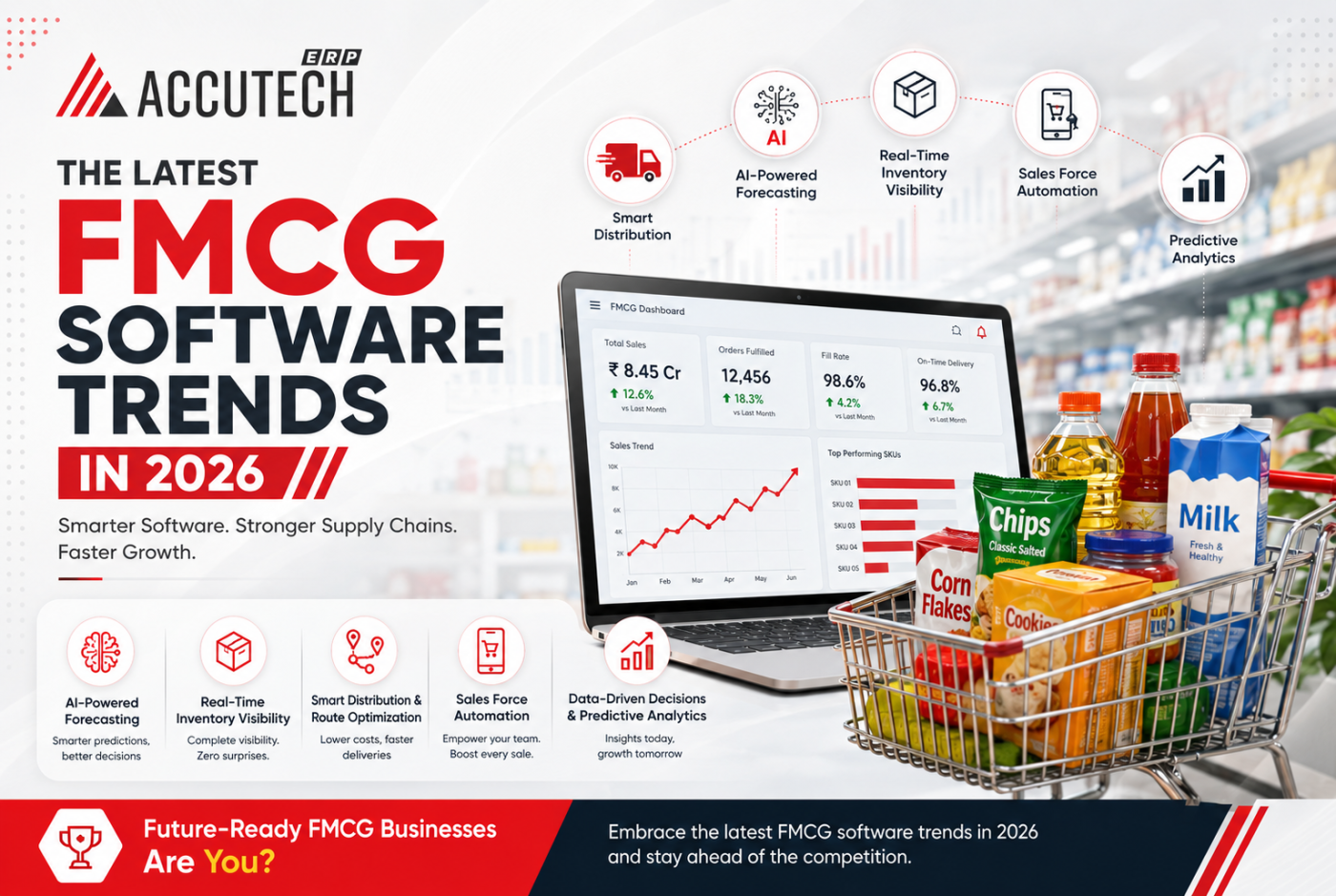
The top FMCG software trends in 2026 include AI-powered demand forecasting, real-time inventory visibility, smart distribution and route optimisation, mobile-first sales force automation, integrated accounting and GST compliance, and advanced business intelligence dashboards. Cloud architecture and promotion management automation are also accelerating rapidly.
Q3: How much does FMCG management software cost?
Pricing varies significantly based on the number of users, modules required, and deployment scale. Modern cloud-based platforms typically follow a SaaS subscription model, making them far more accessible than traditional on-premise systems. Many vendors offer tiered pricing that scales with your business. The focus should be on total cost of ownership including implementation, training, and ongoing support rather than just the licence fee.
Q4: How long does it take to implement FMCG distribution software?
With modern cloud-based fmcg management software, most businesses are fully operational within four to eight weeks for core modules. Complex multi-location rollouts with custom integrations may take longer. The key factors are data readiness, team availability for training, and the quality of vendor implementation support.
Q5: Can small distributors afford and benefit from FMCG software?
Absolutely. In 2026, the economics of FMCG software have democratised considerably. Cloud-based SaaS platforms require no large upfront investment, and small distributors often see faster ROI than larger organisations because their operational complexity is more manageable to transform. Even a business running five delivery routes can see significant gains in order accuracy, stock visibility, and distribution efficiency.
Q6: How does FMCG software handle GST compliance in India?
Leading FMCG platforms in 2026 include built-in GST engines that automatically calculate tax at the correct rates across product categories, generate e-invoices in the required format, prepare GSTR reconciliation reports, and flag mismatches before submission. This eliminates most of the manual reconciliation work that previously consumed significant accounts team time.
Q7: What is the difference between FMCG ERP and general ERP software?
General ERP systems are built for broad applicability across industries, which means FMCG-specific workflows beat planning, van sales, secondary sales tracking, outlet-level analytics, and scheme management are either absent or require expensive customisation. FMCG-specific software has these workflows built in from day one, resulting in faster implementation, better adoption, and more relevant functionality out of the box.
How does AI improve FMCG distribution?
AI improves FMCG distribution across several dimensions: demand forecasting that accounts for dozens of variables simultaneously, route optimisation that considers real-time traffic and vehicle constraints, automatic replenishment triggers based on predicted consumption, and anomaly detection that flags unusual patterns in sales or inventory before they become serious problems.
Q9: What are smart distribution solutions in FMCG?
Smart distribution solutions refer to technology platforms that optimize the physical movement of goods from distributor to retailer. They typically include dynamic route planning, GPS-enabled delivery tracking, proof of delivery capture, vehicle load optimisation, and outlet-level performance analytics. The goal is maximum efficiency with minimum cost and maximum customer satisfaction.
Q10: Is cloud-based FMCG software secure?
Yes, reputable cloud-based platforms in 2026 maintain enterprise-grade security standards, including data encryption in transit and at rest, role-based access control, regular security audits, and compliance with relevant data protection regulations. In most cases, cloud security is more robust than what a typical distributor or manufacturer could maintain on their own on-premise infrastructure.
Suggested Internal Linking Ideas
- Link to your FMCG Distribution Solutions page from the section on Smart Distribution Solutions
- Link to a case study page from the ROI section
- Link to a feature detail page on Sales Force Automation from Trend #4
- Link to a pricing or demo page from the FAQ section on costs
- Link to a blog on GST compliance from the accounting automation section
CTA Ideas for Conversion
- Primary CTA: 'Book a Free Demo, See How FMCG Software Works for Your Business'
- Secondary CTA: 'Download Our Free FMCG Software Selection Checklist'
- Inline CTA: 'Talk to an FMCG Expert, No Sales Pitch, Just Honest Advice'
- Exit Intent CTA: 'Before You Go, Get a Custom ROI Estimate for Your Business'
- Blog Footer CTA: 'Ready to Explore What Modern FMCG Software Can Do? Start Here.'
Conclusion: The Future of FMCG Is Already Here
We started this article with a story about a distributor watching a competitor outperform them while they were drowning in manual processes. That story plays out hundreds of times every day across the FMCG industry.
The gap between businesses that have embraced modern technology and those still operating on legacy systems is widening in 2026 not slowly, but rapidly. And the good news is that catching up has never been more accessible or more affordable than it is right now.
The FMCG software trends we've covered in this guide from AI forecasting and real-time visibility to smart distribution solutions and mobile SFA are not theoretical. They are live, proven capabilities available in platforms deployed by businesses of every size across India and beyond.
The question is not really whether your business needs modern fmcg business software. In 2026, the question is how quickly you can get there and whether you're choosing the right partner to help you make the journey.
If you're evaluating options, we'd encourage you to look at purpose-built FMCG platforms that understand your industry deeply. The difference between a generic ERP and a solution designed specifically for FMCG distribution is felt in every implementation, every training session, and every operational outcome.
The future of your FMCG business isn't something that will arrive someday. It's something you can start building today.