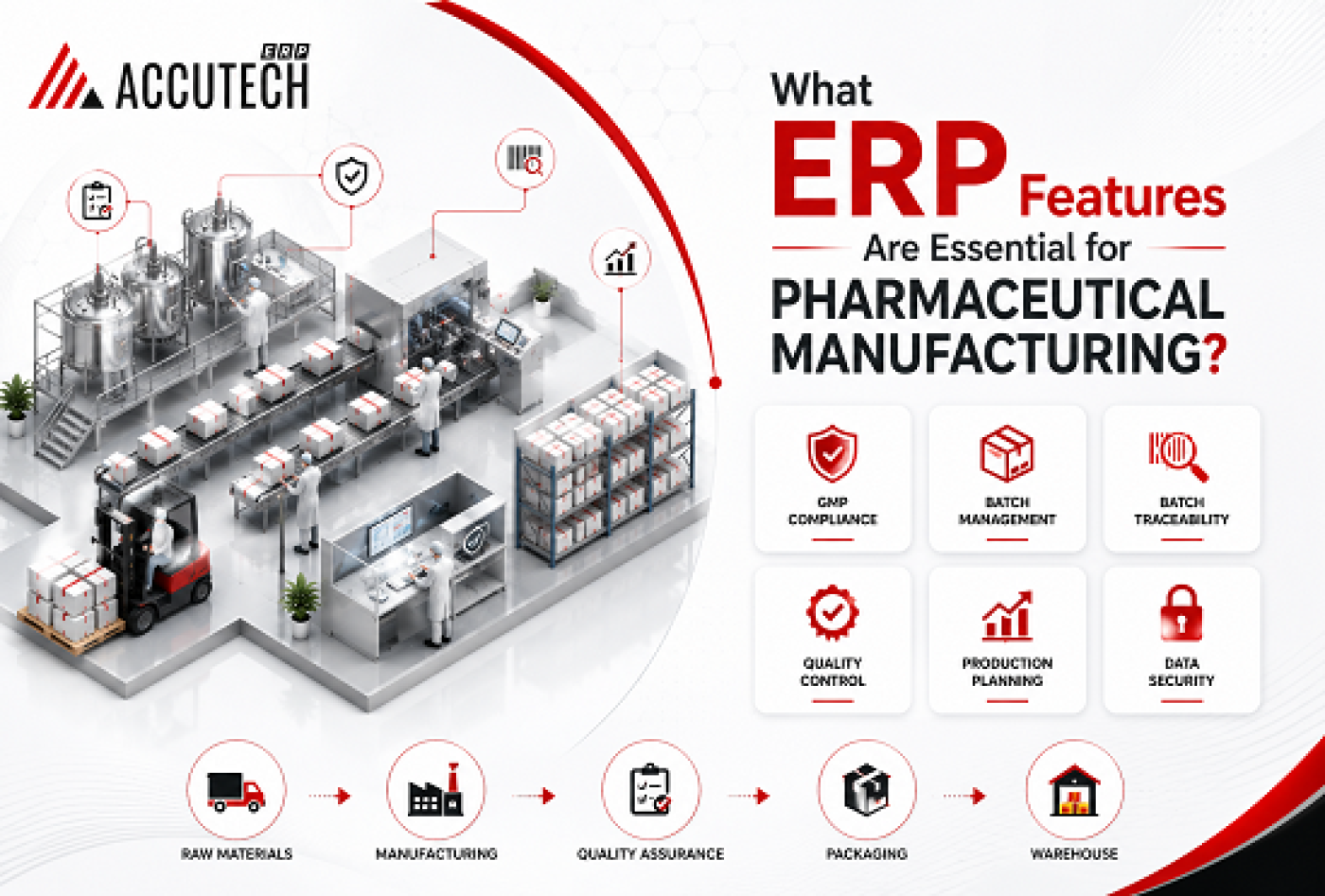
The pharmaceutical manufacturing industry operates in one of the most heavily regulated environments globally. Every tablet produced, every batch documented, and every ingredient tracked must meet stringent compliance standards set by agencies such as the FDA, EMA, and CDSCO. In this complex landscape, implementing the right pharmaceutical ERP software is not just a technological upgrade, it is a business necessity.
Pharmaceutical manufacturers today face significant challenges, including managing complex batch formulations, ensuring complete traceability from raw materials to finished products, maintaining regulatory compliance, and controlling manufacturing costs while remaining competitive. A comprehensive pharmaceutical management system addresses these challenges by integrating production, quality control, inventory, costing, and financial operations into a single, unified platform.
This comprehensive guide explores the essential ERP features pharmaceutical manufacturers should prioritize when selecting an enterprise resource planning system. From GMP compliance and batch management to advanced costing capabilities and supply chain optimization, each critical component helps transform fragmented and manual processes into streamlined, traceable, and auditable workflows that strengthen stakeholder trust and support sustainable business growth.
Why Pharmaceutical Manufacturing Demands Specialized ERP Solutions
Generic ERP systems designed for broad manufacturing industries often fail to address the unique complexities of pharmaceutical production. A specialized Pharma ERP differentiates itself through purpose-built features that embed regulatory compliance directly into operational workflows.
Unlike consumer product manufacturing, where mistakes impact inventory costs, pharmaceutical manufacturing involves life-or-death consequences. A single regulatory violation can result in factory shutdowns, product recalls affecting millions of patients, significant financial penalties, and irreparable damage to brand reputation. This existential risk explains why pharmaceutical companies invest heavily in specialized digital infrastructure.
Why Generic ERP Falls Short
- Lacks built-in batch genealogy and lot traceability capabilities required by FDA 21 CFR Part 11
- Missing electronic batch record (EBR) functionality for digital documentation
- Insufficient audit trail and electronic signature capabilities for regulatory submissions
- No automatic enforcement of GMP principles within workflows
- Cannot handle complex multi-step formulations with variable yield management
- Lacking specialized costing software for pharma that accounts for batch-level expenses and overhead allocation
A purpose-built Pharma ERP ensures compliance isn't bolted onto operations; it's woven into every process. When operators log into the system, they encounter workflows designed specifically for pharmaceutical manufacturing. Required fields cannot be skipped. Batch-level visibility is automatic. Traceability is inherent. Electronic records are validated by default.
Core Compliance Features Every Pharma ERP Must Include
Regulatory compliance stands as the non-negotiable foundation of any pharmaceutical ERP implementation. The system must actively enforce compliance rather than merely record it.
FDA 21 CFR Part 11 Compliance
The FDA's 21 CFR Part 11 regulation governs electronic records and electronic signatures in pharmaceutical manufacturing. A compliant Pharma ERP must provide:
- Secure electronic signatures that uniquely identify users and cannot be forged or repudiated
- Complete audit trails capturing who accessed data, when they accessed it, and what changes they made
- System validation documentation proving the software operates as intended
- Data integrity controls ensuring records cannot be altered after creation
- Encryption for data at rest and in transit to prevent unauthorized access
- Automatic timestamping of all entries with synchronized system clocks
- Role-based access controls limiting employees to data relevant to their responsibilities
Good Manufacturing Practice (GMP) Standards
GMP requirements span facility design, equipment qualification, personnel training, material management, production controls, laboratory testing, and documentation. The best Pharma ERP solutions embed GMP principles into system architecture:
- Master batch record (MBR) management defining approved manufacturing instructions
- Validated process parameters with automatic alerts for deviations
- Equipment maintenance tracking with calibration status and history
- Environmental monitoring integration for temperature and humidity controls
- Personnel training records linked to production activities
- Document management systems ensuring version control and approval workflows
- Deviation and CAPA (Corrective and Preventive Action) modules for issue resolution
Electronic Batch Records (EBR)
Traditional paper batch records are increasingly obsolete in modern pharmaceutical manufacturing. Electronic batch records integrated into a Pharma ERP system provide:
- Real-time data capture from production equipment via sensors and IoT integration
- Automatic population of fields reducing manual transcription errors
- Forced workflow sequences preventing skipped steps
- Digital signatures replacing handwritten approvals
- Complete change history showing what was entered, when, and by whom
- Searchable format enabling rapid retrieval for regulatory inspections
- Version control ensuring operators work with current approved instructions
Advanced Batch Management and Traceability Capabilities
Batch management represents the operational heart of pharmaceutical manufacturing. Every product passes through multiple batches, each containing thousands of units with identical characteristics produced within specific timeframes. A sophisticated Pharma ERP system manages batch lifecycle from conception through distribution and disposal.
End-to-End Batch Traceability
Batch traceability the ability to instantly identify every component used in a batch and every destination of finished products is mission-critical during product recalls. Regulatory agencies expect manufacturers to identify affected batches within hours, not days. Pharma ERP systems enable:
- Forward traceability: Tracking individual finished goods packages to specific retail locations and customers
- Backward traceability: Identifying the exact raw material lots, suppliers, and production dates within a batch
- Lateral traceability: Understanding which other batches shared common materials or equipment
- Complete genealogy: Visualizing the entire product lineage from raw material receipt to patient delivery
Lot genealogy recording ensures that in an emergency recall scenario, pharmaceutical manufacturers can instantly communicate which customers received affected batches, enabling swift product retrieval and minimizing patient risk.
Batch Status Management and Hold Logic
Pharmaceutical batches progress through distinct states: in-process, pending quality review, released for sale, or rejected. A robust Pharma ERP manages these transitions with sophisticated hold/release logic:
- Quality holds preventing product release until QA approves test results
- Regulatory holds triggered when regulatory issues emerge
- Supplier holds blocking use of specific supplier materials during investigations
- Automatic expiration of holds after defined periods with escalation notifications
- Complete audit trails documenting hold reasons, authorizers, and release decisions
Batch Costing Integration
Every batch incurs distinct costs: raw materials, labor, utilities, equipment depreciation, and quality testing. Integrated costing software for pharma allocates these expenses to specific batches, enabling:
- Accurate product cost determination
- Profit margin analysis by product line
- Identification of cost overruns during production
- Pricing strategy validation
- Inventory valuation using FIFO or LIFO methods
- Variance analysis comparing actual costs to standards
Quality Control and Quality Assurance Workflows
Quality represents the defining characteristic differentiating pharmaceutical manufacturing from other industries. A Pharma ERP system must embed sophisticated quality workflows ensuring every batch meets specifications before reaching patients.
Quality Control Modules
In-Process Quality Controls
During manufacturing, operators must conduct specified tests at defined checkpoints. A comprehensive Pharma ERP enforces in-process controls by:
- Defining required tests and acceptance criteria
- Preventing progression to next manufacturing steps until tests complete
- Automatically triggering investigations if results fall outside specifications
- Creating test result records linked to batch genealogy
- Generating alerts when patterns of marginal results suggest equipment degradation
Certificate of Analysis (CoA) Management
Suppliers provide Certificates of Analysis documenting raw material test results. The Pharma ERP must:
- Capture electronic CoAs from suppliers
- Compare supplier results against internal acceptance criteria
- Flag discrepancies triggering vendor quality reviews
- Link CoAs to specific purchase orders and received materials
- Retain CoAs for regulatory audit reference
- Support supplier scorecards rating consistent quality performance
GMP Deviation and CAPA Management
When quality issues emerge, the Pharma ERP system must manage investigations and corrective actions:
- Deviation reporting with automatic escalation to quality leaders
- Root cause analysis documentation with evidence trails
- Corrective action planning with assigned owners and deadlines
- Preventive action implementation to eliminate recurrence
- Effectiveness checks confirming improvements
- Documentation suitable for regulatory submission
Intelligent Costing Software for Pharma Manufacturing
Accurate cost determination represents both a financial necessity and regulatory requirement in pharmaceutical manufacturing. Unlike simple manufacturing where costs are relatively straightforward, pharmaceutical batch costing involves complex calculations across multiple dimensions.
Why Standard Costing Software Falls Short
Off-the-shelf accounting software treats all manufacturing costs identically. Pharmaceutical costing software for pharma must handle:
- Formulation complexity: Products contain dozens of ingredients in precise ratios
- Yield management: Manufacturing rarely achieves 100% yield; scrap and losses must be allocated
- Waste tracking: Shrinkage, moisture loss, and spillage during processing
- Multi-level BOMs: Finished products contain intermediate products containing raw materials
- Regulatory batch costs: Compliance activities generate direct batch costs
- Supplier API costs: Active pharmaceutical ingredients often dominate manufacturing costs
- Environmental controls: Climate-controlled facilities generate significant utility costs allocated to batches
Core Costing Features
Batch-Level Costing
The best costing software for pharma captures actual material consumption per batch from production equipment, records labor hours by employee and activity, allocates machine time and utilities to batches, and processes quality testing costs. This granular approach enables:
- Accurate product cost per unit
- Identification of high-cost batches signaling inefficiency
- Variance analysis comparing actual costs to standards
- Profit contribution by product
- Pricing strategy validation
Standard Cost Management
Most pharmaceutical manufacturers establish standard costs for products based on historical data. The Pharma ERP compares actual batch costs to standards, identifying:
- Material cost variances if ingredients exceed standards
- Labor variances if production takes longer than expected
- Overhead allocation variances
- Efficiency variances from yield issues
- Investigation triggers when variances exceed defined thresholds
Inventory Management and Expiry Tracking
Pharmaceutical inventory management differs fundamentally from other industries due to expiration dates and temperature sensitivity. An effective Pharma ERP must provide:
FEFO (First-Expiring, First-Out) Issuance
Unlike FIFO or LIFO inventory valuation methods, pharmaceutical manufacturers must physically distribute the soonest-expiring products first to avoid waste. The Pharma ERP automatically:
- Identifies inventory approaching expiration
- Prioritizes older inventory for picking and shipping
- Prevents issuance of expired stock
- Alerts warehouse staff to disposal requirements
- Tracks disposition of expired inventory for regulatory compliance
Automatic Expiration Controls
The system must prevent distribution of expired products through:
- Real-time shelf-life calculation from manufacture date
- Automatic blocking of expired lots from order fulfillment
- Quarantine procedures for stock approaching expiration
- Disposition workflows for expiring inventory
- Regulatory-compliant destruction documentation
Temperature and Cold-Chain Management
Temperature-sensitive pharmaceuticals require continuous monitoring throughout storage and distribution. A sophisticated Pharma ERP integrates with IoT sensors to:
- Monitor temperature in real-time during storage
- Track temperature during shipment using integrated sensors
- Alert staff to deviations requiring investigation
- Record temperature excursions in batch histories
- Support hold/release decisions for potentially compromised batches
- Generate cold-chain compliance reports for regulatory submission
ERP Security Features for Pharmaceutical Data Protection
Pharmaceutical data ranks among the most valuable and sensitive information in modern business. Product formulations represent trade secrets worth millions. Patient information requires HIPAA protection. Production records undergo regulatory scrutiny. An enterprise Pharma ERP must provide military-grade security.
Data Encryption
Encryption for Data at Rest
All data stored in the Pharma ERP should be encrypted using AES-256 or equivalent standards. Encryption keys should be managed separately, never embedded in databases, and rotated regularly.
Encryption for Data in Transit
All data traveling between systems must use TLS 1.2 or higher, preventing network sniffing attacks.
Role-Based Access Control (RBAC)
Users should access only data relevant to their job responsibilities. A comprehensive Pharma ERP implements:
- Detailed roles defining permitted actions per user type
- Multi-level approvals preventing single individuals from authorizing significant changes
- Segregation of duties ensuring purchasing, receiving, and payment involve different staff
- Time-based access restrictions limiting login hours
- Device restrictions preventing access from unauthorized devices
- Automatic session timeout after inactivity
Audit Trails and Logging
Complete audit trails document:
- Every user action: login/logout events, data access, data modifications
- Timestamps using synchronized system clocks
- User identification ensuring actions cannot be attributed to generic accounts
- Pre- and post-change values enabling investigation of unauthorized modifications
- Immutable storage preventing audit log tampering
- Regular backup to separate systems protected against simultaneous compromise
User Authentication
Modern Pharma ERP systems should support:
- Multi-factor authentication (MFA) combining passwords and secondary factors
- Single sign-on (SSO) integration with enterprise identity systems
- Complex password requirements enforcing strong credentials
- Automatic password expiration and history preventing reuse
- Account lockout after failed login attempts
- Electronic signature implementation for regulatory compliance
Production Planning and Scheduling Features
Efficient production planning directly impacts manufacturing costs and on-time delivery. A Pharma ERP system must optimize production flow while respecting constraints.
Demand Forecasting and Planning
Pharmaceutical demand varies seasonally and geographically. Advanced Pharma ERP systems use:
- Historical sales analysis to forecast future demand
- Seasonal adjustment factors
- Promotional event anticipation
- Customer contract analysis
- Safety stock calculations preventing stockouts
- Inventory targeting balancing carrying costs against service levels
Production Scheduling
Once demand is forecasted, manufacturing must be scheduled efficiently:
- Batch sequence optimization minimizing changeovers and cleaning time
- Equipment constraint consideration ensuring available capacity
- Lead time calculation including material procurement and QA review periods
- Priority rules balancing order due dates against operational efficiency
- Rough-cut capacity planning identifying bottlenecks
- Detailed scheduling creating realistic production calendars
- Production order generation triggering purchase requisitions for materials
Capacity Planning
Manufacturing capacity constraints limit production volume. A robust Pharma ERP system:
- Calculates available capacity per equipment line
- Identifies over/under-capacity situations
- Recommends production order adjustments
- Supports what-if analysis for new product launches
- Tracks actual vs. planned production identifying delays
Reporting, Analytics, and Business Intelligence
Data visibility enables informed decision-making. An enterprise-class Pharma ERP provides comprehensive reporting covering:
Operational Dashboards
Real-time production dashboards display:
- Production progress vs. schedule
- Quality test results and pass rates
- Equipment downtime and causes
- Batch cycle time trending
- Material shortage alerts
- Order fulfillment status
Financial Reporting
The Pharma ERP integrates with costing software for pharma to provide:
- Product profitability analysis
- Cost variance reporting
- Contribution margin analysis
- Gross margin trend analysis
- Customer profitability
- Product mix recommendations
Compliance and Regulatory Reports
For regulatory submissions and audits, the system generates:
- Batch genealogy and traceability documentation
- Deviation and CAPA reports
- Change control history
- Validation and qualification documentation
- Training records by employee
- Equipment maintenance and calibration schedules
- Environmental monitoring trends
Frequently Asked Questions About Pharma ERP Systems
Q1: How long does pharmaceutical ERP implementation typically take?
Implementation timelines vary significantly based on company size, system complexity, and customization requirements. Small to mid-sized pharmaceutical manufacturers typically require 6–12 months for complete implementation, while larger enterprises may need 12–24 months.
Critical success factors include executive sponsorship, dedicated internal resources, process redesign before system deployment, and selecting a vendor with proven pharmaceutical industry implementation expertise.
Q2: What is the typical ROI from investing in pharmaceutical ERP software?
Most mid-sized pharmaceutical manufacturers achieve a return on investment within 12–18 months through:
- A 10–20% reduction in production costs through improved efficiency and yield optimization
- Reduced regulatory penalties through stronger compliance controls
- Faster batch release through automated quality assurance workflows
- Lower inventory carrying costs through improved demand forecasting
- Better on-time delivery performance and fewer customer penalties
These benefits continue to increase as organizations expand and improve their use of the system.
Q3: How does pharmaceutical ERP software support FDA compliance?
Enterprise pharmaceutical software supports FDA compliance through several mechanisms:
- Electronic records that meet 21 CFR Part 11 requirements, including audit trails and electronic signatures
- Embedded GMP workflows that help prevent deviations from approved procedures
- Automated documentation that ensures complete traceability
- System validation documents that support regulatory inspections and submissions
- Role-based access restrictions that prevent unauthorized system use
- Automatic alerts for deviations requiring investigation and documentation
Q4: Can small pharmaceutical manufacturers afford pharmaceutical ERP software?
Yes. Cloud-based pharmaceutical management solutions have made advanced technology accessible to smaller manufacturers.
Cloud deployment eliminates the need for expensive on-premises infrastructure and large internal IT teams. Subscription-based pricing aligns costs with business size, while modular implementation allows companies to begin with essential modules and add more features as their operations grow.
Many software providers also offer flexible licensing based on users, locations, or production volumes.
Q5: How does pharmaceutical ERP software integrate with existing laboratory systems?
Modern pharmaceutical management systems integrate with Laboratory Information Management Systems through standardized APIs and data interfaces.
This integration enables:
- Automatic transfer of test results from LIMS to batch records
- Comparison of test results against approved specification limits
- Automated pass or fail determination
- Immediate alerts when results exceed acceptance criteria
- Elimination of manual data-entry and transcription errors
- Complete traceability linking laboratory results with batch genealogy
Q6: What security measures protect pharmaceutical data in cloud-based ERP software?
Cloud-based pharmaceutical software providers commonly implement enterprise-grade security measures, including:
- AES-256 encryption for stored data
- TLS encryption for data transmitted between systems
- Multi-factor authentication and single sign-on integration
- Role-based access controls that limit data visibility
- Comprehensive audit logs and activity monitoring
- Regular vulnerability scanning and security testing
- Compliance with standards such as SOC 2 Type II
- Automated backups across geographically distributed data centres
- Disaster recovery systems that support business continuity
Q7: How does pharmaceutical ERP software handle product recalls?
An integrated pharmaceutical management system enables faster and more controlled recall management through:
- Immediate identification of affected batches using finished-product serial numbers
- Automated lot genealogy showing production history and all components used
- Forward traceability to identify customers who received affected products
- Automated recall notifications containing product and customer information
- Inventory quarantine controls that prevent further distribution
- Recall effectiveness tracking to confirm product retrieval
- Complete recall documentation for regulatory submissions and legal records
Q8: Can pharmaceutical ERP software support contract manufacturing operations?
Yes. Advanced pharmaceutical systems can support contract manufacturing through:
- Multi-company configurations that separate client inventory and transactions
- Third-party cost allocation, billing, and invoicing
- Confidentiality controls that protect client formulas and specifications
- Client order management and delivery tracking
- Quality performance and service-level monitoring for each contract
- Automated production cost tracking and client billing
- Enforcement of client-specific regulatory and quality requirements
Q9: What training is required for pharmaceutical ERP implementation?
Successful implementation requires structured training for different user groups:
- System administrators generally require 40–80 hours of technical training covering architecture, security, configuration, and maintenance
- Process owners may need 60–100 hours of end-to-end workflow training
- Production operators generally require 20–40 hours of role-specific shop-floor training
- Quality teams may require 40–60 hours of training on quality control, quality assurance, deviation management, and documentation
- Finance teams generally need 40–60 hours of training on accounting, costing, and reporting
- Executives may require 10–20 hours of training on dashboards, analytics, and strategic reports
Training commonly continues for two to three months after go-live, supported by refresher sessions and user assistance.
Q10: How does pharmaceutical ERP software support multiple manufacturing locations?
Enterprise pharmaceutical platforms support multi-location manufacturing through:
- A unified data model that consolidates inventory across locations
- Inter-branch and inter-facility transfer order management
- Receiving, inspection, and quality control processes for transferred materials
- Centralized reporting for cross-location performance analysis
- Independent manufacturing operations and batch records for each facility
- Capacity-based production planning and facility allocation
- Consolidated financial reporting for location-wise profitability
- Shared master data for formulas, specifications, products, and suppliers
- Location-specific workflows, permissions, and configurations
Conclusion
The pharmaceutical manufacturing landscape continues to evolve due to increasing regulatory complexity, supply chain pressures, and intense market competition. Manufacturers that adopt specialized pharmaceutical management software such as Accutech ERP can achieve sustainable growth, stronger compliance, and better operational control.
Accutech ERP goes beyond traditional business software by providing a connected digital foundation for pharmaceutical manufacturing. It helps businesses improve production efficiency while maintaining strict regulatory and quality standards. From advanced batch management and quality control workflows to accurate costing, inventory tracking, and data security, its integrated features help streamline critical manufacturing operations.
The question is no longer whether pharmaceutical manufacturers can afford to invest in modern ERP technology. The more important question is whether they can continue operating efficiently without an integrated and compliant digital system. Manual and disconnected processes can lead to missed opportunities, higher operational risks, inaccurate costing, inventory issues, and competitive disadvantages.
The future of pharmaceutical manufacturing is digital, integrated, and intelligent. Forward-thinking manufacturers should consider Accutech ERP, a specialized solution designed to support the pharmaceutical industry’s unique manufacturing, compliance, inventory, costing, and reporting requirements.
With industry-focused features, reliable implementation support, and scalable technology, Accutech ERP can help pharmaceutical manufacturers improve efficiency, strengthen compliance, control production costs, and accelerate long-term business growth.