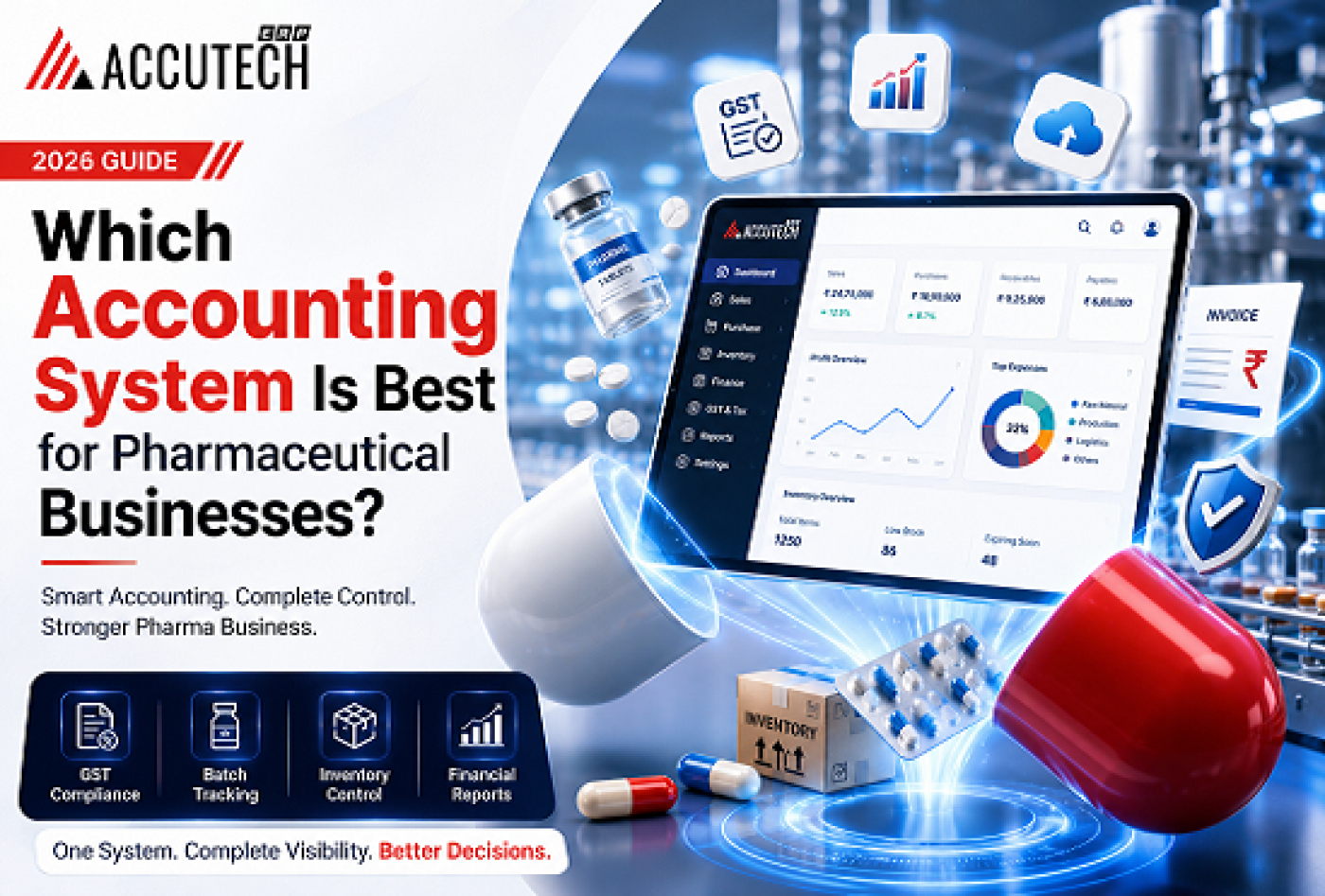
The pharmaceutical industry operates under relentless pressure. Between managing inventory across multiple batches, tracking expiry dates, ensuring GST compliance, and maintaining accurate financial records, pharmaceutical business owners face complexity that generic accounting software simply cannot address.
Whether you're running a Pharma PCD distribution network, managing a pharmaceutical manufacturing unit, or operating as a bulk drug trader, the right accounting system can make the difference between operational chaos and streamlined profitability.
This guide helps you find the right solution. We'll explore what pharmaceutical accounting software can do, how it differs from standard tools, and exactly how to evaluate options that fit your business.
Why Pharmaceutical Businesses Need Specialized Accounting Software
Pharmaceutical companies operate in one of the most regulated industries on earth. Every product you handle carries legal requirements. Every transaction touches compliance rules. Every sale involves taxes calculated differently based on product type.
Consider what happens when you sell a batch of medicine. It's not just a transaction. The system needs to know: which batch left your warehouse, what was its cost, what was its selling price, which customer received it, what was the margin, which tax slab applies, whether this batch was close to expiry, whether it qualifies for ITC, and six months later if the customer returns it.
Generic accounting software wasn't designed for this complexity. Excel spreadsheets can't handle it. Even standard ERP systems stumble because they don't have batch-level thinking built in.
The Three Core Challenges Generic Tools Miss
First: Batch and expiry tracking. Every pharmaceutical product is a collection of batches with different manufacturing dates and expiry timelines. Selling expired medicine isn't just bad business, it's illegal. Generic systems track inventory by product code, not by batch. They can't alert you that batch #2024-05-XYZ expires next month. They can't prevent you from accidentally shipping expired stock.
Second: GST complexity for regulated products. India's GST structure isn't simple for pharma. Different products have different tax rates. You need to correctly classify every item using HSN codes. You need to track Input Tax Credit separately. GSTR filings require precision. One classification error cascades through your entire accounting.
Third: Distribution network visibility. If you work through distributors, franchisees, or retail channels, you need to see sales at every level. You need to track which distributor owes you money, which products are moving fast in which territories, and what your real profitability is after all the discounts and schemes.
Understanding Your Pharma Business Model and Accounting Needs
Not all pharmaceutical businesses operate the same way. Before selecting software, understand your specific business structure:
Pharma PCD Distribution Model
In the Pharma PCD (Propaganda Cum Distribution) model, you purchase products from a parent pharmaceutical company and distribute them to retail channels, hospitals, and clinics within your territory. Your accounting needs center on managing distributor credit cycles, tracking sales across multiple retail partners, managing returns and damaged goods, monitoring market schemes and promotional discounts, and maintaining compliance with company-specific reporting requirements.
Pharmaceutical Manufacturing
Manufacturing operations require production costing, batch traceability, quality control documentation, and regulatory compliance documentation. Your accounting software must integrate with production planning, raw material consumption tracking, and finished goods inventory management.
Bulk Drug Trading
Bulk drug traders manage high-volume, lower-margin transactions. The accounting system must handle rapid inventory turnover, manage price volatility, track HSN classifications precisely, and provide real-time profitability analysis.
What Makes Specialized Systems Different
Here's whatpharmaceutical accounting software does that generic tools can't:
Batch-Level Everything
Not just tracking that you have 1,000 units of Product X. Tracking that you have 500 units from Batch A (expiring March 2026) and 500 from Batch B (expiring June 2026). Recording manufacturing date, expiry date, cost price, and location for every batch separately.
When you sell 100 units, the system knows which batch they came from. When you run an expiry report, it shows you exactly what's at risk and when. When an audit happens, you have complete traceability.
GST Built from the Ground Up
Automated calculations based on product type and HSN classification. Automatic ITC tracking so you never claim credit you shouldn't or miss credit you can claim. GSTR-1, GSTR-2A, and GSTR-3B generation that doesn't require manual spreadsheet massage.
Reconciliation reports that show discrepancies before your accountant finds them. Tax liability calculations that account for all your transactions automatically.
Multi-Level Distribution Intelligence
Sales funneling through multiple channels? The system shows you sales by distributor, territory, product, and customer. You see profitability at every level. You track credit given out and receivables coming in. You measure performance and identify bottlenecks.
Outstanding balances, aging reports, credit limits, and payment patterns all at your fingertips without manual work.
Profitability at Any Angle
Want to know which product made you the most money last month? Which distributor is most profitable? Which batch had the best margin? The system answers these questions instantly.
You can analyze profitability by product, by customer, by territory, by salesperson, or by batch. This visibility drives better business decisions.
Comparing Top Solutions for Pharma Businesses
Enterprise Solutions vs. Mid-Market Solutions
Aspect | Enterprise ERP | Mid-Market Solutions | Cloud-Based Specialized |
Implementation Time | 12-18 months | 3-6 months | 4-12 weeks |
Deployment Model | On-Premise/Cloud | Cloud Primarily | 100% Cloud-Native |
Cost Structure | High capex, licensing | Moderate capex, SaaS | Low capex, transparent |
Pharma Features | Configurable | Good support | Built-in |
Pharma PCD Software: Distribution-Specific Advantages
If you operate in the Pharma PCD space, specialized software provides specific advantages:
Territory and Distributor Management
Track sales performance by territory and individual distributor. Monitor market schemes, incentives, and promotional periods. Measure sell-through vs. sell-in data to understand actual market movement.
Franchise-Specific Workflows
Pharmaceutical accounting software designed for franchises handles credit management with term limits, free sample tracking, promotional item allocation, and franchise compliance reporting. This is different from standard distribution, and generic software doesn't address these workflows.
Return and Damage Management
Pharmaceuticals have high return rates due to expiry or damage. Specialized software streamlines return processing, tracks reasons for returns, manages reverse logistics, and updates inventory automatically.
Implementation Roadmap: From Selection to Go-Live
Phase 1: Assessment and Planning (Week 1-2)
Document current processes, identify pain points, and define success metrics. Map your business structure to software modules. Identify who will champion adoption internally.
Phase 2: Vendor Selection and Demo (Week 2-4)
Request demos from shortlisted vendors. Test with your real data if possible. Check references from similar-sized pharma businesses. Negotiate pricing and support terms.
Phase 3: Data Migration and Configuration (Week 4-8)
Extract historical data, clean it, and prepare for migration. Configure the software to match your business structure. Set up user roles and access permissions. Create master data for accounts, products, and customers.
Phase 4: Training and Testing (Week 8-10)
Train users on key processes. Conduct parallel runs to validate data accuracy. Identify and fix configuration issues before go-live.
Phase 5: Go-Live and Support (Week 10+)
Execute cutover, activate the system, and monitor closely for the first month. Have support readily available to resolve issues immediately.
Cost-Benefit Analysis of Investing in Pharma ERP
Benefits That Outweigh Initial Investment:
- Reduction in accounting errors: 60-70% fewer manual reconciliation hours
- Faster financial closure: From 10-15 days to 2-3 days
- Improved GST compliance: Elimination of filing penalties
- Inventory optimization: 15-20% reduction in carrying costs through better expiry management
- Enhanced cash flow: Faster collection cycles and better receivables management
- Data-driven decision making: Real-time profitability and performance metrics
- Regulatory confidence: Audit-ready records and comprehensive documentation
For a mid-sized pharma business with 10 crores in annual revenue, typical ROI is achieved within 12-18 months through a combination of operational efficiency and error reduction.
Overcoming Common Implementation Challenges
Challenge: User Adoption
Solution: Invest in comprehensive training and identify power users who can champion the system internally. Provide ongoing support to address concerns and build confidence.
Challenge: Data Quality Issues
Solution: Clean historical data before migration. Run parallel systems temporarily. Validate imported data against source records.
Challenge: Customization Scope Creep
Solution: Define core requirements upfront. Distinguish between "must have" and "nice to have" features. Use post-implementation phases for less critical enhancements.
Future-Ready Features: AI, Automation, and Compliance
Modern pharmaceutical accounting software should offer:
- AI-powered reconciliation that flags anomalies
- Predictive inventory management based on demand patterns
- Automated invoice processing and exception handling
- Real-time dashboard analytics with mobile access
- Integrated compliance calendars with automated reminders
- API connectivity for seamless integration with banking and logistics partners
Frequently Asked Questions
1. What is the primary difference between generic accounting software and specialized pharma software?
Generic accounting software treats all businesses identically. A specialized pharma accounting solution is designed for the industry's unique requirements, including batch tracking, expiry management, multi-level GST compliance, specialized reporting for distribution networks, and regulatory documentation. Without these features, pharma businesses may face compliance gaps, financial inaccuracies, and operational inefficiencies.
2. Can we use Tally or simple accounting software for pharmaceutical businesses?
While Tally handles basic accounting, it lacks advanced batch management, distributor network features, and specialized pharma reporting. Many businesses start with Tally and later migrate to a dedicated pharma business management system as they scale and operational complexity increases.
3. How long does implementation typically take?
A cloud-based pharma accounting solution typically requires 8–12 weeks for a mid-sized business. This includes data migration, configuration, training, and parallel testing. Enterprise implementations may take 3–6 months depending on complexity and customization needs.
4. What about GST compliance how does specialized software help?
Specialized pharma software automates GST calculations based on HSN codes, applies correct tax rates, manages ITC tracking, and helps generate GSTR-1, GSTR-2A, and GSTR-3B reports. This reduces manual errors that may lead to penalties and helps ensure timely compliance.
5. How does batch tracking work in pharma accounting systems?
Every batch is tracked individually with manufacturing date, expiry date, quantity, cost, and storage location. When inventory is sold, the system records which batches were used. Automated alerts notify users before stock expires, helping prevent financial losses and compliance issues.
6. Can the software handle multiple distributors and territories?
Yes. Pharma PCD software is designed for multi-level distribution. It can track sales by distributor, territory, and product, manage credit limits, monitor market schemes, and measure performance across the distribution network. Specialized dashboards also provide better visibility into each distributor's performance.
7. What kind of reports can we generate?
Reports may include profitability by product, batch, or distributor, outstanding and receivables aging, GST compliance reports, inventory turnover and expiry analysis, cash flow forecasts, distributor performance comparisons, and financial statements such as P&L, balance sheet, and cash book.
8. Is cloud-based pharma accounting software secure?
Reputable cloud-based pharma solutions generally include enterprise-grade security features such as encryption, role-based access control, automated backups, and data protection measures. Cloud systems can also reduce the risks associated with local hardware failure and manual backups.
9. How much does pharma accounting software cost?
Cloud-based solutions can vary significantly in price depending on features, number of users, business size, integrations, and customization requirements. Enterprise solutions are generally more expensive. Businesses should evaluate the overall cost against improvements in efficiency, accuracy, compliance, and operational control.
10. What happens if we switch software in the future?
Choose vendors offering data export in standard formats (CSV, Excel, or XML). This ensures you're not locked in. Historical data should be exportable for audit purposes and for migration to alternative systems if needed.
Conclusion:
Choosing the right accounting system for your pharma business isn't about picking the fanciest software. It's about finding a system that truly understands your specific challenges.
Whether you distribute through a Pharma PCD network, manufacture products, or trade bulk drugs, you need batch tracking, GST automation, multi-distributor management, and regulatory compliance built in not added later or configured as an afterthought, but designed as part of the core system.
A well-structured platform like Accutech ERP is built with these requirements in mind, helping pharma businesses streamline operations from day one.
The right investment protects you against compliance penalties, inventory losses, and poor decisions based on inaccurate data. In many cases, it pays for itself within 18 months through improved efficiency and reduced errors.
Start by clearly identifying your pain points. Then evaluate vendors against your specific needs. Most reputable providers, including Accutech ERP, offer trials and demos using them. Speak with their existing pharma customers and verify references thoroughly.
The right system doesn't just process transactions. It becomes the intelligence layer that helps you run your business smarter, faster, and with greater confidence.