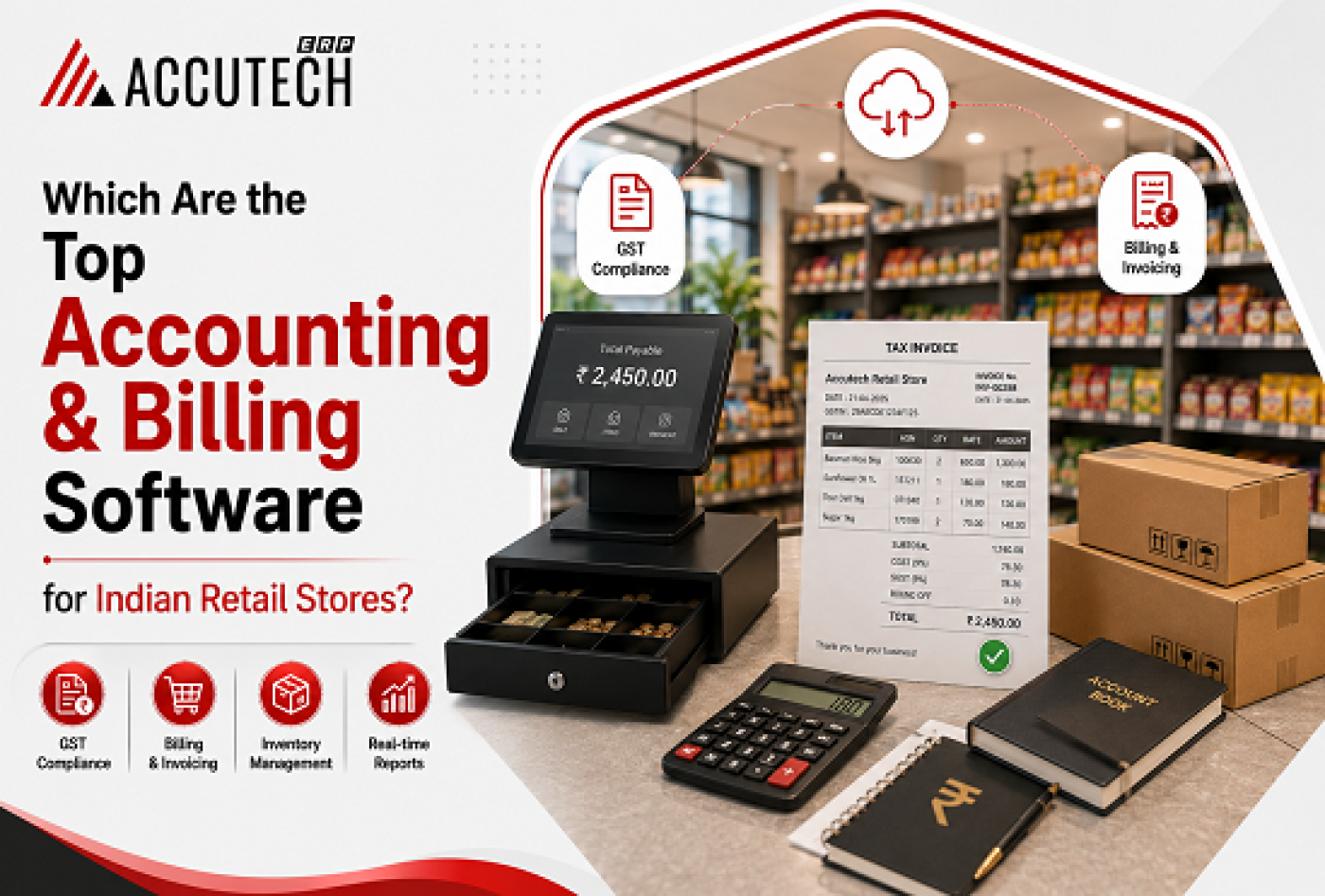
Running a successful retail business in India requires more than just excellent products and customer service. Behind every thriving retail store is a robust accounting and billing system that keeps finances organized, ensures GST compliance, manages inventory, and provides real-time insights into business performance. Yet, many retail store owners still rely on outdated methods, spreadsheets, manual entries, and fragmented software solutions that waste time, create errors, and complicate tax filing.
The challenge is real: Indian retailers face unique complexities including GST compliance, multi-branch operations, inventory synchronization, and the constant pressure to maintain accurate financial records while managing daily operations. Without the right tools, these tasks become overwhelming and prone to costly mistakes.
The solution? Implementing the best advance accounting software specifically designed for Indian retail businesses. In this comprehensive guide, we'll explore the top accounting and billing software solutions available for Indian retail stores, compare their features, and help you select the right platform to streamline your business operations, ensure tax compliance, and drive growth.
Why Indian Retail Stores Need Advanced Accounting Software
Indian retail businesses operate in a uniquely complex environment. Unlike many Western markets, Indian retailers must navigate GST (Goods and Services Tax) regulations, manage high transaction volumes, maintain multiple inventory locations, and ensure compliance with constantly evolving tax laws. This is where accounting and billing software becomes not just helpful, it's essential.
The Impact of Manual Accounting:
- Time Wasted: Manual entry and reconciliation take 20-30 hours per week
- Error Prone: Human mistakes lead to inaccurate financial statements and tax issues
- Tax Risks: Delayed compliance and incorrect filings result in penalties
- Visibility Loss: Delayed reporting means decisions are made on outdated information
- Scalability Limits: Manual processes break down as your business grows
Advanced accounting software solves these problems by automating transactions, ensuring GST compliance, providing real-time reporting, and enabling multi-branch management all critical for modern Indian retail stores.
Key Features of Top Accounting Software for Retail
When evaluating accounting software for your retail store, specific features determine whether the solution truly serves your business needs. Here are the essential features every leading accounting and billing software in India should offer:
A. Automated Billing and Invoice Management
The ability to generate invoices instantly, apply taxes automatically, and manage returns seamlessly. Look for software that supports multiple invoice formats, batch billing, and digital invoice delivery. This feature alone reduces billing time from 30 minutes per transaction to seconds.
B. Real-Time Inventory Integration
Your accounting software should automatically update inventory with every sale, purchase, or return. This ensures stock data is always accurate, prevents overselling, and eliminates the nightmare of manual stock reconciliation. Real-time inventory visibility is crucial for retail operations.
C. GST Compliance Automation
The software should automatically calculate GST on all transactions, generate GSTR-1 and GSTR-2 reports, and prepare data for GSTR-3B filing. It should handle different GST rates (5%, 12%, 18%, 28%), reverse charges, and maintain an audit trail for compliance verification.
D. Financial Reporting and Analysis
Access to real-time profit & loss statements, balance sheets, cash flow reports, and customer/supplier analytics. These reports should be available on-demand and support drill-down analysis from summary to transaction level.
E. Multi-Branch and Multi-Entity Support
For growing retail chains, the ability to manage multiple stores, warehouses, and business entities from a single system is invaluable. Consolidated reporting combined with branch-specific visibility ensures complete business control.
F. Mobile Accessibility
Modern retail managers need access to business data from anywhere. Mobile apps should allow viewing reports, approving invoices, and monitoring sales on-the-go.
Understanding GST Compliance in Accounting Software
GST compliance is perhaps the most critical challenge for Indian retail stores. Failing to file correct GST returns can result in penalties up to 25% of tax amount, interest charges, and potential legal action. This is why choosing accounting software with robust GST capabilities is non-negotiable.
How Best Advance Accounting ERP Software Handles GST:
- Automatic Tax Calculation: Every invoice automatically calculates appropriate GST based on product type, customer location, and supply type (intra-state vs inter-state).
- GSTR Report Preparation: The software generates GSTR-1 (outbound sales), GSTR-2A reconciliation, and GSTR-3B (tax summary) automatically with zero manual compilation.
- ITC Tracking: Input Tax Credit (ITC) is automatically tracked and reconciled against purchase bills, preventing cash flow losses from unclaimed ITC.
- Reverse Charge Mechanism: The system automatically identifies supplies subject to reverse charge and applies appropriate tax treatment.
- Compliance Updates: Leading accounting software receives regular updates to reflect GST rule changes and new compliance requirements.
Real-Time Billing and Inventory Management Benefits
The combination of real-time billing and inventory management is transformative for retail operations. Let's explore why this integration is crucial:
Immediate Stock Updates
When a customer purchases an item, the billing system instantly updates inventory. This eliminates double-selling and ensures stock reports are always accurate. Staff can check real-time availability before promising delivery dates.
Faster Checkout Process
Integration between billing and inventory means faster checkout with automatic invoice generation, tax calculation, and receipt printing. Customers spend less time at the counter, improving satisfaction.
Automated Reordering
The software can automatically generate purchase orders when inventory drops below reorder points, ensuring you never run out of popular items while avoiding excess stock of slow-moving products.
Detailed Sales Analytics
Integrated systems provide insights into which products are selling, profit margins by product, customer preferences, and sales trends. This data-driven information helps optimize product selection and pricing.
Top Accounting and Billing Software Solutions Compared
Several accounting and billing software solutions are available for Indian retail stores. Here's how they compare:
Comparison - Leading Accounting & Billing Software for Indian Retail:
- Accutech ERP: Full Auto GST | Dashboard Reporting | Unlimited Multi-Branch | Real-time Inventory | Mobile App | 24/7 Local Support | Flexible Pricing | 3-5 Days Setup
- Tally Prime: Full Auto GST | Traditional Reports | Unlimited Multi-Branch | Real-time Inventory | Mobile App | Business Hours Support | License Model | 1-2 Weeks Setup
- GST Suvidha: Good GST Coverage | Limited Reports | Limited Multi-Branch | Manual Inventory | No Mobile App | Limited Support | Freemium Model | 1-2 Days Setup
- Zoho Books: Good GST Coverage | Dashboard Reporting | Unlimited Multi-Branch | Real-time Inventory | Mobile App | 24/7 Global Support | Subscription Model | 1 Week Setup
Best Advance Accounting ERP Software for Growing Retail Businesses
For retail businesses that are serious about growth and operational excellence, Accutech ERP's best advance accounting ERP software stands out as a comprehensive solution designed specifically for Indian market requirements.
Why Accutech ERP is the Leading Choice:
- Complete Financial Control: From invoice creation to financial statement generation, every transaction is tracked with complete visibility. The software maintains comprehensive audit trails showing who accessed or modified data and when.
- Automated GST Workflows: Rather than manual tax calculation and return preparation, AccuTech ERP automates the entire GST process. Transactions are automatically mapped to GSTR forms, input tax is tracked and reconciled, and monthly tax liability is calculated instantly.
- Real-Time Financial Visibility: Get instant access to profit & loss statements, balance sheets, cash flow reports, and customer/supplier analytics. Business decisions can be made on current data, not historical information.
- Multi-Entity Support: Manage multiple retail stores, warehouses, and business entities from a single platform with separate books for each entity and consolidated reporting capabilities.
- Enterprise Security: Bank-grade encryption, multi-level authentication, role-based access control, and 8+ years of audit trail maintenance protect your financial data.
- Easy Integration: Connect with existing POS systems, payment gateways, e-commerce platforms, and other business software without technical complexity.
- Scalable Infrastructure: Whether you're managing a single store or a chain with 50+ locations, the system scales to match your growth without performance degradation.
Multi-Branch and Multi-Entity Support: Why It Matters
Retail chains operating multiple stores face a unique challenge: maintaining consistency across locations while keeping each branch's financials separate. This is where leading accounting and billing software in India proves invaluable.
Advantages of Multi-Branch Support:
- Separate Books: Each branch maintains independent financial records while sharing the same software platform
- Consolidated Reporting: View company-wide financial statements and performance metrics instantly
- Branch Comparison: Analyze performance differences between branches to identify best practices and opportunities
- Inventory Management: Track stock levels across all branches and facilitate inter-branch transfers
- Unified GST: Manage multiple GSTIN numbers while maintaining consistent tax compliance
- Centralized Control: Head office can monitor all operations while local managers have branch-level autonomy
Security and Data Protection in Accounting Software
Financial data is sensitive. Your accounting software holds information about customer transactions, supplier details, bank accounts, and confidential financial information. Security is not a luxury, it's essential.
Critical Security Features to Verify:
- Data Encryption: Look for end-to-end encryption using industry-standard protocols (TLS 1.3 minimum). Data should be encrypted both in transit and at rest.
- Multi-Level Authentication: The software should support multi-factor authentication (MFA), requiring passwords plus additional verification methods.
- Role-Based Access Control: Different team members should have different permission levels. The accountant might see all transactions, while a sales manager might only see sales data relevant to their location.
- Complete Audit Trail: The system should maintain detailed logs of who accessed data, when they accessed it, and what changes were made. This is crucial for tax audits and dispute resolution.
- Regular Backups: Automatic daily backups ensure your data is never lost even if the main server fails.
- Compliance Certifications: Verify that the software complies with international security standards (ISO 27001, SOC 2) and data protection regulations (RBI guidelines for Indian fintech).
Integration Capabilities and Scalability
Retail operations involve multiple software systems working together. Your billing software, inventory management, e-commerce platform, payment gateway, and accounting software must all communicate seamlessly.
Key Integration Considerations:
- POS Integration: The accounting software should directly connect to your point-of-sale system, eliminating manual data entry and ensuring consistency.
- E-Commerce Platform Integration: If you sell online, the software should integrate with your e-commerce platform to automatically import online orders and sales data.
- Payment Gateway Connectivity: Bank deposits and payment confirmations should flow automatically into the accounting system.
- API Availability: The software should offer APIs for custom integrations with other business applications you use.
- Cloud Scalability: As your business grows and transaction volumes increase, the cloud-based system should scale automatically without performance issues.
Implementation and Training: Getting Your Team Ready
Implementing new accounting software is more than just installing it. Success requires proper planning, team training, and change management. Here's how to approach implementation:
Step 1: Preparation Phase (1-2 weeks)
Define your chart of accounts structure, identify all transaction types, document current processes, and plan data migration from existing systems. The clearer your requirements, the smoother the implementation.
Step 2: Configuration (1-2 weeks)
Set up the software according to your business structure, configure tax rates for your product categories, define user roles and permissions, and establish data entry workflows.
Step 3: Training (1-2 weeks)
Conduct hands-on training for all team members. Different staff need different training: accountants need full training, store managers need billing training, and executives need reporting training.
Step 4: Data Migration (1-3 days)
Transfer historical data from old systems. Start with opening balances, then gradual transaction migration before going live completely.
Step 5: Go-Live and Support (Ongoing)
Launch the system with dedicated support available during the first month. Have a rollback plan in case critical issues emerge. After go-live, the vendor should provide ongoing technical support.
Cost-Benefit Analysis: ROI of Accounting Software
Investing in the best advance accounting ERP software requires financial commitment. However, the return on investment (ROI) is typically significant for growing retail businesses. Let's analyze the numbers:
Typical Cost Structure:
Software License/Subscription: ₹15,000 - ₹50,000 per month (depending on features and number of users)
Implementation & Training: ₹1,00,000 - ₹3,00,000 (one-time)
Hardware/Infrastructure: ₹0 (cloud-based systems)
Quantifiable Benefits (Annual):
Time Savings: Reducing manual accounting work by 80% saves 1000+ hours annually. At ₹500/hour labor cost, that's ₹5,00,000 in savings.
Error Reduction: Minimizing accounting mistakes reduces tax penalties and rework. Average savings: ₹1,00,000 - ₹2,00,000 annually.
GST Compliance: Filing accurate GST returns on time prevents penalties (₹10,000-₹1,00,000 per violation). Compliance savings: ₹3,00,000 - ₹5,00,000.
Better Decision Making: Real-time data enables faster inventory decisions and pricing optimization, improving profit margins by 2-3%. For stores with ₹50L annual turnover, that's ₹1,00,000 - ₹1,50,000 additional profit.
Total Annual Benefits: ₹10,00,000 - ₹15,00,000 | Total Annual Cost: ₹2,50,000 - ₹6,00,000 | Net Annual Benefit: ₹4,00,000 - ₹12,50,000 | ROI: 150% - 400%
Common Mistakes in Selecting Accounting Software
Many retail businesses make costly mistakes when selecting accounting software. Avoid these pitfalls:
Mistake 1: Choosing Based on Price Alone - The cheapest software often lacks essential features, leading to workarounds that consume more time and resources than the savings from lower cost. Evaluate total cost of ownership.
Mistake 2: Not Verifying GST Compliance - Assuming any accounting software handles GST properly can lead to non-compliance issues. Verify GST-specific capabilities before selection.
Mistake 3: Ignoring Scalability - Selecting software adequate for current operations without considering future growth leads to expensive migration later. Choose software that grows with your business.
Mistake 4: Overlooking Integration Capabilities - Disconnected software systems require manual data transfer, creating errors and inefficiency. Ensure accounting software integrates with POS and inventory systems.
Mistake 5: Insufficient User Training - Even the best software underperforms if users aren't properly trained. Budget for comprehensive training and allocate time for team learning.
Expert Tips for Maximizing Your Accounting Software
Once implemented, these practices help maximize the value from your accounting software investment:
Tip 1: Use Real-Time Dashboards Daily - Review key metrics every morning daily sales, top-selling products, cash position, and GST liability. This enables quick decision-making based on current data.
Tip 2: Automate Recurring Transactions - Set up automatic entries for fixed costs like rent, salaries, and utilities. This reduces manual entry errors and ensures consistent treatment of recurring items.
Tip 3: Regular Reconciliation - Reconcile bank accounts weekly and GST inputs monthly. Catching discrepancies early prevents larger problems during audits.
Tip 4: Maintain Proper Documentation - Keep supporting documents (invoices, bills, receipts) organized and linked to transactions. This makes audit processes smooth and demonstrates tax compliance.
Tip 5: Leverage Financial Analysis Reports - Use accounting software to analyze profitability by product, customer, and time period. These insights drive business growth.
Frequently Asked Questions (FAQs)
Q1: What is the difference between accounting software and ERP software?
Accounting software focuses on financial management. ERP integrates accounting with inventory, sales, purchasing, and HR. For growing retail stores, ERP solutions like AccuTech ERP provide comprehensive business management.
Q2: Can small retail stores benefit from advanced accounting software?
Absolutely. Even single-location stores benefit significantly from automation, GST compliance assurance, and real-time reporting. The time saved justifies the investment regardless of store size.
Q3: How long does implementation take?
Typical implementation takes 3-5 weeks for small retailers and up to 2-3 months for large chains. This includes preparation, configuration, training, data migration, and go-live support.
Q4: Is cloud-based or on-premise better for retail?
Cloud-based solutions are better for retail because they offer scalability, accessibility from multiple locations, automatic backups, and regular security updates. No hardware investment required.
Q5: How does accounting software ensure GST compliance?
Best advance accounting ERP software automatically calculates GST on all transactions, generates GSTR returns, tracks input tax credits, and maintains audit trails. This ensures accurate, timely GST filing.
Q6: What security measures protect financial data?
Leading software implements data encryption, multi-factor authentication, role-based access control, detailed audit trails, regular backups, and compliance with international security standards (SOC 2, ISO 27001).
Q7: Can accounting software integrate with POS systems?
Yes, most modern accounting software offers integration with popular POS systems through APIs. This automatically transfers sales data, eliminating manual entry and ensuring consistency.
Q8: What training is required for staff?
Training depends on staff roles. Accountants need comprehensive training. Store managers need billing training. Executives need reporting training. Most vendors provide 2-4 weeks of training during implementation.
Q9: How much does accounting software cost?
Costs vary. Basic packages: ₹5,000-₹15,000 monthly. Advanced solutions: ₹25,000-₹50,000+ monthly. Implementation: ₹1,00,000-₹3,00,000. ROI is typically achieved within 6-12 months.
Q10: How does accounting software improve decision-making?
Real-time reporting provides immediate visibility into business performance which products are profitable, which customers are valuable, cash flow status, and trends. Managers respond quickly to opportunities rather than relying on delayed reports.
Conclusion:
Selecting the right accounting and billing software for your Indian retail store is one of the most important decisions you'll make. The best advance accounting ERP software transforms how you manage finances, ensure compliance, and grow your business.
The retail landscape is changing rapidly. Customers expect instant service, tax authorities demand digital compliance, and competition requires efficient operations. Manual accounting processes are increasingly inadequate. Modern retail success demands technology that automates transactions, ensures GST compliance, provides real-time insights, and supports multi-branch growth.
Leading accounting and billing software in India combines powerful financial management with GST compliance, real-time reporting, and scalability. Accutech ERP's best advance accounting ERP software exemplifies these capabilities, offering complete financial control, automated compliance, and the visibility modern retailers need.
The benefits are substantial: 80% reduction in accounting time, zero GST compliance risk, improved profit visibility, and confidence in financial accuracy. The ROI is typically 150-400% annually.
Ready to transform your retail store's accounting operations? Contact Accutech ERP today for a personalized demo tailored to your business. Our team will show exactly how our accounting software handles your challenges GST compliance, multi-branch management, real-time reporting, and financial control.
Schedule your demo or call 8091696016 today. Don't let outdated accounting methods hold back your retail business. Upgrade to the best advance accounting ERP software today and join hundreds of successful Indian retailers.