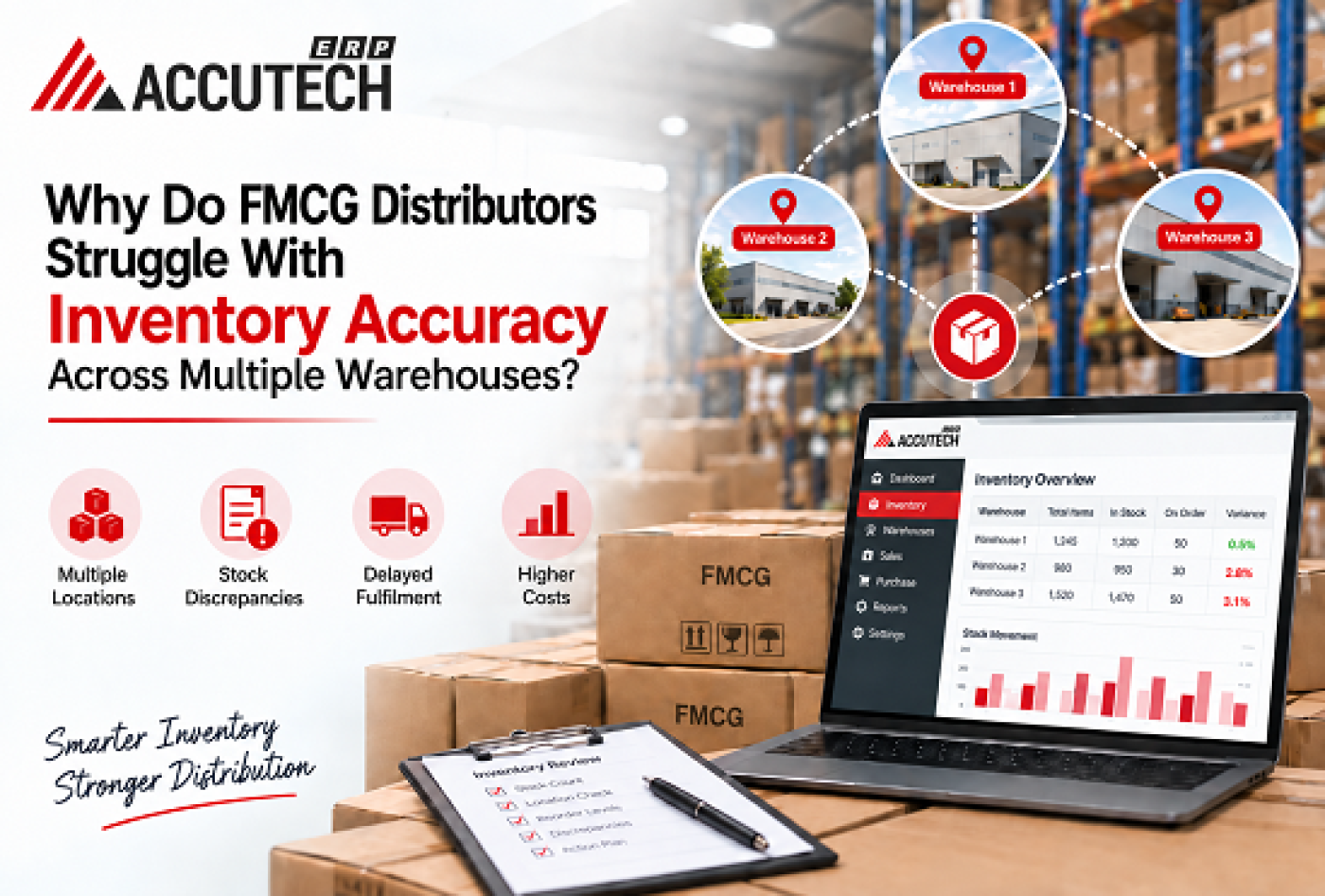
In the fast-paced world of Fast-Moving Consumer Goods (FMCG), accurate inventory management is not just a nice-to-have, it's a business necessity. Yet, countless FMCG distributors across India and beyond struggle with a persistent challenge: maintaining precise inventory accuracy across multiple warehouses. This seemingly simple task has become a major pain point that impacts profitability, customer satisfaction, and operational efficiency.
The problem is more widespread than many realize. When products move across different warehouse locations each with its own stock levels, sales patterns, and operational challenges discrepancies pile up quickly. By the time management discovers inaccurate inventory data, the damage is already done: stockouts that disappoint customers, excess inventory that ties up working capital, and operational inefficiencies that drain resources.
Modern FMCG Distribution ERP Software has become essential for solving these challenges. But before we explore solutions, let's understand why this challenge exists in the first place and what it really costs your business.
The Hidden Cost of Inventory Inaccuracy in FMCG Distribution
Inventory inaccuracy is like a silent thief stealing from your FMCG business. The costs aren't always obvious at first, but they accumulate quickly and significantly impact your bottom line.
Financial Impact
When inventory records don't match physical stock, multiple financial problems emerge simultaneously. Distributors often experience dead stock products sitting in warehouses past their shelf life or expiry date that cannot be sold. This represents pure loss. Simultaneously, frequent stockouts occur because the system shows inventory that doesn't actually exist, leading to lost sales opportunities and frustrated customers.
Research indicates that inventory inaccuracy can cost FMCG businesses between 2-5% of their total revenue annually. For a mid-sized distributor with 10 crore in annual revenue, this translates to 20-50 lakhs in direct losses, a staggering amount that directly impacts profitability.
Operational Inefficiencies
Beyond financial losses, inaccurate records create cascading operational problems. When warehouse staff cannot locate products quickly due to misaligned data, picking and packing times increase. This delays deliveries and increases logistics costs. Customers become unhappy, complaint rates rise, and your reputation suffers.
The situation becomes worse across multiple warehouses. With decentralized operations, synchronizing inventory data becomes a nightmare. Manual data entry errors compound as information moves between warehouses and regional offices. By the time discrepancies are discovered and reconciled, weeks may have passed, making it impossible to trace exactly where and when the error occurred.
Why FMCG Distributors Face Multi-Warehouse Challenges
Distributors operate in a uniquely complex environment. Unlike manufacturing facilities with standardized processes or retail stores with limited SKUs, FMCG distribution involves managing thousands of products, serving hundreds of customers, and maintaining multiple warehouse locations simultaneously. This complexity is precisely why maintaining accurate stock levels becomes so difficult.
Scale and Complexity
A typical distributor might stock 500-2,000 different products across 2-10 warehouse locations. Each product has different characteristics: shelf life, fragility, storage requirements, demand patterns, and seasonal variations. When customers order, products must move through the supply chain efficiently. But with multiple warehouses involved, tracking which product is where becomes incredibly complex.
The challenge intensifies during peak seasons. During festival seasons or special promotions, sales volume can increase by 300-400%. Managing this surge while maintaining accurate inventory using manual systems or disconnected spreadsheets is virtually impossible.
Multiple Stakeholders and Touchpoints
In typical distribution operations, inventory data passes through numerous hands: warehouse staff, sales representatives, logistics managers, and accounting teams. Each touchpoint introduces opportunities for errors. When the same data is recorded manually in different formats at different locations, inconsistencies multiply.
Without a centralized system like FMCG inventory management software, there's no single source of truth. One warehouse might show 500 units of a product as available, while another location actually has only 300 units. The sales team, working from outdated data, promises delivery to customers creating fulfillment crises.
Root Causes of Inventory Discrepancies
Understanding the root causes of inventory inaccuracy is crucial for implementing effective solutions. While the problems manifest in multiple ways, they typically stem from a few fundamental issues.
Manual Data Entry and Spreadsheet Limitations
Many distributors still rely on Excel spreadsheets or manual stock registers to track inventory. While these tools worked decades ago, they're fundamentally inadequate for modern operations. Spreadsheets lack real-time visibility, version control is non-existent, and human error rates in data entry are alarmingly high.
Studies show that manual data entry has error rates between 1-5%. In a warehouse handling 2,000 daily transactions, this means 20-100 inventory errors occur every single day. Over a month, that's 600-3,000 inaccuracies accumulating in your system. This is precisely why FMCG inventory management software with automated data capture is essential.
Lack of Real-Time Visibility
Traditional systems provide visibility only at end-of-day or end-of-week. By then, inaccuracies have already occurred, decisions based on wrong data have already been made, and customers have already been disappointed. Without real-time tracking, distributors operate in a constant state of information lag.
The consequence is predictable: stockouts and overstocking occur simultaneously across different warehouses. One location runs out of a popular product while another location is overstocked with the same item.
Inefficient Physical Stock Verification
Physical stock verification (inventory audits) are time-consuming and expensive. Most distributors conduct full audits only annually or semi-annually. Between audits, system discrepancies accumulate unchecked. When the audit finally happens, discovering thousands of unaccounted items is common.
Additionally, the audit process itself is manual and error-prone. Staff manually count products, write down quantities, and later transcribe these counts into the system. Each step introduces potential errors.
Inadequate Integration Between Systems
Many businesses use disconnected systems: separate software for accounting, separate systems for warehouse management, different tools for sales tracking. When these systems don't integrate seamlessly, data inconsistencies emerge. A sale recorded in the sales system might not automatically update in the warehouse system, creating phantom inventory.
Impact on Business Operations and Profitability
The consequences of inventory inaccuracy extend far beyond simple data discrepancies. They fundamentally impact business operations, customer relationships, and financial performance.
Customer Service Deterioration
When inventory accuracy is poor, fulfillment rates decline. Customers order products, the system shows they're available, but when the order reaches the warehouse, stock is unavailable. This causes order cancellations, refund processing, and customer dissatisfaction.
For businesses operating on thin margins, losing even 10% of orders to fulfillment failures can be devastating. Customers switch to competitors, and acquiring new customers becomes exponentially more expensive than retaining existing ones.
Increased Operational Costs
Poor accuracy drives up operational costs across multiple areas. Emergency freight charges increase when stockouts require urgent replenishment shipments. Slow-moving inventory ties up working capital that could be invested elsewhere. Labour costs increase as staff spend time investigating discrepancies instead of productive work.
The best software for FMCG distributor operations includes automation that reduces manual work and associated costs significantly.
Supply Chain Disruptions
Inaccurate data creates cascade failures through the entire supply chain. When distributor inventory doesn't match procurement data, order quantities become incorrect. This either creates false shortages that impact production or excess inventory that strains warehouse capacity.
How FMCG Inventory Management Software Solves These Problems
Modern FMCG inventory management software, particularly comprehensive FMCG Distribution ERP Software, addresses the root causes of inventory inaccuracy through technology, process automation, and integrated workflows.
Real-Time Inventory Tracking
A robust FMCG Distribution ERP Software provides instantaneous visibility into inventory levels across all warehouses. When a product is picked, packed, or received, the system updates immediately. No more end-of-day reconciliation. No more week-old data driving decisions.
This real-time visibility enables precise demand forecasting and optimal stock allocation across warehouses. If one location shows high demand, inventory can be transferred from lower-demand locations before stockouts occur.
Automated Data Capture and Integration
Best software for FMCG distributor eliminates manual data entry through automated capture systems. Barcode scanning, RFID technology, and integrated APIs connect all warehouse operations to a central database. This eliminates transcription errors and ensures data consistency.
When sales orders are created, they automatically reduce inventory. When purchase receipts are processed, stock levels update instantly. All systems accounting, warehousing, sales, procurement work with the same data in real-time.
Advanced Stock Reconciliation
Modern systems enable continuous inventory verification rather than waiting for annual audits. Cycle counting features allow staff to verify small portions of inventory regularly. The system identifies discrepancies immediately, enabling quick investigation and correction.
This approach catches errors early when they're easiest to correct, rather than discovering massive discrepancies during annual audits.
Multi-Location Synchronization
FMCG Distribution ERP Software with multi-warehouse capabilities maintains synchronized inventory across all locations. When a unit is sold at one warehouse, it's immediately reflected across the system. Inter-warehouse transfers are tracked precisely, preventing duplicate counts or missed inventory.
Key Features to Look for in Distribution ERP Solutions
Not all ERP systems are created equal. When selecting a solution, ensure it includes these critical features:
Feature | Why It Matters |
Real-Time Inventory Visibility | Immediate updates across all warehouses prevent stockouts and overstocking |
Barcode/RFID Integration | Automated data capture eliminates manual entry errors |
Multi-Warehouse Management | Centralized control with location-specific operations |
Expiry Date Tracking | Critical for FMCG; prevents expired product sales |
Automated Reorder Points | Triggers purchases before stockouts occur |
Cycle Counting Module | Continuous verification without disrupting operations |
GST Compliance Support | Ensures tax accuracy and regulatory adherence |
Advanced Reporting and Analytics | Data-driven insights for inventory optimization |
Real-World Success Stories and Case Studies
Case Study 1: Regional Distributor Transformation
A regional distributor in Punjab operating 5 warehouses struggled with inventory accuracy averaging 78%. Monthly discrepancies reached 8-10 lakhs. After implementing an integrated warehouse management solution, within three months:
- Inventory accuracy improved to 96%
- Monthly discrepancies reduced to 1-2 lakhs
- Customer fulfillment rate increased from 88% to 97%
- Warehouse operational efficiency improved by 35%
The primary benefit? Real-time visibility eliminated guesswork. When salespeople received orders, they could confirm stock availability immediately instead of discovering shortages at warehouse level.
Case Study 2: Multi-Brand Distributor Scale-Up
A distributor managing multiple brands across 8 warehouses used spreadsheets for coordination. Manual consolidation took 3 days weekly. After implementing an inventory management solution:
- Weekly reconciliation time reduced from 3 days to 2 hours (automated)
- Stock obsolescence decreased by 40%
- Working capital efficiency improved by 28%
- Warehouse staff productivity increased by 25%
The best software for FMCG distributor automated what previously required manual effort, freeing staff to focus on strategic activities.
Best Practices for Implementing Inventory Solutions
Start with Data Audit
Before implementation, audit existing inventory data. Identify discrepancies and determine root causes. This baseline helps measure improvement.
Train Staff Thoroughly
Technology alone won't succeed. Comprehensive training ensures staff use the system correctly. Resistance to change is natural to address it proactively.
Implement Gradually
Don't migrate all warehouses simultaneously. Start with one location, perfect processes, then expand. This limits disruption and enables refinement.
Set Clear KPIs
Define what success looks like: target accuracy rates, fulfillment rates, etc. Monitor progress regularly and adjust strategies accordingly.
Regular Reconciliation
Schedule cycle counts regularly weekly or bi-weekly rather than annual audits. Catch and correct errors quickly.
Continuous Optimization
After implementation, continuously review reports and analytics. Identify patterns, adjust processes, optimize settings.
Common Mistakes to Avoid
Overcomplicating Implementation
Trying to configure every feature immediately. Start simple, expand functionality over time as teams master basics.
Inadequate Data Cleanup
Rushing into implementation with dirty data. Corrupted data in the system creates garbage-in-garbage-out problems.
Lack of Executive Support
Without strong leadership commitment, resistance to change prevents successful adoption. Executive sponsorship is critical.
Ignoring Change Management
Technology changes quickly; organizational change takes longer. Neglecting change management dooms implementations.
Insufficient Integration
Selecting a solution that doesn't integrate with existing systems. This recreates data silos and duplicate entry.
Poor User Adoption
Implementing features users don't understand or trust. Comprehensive training and support ensure adoption.
Frequently Asked Questions (FAQs)
Q1: What exactly is inventory inaccuracy in distribution?
Inventory inaccuracy occurs when recorded stock levels in the system don't match actual physical stock in warehouses. This can happen due to manual errors, theft, spoilage, or system discrepancies. Even small inaccuracies compound across multiple warehouses, creating significant problems.
Q2: How much does inventory inaccuracy typically cost a business?
For distributors, inaccuracy typically costs 2-5% of annual revenue. For a 10 crore business, this represents 20-50 lakhs annually. Costs include lost sales from stockouts, obsolete inventory, excess safety stock, and operational inefficiencies.
Q3: Can we improve inventory accuracy without implementing new software?
Incremental improvements are possible through better processes and training. However, sustainable, significant improvements require technology. Manual systems hit accuracy ceilings around 90-92%. To exceed 95% accuracy consistently requires FMCG Distribution ERP Software automation.
Q4: How long does it take to implement warehouse management software?
Implementation typically takes 2-4 months depending on complexity, number of warehouses, and data quality. Start with one location (2-3 weeks), then gradually expand. Quick implementations (trying to do everything in 2 weeks) usually fail.
Q5: What's the typical ROI from implementing these solutions?
Most distributors see positive ROI within 6-9 months through reduced inventory holding costs, eliminated stockout losses, and operational efficiency gains. By year two, ROI typically exceeds 300-400%.
Q6: How does modern inventory software handle expiry dates?
Best software for FMCG distributor includes expiry date tracking. The system can flag approaching expiry dates, prioritize sales of nearing-expiry products, and prevent sales of expired stock. This is critical for FMCG where shelf life is a key consideration.
Q7: Can inventory management software work with multiple brands?
Yes, modern systems support multi-brand operations. Each brand can have separate inventory, pricing, and reporting, while still providing consolidated visibility to management.
Q8: What about GST compliance?
Comprehensive ERP solutions include built-in GST compliance. They automatically calculate GST on all transactions, maintain compliance records, and generate GST-ready reports.
Q9: How do we choose between different software options?
Evaluate based on: real-time tracking capability, ease of integration, scalability, support quality, cost structure, and industry-specific features. Request demos and speak with existing customers. Most providers offer trial periods using them.
Q10: Is cloud-based or on-premise better?
Cloud-based offers flexibility, automatic updates, and lower upfront costs ideal for growing businesses. On-premise offers control and works in low-connectivity areas. Many businesses use hybrid approaches. Choose based on your specific needs.
Conclusion:
Inventory inaccuracy across multiple warehouses isn't just a minor inconvenience, it's a profit-killer that impacts every aspect of distribution operations. From customer satisfaction to financial performance, the consequences are far-reaching and significant.
The good news? This challenge has proven solutions. Modern warehouse management technology, combined with proper implementation strategies and committed change management, delivers dramatic improvements in accuracy, operational efficiency, and profitability.
Distributors using the best software for FMCG distributor report accuracy improvements from 78% to 96%+, reduced operational costs by 30-40%, and significantly improved customer satisfaction. These aren't theoretical benefits, they're documented results from real businesses.
Solutions like Accutech ERP can help FMCG distributors manage inventory across multiple warehouses with better visibility, centralized control, and more accurate stock tracking.
The question is no longer whether you can afford to implement FMCG inventory management software. The question is whether you can afford not to. Every day without accurate inventory management costs your business money. Every month of delay represents thousands in lost profits and customer dissatisfaction.
If you're currently struggling with inventory accuracy across multiple warehouses, it's time to take action. The technology exists. The methodology is proven. What's needed is your commitment to making the change.