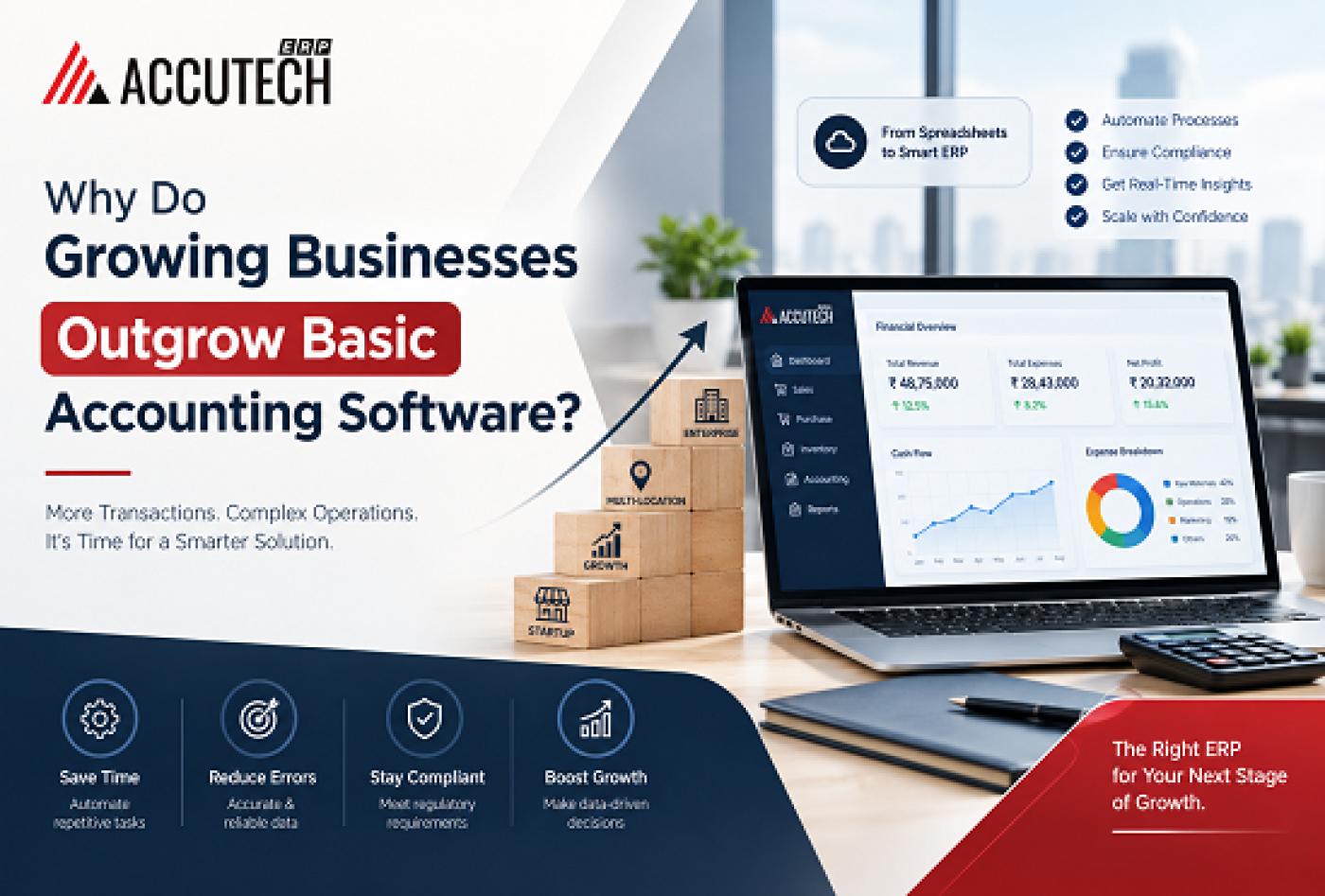
Every business starts small. Your bookkeeper tracks invoices in spreadsheets, expenses come through email, and GST returns are calculated manually. When managing 10-15 customers with basic transactions, this approach works fine.
But then something wonderful happens and your business grows.
You land bigger clients, hire more team members, expand to new locations, and launch additional product lines. Your transaction volume doubles, then triples. Your customer base becomes diverse with unique billing cycles. Suddenly, that spreadsheet-based accounting approach starts cracking under pressure.
This is when businesses discover they need more than basic accounting software. They need an advanced accounting system that scales with them. They need cloud erp accounting solutions that automate complex processes, ensure compliance, and provide real-time financial visibility.
In this comprehensive guide, we'll explore exactly why growing businesses outgrow basic accounting software, what limitations they face, and how the best advance accounting ERP software solves these challenges.
Why Basic Accounting Software Fails Growing Businesses
Basic accounting software was designed for small operations with straightforward needs. Think simple debit-credit entries, single-location operations, and minimal compliance requirements. Tools like spreadsheets or entry-level packages served their purpose during your startup phase.
However, the moment your business complexity increases through growth, regulatory changes, or operational expansion these basic tools reveal fundamental limitations. In contrast, advanced accounting software was built specifically to handle the sophistication that comes with scaling operations.
Let's examine the specific ways basic accounting software becomes a liability rather than an asset.
Manual Process Bottlenecks That Kill Productivity
Most growing businesses face this reality: your accounting team, which handled all transactions three months ago, suddenly finds itself overwhelmed. Not because they're incompetent, but because they're drowning in manual work.
With basic accounting software, virtually every step requires manual intervention:
Invoices arrive via email, WhatsApp, or paper. Your team manually enters each into the system. Returns and credit notes come in. Someone manually creates reversal entries. Bank statements arrive weekly. Your accounting staff spends hours matching transactions and reconciling accounts. GST calculations need manual verification for each invoice. Monthly reports require building spreadsheets to pull data from your software.
This manual approach works when processing 100 transactions monthly. But when volume jumps to 1,000 or 5,000 monthly, the process breaks completely. Your team works nights trying to keep up. Month-end closes become crisis events.
A cloud erp accounting solution automates these workflows entirely. Invoices are captured automatically. Tax calculations happen instantly. Reconciliation is assisted through AI-powered matching. Your accounting team shifts from data entry to analysis and strategic insights.
Compliance Complexity: GST and Tax Management at Scale
If you're operating in India or have multi-state operations, GST compliance isn't optional, it's mandatory. For small businesses with simple operations, manually managing GST might work. But as you grow, complexity multiplies exponentially.
Growing businesses struggle with GST compliance because they must manage different tax rates across products and services, track input tax credits across multiple vendors, reconcile GSTR-2A with purchase records, file GSTR-1 and GSTR-3B on time, handle reverse charges and special scenarios, and maintain proper audit trails.
Basic accounting software often lacks sophisticated GST management. You manually calculate tax, and filing returns involves exporting data to spreadsheets and manual reconciliation. Each quarter brings anxiety. Did we file correctly? Did we claim all entitled credits? Will we face penalties?
The best advance accounting ERP software handles GST as a core function. It automatically calculates tax on every transaction, maintains real-time GST registers, validates your data against GSTR-2A automatically, and generates compliance-ready returns with zero manual intervention. Advance accounting software makes multi-state operations manageable because the system understands complex tax scenarios.
Data Fragmentation and Reporting Nightmares
As your business grows, data lives everywhere. Sales transactions in one system, inventory in another, HR data in spreadsheets, customer information scattered across emails and documents. Your basic accounting software knows only about financial transactions, leaving critical business data disconnected.
This fragmentation creates serious problems. When management asks for profit by product line, you spend hours consolidating data from multiple systems. Finance wants customer profitability another manual exercise. You need vendor performance analysis, but data is scattered everywhere.
Moreover, basic accounting software generates static reports that take hours to produce and are often outdated by completion. Real-time decision-making becomes impossible. Your CFO can't get instant visibility into cash position, accounts receivable, or vendor payables.
Cloud erp accounting solutions integrate sales, purchases, inventory, and accounting into one unified system. Reports that took hours now generate in seconds. Profit analysis by product, customer, or location is instant. Real-time dashboards show your financial position 24/7. Decision-makers get information without delays.
Scalability and Multi-Entity Challenges
Success brings expansion. You might open new branches, launch subsidiaries, acquire complementary companies, or expand operations across different cities. Now you face a critical problem: your basic accounting software wasn't designed to handle multiple entities seamlessly.
Many growing businesses resort to terrible workarounds running separate accounting instances for each branch and consolidating manually, hacking single-entity systems to work for multiple entities, or managing different tax IDs across spreadsheets. These workarounds create compliance risks, reduce efficiency, and make consolidation reporting nearly impossible.
Advanced accounting software is built from the ground up to handle multi-entity operations. You maintain separate books for each entity while accessing consolidated reporting instantly. Different tax IDs, compliance requirements, and operational structures are managed within one unified system. Inter-company transactions are tracked automatically. Consolidated financial statements are generated with zero manual effort.
The Power of Advanced Accounting Software Solutions
Now that we understand basic accounting software limitations, let's explore how modern solutions transform growing businesses.
Automation That Scales Your Accounting Function
Advanced accounting systems automate workflows that manual processes struggle with. Invoice capture becomes automatic through OCR technology. Transaction processing happens without human touch. Reconciliation is assisted through intelligent matching algorithms. Tax calculations are computed instantly on every transaction.
This automation doesn't just save time. It fundamentally changes your accounting function. With routine tasks automated, your team focuses on financial analysis, forecasting, and strategic planning rather than data entry. Your best people provide real business value.
Compliance Built Into Every Process
With cloud erp accounting solutions, compliance isn't something you bolt on afterward. It's embedded into the core system. When you create an invoice, GST is calculated correctly. When you record a purchase, input tax credit rules are applied automatically. Real-time compliance monitoring alerts you to issues before they become problems.
Tax filing becomes extracting pre-generated compliance reports from the system rather than manually building complex spreadsheets. This reduces filing errors dramatically and ensures you capture all entitled credits and exemptions.
Real-Time Financial Visibility
Your business moves fast. Decisions can't wait for month-end close reports. Advanced accounting systems provide real-time financial dashboards showing your cash position, receivables status, payables commitments, and profit performance instantly.
Need to know if you have enough cash for a new investment? Instant visibility. Want to understand which customers generate actual profit? Real-time analysis. Looking to identify expensive vendors? Immediate insights. This visibility transforms your business from reactive to proactive decision-making.
Multi-Entity and Multi-Location Support
The best advance accounting ERP software handles multiple entities seamlessly. Each entity maintains separate books meeting legal requirements. Management maintains consolidated visibility across all locations. Inter-company transactions are tracked automatically. Consolidation reports are generated at the click of a button.
This capability becomes critical as you expand. Whether opening new branches or acquiring companies, your accounting infrastructure adapts without requiring custom development or painful workarounds.
Why Choose the Right System for Your Growing Business
Not all advanced accounting systems are created equal. When evaluating solutions, look for these critical capabilities:
Complete Financial Control: The system should give you granular control over every accounting element chart of accounts, ledger structures, reporting hierarchies, and audit trails. Your business structure might be unique, and the software should adapt to you, not force you to adapt to it.
Real-Time Reporting Capabilities: Look for systems providing live dashboards, instant report generation, and drill-down capabilities. Your management team shouldn't wait for reports; they should see financial data as it happens.
GST Automation and Compliance: GST returns should be generated automatically, validated against government data, and filed with minimal manual intervention. This is especially critical for multi-state operations.
Seamless Integration: Your system should integrate with existing systems sales management, inventory, HR, and customer relationship management. Data should flow automatically without manual exports and imports.
Scalability Without Limits: As your business grows, your accounting system should grow with you. Multi-entity support, multi-currency capabilities, and advanced reporting should handle complexity that seems impossible today.
Enterprise Security: Your financial data is sensitive. The system should provide encryption, role-based access controls, complete audit trails, and comply with data security standards.
Frequently Asked Questions
At What Point Should a Growing Business Upgrade to Advanced Accounting Software?
There's no universal answer, but most businesses consider upgrading when processing more than 500 transactions monthly, having multiple locations or entities, facing complex GST compliance requirements, their accounting close takes more than 2-3 days monthly, their accounting team works overtime regularly, or they need real-time financial visibility. If any apply, advance accounting software likely delivers significant ROI.
How Does Cloud ERP Accounting Improve Compliance and Reduce Risk?
Cloud erp accounting solutions embed compliance logic into every transaction. They calculate taxes correctly based on rules updating automatically with regulatory changes. They maintain complete audit trails showing who accessed or changed what data and when. They flag compliance issues in real-time rather than discovering problems during audits. They generate compliance reports automatically, reducing human error. They maintain backups and data redundancy, protecting your records. This systematic approach dramatically reduces compliance risk and audit issues.
Can Advanced Accounting Software Handle Multi-Currency and Multi-Entity Operations?
Yes, the best advance accounting ERP software is built specifically for complex operations. Multi-entity support allows you to maintain separate books for legal entities while consolidating reporting. Multi-currency capabilities handle transactions in different currencies with automatic exchange rate management. Inter-company transaction tracking monitors flows between entities. Consolidated reporting combines performance across all entities and currencies. This eliminates the manual consolidation work that plagues growing companies.
How Does Advanced Accounting Software Save Time on Monthly Close?
Basic accounting software requires days of manual work to close books reconciling accounts, building consolidation spreadsheets, preparing reports. Advanced accounting systems compress this to hours. Automated reconciliation matches transactions instantly. Consolidation reports are generated automatically. Pre-formatted financial statements are available immediately. GST compliance calculations are complete. Analytical reports drill into performance data. What took a week now takes a day.
What About Data Security When Moving to Cloud ERP Accounting?
Cloud solutions provide superior security for most organizations compared to on-premises systems. Data is encrypted in transit and at rest. Access is controlled through role-based permissions and multi-factor authentication. Automatic backups ensure data is never lost. The system provider maintains physical security, network security, and compliance certifications. You benefit from their security expertise and resources, which often exceeds what individual companies can maintain. Most cloud providers comply with international security standards like ISO 27001.
How Do I Transition from Basic Software to Advanced Systems Without Disruption?
Successful transitions follow a structured approach. Start with detailed mapping of your current processes and data. Create a migration plan that typically runs in phases setup, initial data migration, testing and validation, parallel running with the old system, final cutover. Train your team thoroughly before cutover. Maintain your old system for a period while the new system proves reliable. Establish clear communication throughout the organization. Professional implementation support significantly reduces risks and accelerates adoption.
Does Advanced Accounting Software Integrate with Our Existing Business Systems?
Most advanced accounting software integrates with common business systems sales management, inventory, HR, customer relationship management, and e-commerce platforms. Integrations can be real-time (data flows automatically) or scheduled (daily syncs). This eliminates manual data entry between systems, reduces errors, and ensures all systems work with current data. Some integrations are pre-built; others require configuration. A reputable vendor should have extensive integration capabilities.
What's the Typical Cost and ROI of Upgrading to Advanced Systems?
Cloud erp accounting solutions typically operate on subscription models ranging from ₹500-5,000+ monthly depending on features and transaction volume. ROI comes from multiple sources: reduced accounting staff time through automation, eliminated month-end close overtime, faster financial reporting enabling quicker decisions, reduced compliance risk and audit issues, better cash flow management from real-time visibility, and improved profitability insights. Most growing companies recover their investment within 6-12 months through time savings alone.
Conclusion:
Growing businesses face a critical choice. They can continue operating with basic accounting software, drowning in manual work, struggling with compliance, and lacking real-time visibility. Or they can embrace advanced accounting software with Accutech ERP and transform their finance function.
The best advance accounting ERP software eliminates manual bottlenecks, embeds compliance into every process, provides real-time financial visibility, and handles the complexity that comes with scaling. With Accutech ERP, your accounting team can shift from repetitive data entry to analysis and strategic planning, while management gets the information needed to make informed decisions.
Cloud ERP accounting solutions aren't luxuries for enterprises. They're practical necessities for any growing business serious about scaling efficiently and profitably. Accutech ERP provides the financial infrastructure businesses need to manage increasing transactions, improve control, and support sustainable growth.
If your current accounting software is slowing you down, if month-end close is painful, if compliance feels risky, or if you lack real-time financial visibility, it's time to evaluate advanced accounting systems. With Accutech ERP, upgrading to a smarter accounting solution can help your business overcome operational challenges and stay prepared for the next stage of growth.