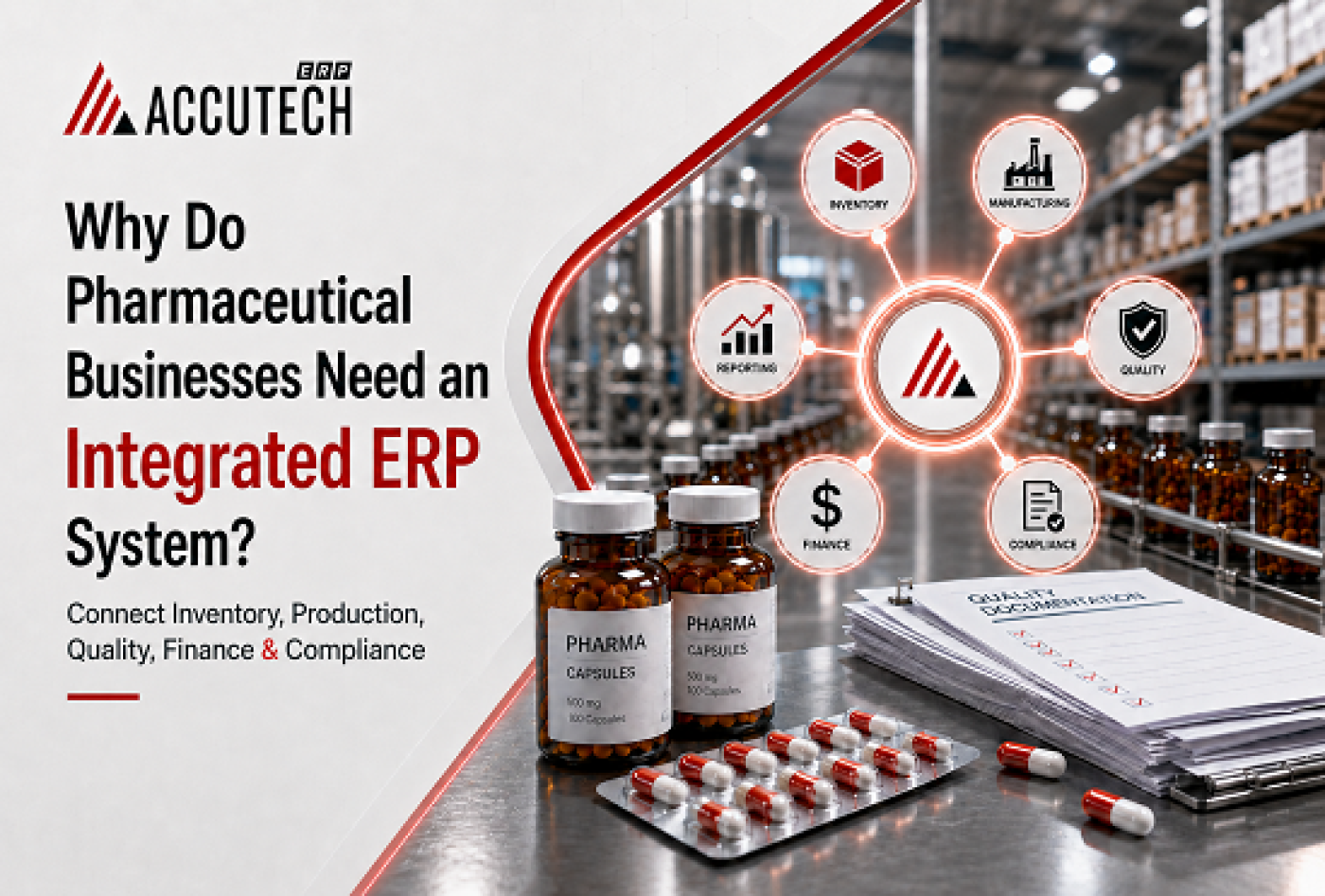
The pharmaceutical industry in 2026 stands at a critical crossroads. Companies relying on spreadsheets and disconnected systems are increasingly unable to compete as regulatory requirements intensify, customer expectations rise, and operational complexity grows. In this environment, pharmaceutical manufacturing ERP software is no longer just a useful business tool; it is becoming essential for sustainable growth.
A modern ERP for pharmaceutical manufacturing industry operations brings inventory, billing, production, quality, finance, GST compliance, and reporting into a single connected environment. At the same time, Pharma PCD ERP Software helps pharmaceutical franchise and distribution businesses manage pricing, stock, customer networks, schemes, orders, and compliance with greater control.
Consider a typical pharmaceutical business day: inventory updates, billing, purchase orders, batch records, quality certificates, financial transactions, GST compliance, and customer interactions all happen simultaneously. Without a unified platform, information gets scattered across teams, creating delays, duplication, errors, and compliance risks. An integrated ERP centralizes these processes and gives management one reliable source of business information.
Understanding the Pharma Business Landscape
The pharmaceutical sector has changed significantly. Manufacturers now deal with complex supply chains, stricter traceability expectations, growing product portfolios, multiple warehouses, batch-wise stock, expiry-sensitive inventory, and faster customer service requirements. Distributors and franchise businesses must also scale quickly without losing visibility over margins, stock movement, receivables, and compliance.
For growing companies, an ERP for pharmaceutical manufacturing industry workflow helps connect production planning, procurement, quality checks, inventory, sales, and finance. This reduces dependence on isolated spreadsheets and manual departmental reporting.
Regulatory readiness is another major concern. Companies need reliable batch records, transaction histories, quality documentation, and audit trails. Industry-focused pharmaceutical manufacturing ERP software can make these controls part of routine operations instead of forcing teams to prepare information manually at the time of an audit.
What Is an Integrated ERP System for Pharma?
An integrated ERP system combines the major functions of a pharmaceutical business into one platform. This can include inventory management, purchase management, sales and billing, production scheduling, financial accounting, quality control, GST reporting, customer management, and business analytics.
For PCD and franchise-driven businesses, Pharma PCD ERP Software is particularly useful because it can support distributor networks, party-wise pricing, schemes, credit limits, order tracking, commission structures, batch information, and expiry management.
True integration means that one transaction can update several connected areas automatically. For example, when a sales invoice is created, stock can be reduced, accounting entries can be posted, GST values can be calculated, customer outstanding balances can be updated, and management reports can reflect the transaction without repeated manual data entry.
Key Operational Challenges Without ERP
Inventory Visibility Gaps
Without pharmaceutical manufacturing ERP software, businesses may struggle to know the exact quantity, location, batch, and expiry status of stock in real time. Sales teams may commit stock that is unavailable, while slow-moving or near-expiry products remain unnoticed. Procurement and production teams may also make decisions using outdated data.
An ERP for pharmaceutical manufacturing industry environment can improve coordination between demand, purchase, production, warehousing, and dispatch so teams work from the same stock position.
Financial Accuracy Issues
Spreadsheet-based accounting creates a higher risk of duplicate entries, missed postings, reconciliation delays, and reporting inconsistencies. When sales, purchase, inventory, and finance are maintained separately, teams spend additional time matching figures before management can trust the reports.
Compliance and Risk Exposure
Pharmaceutical companies need traceable records for batches, quality checks, purchases, production activity, sales, and returns. Disconnected systems can make this information difficult to retrieve quickly, increasing audit pressure and recall-management risk.
Operational Inefficiency
Manual purchase orders, invoice preparation, payment follow-ups, stock reconciliation, production updates, and report compilation consume significant staff time. A connected ERP reduces repetitive work and helps employees focus on exceptions, analysis, and customer service.
How Integrated Pharma ERP Transforms Operations
Implementing Pharma PCD ERP Software can create a major operational shift for franchise, distribution, and PCD businesses by centralizing pricing, customer data, order processing, inventory, collections, and sales reporting.
Real-Time Visibility
Management can view current stock, pending orders, receivables, purchase requirements, sales performance, and production status without waiting for manually prepared reports. Sales teams can check stock before confirming orders, while finance teams can track outstanding amounts and cash flow more accurately.
Automation of Repetitive Work
Modern pharmaceutical manufacturing ERP software can automate routine calculations and connected postings across inventory, billing, taxation, accounting, and reporting. This reduces duplicate work and helps improve data consistency.
Quality Control and Traceability
A strong ERP can connect raw-material receipt, batch production, quality checks, finished goods, and dispatch records. If an issue occurs, teams can trace affected batches and related transactions more quickly.
Critical Features of a Pharma ERP Solution
An ERP for pharmaceutical manufacturing industry operation should include capabilities that reflect real pharmaceutical workflows rather than only generic accounting functions.
Inventory Management
Important features include batch-wise stock, expiry tracking, multiple warehouse visibility, reorder levels, stock transfers, slow-moving stock analysis, near-expiry alerts, and real-time stock reports.
Billing and Sales
For franchise and distribution businesses, Pharma PCD ERP Software should support party-wise rates, schemes, discounts, GST calculation, credit controls, returns, order tracking, salesperson performance, and customer outstanding management.
Financial Integration
A complete ERP should connect sales, purchase, inventory, expenses, receipts, payments, bank entries, GST, profit and loss, balance sheet, and cash-flow information so finance teams do not need to reconcile multiple independent systems.
Production and Planning
Manufacturing-focused solutions should support BOMs, work orders, material requirements, production issues, batch production, yield tracking, quality checks, finished-goods receipt, and production costing.
Compliance and Regulatory Benefits
A major advantage of pharmaceutical manufacturing ERP software is the ability to maintain structured, traceable records across day-to-day operations.
GST Management
ERP systems can help calculate GST at transaction level, classify sales and purchases correctly, maintain input and output tax records, and prepare data required for GST reporting. This can reduce manual reconciliation and improve reporting consistency.
Audit Trails and Access Controls
Role-based access, approval controls, transaction histories, and audit logs help businesses understand who created or changed important records. These features are particularly useful when companies need stronger accountability and documentation.
Batch and Quality Documentation
Connecting batch records, QC status, test results, material movement, production, and dispatch information makes it easier to retrieve supporting records during audits or internal reviews.
Financial Impact and ROI
The financial value of ERP usually comes from several areas rather than one single saving. Better stock visibility can reduce overstocking and expiry losses. Faster billing and collection follow-up can improve working capital. Automation can reduce repetitive administrative work, while integrated reporting can help management identify low-margin products, customers, or processes earlier.
The actual ROI depends on company size, implementation scope, process maturity, number of users, locations, and the amount of manual work being replaced. Businesses should calculate ROI using their own inventory carrying cost, staff time, error rates, compliance effort, collection cycle, and operational delays rather than relying only on generic industry estimates.
Real-World Implementation Scenarios
Pharmaceutical Franchise Business
A pharmaceutical franchise company with a large distributor network can use Pharma PCD ERP Software to centralize customer pricing, order processing, stock visibility, credit limits, schemes, commissions, GST data, and receivable follow-ups. This can reduce dependence on manual coordination between sales, accounts, and warehouse teams.
Contract Manufacturing Organization
A CMO managing multiple customer brands can use ERP to control BOMs, batch production, raw-material consumption, quality checks, job costing, customer-wise production status, and dispatch planning. Centralized information can improve planning and help management understand actual production costs and margins.
Choosing the Right ERP Solution
Selecting an ERP for pharmaceutical manufacturing industry requirements should begin with process fit. The software should match the company's actual workflows for purchase, inventory, production, QC, sales, finance, GST, batch tracking, and reporting.
Cloud-based systems can offer easier access, centralized updates, lower infrastructure requirements, and faster deployment for many businesses. On-premise systems may still be preferred where companies have specific infrastructure, security, or internal IT requirements.
Before selection, evaluate whether the vendor understands pharmaceutical operations, supports configuration without excessive customization, provides reliable implementation support, and can scale with additional users, branches, warehouses, and business units.
The best pharmaceutical manufacturing ERP software should not force a company to redesign every process around generic software. Instead, it should provide strong pharmaceutical functionality while remaining flexible enough to support the company's practical operating model.
Frequently Asked Questions
Q1: What is a Pharma PCD ERP system?
A pharma PCD ERP system is specialized business software for pharmaceutical franchise, distribution, and PCD operations. It can connect customer management, sales orders, inventory, batch and expiry tracking, pricing, schemes, billing, GST, accounting, and reporting in one platform.
Q2: How does pharma ERP help with GST compliance?
A pharma ERP can calculate GST during transactions, maintain tax-wise sales and purchase data, track input and output tax records, and organize information needed for return preparation and reconciliation. This reduces manual data handling and helps improve consistency.
Q3: What is the implementation timeline?
Implementation time depends on company size, number of branches, data migration, integrations, customization, user training, and the modules being deployed. A phased cloud implementation is often faster than a large all-at-once rollout.
Q4: How does ERP improve pharmaceutical inventory management?
ERP provides visibility into batch-wise stock, warehouse locations, expiry dates, stock movement, reorder requirements, slow-moving items, and near-expiry products. Better visibility helps reduce stock-outs, overstocking, and expiry-related losses.
Q5: Can small pharmaceutical businesses benefit from ERP?
Yes. Smaller businesses can benefit from reduced manual work, centralized billing and stock control, GST integration, faster reporting, and improved customer outstanding management. Cloud solutions can make ERP more accessible without heavy infrastructure investment.
Q6: What compliance areas can a pharma ERP support?
Depending on the solution and configuration, ERP can support batch traceability, quality records, transaction audit trails, document retention, GST records, user access controls, approvals, and structured operational reporting.
Q7: What is the actual ROI of ERP?
ROI varies by organization. Companies should measure reductions in manual effort, stock losses, billing delays, reconciliation time, data errors, collection delays, and reporting effort, along with improvements in inventory turnover and decision-making.
Q8: How does pharma ERP improve data security?
Modern ERP platforms may offer role-based access, audit logs, encryption, backups, approval workflows, session controls, and disaster-recovery features. Businesses should verify the vendor's actual security practices and certifications before implementation.
Q9: Which is the best pharma ERP software in India?
The best solution is the one that fits your workflows, business size, compliance needs, inventory structure, manufacturing processes, and reporting requirements. When evaluating an ERP for pharmaceutical manufacturing industry use, prioritize batch tracking, expiry management, GST integration, production control, accounting, inventory visibility, and implementation support over generic feature lists.
Q10: How does integrated ERP improve decision-making?
Integrated ERP gives management a single source of current operational and financial data. Instead of waiting for separate departmental reports, decision-makers can review stock, sales, purchases, receivables, production, margins, and cash flow from connected records.
Conclusion
The pharmaceutical industry in 2026 has moved beyond the question of whether integrated systems are useful. For growing manufacturers, distributors, and franchise businesses, connected operations are becoming a competitive requirement.
The right ERP platform can improve visibility, reduce repetitive work, strengthen traceability, connect financial and operational data, and give management faster access to reliable information. For PCD and franchise businesses, Pharma PCD ERP Software can provide the centralized control needed to manage customers, pricing, stock, billing, GST, and collections more efficiently.
Companies evaluating ERP should focus on industry fit, implementation quality, support, scalability, and real operational value. Accutech ERP's Pharma PCD module can help pharmaceutical businesses bring inventory, production, billing, accounting, GST, and reporting into one connected system.
Take action now. Explore how integrated ERP systems transform pharmaceutical business. Request demonstration and discover why leading pharmaceutical companies choose Accutech ERP's Pharma PCD module for operational excellence.