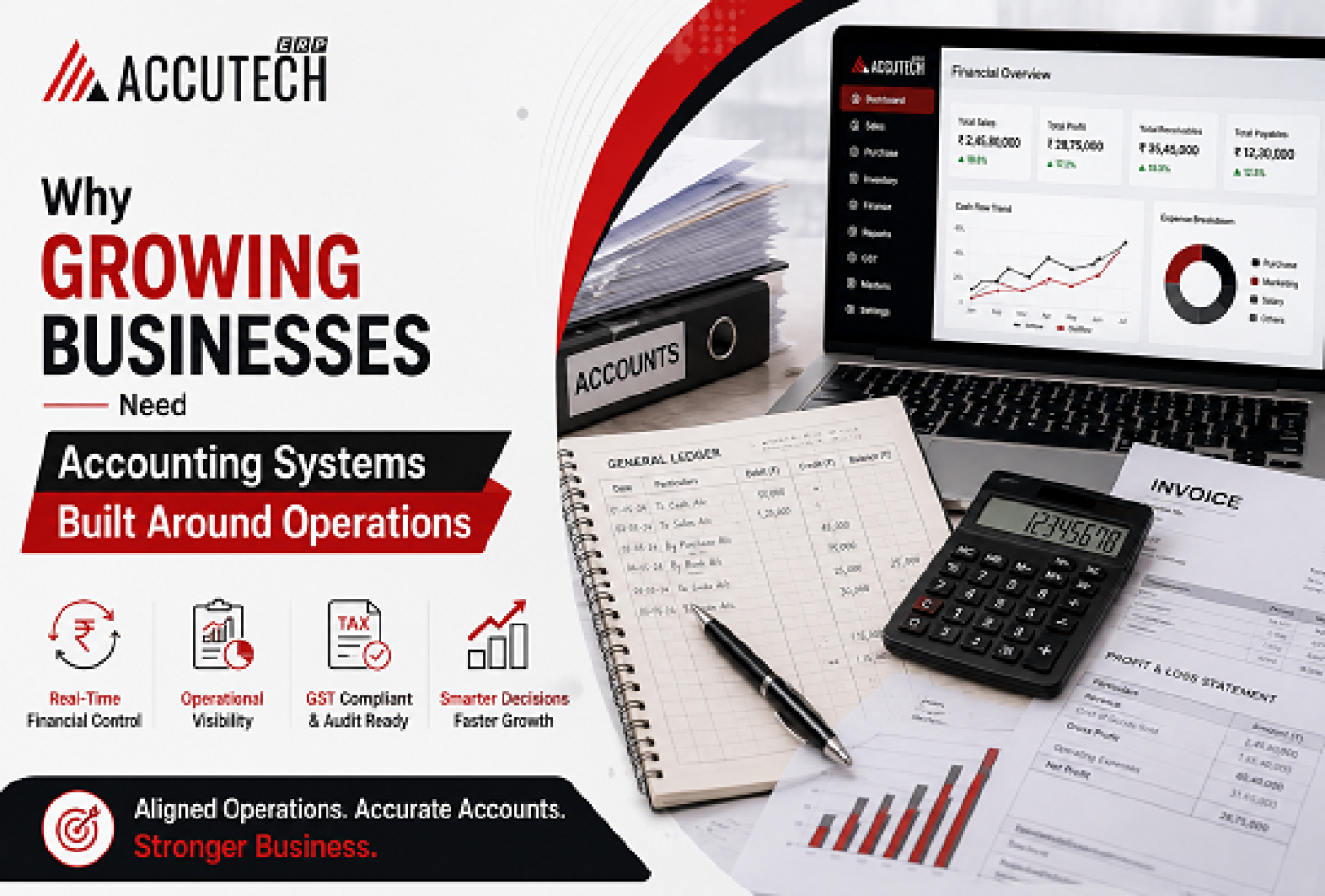
Imagine running a growing business where you're always second-guessing your financial position. You spend hours compiling reports, worry about GST compliance, and struggle to make quick business decisions because your financial data isn't current. This isn't just frustrating, it's dangerous for your bottom line.
Most growing businesses rely on outdated accounting practices that were designed for yesterday's operational needs. Spreadsheets, manual entries, and disconnected systems create a bottleneck that slows decision-making and increases the risk of costly compliance errors.
This is where an advance accounting ERP software becomes transformational. Rather than simply recording transactions, modern accounting systems are built around your actual operational needs. They integrate with your core business processes, automate compliance workflows, and provide real-time financial visibility that drives smarter decisions.
In this comprehensive guide, we'll explore why operational-focused accounting systems are essential for growing businesses, what features matter most, and how the right advanced accounting system can accelerate your growth while reducing financial risks.
What Is an Operational Accounting System?
An operational accounting system goes beyond traditional bookkeeping. While basic accounting focuses on recording what happened (historical data), an operational system focuses on supporting how your business actually works.
Think of it this way: Traditional accounting answers 'How much money did we make?' while operational accounting answers 'How much did each customer, product, or location contribute to that profit? Which transaction types consume the most resources? Where are our operational bottlenecks?'
An advance accounting ERP software bridges the gap between financial management and operational execution. It tracks not just money flow, but also the underlying activities sales orders, purchase requisitions, inventory movements, and service deliveries that drive that money flow. When you integrate accounting with operations, you create a unified system where every transaction is simultaneously a financial event and an operational signal.
This integrated approach delivers three critical advantages:
• Real-time operational insights that inform immediate business decisions
• Automatic compliance with tax regulations because transactions are classified correctly at origin
• Elimination of manual reconciliation work because operational and financial data are synchronized
Why Growing Businesses Fail Without Proper Accounting Systems
Growing businesses operate in a paradox. As they scale, their operational complexity increases exponentially, but many entrepreneurs try to manage accounting the same way they did at startup. This creates predictable failure points.
Let's examine what happens without a proper advance accounting system:
Month-End Chaos
Without an integrated ERP accounting software in India, month-end closing becomes a crisis. Your accounting team spends days (sometimes weeks) chasing down invoices, matching purchase orders to receipts, and compiling reports. This delay means you can't make decisions until 7-10 days after the month ends by which time operational problems have already escalated.
Tax Compliance Risks
GST compliance requires precision. When you're managing transactions across manual systems, spreadsheets, and disconnected software, GST classification errors are inevitable. These errors lead to ITC denials, penalty notices, and audit complications. An advanced accounting system automates GST calculation and ensures every transaction is classified correctly from the moment it's entered.
Scaling Complexity
Every new location, product line, or business entity multiplies your accounting complexity. Without a system that's designed for multi-entity management, you end up maintaining separate books, creating consolidation nightmares, and losing visibility into group-level financial performance. Growing businesses need an advance accounting ERP software that scales with them without requiring proportional increases in accounting headcount.
Decision-Making Blind Spots
Without real-time financial visibility, business leaders operate with delayed information. By the time you see that a particular customer segment is unprofitable or that production costs for a product line are rising, you've already wasted weeks (or months) of resources. Operational accounting systems provide daily visibility into financial metrics, enabling faster course corrections.
Core Features of Advance Accounting ERP Software
The best accounting ERP solution isn't just accounting software it's a system built around your operational processes. Here are the core features that separate operational systems from basic accounting tools:
Integrated Transaction Processing
Transactions (sales, purchases, returns, adjustments) flow automatically from operational modules into accounting. When your sales team creates an invoice, the accounting entries are automatically generated. When you receive inventory, purchase accounting is simultaneously recorded. This eliminates manual data entry, reduces errors, and ensures operational and financial data stay synchronized.
Flexible Chart of Accounts with Hierarchical Structure
Your chart of accounts should reflect your business structure, not industry standards. A modern accounting platform allows you to create unlimited account hierarchies, define reporting structures, and automatically map accounts to financial statements. This flexibility means your financial reports always reflect your actual business segmentation.
Real-Time General Ledger and Reporting
The general ledger should update in real-time, not monthly. You should be able to run a trial balance or profit & loss statement at any moment and get accurate results. With an advanced accounting system, your financial position is always current, enabling truly timely decision-making.
Multi-Entity Consolidation
Growing businesses operate multiple legal entities, branches, or divisions. Your accounting system should handle separate books for each entity while automatically consolidating results at the group level. The best ERP accounting software in India supports intercompany transactions, eliminations, and unified reporting without manual intervention.
Automated Compliance Features
GST compliance, tax calculations, and regulatory reporting should be automated. When you set up your chart of accounts, tax rates, and product classifications, the system should automatically handle tax calculations, generate compliance reports, and prepare GST returns. Your accounting team focuses on analysis instead of data compilation.
How Advanced Accounting Systems Drive Operational Efficiency
The most underrated benefit of implementing a modern accounting ERP platform is the operational efficiency it creates. Better accounting systems don't just improve accounting they improve how your entire business operates.
Reduced Manual Data Entry
With a modern accounting platform, transactions created in one module automatically flow to accounting without re-entry. A sales invoice created in CRM automatically becomes an accounting transaction. A purchase order automatically generates accounting entries when goods are received. This single-entry principle eliminates 60-70% of manual accounting work while eliminating transcription errors.
Automated Bank Reconciliation
Instead of manually matching bank statements to recorded transactions, your system automatically reconciles them. The system identifies unmatched items, flags discrepancies, and speeds up the reconciliation process from hours to minutes. Your cash position is always accurate and current.
Inventory Integration
When you integrate inventory with accounting through an advanced accounting system, cost of goods sold is automatically calculated. You get accurate inventory valuations, automatic adjustments for differences, and real-time stock-to-GL reconciliation. No more month-end surprises about actual vs. recorded inventory.
Customer and Supplier Management
An operational accounting system tracks not just transactions, but customer and supplier relationships. You can see not just how much a customer bought, but the profitability of that customer relationship, payment trends, and credit exposure. This information becomes critical for sales and procurement decisions.
Real-Time Financial Visibility and Decision-Making
The competitive advantage of modern businesses increasingly depends on decision speed. Companies that can analyze data and make decisions faster than competitors win. This is where an advance accounting ERP software delivers exceptional value.
Traditional accounting systems provide historical data about what happened last month. Modern operational accounting systems provide real-time data on what's happening right now. This shift from historical to real-time analysis changes decision-making fundamentally.
Consider a practical scenario: Your sales manager notices that one salesperson's closing rate has dropped 15% this month. Instead of waiting for month-end reports to analyze why, your operational accounting system provides daily sales data by rep, by product, by customer segment. You can immediately identify the problem customer, understand the profitability implications, and take corrective action all within 24 hours instead of weeks.
Real-time dashboards give your entire leadership team current visibility into:
• Daily revenue, customer acquisition, and order fulfillment metrics
• Cash flow position including projected vs. actual liquidity
• Production costs and margin performance by product and line
• Customer lifetime value and profitability by segment
• Supplier performance and procurement cost trends
GST Compliance and Tax Automation
For Indian businesses, GST compliance represents both a significant burden and a critical risk. An advance accounting ERP software eliminates this burden through systematic automation.
How does a modern accounting system ensure GST compliance? Through several integrated mechanisms:
Automatic Tax Classification
When you create a product in the system, you assign its HSN code and applicable GST rate. From that moment forward, every transaction involving that product automatically includes the correct tax calculation. There's no human decision point where GST can be misclassified.
GST Compliance Workflows
Your accounting system should include specific workflows for GST processes. It tracks which invoices have been filed in GSTR-1, which purchase invoices have been claimed in GSTR-2, and which input tax credits have been approved. The system identifies any mismatches or discrepancies automatically, preventing compliance errors before filing.
GSTR-3B and Return Preparation
GSTR-3B return preparation should be automatic. Your system generates the return directly from transaction data, eliminating manual compilation. By the time your compliance deadline arrives, your system has already identified any adjustments needed and prepared all supporting documentation.
ITC Management
Managing input tax credit is complex but critical for cash flow. An operational accounting system tracks which invoices support ITC claims, reconciles them against GSTR-2A/2B automatically, and prevents ITC denials through systematic matching.
Multi-Entity and Multi-Branch Management
One of the biggest mistakes growing businesses make is choosing an accounting system that works for a single location but doesn't scale to multiple entities. Then, when the company expands to a second location or creates a subsidiary, they're stuck either running multiple separate systems (operational nightmare) or forcing their new location into a single-entity system (limiting nightmare).
The best ERP accounting software in India is built from the ground up to handle:
• Multiple legal entities with separate books and tax registrations
• Multiple branches within a single entity with location-specific reporting
• Multiple GSTINs and tax jurisdictions with consolidated compliance reporting
• Intercompany transactions with automatic elimination in consolidated statements
This architecture matters because it means when you open a new location, you're not implementing a new system, you're configuring an additional entity within your existing system. Your existing accounting team, processes, and training remain valid. Your consolidated financial reporting works automatically. Your business scales without technology becoming a bottleneck.
Scaling Your Business with Modern ERP Accounting
The journey from startup to established business requires more than financial prudence; it requires systems that grow with you. A modern accounting ERP platform enables five specific scaling patterns:
Geographic Expansion
Adding new locations becomes operationally straightforward. Each location gets its own accounting books, inventory management, and tax registration without requiring new software or retraining your accounting team. Consolidated reporting across locations happens automatically.
Product Line Extension
When you add new product lines, an advanced accounting system automatically handles the accounting. New products get assigned cost centers, profit centers, or business units as appropriate. Profit & loss statements automatically show performance by product line without manual allocation.
Organizational Restructuring
As your organizational structure evolves adding departments, creating subsidiaries, acquiring businesses an operational accounting system adapts. You can reorganize the chart of accounts, redefine cost allocation, and restructure reporting hierarchies without disrupting transaction processing.
Operational Complexity Management
As transaction volume increases, an advanced accounting platform scales without proportional increases in manual work. What requires manual review and approval at 100 transactions/month works automatically at 10,000 transactions/month. Your accounting team focuses on analysis instead of data processing.
Compliance Evolution
As your business grows, compliance requirements often evolve. You might become subject to additional regulations, need to implement new audit procedures, or expand tax jurisdictions. A modern accounting ERP platform evolves with these requirements through configuration changes rather than system replacement.
Selecting the Right Advance Accounting System for Your Business
Not all accounting software is created equal. When evaluating an advance accounting system, look beyond features and focus on these critical dimensions:
Operational Integration
Does the accounting system integrate with your sales, inventory, procurement, and production systems? Or does it operate as a separate module requiring manual data feeds? The best ERP accounting software in India is purpose-built for operational integration where transactions flow automatically from operations to accounting.
Scalability Architecture
Can it handle 1,000 transactions daily without performance degradation? Can it support 50 users simultaneously? When you outgrow current capacity, does adding capacity require architecture changes or just configuration updates? A system designed for enterprise scalability should handle your growth for 5-10 years without replacement.
India-Specific Features
Since you're evaluating ERP accounting software in India, ensure the system is built specifically for Indian compliance requirements. It should include GST automation, Indian tax calendar, GSTR integration, localized chart of accounts templates, and support for Indian business practices. A global system with India bolted on will create compliance headaches.
Real-Time Capabilities
Can you run reports and access your financial position any time, or only in batch jobs? Is data processing real-time or overnight? Does the system support mobile access for on-the-go decision-making? Real-time capabilities are essential for modern business operations.
Security and Data Protection
Your accounting data is your business's most sensitive information. Verify the system includes data encryption, role-based access controls, audit trail functionality, and compliance with data protection regulations. Cloud-based systems should include disaster recovery and business continuity provisions.
Frequently Asked Questions
Q1: How does an advance accounting ERP software reduce GST compliance errors?
A modern accounting ERP solution eliminates GST errors through systematic automation. When you configure a product or service with its HSN code and applicable GST rate during setup, every transaction involving that item automatically includes correct tax calculations. The system generates GSTR returns directly from transaction data, eliminating manual compilation where errors typically occur. It automatically reconciles your filed GST returns against purchase invoices (GSTR-2A), identifying discrepancies before they become compliance issues. Input tax credit is tracked systematically, preventing denials due to documentation lapses. Monthly tax liability is calculated automatically. The system makes GST compliance a byproduct of transaction processing rather than a separate compliance task.
Q2: Can an operational accounting system handle multiple business entities simultaneously?
Yes, modern accounting ERP software is specifically designed for multi-entity operations. Each legal entity maintains separate books with its own chart of accounts, cost centers, and financial statements. Transactions are recorded entity-wise without confusion. The system automatically consolidates results at the group level, eliminating intercompany transactions and preparing consolidated financial statements. This allows growing businesses to manage subsidiaries, branch operations, or multiple legal structures within a single unified system. You don't need separate accounting installations for each entity configuration handles the multiplicity.
Q3: What's the difference between basic accounting software and an advanced accounting system?
Basic accounting software records financial transactions after they occur, functioning as a historical record system. An advanced accounting system is built around your operational processes. It integrates sales, inventory, procurement, and production activities with accounting in real-time. Where basic software requires manual data entry, an advanced system automates data flow from operations. Where basic software provides monthly reports after period closing, an advanced system provides real-time dashboards. A modern accounting ERP platform transforms accounting from a back-office function into a strategic business tool that informs operational decisions in real-time.
Q4: How does real-time financial reporting improve business decision-making?
Traditional accounting provides reports after month-end closing 7 to 10 days after transactions occur. Real-time financial reporting from a modern accounting ERP solution enables same-day decision-making. If profitability is declining, you can identify the cause and adjust strategy while the month is still in progress. If a customer's credit risk is rising, you can take action before extending additional credit. If production costs are trending above budget, you can investigate root causes immediately. Decision speed increasingly differentiates competitive winners from laggards.
Q5: What implementation challenges should businesses expect?
The primary implementation challenge is organizational transition. Your accounting team must learn new processes and interfaces. The solution is structured change management: comprehensive training before go-live, designated power users, and realistic expectations. Data migration from legacy systems must be carefully validated. A secondary challenge is customization temptation wanting to customize systems to match existing processes. The better approach is adapting your processes to the system's optimized design. Most implementation challenges are organizational rather than technical.
Q6: How does a modern accounting system improve audit readiness?
A modern accounting ERP solution improves audit readiness through complete transaction traceability. Every transaction includes source documentation, approval workflows, and system-generated timestamps. Financial statements automatically reconcile to supporting ledgers. Inventory records automatically reconcile to inventory accounting. Bank balances automatically reconcile to recorded cash. Auditors no longer need to manually trace transactions the system's integration provides automatic verification, reducing audit time significantly.
Q7: Can an ERP system support growth from 50 to 500 employees without replacement?
Yes, if you select a modern accounting ERP solution designed for enterprise scalability. Choose a system with cloud-based or server architecture handling increasing transaction volume without performance degradation. As your business grows, you need configuration changes rather than system replacement: additional cost centers, expanded product hierarchies, new departments. A properly architected system scales through configuration rather than replacement. Assess scalability during initial selection carefully.
Q8: How long does implementation typically take?
Implementation timeline depends on business complexity and current system maturity. A small business might implement in 6-8 weeks. A larger business with multiple entities might require 16-20 weeks. Use a phased approach: implement core accounting first, then add operational modules, then add advanced features. This allows your team to stabilize on core functionality before adding complexity.
Q9: What's the ROI for implementing an advance accounting system?
ROI manifests in multiple forms. Operational efficiency produces immediate savings: reduced manual work (50-70% reduction), faster month-end closing (10-15 days to 3-5 days). Compliance efficiency eliminates audit risk. Working capital improvements come from better receivables and payables management. Growth enablement is significant: a system designed to scale supports growth without proportional increases in headcount. Most implementations achieve positive ROI within 12-18 months.
Q10: How to choose between different advance accounting ERP solutions?
Start by defining non-negotiable requirements: industry specifics, transaction volumes, compliance features, and multi-entity support needs. Look for ERP accounting software in India with proven market presence. Request references from similar businesses. Schedule demos focused on your workflows. Evaluate vendor stability and roadmap. Assess support quality and response time. Don't choose based solely on the cost, a cheaper system that doesn't meet your needs wastes more.
Conclusion:
Growing businesses face a critical inflection point where their existing systems become bottlenecks. The accounting approaches that worked at 1 million revenue won't work at 10 million.
The solution isn't hiring more accountants. The solution is fundamentally rethinking how accounting supports business operations.
An advance accounting ERP software transforms accounting from a post-transaction recording function into a real-time operational support system. Instead of reporting what happened, it informs what should happen next. Rather than creating a compliance burden, it makes compliance automatic.
For growing businesses, this transformation isn't optional, it's essential. The question isn't whether to implement an advanced accounting solution, but when. The earlier you move beyond manual accounting, the earlier you can scale without scaling complexity.
With Accutech ERP, businesses can bring accounting, compliance, reporting, and operational processes into one connected system designed to support faster and more informed decision-making.
Start your transformation today. Request a demonstration of how Accutech ERP can support your specific operational needs. Explore how systems built around your operations can accelerate your growth while reducing financial risk. Your future growth depends on the systems you implement today.