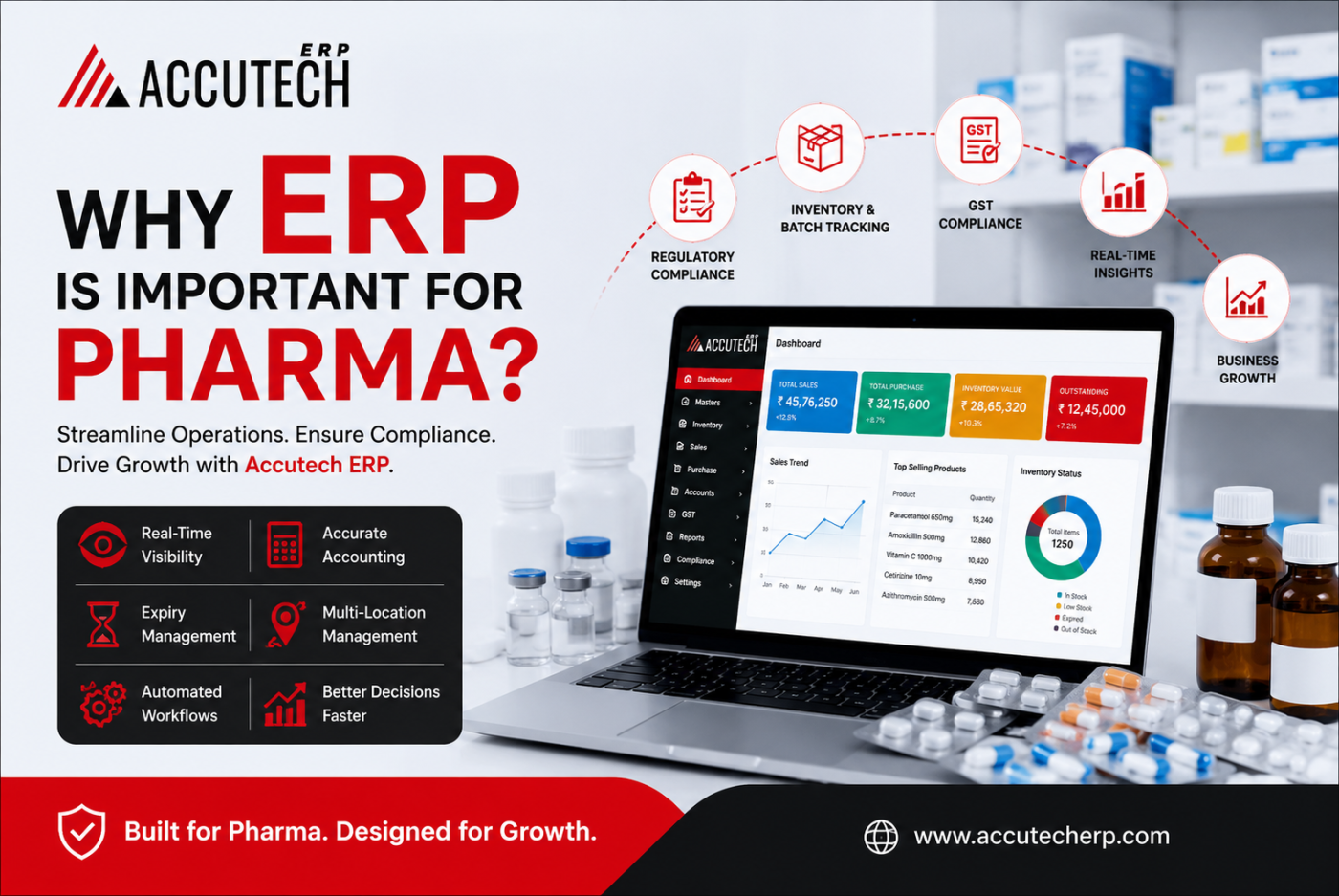
Pharma ERP Software
Pharmaceutical businesses face unique challenges that go beyond traditional accounting. Regulatory compliance, inventory tracking, batch management, expiry dates, multiple distribution channels, and complex taxation requirements make pharma operations incredibly complicated. Yet many small pharma companies still rely on spreadsheets, manual entry, and disconnected software systems. The result? Inefficiency, compliance risks, and lost revenue opportunities.
If you’re running a pharma business, wholesaler operation, or any small enterprise in 2026, you’ve probably asked yourself: “Why do we still struggle with accounting, inventory, and billing when technology should make this easier?” The answer lies in understanding why a modern pharma ERP solution isn’t just helpful, it's absolutely essential for survival and growth in today’s competitive market.
This comprehensive guide explains why ERP is crucial for pharma businesses, how it solves real-world problems, and why Accutech ERP stands out as the ideal solution for small pharmaceutical companies, distributors, and retailers looking to streamline operations in 2026.
THE REALITY: WHY YOUR PHARMA BUSINESS NEEDS ERP NOW
The pharmaceutical industry operates under extreme pressure. Regulatory bodies demand meticulous record-keeping. Customers expect accurate invoicing and quick delivery. Tax authorities require detailed GST compliance documentation. Meanwhile, your inventory constantly changes as batches expire, new medications arrive, and distribution orders multiply.
Many pharma business owners we speak with describe the same painful cycle: they’re drowning in paperwork, missing compliance deadlines, struggling with inventory accuracy, and unable to get real-time financial visibility. By the time they discover an accounting error or an expired batch, it’s already too late. Worse, manual processes mean they’re spending hours on administrative work instead of growing their business.
This is where the question “Why is ERP important for pharma?” becomes not just academic but survival-critical.
UNDERSTANDING ERP: WHAT IT IS AND WHY PHARMA NEEDS IT
Enterprise Resource Planning, or ERP, is an integrated system that connects all aspects of your business into one unified platform. For pharma companies, this means your accounting, inventory management, billing, compliance, and reporting all work together seamlessly instead of existing in isolated silos.
Think of it this way: without ERP, you’re managing accounts in one system, inventory in spreadsheets, billing through another software, and tax compliance through yet another tool. Information gets lost between systems, errors multiply, and decision-makers never have a complete picture of the business. With a modern pharma ERP solution, every transaction automatically updates across all modules. When you issue an invoice, inventory updates. When inventory changes, financial reports reflect the change immediately. When a batch expires, the system alerts you before it becomes a compliance nightmare.
For pharma businesses specifically, ERP is important because it addresses industry-specific needs: batch tracking, expiry management, multi-location distribution, cold chain monitoring, regulatory compliance, and complex GST billing across different categories of medicines. You can’t achieve this level of control with generic accounting software or manual processes.
THE PROBLEMS PHARMA BUSINESSES FACE WITHOUT ERP
Manual Data Entry and Human Error
When your accounting team manually enters transactions into spreadsheets, mistakes are inevitable. Someone transposes a number, forgets a decimal point, or enters data twice. In pharma accounting, these aren’t minor inconveniences, they're serious problems. An inventory count error might mean you think you have enough stock when you don’t, leading to missed sales or stockouts. A billing error could mean underbilling or overbilling customers, creating compliance issues or customer disputes.
Studies show that manual data entry in small businesses leads to errors in approximately 1 out of every 300 entries. For a pharma company processing hundreds of transactions daily, that’s a continuous stream of problems requiring correction, investigation, and remediation.
Inventory Management Nightmares
Pharma inventory is uniquely complex. You’re not just tracking quantities, you're managing batch numbers, expiry dates, manufacturing dates, storage conditions, and distribution locations. Manual tracking through spreadsheets or basic inventory software often fails catastrophically.
Picture this scenario: A sales representative promises a customer 500 units of a specific medicine. Your spreadsheet says you have 600 units. But 400 of those units expire next month, and 50 are held in quarantine awaiting quality checks. In reality, you can only fulfill 150 units. Without real-time inventory visibility from a proper pharma ERP system, you’ve just disappointed your customer and damaged your reputation.
Worse, expired inventory represents pure loss. Many pharma businesses discover expired stock only during physical audits, realizing they’ve lost thousands of rupees to poor tracking. A modern inventory and accounting software with expiry alerts would have prevented this entirely.
GST Compliance and Taxation Headaches
India’s GST system is complex enough under normal circumstances. But for pharma companies selling to hospitals, clinics, retailers, and wholesalers at different tax rates, GST compliance becomes a nightmare. Different medicines fall under different GST slabs. Invoices must be perfectly formatted. Input tax credit calculations require meticulous accuracy. Monthly GST returns demand detailed reconciliation.
Many small pharma businesses hire dedicated GST accountants just to manage compliance. Even then, errors happen. Without a GST accounting software specifically designed for pharma, you’re vulnerable to penalties, audit notices, and customer disputes over incorrect tax amounts.
COMPARING MANUAL ACCOUNTING VS ERP AUTOMATION
Let’s create a clear comparison of how manual accounting compares to modern pharma ERP automation. Understanding this comparison helps you appreciate why ERP is essential in 2026.
Manual Accounting Using Spreadsheets and Basic Software
- Time Required: A pharma business processing 100 daily transactions spends 8-10 hours daily on accounting tasks: invoice creation, data entry, GST calculation, inventory adjustment, financial consolidation.
- Accuracy: Error rate approximately 1 in 300 transactions, meaning about 2 errors daily in a 100-transaction business.
- GST Compliance: Accountant manually reviews medicine classification, calculates tax rates, reconciles totals. Monthly return preparation requires 2-3 days of work.
- Inventory Visibility: Spreadsheets updated periodically, often showing stale information. Inventory counts don’t match system records. Expired medicine isn’t tracked until a physical audit.
- Multi-Location Management: Each location maintains separate records. Consolidation at month-end requires 5-7 days of work.
- Decision-Making: The owner must wait days for reports before understanding what’s happening in the business.
With Accutech ERP Automation
- Time Required: Same 100-transaction business spends 1-2 hours daily on accounting: mostly reviewing automatically-generated invoices and processing exceptional items.
- Accuracy: Error rate less than 1 in 5,000 transactions through automation of entry, calculation, and validation.
- GST Compliance: System automatically calculates GST. Return preparation requires 15 minutes of review and filing.
- Inventory Visibility: Real-time visibility showing every unit of every medicine at every location. Expiry tracking prevents sale of expired products.
- Multi-Location Management: All locations feed into one system. Consolidated reporting automatic and instantaneous.
- Decision-Making: Real-time dashboards and reports available anytime. The owner doesn’t wait for information to make decisions.
STRONG CONCLUSION: WHY ERP IS NON-NEGOTIABLE FOR PHARMA IN 2026
If you’ve read this far, you understand the answer to “Why is ERP important for pharma?” thoroughly.
ERP is important for pharma because it addresses the fundamental challenge of modern pharmaceutical business: managing complexity. Pharma businesses operate in a regulated environment. They manage complex inventory with strict tracking requirements. They deal with complex taxation. They serve diverse customers with different requirements. They must maintain meticulous compliance documentation.
Without integrated ERP systems, managing this complexity consumes enormous time, resources, and mental energy. With proper ERP, complexity is tamed through automation and integration.
The specific benefits matter:
- Real-time financial visibility that enables faster decision-making
- Automated processes that free your team from manual work
- Accurate compliance that eliminates regulatory risk
- Integrated inventory that prevents expired medicine and understocking
- Multi-location management that enables expansion without administrative burden
- Business insights that enable strategic decision-making instead of reactive management
These benefits aren’t theoretical. They’re real, measurable improvements in how your pharma business operates.
The Cost of Waiting
Every month you delay implementing a modern accounting ERP, you’re paying costs: staff time wasted on manual accounting that could be spent on growth, errors creating compliance risk and customer problems, lack of visibility making decision-making slower and less informed, inventory inefficiencies tying up capital and creating waste, and customer relationship challenges harming reputation and repeat business.
The cumulative cost of these inefficiencies significantly exceeds the cost of implementing a proper solution.
Moreover, the sooner you transition, the sooner you gain the competitive advantages of modern business management.
The Time to Act Is Now
Your competitors who’ve already transitioned to cloud-based accounting ERP systems are operating more efficiently, making better decisions, and growing faster. Every month you wait widens this gap.
Choosing the right solution matters. Many ERP options exist. Some are complex enterprise systems designed for large corporations. Some are simplistic systems that don’t solve real business problems. Some don’t understand pharma-specific requirements.
Accutech ERP is specifically designed for your situation. It’s built for pharma, wholesale, distribution, and retail businesses operating in India. It solves the real problems you face. It’s priced appropriately for small business budgets. It includes professional support through implementation. It evolves continuously to meet emerging needs.
Most importantly, it works. Hundreds of pharma businesses, wholesalers, distributors, and retailers have already made the transition and are seeing real improvements in operations, profitability, and growth.
If you’re still managing your pharma accounting through spreadsheets, disconnected software, or outdated systems, it’s time to make the change.
Your Next Step
The first step is simple: have a conversation with someone who understands your business challenges. Accutech offers free consultations where we understand your specific situation and show you exactly how the system would transform your operations.
Don’t let another year pass struggling with accounting challenges that have been solved. The technology exists. The solution is proven. The time to act is now.
Contact Accutech ERP today to learn how modern accounting software can transform your pharma business from a source of stress into a competitive advantage.