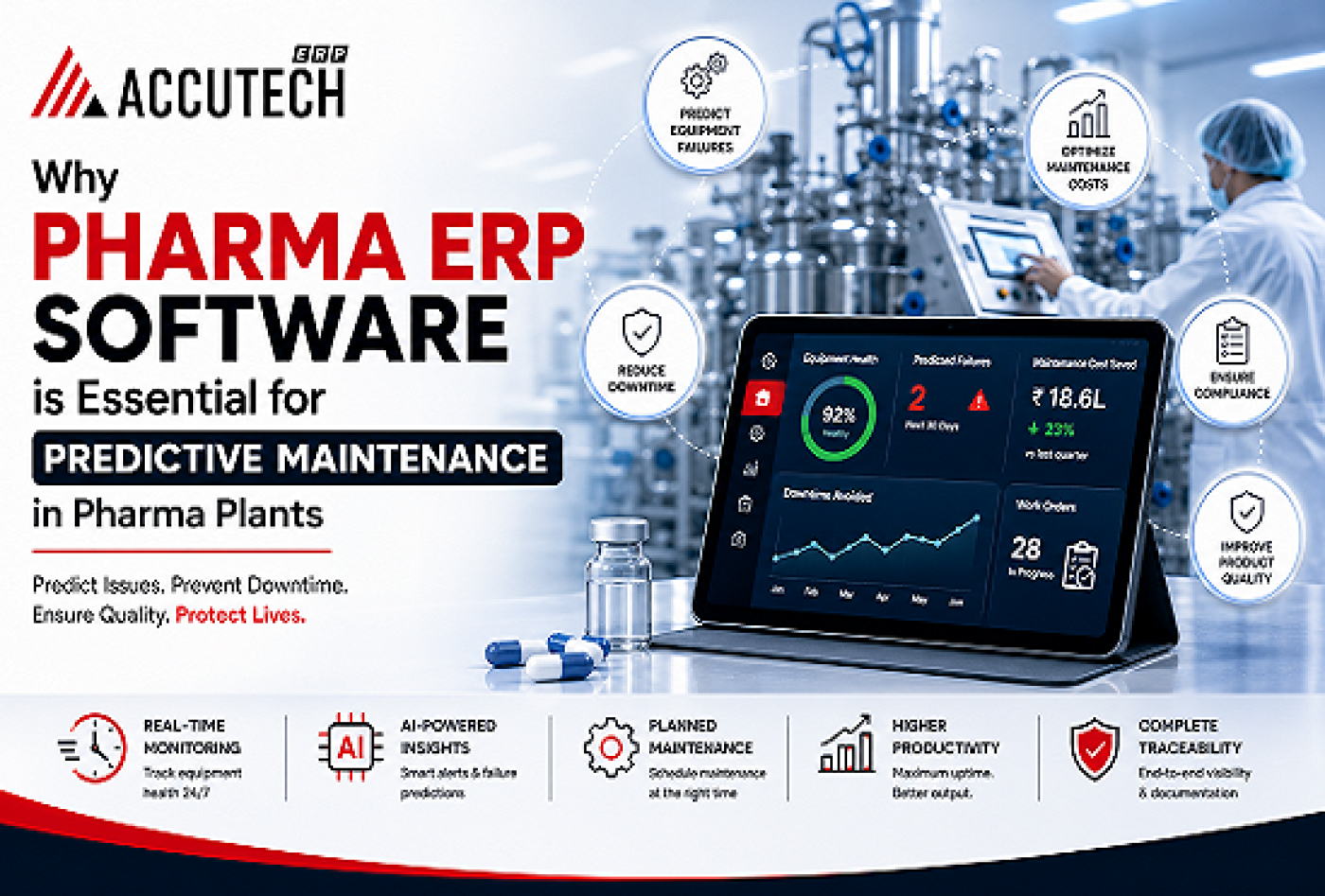
Picture this: It's 3 AM at a busy pharmaceutical manufacturing plant. A critical piece of equipment suddenly fails without warning. Production comes to a grinding halt. Thousands of doses that were supposed to reach patients by morning sit unfinished. Emergency maintenance teams scramble. The financial impact is already in the millions. Regulatory compliance deadlines are missed. Patient safety takes a backseat to crisis management.
This scenario plays out more often than you'd think in the pharmaceutical industry but here's the thing: it doesn't have to.
The pharmaceutical manufacturing world has undergone a transformation. For decades, companies relied on reactive maintenance: wait for something to break, then fix it. But today's advanced pharma manufacturing software solutions are changing the game entirely. By shifting from reactive to predictive maintenance, pharmaceutical manufacturers are preventing equipment failures before they happen, saving money, and ensuring that critical medications reach patients on time and every time.
At the heart of this revolution lies a sophisticated tool that most modern pharma plants can't function without anymore: the pharmaceutical manufacturing erp software. This isn't just about tracking inventory or managing finances though it does that exceptionally well. Modern pharma erp software systems are intelligent, data-driven platforms that predict equipment failures, optimize maintenance schedules, and transform how plants operate.
Let me walk you through why this matters to your business, how it works, and how solutions like Pharma PCD ERP are reshaping the pharmaceutical manufacturing landscape in 2026.
Understanding the Challenge - Why Pharma Plants Struggle with Maintenance
The pharmaceutical manufacturing environment is unforgiving. Unlike consumer products where a delay might frustrate customers, pharmaceutical products are matters of life and death. Patients depend on the steady supply of medications to manage chronic conditions, treat acute illnesses, and maintain their quality of life.
Despite this critical importance, many pharma plants continue to operate with outdated maintenance strategies. The problems are real and increasingly costly:
The Traditional Maintenance Trap
Most pharmaceutical manufacturers still operate primarily on scheduled maintenance models. They follow predetermined maintenance calendars, service equipment every six months, replace parts every year, and inspect systems quarterly. On the surface, this sounds responsible. In reality, it's incredibly wasteful.
Think about your car. If you change the oil every 5,000 miles whether your engine needs it or not, you're wasting money on unnecessary oil changes and filters. But if you never check your oil and one day your engine seizes, you've lost your vehicle entirely. Pharmaceutical maintenance operates in this same frustrating middle ground, except the stakes involve patient health.
Equipment doesn't break on a convenient schedule. A bearing might wear out in 8 months instead of 12. A seal might start failing at month 10 instead of month 18. Scheduled maintenance misses these variations entirely. You either do maintenance that wasn't necessary or you miss problems until they become failures.
The Cost of Equipment Failure
When a critical manufacturing system goes down in a pharma plant, the financial consequences ripple through the entire operation:
Immediate downtime costs and lost production capacity. A modern pharmaceutical production line might produce 500,000 units per day. Every hour of downtime represents approximately 20,000-50,000 in lost revenue for a mid-sized facility. Emergency repair expenses, which typically run 300-400% higher than planned maintenance. Regulatory penalties and compliance violations, which can reach hundreds of thousands or even millions of dollars. Impact on patient access to medications, affecting public health and company reputation. Overtime costs for technicians performing emergency repairs. Documentation and investigation time required for regulatory compliance.
Without proper visibility into equipment health, these failures seem to happen randomly. But they're not random, they're predictable. The signs are there; companies just haven't had the right tools to read them.
The Complexity of Pharma Manufacturing
Pharmaceutical manufacturing isn't like producing widgets. Every process is tightly controlled and heavily regulated. The FDA requires detailed documentation of every step. Equipment must meet strict validation standards. Parameters must be monitored within narrow ranges.
A pharmaceuticals manufacturing software solution must manage all these complexities while maintaining perfect accuracy. Miss one parameter. Fail to log one maintenance action. Skip one validation step. Suddenly, an entire batch becomes worthless, or worse, non-compliant.
Legacy systems spreadsheets, disparate software platforms, manual tracking simply can't handle this complexity efficiently. They create silos of information. Maintenance teams don't know what production teams are planning. Financial teams can't see why equipment costs keep rising. Regulatory teams scramble to compile documentation during audits.
This fragmentation is where so many plants struggle, and it's precisely where modern pharma ERP software solutions create tremendous value.
What is Pharma ERP Software and How Does It Work?
Before we dive into predictive maintenance specifically, let's establish what a pharma ERP software system actually is and why it's so fundamentally different from legacy approaches.
The Evolution to Enterprise Resource Planning
ERP stands for Enterprise Resource Planning. A pharmaceutical manufacturing erp software system is an integrated software platform that brings together all the different functions of a pharmaceutical manufacturing operation into one unified ecosystem.
Think of it like this: Previously, a pharma plant might have used five different systems one for production scheduling, another for maintenance tracking, another for inventory, another for quality control, and yet another for financial management. These systems didn't talk to each other. A maintenance manager couldn't see production schedules. A quality inspector couldn't immediately access maintenance history. A financial analyst couldn't correlate equipment maintenance costs with production yields.
A modern pharma erp software system integrates all these functions. Everything connects. Everyone has access to the same data in real-time. When maintenance is performed on equipment, that information immediately becomes visible to production schedulers, quality teams, and financial analysts.
Key Functions of Modern Pharma ERP Systems
A comprehensive pharma manufacturing software solution typically includes:
- Production Planning and Scheduling: Coordinating what gets produced when, based on demand, inventory levels, and equipment availability.
- Inventory Management: Tracking raw materials, work-in-progress products, and finished goods with accuracy that regulatory bodies demand.
- Quality Management: Maintaining detailed records of quality tests, results, deviations, and corrective actions.
- Maintenance Management: This is our focus, and it includes scheduling, tracking, and optimizing all maintenance activities.
- Financial Management: Managing costs, analyzing profitability, tracking expenses by department or product line.
- Compliance and Documentation: Creating the audit trails and documentation that regulatory bodies require.
All of these functions work together. When a maintenance plan is created, it immediately affects production scheduling, inventory forecasting, and cost projections. When quality issues arise, maintenance data is instantly accessible for investigation.
Why Pharma Plants Are Switching Now
For years, many pharmaceutical manufacturers saw ERP systems as nice-to-have rather than essential. The upfront investment is significant. Implementation takes time and resources. Training is required. Change management can be challenging.
But several factors have converged to make modern pharma erp software adoption essential in 2026:
- Increasing Regulatory Complexity: Regulatory requirements have expanded dramatically. FDA guidance documents, ICH guidelines, and international compliance standards demand more detailed tracking and documentation than legacy systems can reasonably provide.
- Supply Chain Pressures: Post-pandemic supply chain disruptions made pharmaceutical manufacturers acutely aware of their vulnerabilities. ERP systems provide the visibility needed to navigate complex, global supply chains.
- Equipment Advancement: Modern manufacturing equipment generates vastly more data than older systems. A legacy maintenance approach can't capitalize on this data. Predictive systems can.
- Rising Labor Costs: Skilled maintenance technicians are harder to find and more expensive than ever. Efficiency gains from optimized maintenance directly impact labor costs.
- Competitive Necessity: Competitors who implement modern systems gain significant advantages in efficiency, compliance, and patient safety. Staying competitive means matching these capabilities.
For these reasons, pharma manufacturing software adoption has accelerated significantly, and the best-in-class solutions incorporate predictive maintenance as a core capability.
Predictive Maintenance - The Game Changer for Pharma Manufacturing
This is where things get truly exciting. Predictive maintenance is where pharma erp software transcends being a management tool and becomes a strategic asset for the entire organization.
Predictive vs. Preventive vs. Reactive Maintenance
To understand predictive maintenance, let's clarify the three primary maintenance approaches:
Reactive Maintenance (Breakdown Maintenance): The equipment breaks. You call someone to fix it. This is the most expensive approach: emergency repairs cost more, production is halted, regulatory implications arise. Most old-school pharma plants rely heavily on this despite trying to minimize it.
Preventive Maintenance (Scheduled Maintenance): You perform maintenance on a predetermined schedule every six months, every year, every 10,000 hours of operation. This reduces breakdowns compared to reactive maintenance but wastes resources on unnecessary maintenance and still misses problems that develop outside the schedule.
Predictive Maintenance (Condition-Based Maintenance): You continuously monitor equipment condition. When data indicates that failure is approaching, you schedule maintenance at the optimal time. Equipment is maintained only when needed, right before problems occur.
The difference in outcomes is substantial:
Reactive Maintenance: 40-50% of maintenance performed is emergency maintenance (highest cost). Breakdowns are unpredictable. Equipment reliability is unpredictable.
Preventive Maintenance: Reduces emergency maintenance to 15-20%. More predictable than reactive but still includes unnecessary maintenance.
Predictive Maintenance: Reduces emergency maintenance to under 5%. Maintenance happens only when needed. Equipment reliability improves dramatically. Costs are minimized.
For a mid-sized pharma plant spending 2-5 million annually on maintenance, moving from preventive to predictive approaches can save 500,000-1.5 million per year while improving reliability. That's enormous.
How Predictive Maintenance Works in Pharma ERP Systems
Here's where modern pharmaceutical manufacturing erp software demonstrates its sophisticated intelligence:
Continuous Data Collection
Modern manufacturing equipment is increasingly equipped with sensors. A tablet press might have vibration sensors, temperature sensors, pressure sensors, and acoustic sensors. A filling machine has multiple sensor types monitoring flow rates, pressure, temperature, and mechanical stress.
A robust pharma erp software system collects data from these sensors continuously not occasionally, but constantly. Some advanced systems collect data every second or even more frequently. This creates a detailed picture of how equipment is performing in real-time.
The volume of data is enormous. A single piece of equipment might generate gigabytes of sensor data per day. Processing this information requires sophisticated software and infrastructure, which is precisely what modern ERP systems provide.
Baseline Establishment and Anomaly Detection
The system establishes a baseline for normal equipment operation. What are normal vibration levels? Normal temperature ranges? Normal pressure patterns? This baseline is unique to each piece of equipment, accounting for its age, design, maintenance history, and operating conditions.
The software then continuously compares current performance against this baseline. When performance deviates from the expected pattern, the system flags it. It doesn't necessarily mean failure is imminent, it means the equipment is behaving differently than normal.
A vibration sensor might detect oscillations at a frequency that weren't there before. A temperature sensor might show gradual increases that aren't explained by ambient conditions. A pressure sensor might show fluctuations rather than the steady readings previously observed.
These anomalies are the equipment's way of "saying" something is changing. Maybe a bearing is beginning to wear. Maybe a seal is starting to degrade. Maybe lubrication is breaking down. The anomaly signals the beginning of the failure process.
Predictive Algorithms and Machine Learning
Here's where modern pharma ERP software becomes truly intelligent. The system uses statistical analysis and machine learning algorithms to predict when failure is likely to occur based on detected anomalies.
Think of it like this: The system has analyzed thousands of previous equipment failures across the industry. It knows the patterns. When bearing wear starts, it typically progresses to failure over 30-60 days depending on operating conditions. When seal degradation begins, the timeline is usually 20-40 days before failure occurs.
When the system detects the beginning of these patterns in your equipment, it doesn't just alert you that something is wrong. It predicts: "Based on current degradation trends, this bearing will likely fail in 35 days if no action is taken."
These predictions become progressively more accurate as the algorithm accumulates data specific to your equipment and your operating conditions. After running for a few months, the system understands your equipment's behavior patterns intimately.
Maintenance Scheduling and Optimization
With this predictive intelligence, maintenance can be scheduled optimally. The system recommends maintenance just before predicted failure, allowing you to:
- Choose the timing that minimizes production impact. Many pharma plants can schedule equipment maintenance during planned downtime or slower production periods. The system becomes another voice in these planning discussions, providing critical data.
- Order replacement parts well in advance, ensuring they're available when needed rather than paying rush shipping.
- Assign the right technicians with appropriate training and tools.
- Plan for multiple related maintenance tasks on the same equipment during one downtime window, improving efficiency.
For pharmaceutical manufacturers, this means planned maintenance windows rather than emergency calls at 3 AM. It means equipment that's maintained proactively, extending its service life. It means production schedules that can be met because equipment doesn't fail unexpectedly.
The Transformative Benefits of Pharma ERP Software for Maintenance
Let's ground all this in reality. How does predictive maintenance powered by pharma erp software actually improve operations for pharmaceutical manufacturers? The benefits are significant and measurable.
Benefit 1: Dramatic Cost Reduction
This is the most immediately quantifiable benefit. By shifting from emergency maintenance to planned, predictive maintenance, pharmaceutical manufacturers achieve substantial cost savings:
- Emergency repairs are typically 300-400% more expensive than planned maintenance. Preventing just one emergency repair per month pays for a significant portion of ERP software costs.
- Parts waste is reduced significantly. Preventive maintenance approaches often replace parts that still have useful life. Predictive maintenance replaces parts only when necessary.
- Labor costs decrease because technicians work planned maintenance schedules rather than emergency overtime.
- Extended equipment life results from optimized maintenance rather than failure-driven operation.
A pharma plant spending 3 million annually on maintenance might realistically save 600,000-900,000 per year through predictive maintenance optimization. For a company spending 50 million annually, savings could exceed 10 million.
Benefit 2: Improved Equipment Reliability and Uptime
Production relies on equipment availability. Every hour of unplanned downtime impacts revenue, regulatory timelines, and patient access to medications.
Pharma erp software with predictive maintenance capabilities dramatically improves equipment reliability:
- Unplanned downtime is reduced by 50-80% through predictive failure prevention.
- Equipment lifetime is extended through optimized maintenance that prevents catastrophic failures.
- Maintenance windows become predictable, allowing production to plan around them.
- Equipment performance remains more consistent over time because degradation is caught early.
The reliability improvements have cascading positive effects. Production managers can commit to delivery schedules with greater confidence. Supply chains become more stable. Patient access to medications improves.
Benefit 3: Regulatory Compliance and Documentation
Pharmaceutical manufacturing is heavily regulated. The FDA requires detailed documentation of all activities, including maintenance. FDA audits focus intently on equipment maintenance—evidence that equipment is properly maintained, that maintenance follows protocols, and that issues are identified and addressed appropriately.
A comprehensive pharmaceutical manufacturing erp software system creates perfect documentation:
- Every maintenance action is logged automatically.
- Every equipment inspection is recorded.
- Anomalies are documented when detected, not discovered months later during an audit.
- Maintenance protocols are standardized across all equipment.
- Regulatory inspectors can access complete maintenance histories instantly.
- Deviations and corrective actions are formally documented.
When FDA inspectors arrive, instead of scrambling through files and email to reconstruct maintenance history, you can provide a complete, organized record instantly. This demonstrates regulatory maturity and excellence.
Benefit 4: Production Quality Improvement
Equipment condition directly impacts product quality. Poorly maintained equipment produces inconsistent results:
- A tablet press with misaligned dies produces tablets with slight variations.
- A filling machine with worn nozzles creates slight overfills or underfills.
- A lyophilizer with contamination produces variable product consistency.
By maintaining equipment in optimal condition through predictive approaches, product quality becomes more consistent:
- Fewer batch failures and deviations occur due to equipment issues.
- Product consistency improves, which particularly matters for critical medications like biologics.
- Customer satisfaction increases because product quality is superior.
- Regulatory issues related to product quality decline.
Myths and Misconceptions About Pharma ERP and Predictive Maintenance
As adoption of pharma manufacturing software has accelerated, various myths have emerged about ERP systems and predictive maintenance. Let's address the major ones:
MYTH 1: ERP Systems Are Only for Large Companies
Reality: While large pharma manufacturers were early adopters, modern pharmaceutical manufacturing erp software solutions are now scalable for mid-sized and even smaller operations. Solutions like PHARMA PCD ERP offer configurations suitable for facilities of different sizes. The return on investment applies across company sizes; smaller facilities just have smaller absolute savings, but the percentage improvement is similar.
MYTH 2: Predictive Maintenance Is Too Complicated for Our Plant
Reality: This was true 10-15 years ago. Modern pharma ERP software automates most of the complexity. The algorithms run in the background. Maintenance managers don't need to understand machine learning to use these systems effectively. They see recommendations and alerts in an easy-to-understand interface. The sophistication is built in; you don't need to build it yourself.
MYTH 3: We'll Lose Control with an ERP System
Reality: The opposite is true. Legacy disconnected systems actually create less control because information is scattered. A comprehensive pharma ERP software system consolidates information and creates transparency. You have better control because you have better visibility.
MYTH 4: Implementation Will Completely Disrupt Our Operations
Reality: Implementation does require planning and attention. However, well-planned implementations with dedicated resources can be completed while maintaining normal operations. Many pharma plants successfully implement ERP systems with minimal disruption through phased approaches and careful change management.
MYTH 5: Old Equipment Can't Work with Predictive Maintenance Systems
Reality: While newer equipment with built-in sensors provides more data, pharma erp software can incorporate older equipment through retrofitted sensors, data integration from existing systems, or manual data entry for certain parameters. Predictive maintenance can be partially implemented even in legacy environments.
Implementing Pharma ERP Software - A Practical Guide
If you're considering implementing a pharma erp software system at your facility, understanding the practical realities of implementation is essential.
Phase 1: Assessment and Planning
Before any software is installed, thorough assessment is critical:
Evaluate Current State: Document your existing processes, systems, and data. Understand where information silos exist. Identify pain points.
Define Business Requirements: What specific challenges does your facility need to address? What are your operational goals? What regulatory requirements must be met? A pharmaceutical manufacturing ERP software system is a tool the more clearly you understand your needs, the better the system will serve you.
Select the Right System: Not all ERP systems are equal. Some are designed for specific industries. Pharma PCD ERP, for example, is specifically designed for pharmaceutical manufacturers. Systems designed for generic manufacturing might not understand pharma-specific requirements like batch documentation, quality systems, and regulatory needs.
Conduct Feasibility Analysis: Understand costs, timelines, resource requirements, and expected ROI.
Phase 2: Vendor Selection and Contracting
Selecting the right vendor is perhaps the most critical decision:
- Evaluate expertise in pharmaceutical manufacturing specifically.
- Understand their implementation track record. References from comparable-sized facilities in the pharmaceutical industry are invaluable.
- Clarify support structures: what happens after implementation? What training is provided? What's included in ongoing support?
- Negotiate contracts carefully. Understand licensing structures, upgrade policies, and cost escalation terms.
- Implement vendor assessment through pilots if possible. Some vendors offer limited pilots where you can test the system on a subset of your operation before full implementation.
Phase 3: Detailed Design and Customization
ERP systems are highly configurable, but configuration requires expertise:
- Map existing processes to the new system. Some processes will need to change; this is expected and often beneficial. A good pharma ERP software vendor brings best practices knowledge, suggesting process improvements.
- Design the system architecture for your specific facility. How will equipment be configured in the system? What monitoring parameters will you track? How will alerts be triggered?
- Design workflows and approval structures. Who approves purchase orders? Who authorizes maintenance? What's the escalation process for urgent issues?
Phase 4: Data Migration and System Setup
Moving from legacy systems to a new pharma manufacturing software platform requires careful attention to data:
- Data cleaning and validation are critical. Don't just dump old data into a new system. Clean it, validate it, and ensure it's properly formatted.
- Data mapping ensures that data from old systems is correctly translated into new system structures.
- Historical data loading provides the new system with context about your equipment and operations.
- Master data setup (equipment lists, personnel, vendors, materials) establishes the foundation for all future operations.
Phase 5: Testing and Training
Extensive testing before go-live prevents problems after launch:
- System testing confirms that the pharma erp software functions as designed in your environment.
- Integration testing confirms that all modules work together correctly.
- User acceptance testing has your actual staff using the system to confirm it works for their roles.
- Comprehensive training prepares staff to use the system effectively. Good implementation vendors provide extensive training tailored to different roles.
Phase 6: Go-Live and Stabilization
The launch is just the beginning:
- Phased go-live approaches are often used departments or functions that go live sequentially rather than everything simultaneously. This reduces risk.
- Intensive monitoring in the first weeks identifies issues quickly.
- Responsive support teams address problems as they arise.
- Staff adaptation takes time. Be patient. People need time to adjust to new systems.
Phase 7: Optimization and Continuous Improvement
The real benefits emerge after go-live as you optimize the system:
- Configure the predictive maintenance features based on your actual equipment and failure patterns.
- Refine algorithms and thresholds based on actual system performance.
- Expand monitoring to additional equipment as confidence grows.
- Train staff on advanced features. Push the system to deliver the full benefit potential.
This entire process typically takes 6-18 months depending on facility complexity and size.
Real-World Results - How Pharma Plants Are Transforming Operations
Understanding theoretical benefits is one thing. Seeing how real pharmaceutical manufacturers have transformed their operations is more compelling.
Case Study Scenario: The Mid-Sized Generics Manufacturer
Consider a mid-sized generic pharmaceutical manufacturer producing 200+ products with annual revenue around 50 million. Before implementing pharma erp software, they faced familiar challenges:
- Equipment downtime was costing them approximately 35,000-50,000 per day when critical systems failed.
- Emergency maintenance costs were running 4.2 million annually much higher than planned maintenance would cost.
- Regulatory audits typically identified 15-25 findings related to documentation and maintenance records.
- Production schedules were unreliable because equipment failures were unpredictable.
- Staff turnover among maintenance personnel was high because the work was reactive and stressful.
After implementing a comprehensive pharmaceutical manufacturing erp software solution with predictive maintenance:
- Equipment downtime decreased 65% within 18 months.
- Emergency maintenance costs dropped to 1.2 million annually, a savings of 3 million per year.
- Regulatory findings dropped to 2-4 per audit, reflecting excellent documentation and maintenance practices.
- Production schedules became reliable with 96%+ on-time delivery.
- Maintenance staff turnover dropped significantly as the work became more professional and less crisis-driven.
The ROI was remarkable: implementation cost approximately 1.8 million. Annual operating costs were approximately 400,000. Within six months, savings from reduced emergency maintenance exceeded implementation costs. The system has now been in place for four years, delivering 2.5+ million in annual savings.
Common Success Patterns
Across many pharmaceutical manufacturers who have successfully implemented pharma manufacturing software with predictive maintenance:
- Facilities achieve 30-50% reductions in emergency maintenance costs.
- Equipment uptime improvements of 15-30% are common.
- Regulatory compliance scores improve notably.
- Staff satisfaction increases, particularly among maintenance personnel.
- Production reliability improves, allowing better customer commitments.
These aren't anomalies. They're common outcomes from proper implementation of integrated pharmaceutical manufacturing erp software.
Looking Ahead - Pharma ERP in 2026 and Beyond
The pharmaceutical manufacturing landscape continues to evolve. Understanding where pharma ERP software and predictive maintenance are heading helps inform your decisions today.
Artificial Intelligence and Advanced Analytics
AI and machine learning continue to advance. Modern pharma erp software systems are increasingly incorporating:
- Natural language processing that allows maintenance descriptions in plain language, automatically categorizing and analyzing them.
- Anomaly detection that improves continually, learning from each equipment failure to prevent similar failures.
- Prescriptive maintenance recommendations that don't just predict failure but recommend the optimal preventive action.
- Pattern recognition across your entire facility, identifying systemic issues that affect multiple pieces of equipment.
As adoption of pharma ERP software with predictive maintenance accelerates, it's shifting from competitive advantage to competitive necessity. Manufacturers without these capabilities are increasingly at a disadvantage in terms of cost, reliability, and regulatory maturity.
Selecting the Right Pharma ERP Solution - Key Criteria
If you're evaluating pharma erp software solutions, several critical criteria should guide your decision:
Industry-Specific Functionality
Look for systems specifically designed for pharmaceutical manufacturing:
- Built-in understanding of batch manufacturing.
- Integrated compliance with FDA Part 11, ICH guidelines, and other regulatory requirements.
- Quality management systems integrated with production and maintenance.
- Formulae and recipe management for different products.
Predictive Maintenance Capabilities
Evaluate the sophistication of maintenance features:
- Does the system support sensor integration?
- Can it work with both modern equipped and legacy equipment?
- Are predictive algorithms included or are they an expensive add-on?
- What data visualization tools help you understand equipment conditions?
- How customizable are alerts and thresholds?
Frequently Asked Questions
Q1: How Quickly Will We See ROI from a Pharma ERP System?
For most mid-sized pharmaceutical manufacturers, ROI materializes within 12-24 months. This assumes typical savings from reduced emergency maintenance (typically 1-3 million annually for mid-sized facilities). Some quick wins, like improved regulatory compliance and reduced documentation time, appear within weeks. Larger savings from optimized production scheduling and improved equipment reliability develop over months.
Q2: What Happens if Our Equipment Isn't New and Doesn't Have Sensors?
Modern pharma ERP software can work with both equipped and legacy equipment. For legacy equipment, you have options: retrofit sensors (increasingly affordable), integrate data from existing equipment monitoring systems, or rely on historical data and manual monitoring for certain parameters. You don't need to replace equipment to benefit from ERP implementation.
Q3: How Long Does Implementation Typically Take?
Implementation timelines vary by facility complexity and size. A smaller facility with 5-10 major pieces of equipment might be implemented in 6-9 months. A larger facility with multiple production lines might require 12-18 months. Phased implementations can extend over longer timeframes, but benefits appear as each phase goes live.
Q4: Will an ERP System Work with Our Existing Systems?
This depends on the specific systems. Good pharma ERP software solutions are designed for integration. However, legacy systems sometimes require data migration rather than real-time integration. Discuss integration requirements thoroughly during the vendor selection process.
Q5: How Much Training Will Our Staff Need?
Staff training needs vary by role. Maintenance technicians might need 20-40 hours of training. Production managers might need 30-50 hours. Financial analysts might need 40-60 hours. Good implementations provide role-specific training and ongoing support resources.
Q6: How Does Predictive Maintenance Differ from Preventive Maintenance?
Preventive maintenance is time-based or hours-based (service every six months or every 5,000 hours). Predictive maintenance is condition-based (service when data indicates failure is imminent). Predictive maintenance typically costs 20-40% less while providing better reliability because you're not doing unnecessary maintenance.
Q7: Can Small Pharma Companies Afford ERP Systems?
Yes, though implementation costs are real. Small companies typically require fewer modules and simpler configurations than large facilities, reducing costs. Cloud-based solutions often provide more affordable starting points than on-premises systems. ROI calculations should be completed specifically for your facility size to evaluate affordability.
Q8: How Does Predictive Maintenance Affect Regulatory Compliance?
Positively. Predictive maintenance systems create perfect documentation of all maintenance activities. They demonstrate data-driven decision-making. They provide clear records of equipment condition monitoring. During FDA audits, this level of documentation is viewed very favorably.
Q9: How Does Artificial Intelligence Improve Maintenance Predictions?
AI systems learn from patterns in your data. The more equipment failures the system has analyzed, the more accurate predictions become. AI can identify subtle patterns humans would miss. Over time, AI-powered systems become progressively more accurate for your specific facility and equipment.
Q10: Will Implementing a Pharma ERP System Require Hiring New Staff?
Typically, no. However, you may need to dedicate internal resources to the implementation project. Some organizations hire implementation consultants to lead the project. After go-live, ongoing support can typically be managed by existing IT and operations staff with training.
Conclusion
We started this article with a story about a catastrophic equipment failure in a pharmaceutical manufacturing plant at 3 AM. That failure was preventable.
The pharmaceutical manufacturing industry has transformed dramatically over the past decade. Regulatory requirements have become more complex. Supply chains have become more fragile and globally distributed. Competition has intensified. Patient expectations for reliable access to medications have increased. At the same time, technological capabilities have advanced remarkably.
Pharma erp software represents the convergence of these forces. It's not a luxury. It's not something that only large companies need. It's an essential capability that pharmaceutical manufacturers need to compete effectively, comply with regulations, operate efficiently, and serve patients.
The specific capability we've focused on predictive maintenance exemplifies why pharmaceutical manufacturing ERP software matters. Rather than waiting for equipment to fail, modern systems predict failure and enable proactive maintenance. The results are dramatic: lower costs, better reliability, improved compliance, and less stressful work environments for maintenance teams.
For pharmaceutical manufacturers still operating with reactive or basic preventive maintenance approaches, the opportunity is significant. The technology exists. Implementation is achievable. ROI is predictable. The question isn't whether to implement pharma ERP software but when and how to do it effectively.
If your facility is considering this journey, start with a clear assessment of your challenges. Understand your needs. Select a vendor with genuine pharmaceutical expertise, not just generic ERP knowledge. Plan carefully. Expect the implementation to be demanding but manageable. Most importantly, recognize that this investment is not optional; it's essential to staying competitive and serving patients effectively in 2026 and beyond.
The pharmaceutical manufacturers who embrace modern pharma ERP software and predictive maintenance approaches are building operational excellence. They're reducing costs, improving reliability, and ensuring that critical medications reach patients reliably. They're positioning themselves for success in an increasingly competitive, increasingly regulated industry.
That equipment failure at 3 AM doesn't have to be part of your story. With the right pharma manufacturing software solution, it can become the exception rather than the rule. The technology exists. The path forward is clear. The question now is: are you ready to transform your operations?