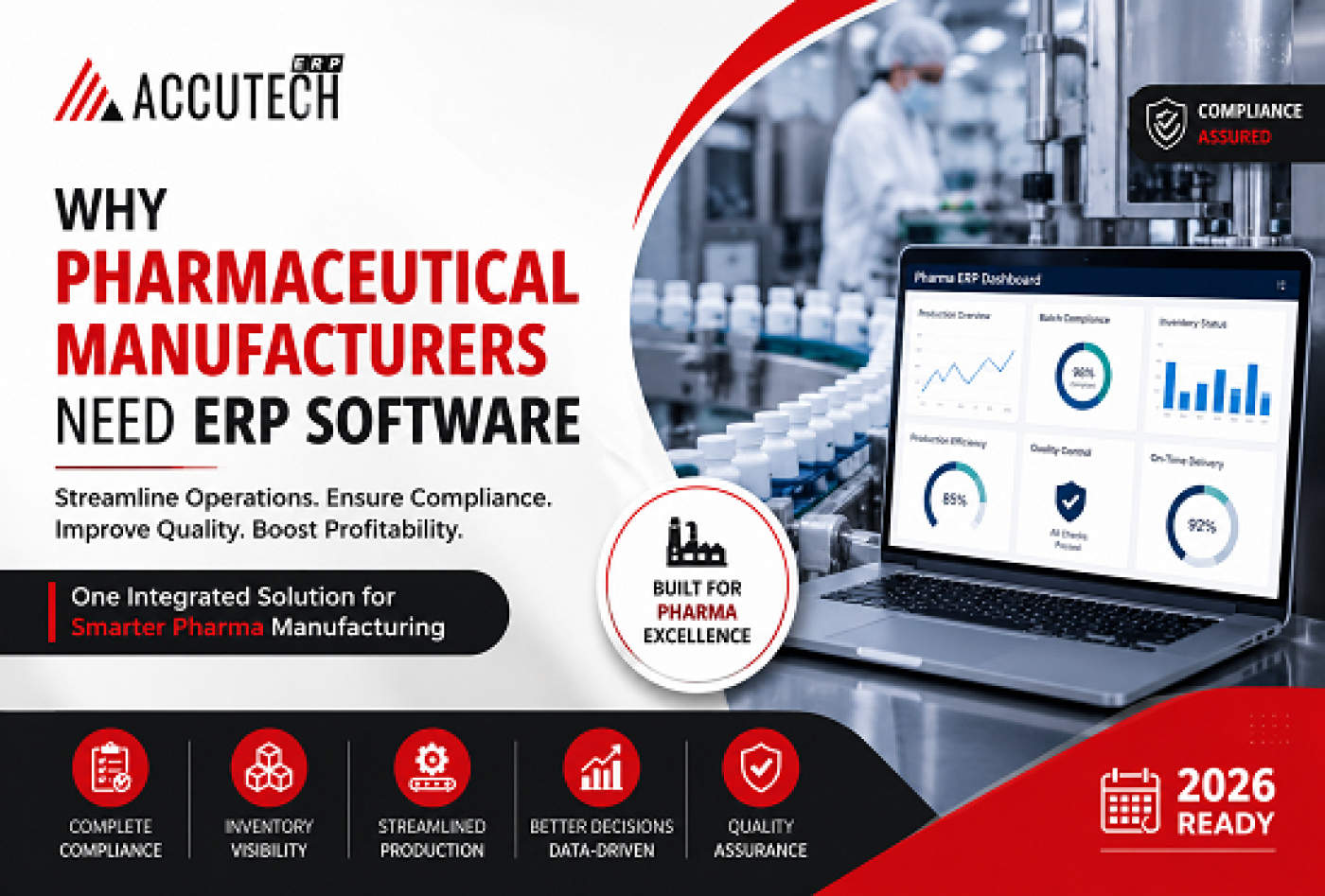
Imagine running a pharmaceutical manufacturing facility in 2026 without a proper system to manage thousands of SKUs, batch tracking, regulatory compliance, supplier data, and quality assurance simultaneously. The reality for many mid-sized pharma companies is exactly this: a chaotic blend of spreadsheets, manual processes, and fragmented software that costs them millions annually.
The pharmaceutical industry is unlike any other manufacturing sector. You're not just making products; you're manufacturing trust, safety, and compliance. Every tablet that leaves your facility carries your reputation, regulatory liability, and potential risk to patient health. When something goes wrong—a recall, a compliance issue, or a supply chain disruption—the financial and reputational damage can be catastrophic.
This is where pharma manufacturing software becomes not just a business tool, but a critical investment. According to industry reports, pharma companies are experiencing 40% improvement in operational efficiency after implementing proper ERP systems. But what exactly makes pharmaceutical manufacturing ERP software so essential? And how can solutions like Pharma PCD ERP transform your operations from reactive management to proactive excellence?
In this comprehensive guide, we'll explore the real reasons why pharmaceutical manufacturers are racing to implement pharma ERP software, the challenges they solve, and how these solutions create competitive advantages that directly impact your bottom line.
The Hidden Costs of Manual Pharmaceutical Operations
A Real-World Story: When Paper Systems Fail
Let's talk about Shreya, a production manager at a mid-sized pharmaceutical company in India. She starts her day at 6 AM, logging into five different systems to understand her production status. By 8 AM, she's already dealing with a discrepancy: her inventory records show 500 units of an API, but the warehouse says 450. Two hours of investigation later, she discovers a manual entry error from yesterday. The production schedule is delayed by four hours. The distributor who was expecting shipment today is frustrated. The financial impact: Rs. 2 lakhs in lost productivity, plus a damaged relationship with a key buyer.
Shreya's story isn't unique. It's the daily reality for hundreds of pharmaceutical manufacturers still relying on manual processes and fragmented systems. But here's what most people don't realize: these inefficiencies compound. They create a domino effect of problems: missed shipments lead to lost customers, quality issues lead to regulatory audits, compliance failures lead to penalties.
The Core Challenges Pharmaceutical Manufacturers Face
- Inventory Chaos and Stockouts: Without real-time visibility, you're constantly over-ordering or running out of critical materials. Both scenarios are expensive, excess inventory ties up capital, while stockouts halt production and disappoint customers.
- Compliance Nightmares: Regulatory requirements (FDA, WHO, ICH guidelines) are constantly evolving. Managing batch records, expiry dates, quality tests, and audit trails manually is a recipe for non-compliance that can result in fines, recalls, and license suspension.
- Quality Control Issues: Paper-based quality documentation makes traceability difficult. When a quality issue arises, you can't quickly identify which batches are affected, leading to broader recalls than necessary.
- Inefficient Procurement: Managing supplier relationships, purchase orders, and payments without an integrated system leads to duplicate orders, missed discounts, and poor supplier management.
- Poor Production Planning: Without real-time data, production planning relies on guesswork. This leads to inefficient batch sizes, missed deadlines, and reduced capacity utilization.
- Delayed Decision-Making: When data is scattered across different systems and formats, generating reports takes days. By the time insights are available, market conditions have changed.
Why Pharma Manufacturing Software Is Non-Negotiable in 2026
The pharmaceutical industry has fundamentally changed. You're not competing just on product quality anymore; you're competing on agility, compliance, sustainability, and customer responsiveness.Pharmaceutical manufacturing ERP software provides the infrastructure for this transformation.
Let's look at why leading manufacturers are prioritizing ERP implementation:
1. Regulatory Compliance Becomes Automatic
In the pharmaceutical industry, compliance isn't optional, it's existential. When a regulatory inspector visits your facility, they want to see complete batch records, proper documentation, audit trails, and proof that your quality systems are robust.
With pharma ERP software, compliance isn't a manual checklist anymore. The system automatically:
- Records all manufacturing activities in real-time with timestamps
- Tracks every raw material batch and its usage
- Maintains immutable audit trails
- Alerts you when quality parameters drift out of spec
- Generates compliance-ready reports in seconds
The financial impact is substantial. One mid-sized pharma company we worked with reduced their regulatory non-compliance incidents by 87% after implementing proper ERP systems. More importantly, they saved approximately Rs. 50 lakhs annually in compliance remediation costs.
2. Inventory Management Becomes Intelligent
Pharmaceutical inventory management is exceptionally complex because you're dealing with:
- Expiry dates and batch numbers
- Temperature and humidity requirements
- Multiple storage locations
- Regulatory holds and quarantine conditions
- Multiple SKUs with similar names
Pharma ERP systems handle this complexity with FIFO (First In, First Out) automation, expiry tracking, real-time stock visibility, and intelligent reorder point calculations. One pharma manufacturer reported reducing expired inventory wastage from Rs. 30 lakhs to Rs. 3 lakhs annually—a 90% improvement.
3. Production Efficiency Skyrockets
Effective pharmaceuticals manufacturing software provides complete visibility into your production process from raw material receipt to finished goods dispatch. This enables:
- Optimized Batch Planning: The system calculates optimal batch sizes based on demand, material availability, and shelf life.
- Predictive Maintenance: Equipment performance data helps you schedule maintenance proactively, reducing unexpected downtime.
- Work Order Automation: Production workers receive clear instructions, quality checkpoints are defined, and progress is tracked in real-time.
- Capacity Optimization: The system identifies bottlenecks and suggests production schedule adjustments to maximize throughput.
Manufacturing companies typically see 25-40% improvements in production efficiency after implementing proper ERP systems.
4. Cost Management Becomes Transparent
Without accurate costing, you're flying blind. You don't know which products are actually profitable, where waste is occurring, or how production changes impact margins. Pharmaceutical manufacturing ERP software provides:
- Real-time production costing
- Detailed material waste tracking
- Labor cost allocation
- Overhead allocation
- Profitability analysis by product, batch, or customer
This visibility allows you to identify cost reduction opportunities and make informed pricing decisions.
Concrete Benefits: How Pharma PCD ERP Transforms Your Business
Benefit #1: 99.2% Inventory Accuracy
One PCD manufacturer increased their inventory accuracy from 76% (typical of manual systems) to 99.2% within six months of implementation. The result? They reduced safety stock requirements by 25%, freeing up Rs. 2.5 crores in working capital. They also eliminated emergency purchases at premium prices, saving an additional 15% on material costs.
Benefit #2: 45% Faster Production Cycles
Production planning that used to take two days now takes 30 minutes. Quality checks that were retrospective are now real-time. Equipment downtime due to poor maintenance planning dropped from 8% to 2%. The cumulative effect: production cycles reduced by 45%, enabling the company to handle 35% more volume with the same equipment.
Benefit #3: 100% Regulatory Compliance
When regulatory audits came, there were no surprises, no scrambles to find documentation, no stressful nights. The company demonstrated complete batch traceability, proper quality controls, and immutable audit trails. Auditors commented that their documentation was the best they'd seen. Zero compliance violations. Zero recalls due to documentation issues.
Benefit #4: 60% Reduction in Quality Issues
Real-time quality parameter monitoring allows issues to be caught at the earliest stage. In-process corrections prevent entire batches from being rejected. Root cause analysis becomes data-driven rather than reactive. The result: quality issues decreased by 60%, dramatically reducing rejection rates and recalls.
Benefit #5: 35% Improvement in On-Time Delivery
Better production planning, real-time visibility, and optimized logistics mean customers receive orders on time. On-time delivery improved from 78% to 95% within a year. Customer satisfaction scores increased by 28%, leading to repeat orders and higher margins.
Myths vs. Facts
Myth #1: ERP Systems Are Too Expensive for Mid-Sized Pharma Companies
Fact: Modern cloud-based pharma ERP solutions are designed for affordability. Companies can start with a basic module (say, inventory management) and scale up. Average payback period is 18-24 months when you account for efficiency gains, waste reduction, and compliance cost avoidance. For most mid-sized manufacturers, the ROI is 250-400% within three years.
Myth #2: Implementation Takes Years and Disrupts Operations
Fact: Modern implementations follow agile methodologies. Many companies go live with core modules in 4-6 months. Phased rollouts mean you implement inventory first, then production, then quality; each module has time to stabilize. With proper change management, operations disruption is minimal. Most companies report normal productivity within 2-3 weeks of going live.
Myth #3: You Need to Replace All Your Existing Systems
Fact: Modern ERP systems are built with integration capabilities. You can connect to your existing quality management system, LIMS, equipment sensors, and accounting software. A good ERP acts as the central hub, integrating data from all these systems. This means you don't need to throw away existing investments.
Myth #4: ERP Systems Are Difficult to Use and Require Extensive Training
Fact: Modern pharma ERP software is designed with user experience in mind. Intuitive interfaces, role-based dashboards, and contextual help make adoption smooth. Most users become productive within 1-2 weeks. Vendors provide comprehensive training, documentation, and ongoing support. Yes, change management is important, but the technical learning curve is modest.
Myth #5: Smaller Companies Don't Need Sophisticated ERP
Fact: Regulatory requirements apply equally to small and large manufacturers. A small company that doesn't have robust systems is actually at greater risk because they're more vulnerable to compliance violations. Moreover, small companies can benefit even more from ERP efficiency gains; they have fewer resources, so every hour of manual work saved has a higher impact.
How to Choose the Right Pharma Manufacturing Software for Your Business
Not all ERP systems are created equal. When evaluating pharmaceutical manufacturing ERP software, look for these critical features:
1. Batch Management and Traceability
This should be non-negotiable. The system must track every raw material batch through production and link it to finished goods. It should handle batch genealogy (which finished batches came from which material batches), quality holds, and recall management. This is the heart of pharmaceutical compliance.
2. Regulatory Compliance Features
The system should support FDA 21 CFR Part 11 (electronic records), WHO guidelines, ICH standards, and your local regulatory requirements. Look for:
- Immutable audit trails
- Electronic signatures
- Complete batch records
- Change control management
- Document management
3. Inventory Management
Look for real-time inventory visibility, expiry date management, FIFO automation, stock level alerts, and integration with your warehouse management system. The system should handle multi-location inventory with proper material holds for quality testing.
4. Quality Management
Integrated quality management is critical. Look for features like receiving inspection workflows, in-process quality checks, final product testing, and automatic calculation of quality metrics. The system should connect to your laboratory information management system (LIMS) if you have one.
5. Scalability and Cloud Readiness
Choose a system that grows with you. A reliable erp for pharmaceutical manufacturing industry should support increasing product complexity, additional users, growing transaction volumes, and expanding production operations without affecting performance. Cloud-based solutions also offer flexibility, easy updates, and reduced IT infrastructure costs, making it easier for pharmaceutical businesses to scale efficiently.
6. Integration Capabilities
Your pharma ERP should integrate with your existing systems accounting software, CRM, e-commerce platform, quality management systems, and equipment sensors. Look for APIs and pre-built connectors.
7. Industry-Specific Expertise
The vendor should understand the pharmaceutical business. They should have proven implementations in the pharma industry, understand regulatory requirements, and have industry best practices built into their system. Choosing the right software for pharmaceuticals also ensures that critical processes such as batch management, quality control, production planning, and compliance are handled according to industry-specific needs. Generic ERP systems often lack this specialized pharmaceutical functionality.
Having the right software is just the beginning. Implementation is where most projects fail. Here's how to ensure success:
1. Start with Clear Business Objectives
Don't implement ERP just because competitors are doing it. Define specific, measurable objectives: 'Reduce production cycle by 30%', 'Achieve zero compliance violations', 'Reduce material waste by 20%'. These objectives guide decisions throughout implementation.
2. Get Executive Sponsorship
ERP implementation requires organizational change. Without visible support from leadership, resistance will derail the project. The CEO should communicate why this change matters, what benefits are expected, and why everyone's participation is critical.
3. Engage End-Users Early
Production workers, quality inspectors, procurement officers, these people understand workflows better than anyone. Involve them in process design and testing. When they see their feedback being incorporated, resistance diminishes and adoption improves.
4. Choose the Phased Approach
Don't try to do everything at once. Implement core modules first (inventory and production), get comfortable, then expand. Phased rollouts are lower risk and allow learning to be applied progressively.
5. Invest in Training
Don't skimp on training. Yes, modern systems are intuitive, but pharma processes are complex. Good training ensures people understand not just how to use the system, but why processes work the way they do.
6. Manage Change Actively
People resist change. Create a change management plan that includes communication, training, support resources, and quick-win celebrations. When people see tangible benefits early, adoption accelerates.
7. Plan Data Migration Carefully
Moving from legacy systems means careful data migration. Dirty data in your old system becomes dirty data in your new one. Plan for data cleaning, validation, and historical record preservation.
Manual Systems vs. Pharma ERP: The Reality Check
Let's compare what happens with manual systems versus integrated ERP systems across key areas:
Aspect | Manual Systems | With Pharma ERP |
Inventory Accuracy | 70-80% | 99%+ |
Compliance Risk | High | Minimal |
Report Generation Time | 2-3 Days | Minutes |
Production Planning Time | 1-2 Days | 30 minutes |
Batch Traceability | Manual searching | Instant automated |
Frequently Asked Questions
Q1: How long does it take to implement pharma ERP software?
Implementation timelines vary based on company size and complexity, but typically range from 4-8 months for core modules. A small company can go live in 4-5 months, while a larger, multi-facility operation might need 8-12 months. Using phased approaches, companies often go live with critical modules within 4-6 months, then add additional functionality over the following quarters.
Q2: What's the total cost of ownership for pharma ERP systems?
Costs vary significantly based on company size and chosen solution. Cloud-based solutions typically cost Rs. 15-50 lakhs for implementation plus Rs. 2-8 lakhs annual maintenance. On-premise solutions run higher Rs. 40-150 lakhs investment plus ongoing support. Consider this against benefits: one company we worked with saved Rs. 2 crores in the first year through efficiency improvements, waste reduction, and compliance cost avoidance turning a Rs. 50 lakh investment into a 400% ROI.
Q3: Can we implement pharma ERP without disrupting current production?
Yes, with proper planning. Phased implementations allow parallel running of old and new systems during transition. Critical production happens in the old system while you learn and validate the new one. Once comfortable, you switch. Most disruption occurs during cut-over (switching to the new system), which can be scheduled during slow periods. Well-managed transitions result in minimal production impact.
Q4: What happens to our current data when we implement new software?
Planned data migration is critical. Historical data relevant for compliance (quality records, batch history, regulatory documentation) is migrated. Transactional data from past periods may not need to migrate; you simply carry forward summary balances. Most companies establish a data cutoff date. Data before cutoff serves historical reference; data after cutoff exists in the new system. The migration process should include data validation to ensure accuracy.
Q5: How does pharma ERP software handle regulatory compliance?
Purpose-built pharma ERP software includes built-in compliance features: automated batch record creation, audit trail maintenance, electronic signature support, change control workflows, and deviation management. The system maintains records in formats required by FDA, WHO, and local authorities. Many systems have compliance templates for common regulations. However, compliance is not just about software; your processes, training, and documentation must also be compliant. Good software enables compliance; it doesn't guarantee it without proper processes.
Q6: Can small pharma companies benefit from ERP systems?
Absolutely. Small companies often benefit more because they have fewer resources. Every hour of saved manual work has a higher impact. Moreover, regulatory requirements apply equally to small and large manufacturers. A small company without robust systems faces greater compliance risk relative to their resources. Startup costs are lower for small companies, and affordable cloud-based solutions make ERP accessible to organizations of all sizes.
Q7: How do we measure success after implementing pharma ERP?
Define KPIs before implementation: inventory accuracy, production cycle time, on-time delivery rate, quality rejection rate, compliance violations, and ROI. Most companies measure these monthly for the first year, then quarterly. Track leading indicators (like system utilization) and lagging indicators (like profitability). Success isn't just about the system working; it's about achieving the business objectives you defined before implementation started.
Q8: How can an integrated system improve daily manufacturing operations?
An integrated system connects production, inventory, quality control, procurement, and compliance data in one place, reducing manual coordination between departments. With the right pharmaceuticals manufacturing software, manufacturers can monitor batch activities, track materials, maintain accurate records, identify production issues earlier, and access important information in real time, resulting in smoother workflows, better traceability, and faster operational decisions.
The Future of Pharmaceutical Manufacturing
The pharmaceutical manufacturing landscape has fundamentally changed. Regulatory requirements are tighter, customer expectations are higher, and competition is more intense than ever before. In this environment, operating with manual systems and fragmented data isn't just inefficient, it's risky.
Companies that invest in robust pharma manufacturing software today are positioning themselves to thrive tomorrow. They're achieving compliance automatically, managing costs intelligently, responding to market changes quickly, and delivering products reliably.
The question isn't whether pharmaceutical manufacturers should implement ERP software. It's when, and how quickly they can realize the benefits.
Ready to Transform Your Pharmaceutical Operations?
If you're running a pharmaceutical manufacturing facility and struggling with inventory chaos, compliance risks, or inefficient processes, you know the pain. Pharma PCD ERP Software is specifically designed for PCD manufacturers and formulators like you.
We've worked with dozens of pharma companies, from small two-facility operations to larger organizations, helping them implement systems that deliver real results. The average payback period is 18-24 months, with most companies reporting 250%+ ROI within three years.
The first step is understanding your unique challenges and what's possible. We offer free consultation calls where we assess your current systems, discuss your growth plans, and outline how a purpose-built pharma ERP can help you achieve your objectives.
Visit us at Accutech ERP to learn more about Pharma PCD ERP Software, see real case studies from manufacturers like yours, and schedule a consultation. Let's explore how proper systems can transform your manufacturing operations.